Constructive approach
A picture is worth
a thousand words
Contents
1. Meaning of Constructive Approach
2. Types
3. Components of constructive
4. Importance in Early Childhood
5. Principles
6. Approaches in Learning
7. Pros and Cons
8. Effective use in classrooms
9. Constructivist Curriculum
10. Goals
What is constructivism?
?
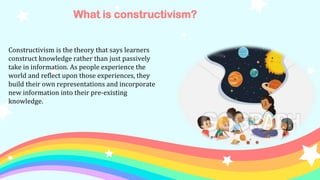
Constructivism is the theory that says learners
construct knowledge rather than just passively
take in information. As people experience the
world and reflect upon those experiences, they
build their own representations and incorporate
new information into their pre-existing
knowledge.
“In search of the rainbow”
Types
1. Cognitive Constructivism
2. Social Constructivism
1. Create cognitive dissonance
2. Apply knowledge with feedback
3. Reflect on learning
4. Elicit prior knowledge
Components
“Play is our brain’s
favourite way of
Learning”
- Diane Ackerman
Importance of Constructive
Play
 Helps develop fine motor skills.
 It develops hand-eye co-ordination
 Children learn patience and to focus on the task.
 It encourages Imagination
 It promotes problem solving, reasoning and critical
thinking
 Children learn to work together and the skill of
communication
 It boosts confidence
 Helps develop children’s special skills
“Principles”
 Engage students in problems that become relevant and meaningful.
 Organize curriculum into activities that address broad primary
concepts.
 Seek out and value students' perspectives.
 Encourage students to investigate and challenge their assumptions
and suppositions.
 Use assessment to guide student learning.
 At the center of constructivist education is an environment in which
children become active learners who make choices and seek out
experiences that foster their development.
 Teachers provide an integrated curriculum that allows children to
explore multiple themes and subjects within a topic.
How can we apply principle of
constructivism in Teaching?
 The role of the teacher in a constructivist approach to early
childhood education is primarily one of guidance. Teachers act
as a guide to children's learning by facilitating activities and
learning opportunities without dictating learning objectives.
 Teachers act as a guide to children's learning by facilitating
activities and learning opportunities without dictating learning
objectives.
 The role of the teacher in a constructivist approach to early
childhood education is primarily one of guidance.
Approaches
Pros
•Children often enjoy the learning process if they are engaged in activities rather
than listening to instruction.
•A sense of ownership is created within a child when the learning occurs from
hands-on experience and investigation rather than being given new information by
someone else.
Cons
•Teachers using constructivism theory may believe learning is based on
the child's ability to discover new knowledge and not on the abilities of
the teacher.
•Some argue that teachers may not take responsibility for poor learning
in the classroom because of constructivism's focus on self learning.
“Effective uses”
 Constructivist teachers focus more on learning through
activity, rather than learning from textbook.
 The teacher will make an effort to understand their
students' pre-existing conceptions and use active
techniques, such as real-world problem solving and
experiments, to address the students' conceptions and
build on them.
 Students become expert learners in actively constructing
knowledge instead of reproducing a series of facts.
Curriculum
Constructivist curriculum:-
 A constructively oriented curriculum presents an emerging agenda based on
what children know, what they are puzzled by, and the teachers' learning goals.
Thus, an important part of a constructivist-oriented curriculum should be the
negotiation of meaning.
 n constructivist classrooms, curriculum is generally a process of digging deeper
and deeper into big ideas, rather than presenting a breadth of coverage. For
example, in the Fostering Communities of Learners project where students learn
how to learn, in knowledge-building classrooms where students seek to create
new knowledge, or in Howard Gardner's classrooms where the focus is on
learning for deep understanding, students might study endangered species,
island biogeography, or the principles of gravity over several months
 To provide experience with the knowledge
construction process (students determine how
they will learn)
 To provide experience in and appreciation for
multiple perspectives (evaluation of alternative
solutions)
 3) To embed learning in realistic contexts
(authentic tasks)
Goals
“Thankyou”
Submitted By:-
Aditi Vats
Shikha
Hiral

Find a rainbow day by slidesgo

  • 1.
  • 2.
    A picture isworth a thousand words
  • 3.
    Contents 1. Meaning ofConstructive Approach 2. Types 3. Components of constructive 4. Importance in Early Childhood 5. Principles 6. Approaches in Learning 7. Pros and Cons 8. Effective use in classrooms 9. Constructivist Curriculum 10. Goals
  • 4.
    What is constructivism? ? Constructivismis the theory that says learners construct knowledge rather than just passively take in information. As people experience the world and reflect upon those experiences, they build their own representations and incorporate new information into their pre-existing knowledge.
  • 5.
    “In search ofthe rainbow”
  • 6.
  • 7.
    1. Cognitive Constructivism 2.Social Constructivism
  • 8.
    1. Create cognitivedissonance 2. Apply knowledge with feedback 3. Reflect on learning 4. Elicit prior knowledge Components
  • 9.
    “Play is ourbrain’s favourite way of Learning” - Diane Ackerman
  • 10.
    Importance of Constructive Play Helps develop fine motor skills.  It develops hand-eye co-ordination  Children learn patience and to focus on the task.  It encourages Imagination  It promotes problem solving, reasoning and critical thinking  Children learn to work together and the skill of communication  It boosts confidence  Helps develop children’s special skills
  • 11.
  • 12.
     Engage studentsin problems that become relevant and meaningful.  Organize curriculum into activities that address broad primary concepts.  Seek out and value students' perspectives.  Encourage students to investigate and challenge their assumptions and suppositions.  Use assessment to guide student learning.  At the center of constructivist education is an environment in which children become active learners who make choices and seek out experiences that foster their development.  Teachers provide an integrated curriculum that allows children to explore multiple themes and subjects within a topic. How can we apply principle of constructivism in Teaching?
  • 13.
     The roleof the teacher in a constructivist approach to early childhood education is primarily one of guidance. Teachers act as a guide to children's learning by facilitating activities and learning opportunities without dictating learning objectives.  Teachers act as a guide to children's learning by facilitating activities and learning opportunities without dictating learning objectives.  The role of the teacher in a constructivist approach to early childhood education is primarily one of guidance. Approaches
  • 14.
    Pros •Children often enjoythe learning process if they are engaged in activities rather than listening to instruction. •A sense of ownership is created within a child when the learning occurs from hands-on experience and investigation rather than being given new information by someone else.
  • 15.
    Cons •Teachers using constructivismtheory may believe learning is based on the child's ability to discover new knowledge and not on the abilities of the teacher. •Some argue that teachers may not take responsibility for poor learning in the classroom because of constructivism's focus on self learning.
  • 16.
    “Effective uses”  Constructivistteachers focus more on learning through activity, rather than learning from textbook.  The teacher will make an effort to understand their students' pre-existing conceptions and use active techniques, such as real-world problem solving and experiments, to address the students' conceptions and build on them.  Students become expert learners in actively constructing knowledge instead of reproducing a series of facts.
  • 17.
    Curriculum Constructivist curriculum:-  Aconstructively oriented curriculum presents an emerging agenda based on what children know, what they are puzzled by, and the teachers' learning goals. Thus, an important part of a constructivist-oriented curriculum should be the negotiation of meaning.  n constructivist classrooms, curriculum is generally a process of digging deeper and deeper into big ideas, rather than presenting a breadth of coverage. For example, in the Fostering Communities of Learners project where students learn how to learn, in knowledge-building classrooms where students seek to create new knowledge, or in Howard Gardner's classrooms where the focus is on learning for deep understanding, students might study endangered species, island biogeography, or the principles of gravity over several months
  • 18.
     To provideexperience with the knowledge construction process (students determine how they will learn)  To provide experience in and appreciation for multiple perspectives (evaluation of alternative solutions)  3) To embed learning in realistic contexts (authentic tasks) Goals
  • 19.