Constructivism The 5 E's Visual Display
What is Constructivism ? Learners build their own understanding of the topic. 2. Learning is not linear. We use prior knowledge/ experiences to expand what we know and learn. 3. Learning is an active, engaging process
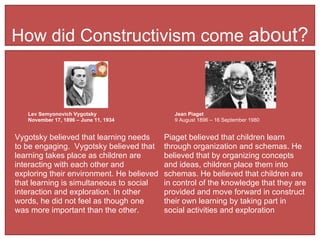
How did Constructivism come  about? Vygotsky believed that learning needs to be engaging.  Vygotsky believed that learning takes place as children are interacting with each other and exploring their environment. He believed that learning is simultaneous to social interaction and exploration. In other words, he did not feel as though one was more important than the other. Jean Piaget 9 August 1896 – 16 September 1980 Lev Semyonovich Vygotsky  November 17, 1896 – June 11, 1934  Piaget believed that children learn through organization and schemas. He believed that by organizing concepts and ideas, children place them into schemas. He believed that children are in control of the knowledge that they are provided and move forward in construct their own learning by taking part in social activities and exploration
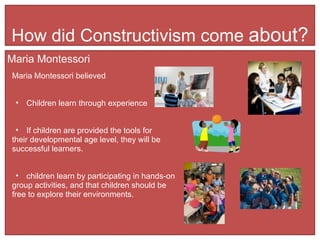
How did Constructivism come  about? Maria Montessori Maria Montessori believed  Children learn through experience If children are provided the tools for  their developmental age level, they will be  successful learners. children learn by participating in hands-on  group activities, and that children should be  free to explore their environments.
How Do Teachers Support a Constructivist Environment? Answer:  The 5 E's Engage Evaluate Explore Elaborate  Explain
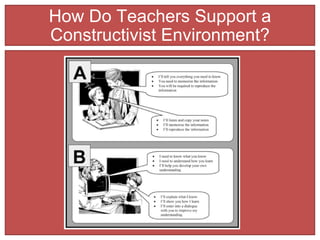
How Do Teachers Support a Constructivist Environment?
How Do Teachers Support a Constructivist Environment? Teacher engages students by providing knowledge expansion tools the students use, collaboratively and cooperatively through inquiry, exploration, teamwork, whole group discussions, and evaluation. Listen Collaborate Explore Evaluate Advantages: Students … LISTEN to their peers COLLABORATE with group members Disadvantages: Requires extensive planning time EXPLORE independently Teacher EVALUATES what students learned
Constructivism: Pros and Cons Advantages: Each person in the world builds their own knowledge. Focuses on student- centered learning Teacher guides students in building their own understanding and knowledge. Students actively engaged in their learning process Disadvantages: Lack of teacher preparation for constructivist classrooms Difficult to break the cycle of those who have been taught in a classroom where they were expected to solely absorb information 
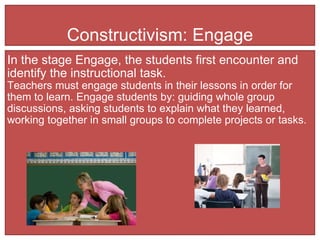
Constructivism: Engage In the stage Engage, the students first encounter and identify the instructional task.  Teachers must engage students in their lessons in order for them to learn. Engage students by: guiding whole group discussions, asking students to explain what they learned, working together in small groups to complete projects or tasks. 
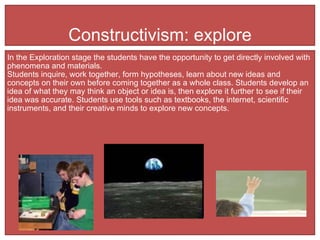
Constructivism: explore In the Exploration stage the students have the opportunity to get directly involved with phenomena and materials.  Students inquire, work together, form hypotheses, learn about new ideas and concepts on their own before coming together as a whole class. Students develop an idea of what they may think an object or idea is, then explore it further to see if their idea was accurate. Students use tools such as textbooks, the internet, scientific instruments, and their creative minds to explore new concepts.
Constructivism: explain Explain , is the point at which the learner begins to put the abstract experience through which she/he has gone /into a communicable form.  The student will define and explain the current concept using their own words.  The student will accomplish this using informational readings, group discussions, and teacher interaction.  Learners will support each other by sharing their ideas, observations, questions, and hypotheses.
Constructivism: elaborate To Elaborate the students expand on the concepts they have learned, make connections to other related concepts, and apply their understandings to the world around them.  Students will expand their learning on the concepts by making connections to related concepts and applying their understanding to the world around them.  This will help students make connections that will lead them to more inquiry which will lead to new understandings.        
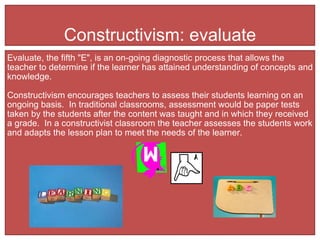
Constructivism: evaluate Evaluate, the fifth "E", is an on-going diagnostic process that allows the teacher to determine if the learner has attained understanding of concepts and knowledge. Constructivism encourages teachers to assess their students learning on an ongoing basis.  In traditional classrooms, assessment would be paper tests taken by the students after the content was taught and in which they received a grade.  In a constructivist classroom the teacher assesses the students work and adapts the lesson plan to meet the needs of the learner.
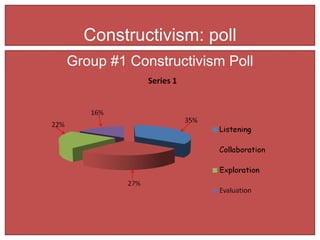
Constructivism: poll Group #1 Constructivism Poll
Constructivism The End For now…
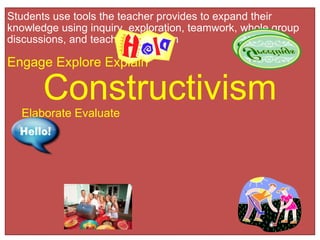
Students use tools the teacher provides to expand their knowledge using inquiry, exploration, teamwork, whole group discussions, and teacher evaluation Engage Explore Explain Constructivism Elaborate Evaluate
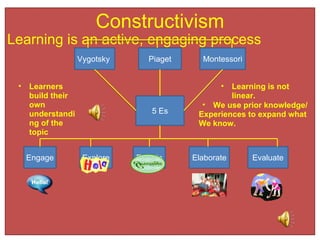
Constructivism Learning is an active, engaging process Piaget Vygotsky  Montessori Engage Explore Explain Elaborate Evaluate 5 Es Learners build their own understanding of the topic Learning is not linear. We use prior knowledge/ Experiences to expand what We know.

WHAT IS CONSTRUCTIVISM PPT

  • 1.
    Constructivism The 5E's Visual Display
  • 2.
    What is Constructivism? Learners build their own understanding of the topic. 2. Learning is not linear. We use prior knowledge/ experiences to expand what we know and learn. 3. Learning is an active, engaging process
  • 3.
    How did Constructivismcome about? Vygotsky believed that learning needs to be engaging.  Vygotsky believed that learning takes place as children are interacting with each other and exploring their environment. He believed that learning is simultaneous to social interaction and exploration. In other words, he did not feel as though one was more important than the other. Jean Piaget 9 August 1896 – 16 September 1980 Lev Semyonovich Vygotsky November 17, 1896 – June 11, 1934 Piaget believed that children learn through organization and schemas. He believed that by organizing concepts and ideas, children place them into schemas. He believed that children are in control of the knowledge that they are provided and move forward in construct their own learning by taking part in social activities and exploration
  • 4.
    How did Constructivismcome about? Maria Montessori Maria Montessori believed Children learn through experience If children are provided the tools for their developmental age level, they will be successful learners. children learn by participating in hands-on group activities, and that children should be free to explore their environments.
  • 5.
    How Do TeachersSupport a Constructivist Environment? Answer: The 5 E's Engage Evaluate Explore Elaborate Explain
  • 6.
    How Do TeachersSupport a Constructivist Environment?
  • 7.
    How Do TeachersSupport a Constructivist Environment? Teacher engages students by providing knowledge expansion tools the students use, collaboratively and cooperatively through inquiry, exploration, teamwork, whole group discussions, and evaluation. Listen Collaborate Explore Evaluate Advantages: Students … LISTEN to their peers COLLABORATE with group members Disadvantages: Requires extensive planning time EXPLORE independently Teacher EVALUATES what students learned
  • 8.
    Constructivism: Pros andCons Advantages: Each person in the world builds their own knowledge. Focuses on student- centered learning Teacher guides students in building their own understanding and knowledge. Students actively engaged in their learning process Disadvantages: Lack of teacher preparation for constructivist classrooms Difficult to break the cycle of those who have been taught in a classroom where they were expected to solely absorb information 
  • 9.
    Constructivism: Engage Inthe stage Engage, the students first encounter and identify the instructional task. Teachers must engage students in their lessons in order for them to learn. Engage students by: guiding whole group discussions, asking students to explain what they learned, working together in small groups to complete projects or tasks. 
  • 10.
    Constructivism: explore Inthe Exploration stage the students have the opportunity to get directly involved with phenomena and materials. Students inquire, work together, form hypotheses, learn about new ideas and concepts on their own before coming together as a whole class. Students develop an idea of what they may think an object or idea is, then explore it further to see if their idea was accurate. Students use tools such as textbooks, the internet, scientific instruments, and their creative minds to explore new concepts.
  • 11.
    Constructivism: explain Explain, is the point at which the learner begins to put the abstract experience through which she/he has gone /into a communicable form. The student will define and explain the current concept using their own words.  The student will accomplish this using informational readings, group discussions, and teacher interaction.  Learners will support each other by sharing their ideas, observations, questions, and hypotheses.
  • 12.
    Constructivism: elaborate ToElaborate the students expand on the concepts they have learned, make connections to other related concepts, and apply their understandings to the world around them. Students will expand their learning on the concepts by making connections to related concepts and applying their understanding to the world around them.  This will help students make connections that will lead them to more inquiry which will lead to new understandings.        
  • 13.
    Constructivism: evaluate Evaluate,the fifth "E", is an on-going diagnostic process that allows the teacher to determine if the learner has attained understanding of concepts and knowledge. Constructivism encourages teachers to assess their students learning on an ongoing basis.  In traditional classrooms, assessment would be paper tests taken by the students after the content was taught and in which they received a grade.  In a constructivist classroom the teacher assesses the students work and adapts the lesson plan to meet the needs of the learner.
  • 14.
    Constructivism: poll Group#1 Constructivism Poll
  • 15.
  • 16.
    Students use toolsthe teacher provides to expand their knowledge using inquiry, exploration, teamwork, whole group discussions, and teacher evaluation Engage Explore Explain Constructivism Elaborate Evaluate
  • 17.
    Constructivism Learning isan active, engaging process Piaget Vygotsky Montessori Engage Explore Explain Elaborate Evaluate 5 Es Learners build their own understanding of the topic Learning is not linear. We use prior knowledge/ Experiences to expand what We know.