PEER TUTORING
DR. C. BEULAH JAYARANI
M.Sc., M.A, M.Ed, M.Phil (Edn), M.Phil (ZOO), NET, Ph.D
ASST. PROFESSOR,
LOYOLA COLLEGE OF EDUCATION, CHENNAI - 34
Teaching
By
Students
INTRODUCTION
 Instructional strategy,
 Consists of student
partnerships,
 High achieving students with
lower achieving students.
2
 Peer teaching is not a new concept. It was First
Organized as a theory by Scotsman Andrew Bell
in 1975,
 Later implemented into French and
English schools in the 19th Century.
 Over the past 30-40 years, peer teaching
is financially efficient methods of
teaching.
HISTORY OF PEER TUTORING …
3
4
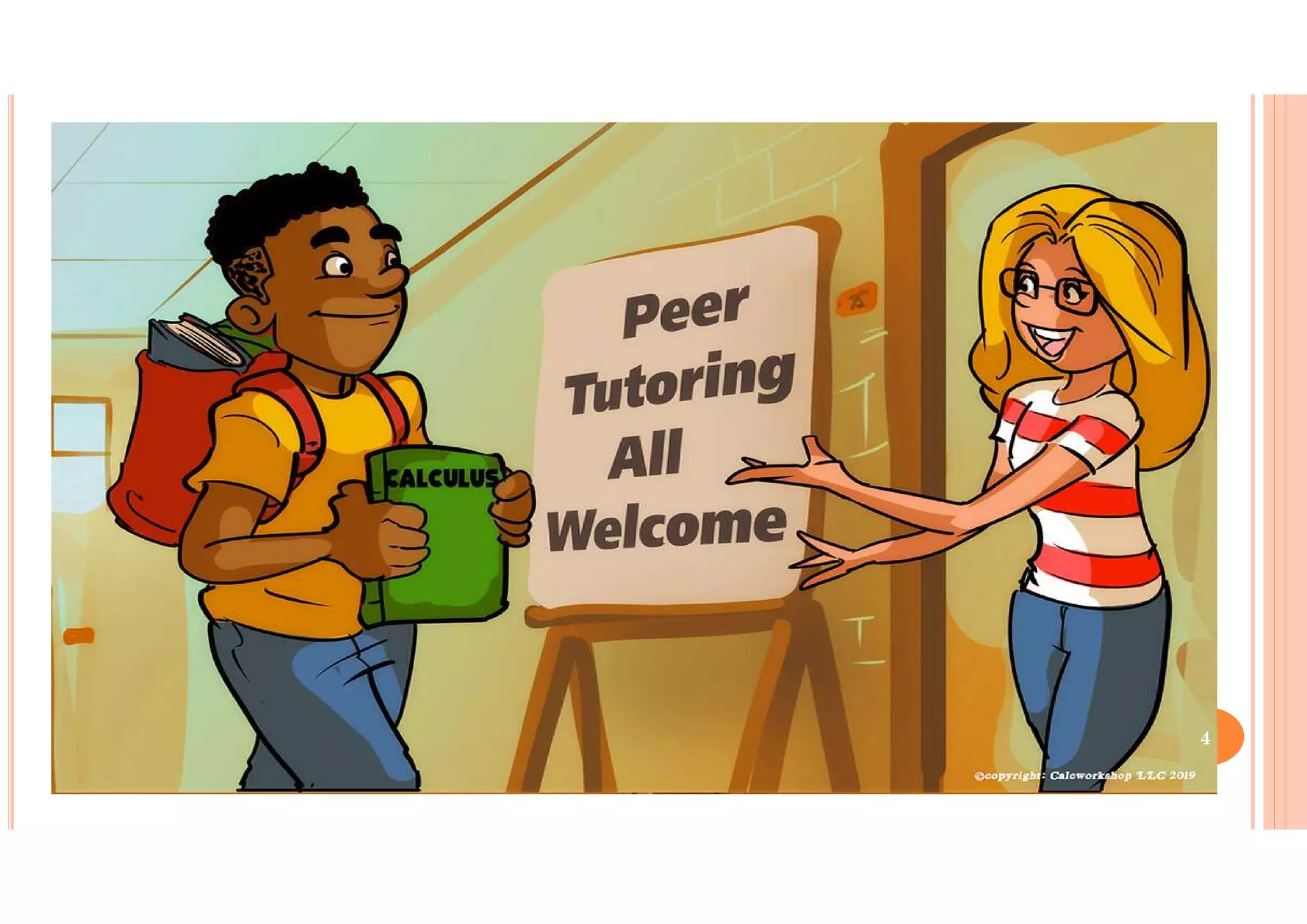
WHAT IS PEER TUTORING ?
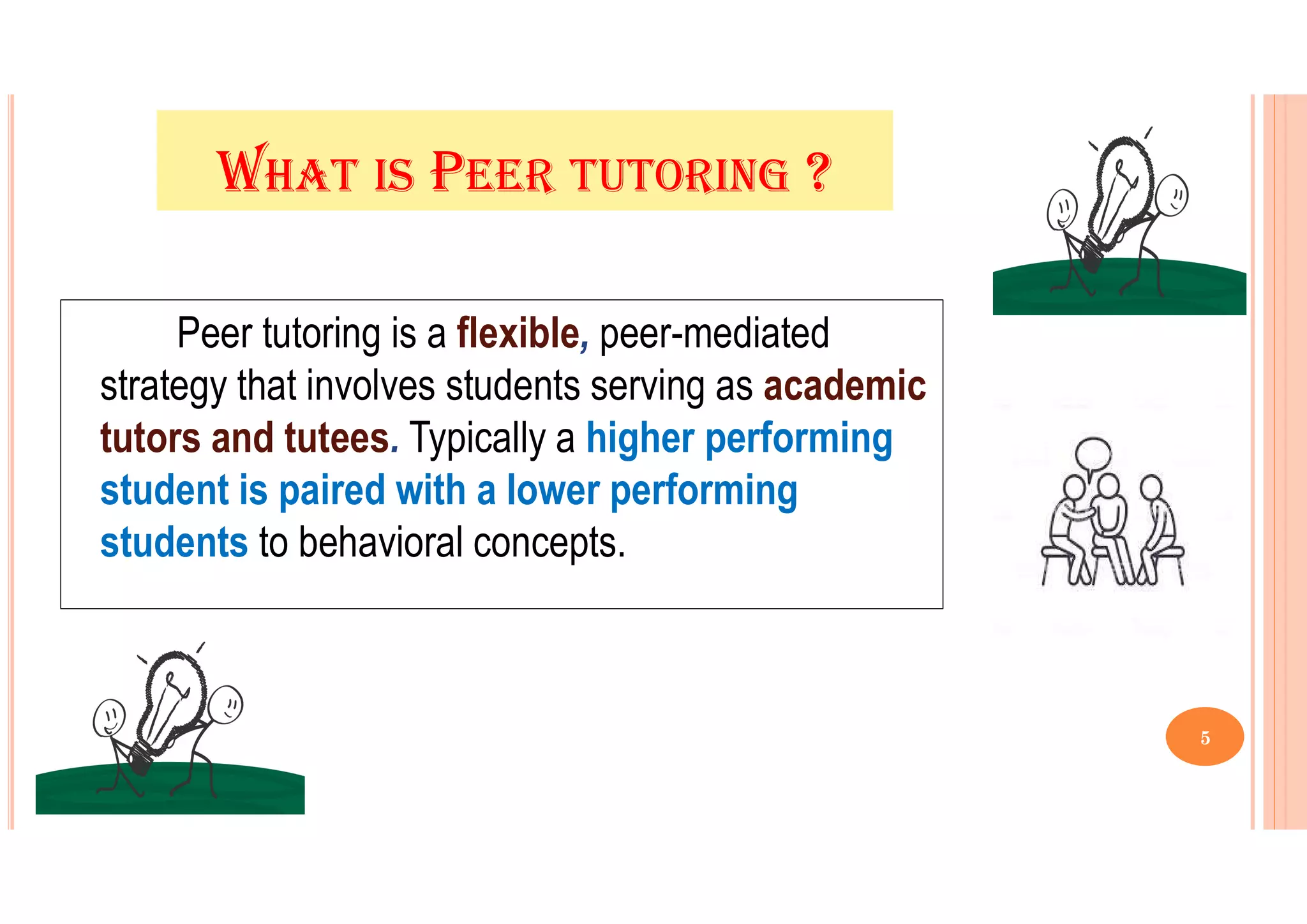
Peer tutoring is a flexible, peer-mediated
strategy that involves students serving as academic
tutors and tutees. Typically a higher performing
student is paired with a lower performing
students to behavioral concepts.
5
WHY WE
CHOOSE PEER
TUTORING ?
6
WHY CHOOSE PEER TUTORING ?
 It is widely practice across ages, grade levels,
and subject areas.
 The intervention allows students to receive one-to-one
assistance.
 Students have increased opportunities to respond in
smaller groups.
 Student engagement and time on task increases.
 Peer tutoring increases self-confidence.
7
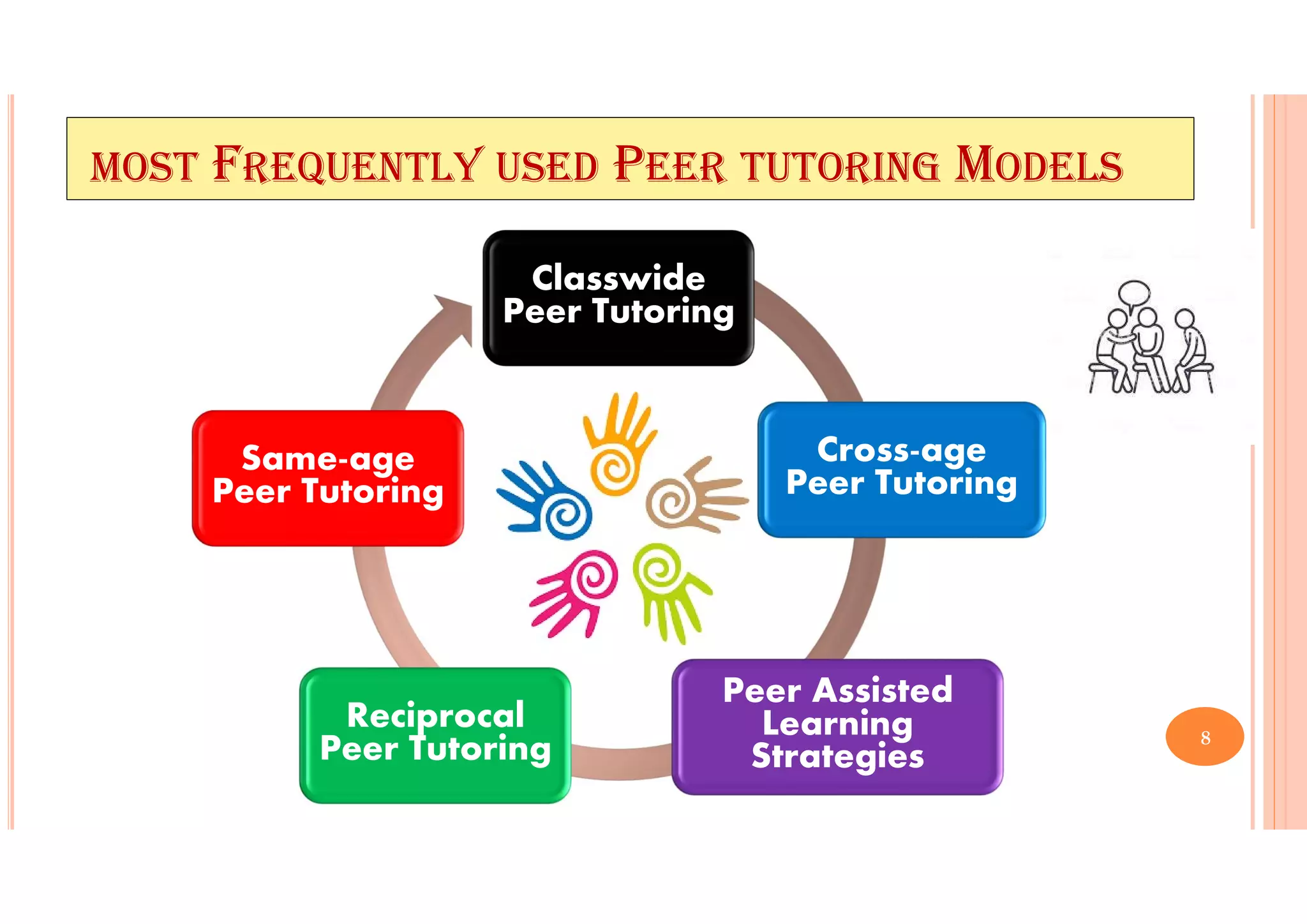
MOST FREQUENTLY USED PEER TUTORING MODELS
Classwide
Peer Tutoring
Cross-age
Peer Tutoring
Peer Assisted
Learning
Strategies
Reciprocal
Peer Tutoring
Same-age
Peer Tutoring
8
1. CLASS WIDE PEER TUTORING
9
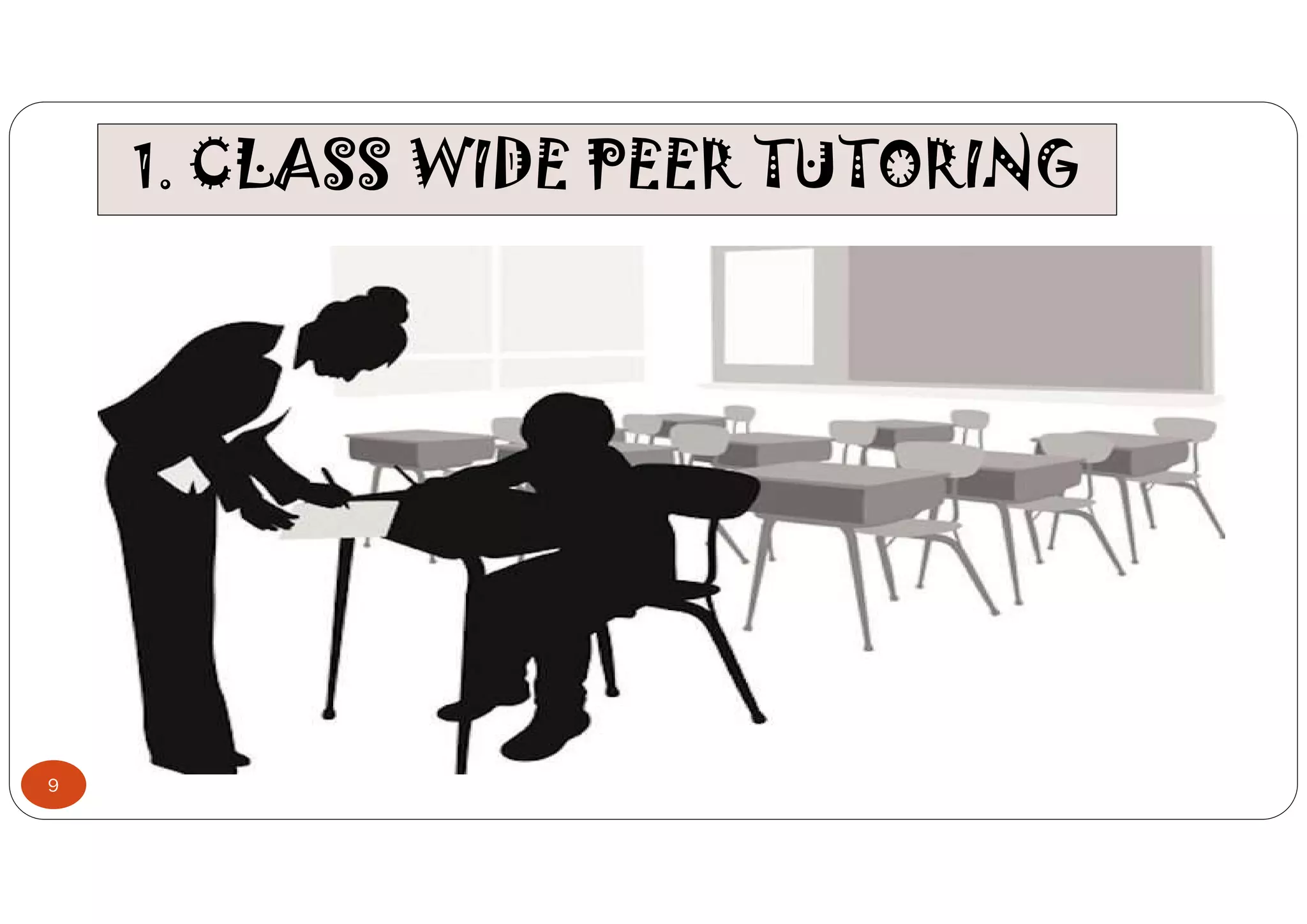
1. CLASS WIDE PEER TUTORING
 It involves into groups of two to five students.
 Students then act as tutors, tutees, or both
tutors and tutees.
 The entire class, it activities two or more times
peer week for approximately 30 minutes.
 Student pairing may change weekly or
biweekly.
 Student pairings may be based on
achievement levels. 10
C
2.CROSS- AGE PEER TUTORING
11
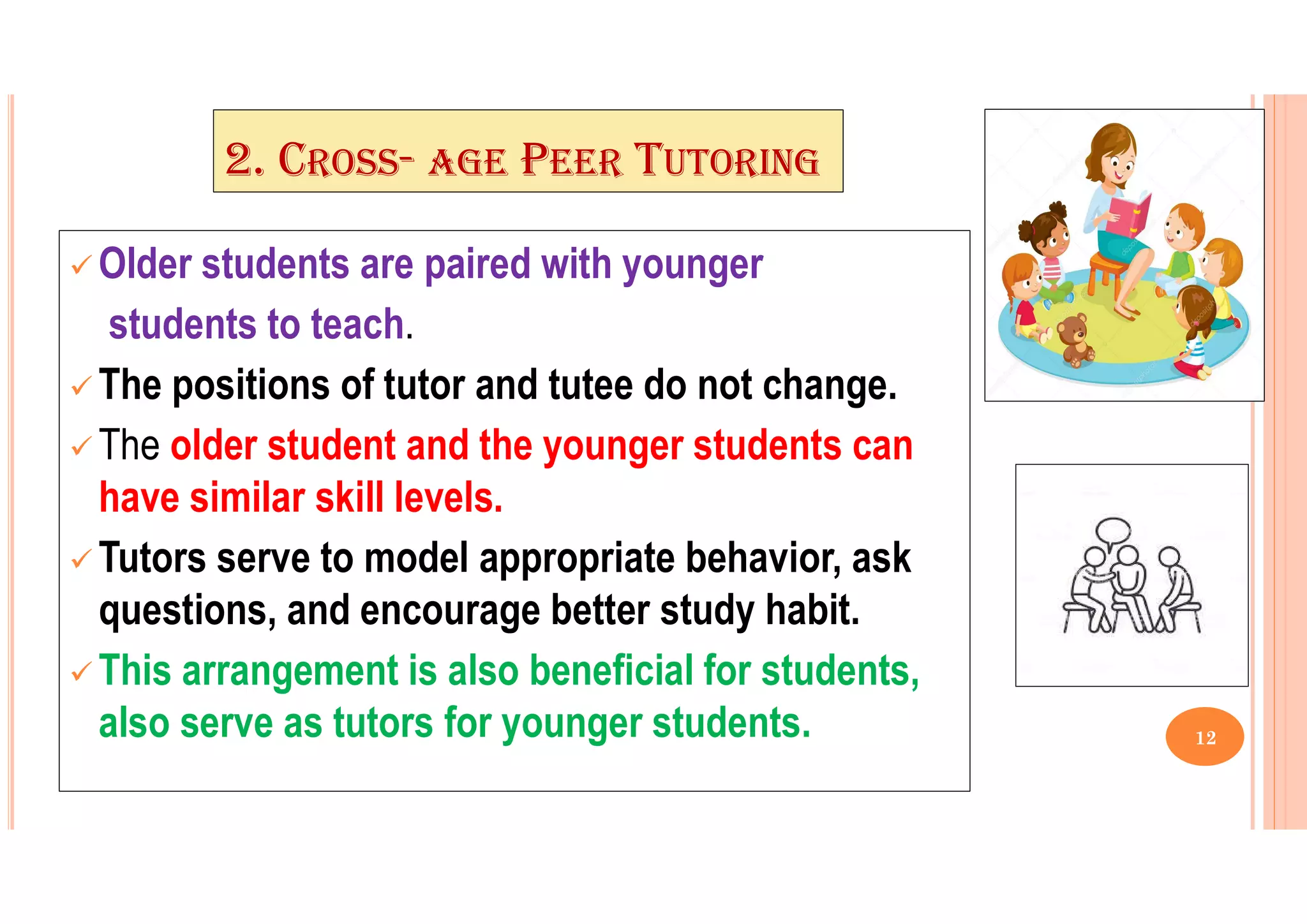
2. CROSS- AGE PEER TUTORING
 Older students are paired with younger
students to teach.
 The positions of tutor and tutee do not change.
 The older student and the younger students can
have similar skill levels.
 Tutors serve to model appropriate behavior, ask
questions, and encourage better study habit.
 This arrangement is also beneficial for students,
also serve as tutors for younger students. 12
3. PEER ASSISTED LEARNING STRATEGIES
13
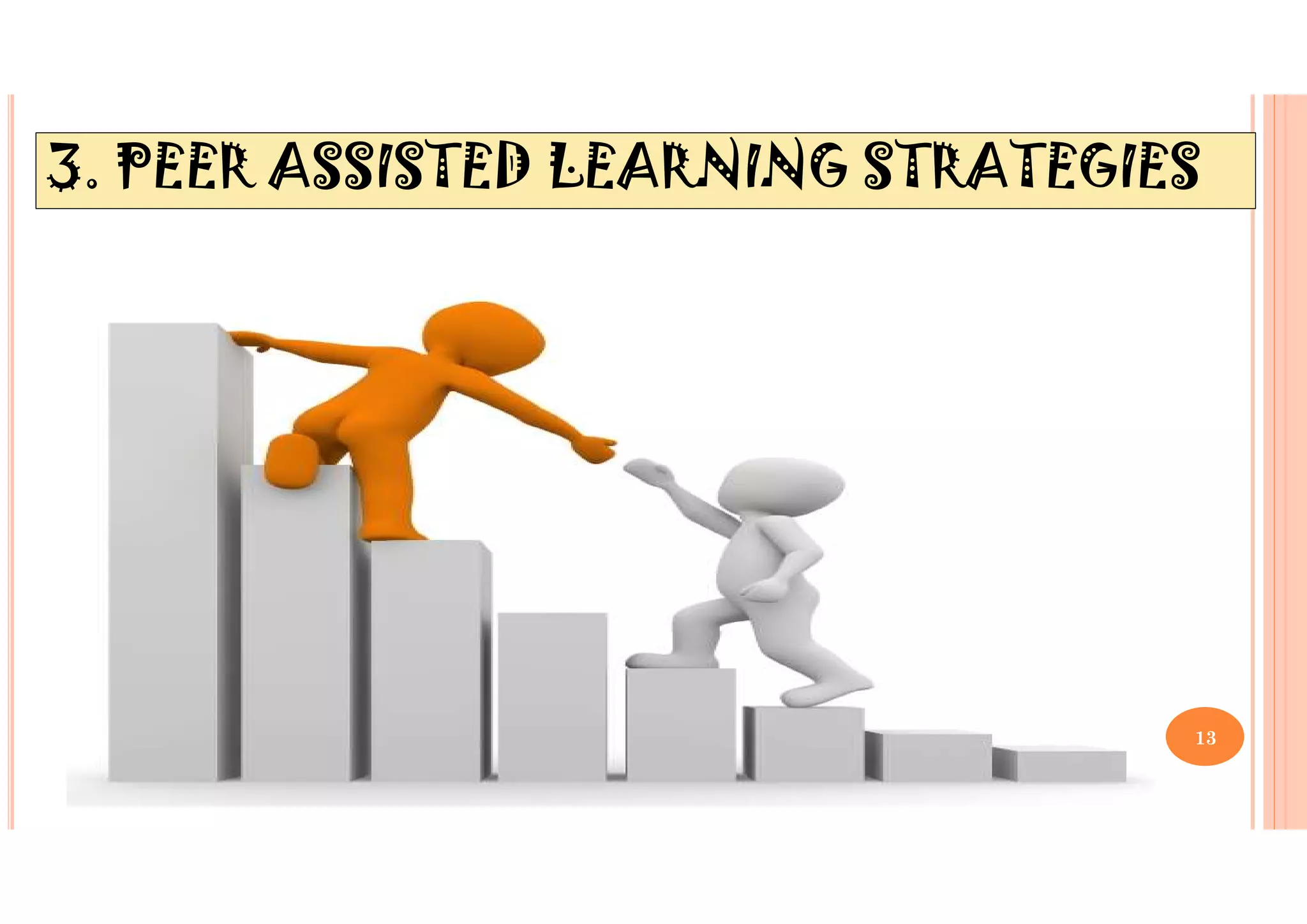
PEER ASSISTED LEARNING STRATEGIES
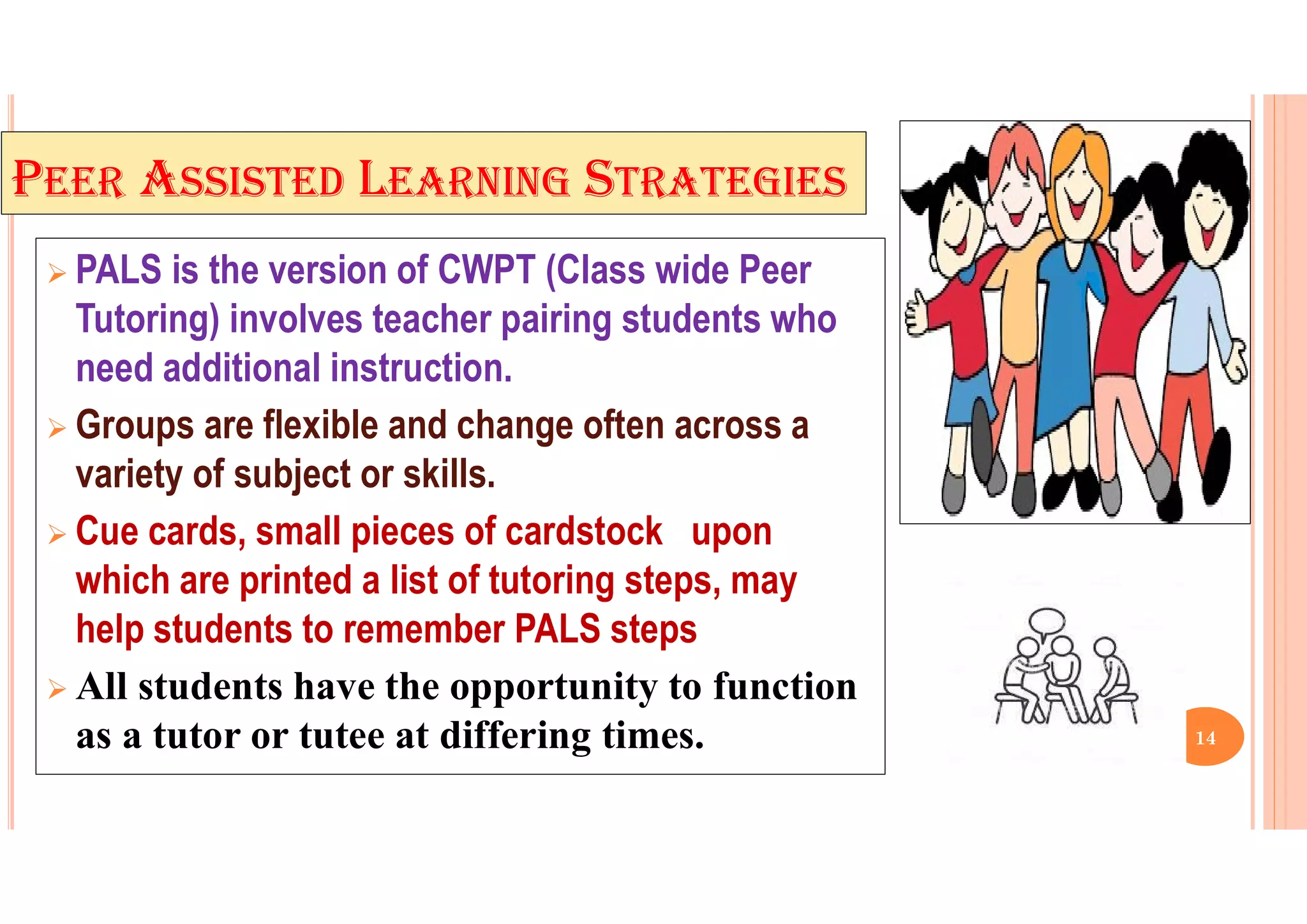
 PALS is the version of CWPT (Class wide Peer
Tutoring) involves teacher pairing students who
need additional instruction.
 Groups are flexible and change often across a
variety of subject or skills.
 Cue cards, small pieces of cardstock upon
which are printed a list of tutoring steps, may
help students to remember PALS steps
 All students have the opportunity to function
as a tutor or tutee at differing times. 14
RECIPROCAL
PEER TUTORING
4. RECIPROCAL PEER TUTORING…..
15
4. RECIPROCAL PEER TUTORING
 Two or more students alternate between acting
as the tutor and tutee during each session.
 Higher Performing students are paired with lower
performing students.
 It encourages teaching material, monitoring
answer,
evaluating and encouraging peers.
 Students in RPT may prepare the instructional
materials and are responsible for their peer once
they have selected a goal. 16
5. SAME-AGE PEER TUTORING
17
SAME-AGE PEER TUTORING
 More advanced student can be paired with a
less advanced student.
 Students who have similar ability should have
an equal understanding of the content material
and concepts.
 The role of the tutor and tutee may be
alternated, allowing the lower performing
student to quiz the higher performing student.
18
 Answer should be provided to the students who
is lower achieving when acting as a tutor in order
to assist with content knowledge.
 Same-age peer tutoring, like class wide peer
tutoring, can be completed within the students.
 Procedures are more flexible than traditional
classwide peer tutoring configurations.
19
HOW TO PULL OFF PEER
TEACHING?
METHODS OF PEER TEACHING
1) Be sure your tutors are trained
2) Use a reward system
3) Emphasize confidentiality,
positive reinforcement and
adequate response time
4) Choose the learning exercise and
the appropriate vehicle for it
5) Use group strategies
21
6)Use role playing and modeling
7) Emphasize the importance of
active learning
8) Teach instructional scaffolding
9) Explain directive versus
nondirective tutoring
10) Explain how to provide feed back
22
1. BE SURE YOUR TUTORS ARE TRAINED…
Peer tutoring program was first implemented in a
middle school in California
This was called as student to student method
In this method high grade student is paired with
low grade student
eg: 8th grade student is asked to teach 6th grade
student
This is matched by the program advisor based
on the needs of the tutees 23
2. USE A REWARD SYSTEM
In this method of peer teaching student of
equal grades are paired
This system is implemented in mid western
urban middle school
The student of either equal ability or high
achieving student are matched with low
achieving student
It encourages the student participation and
on-task behavior 24
3. EMPHASIZE CONFIDENTIALITY, POSITIVE
REINFORCEMENT AND ADEQUATE RESPONSE TIME
 The tutors at student to student are taught to
demonstrate three important things during
any given tutoring session.
 confidentiality
 positive reinforcement
 adequate response time
 The training process also instructed tutors on
explaining directions, designing work,
watching for correcting mistakes, positive
feedback and encouragement 25
4. CHOOSE THE LEARNING EXERCISE AND THE
APPROPRIATE VEHICLE FOR IT
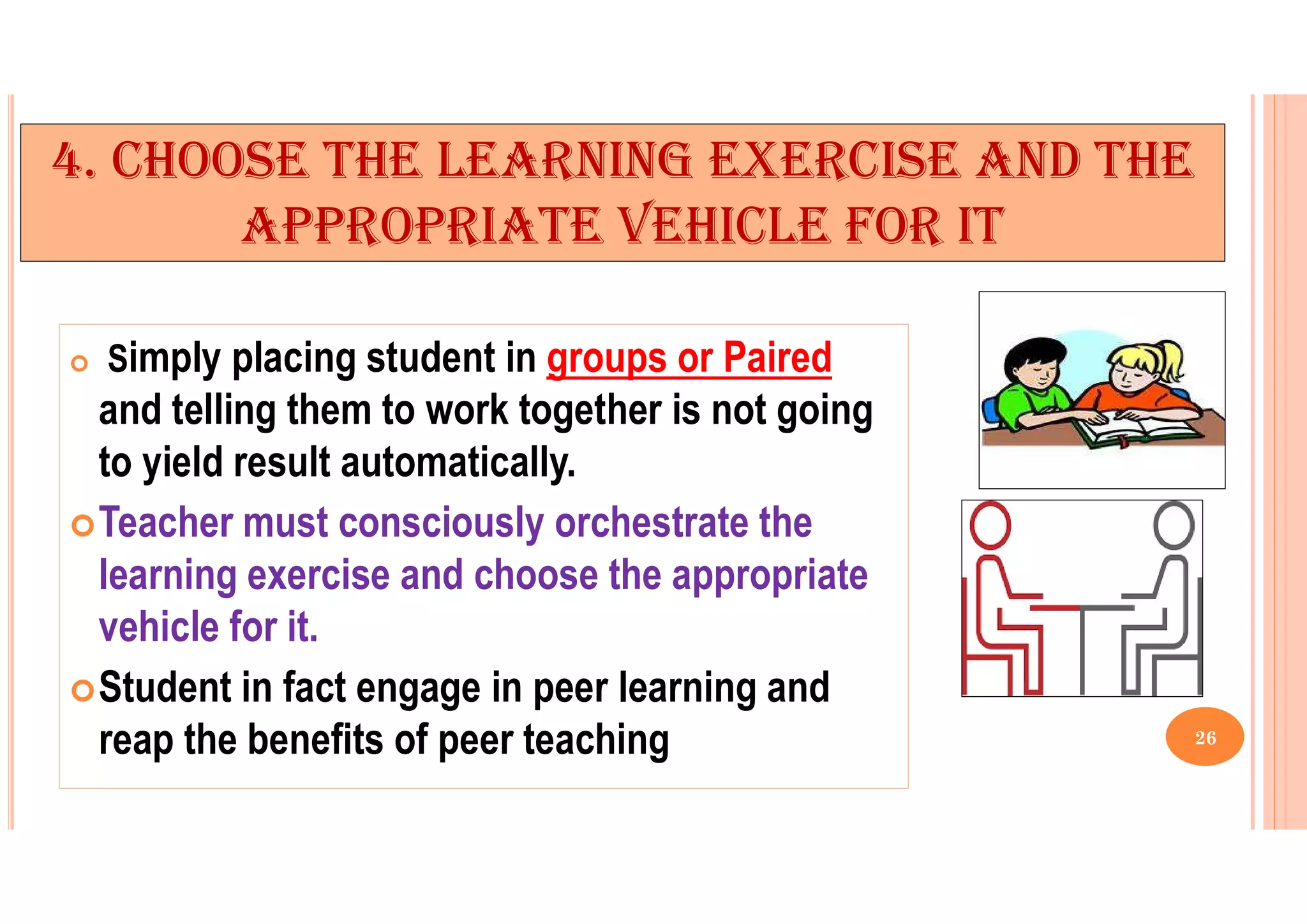
 Simply placing student in groups or Paired
and telling them to work together is not going
to yield result automatically.
Teacher must consciously orchestrate the
learning exercise and choose the appropriate
vehicle for it.
Student in fact engage in peer learning and
reap the benefits of peer teaching 26
5. USE GROUP STRATEGIES
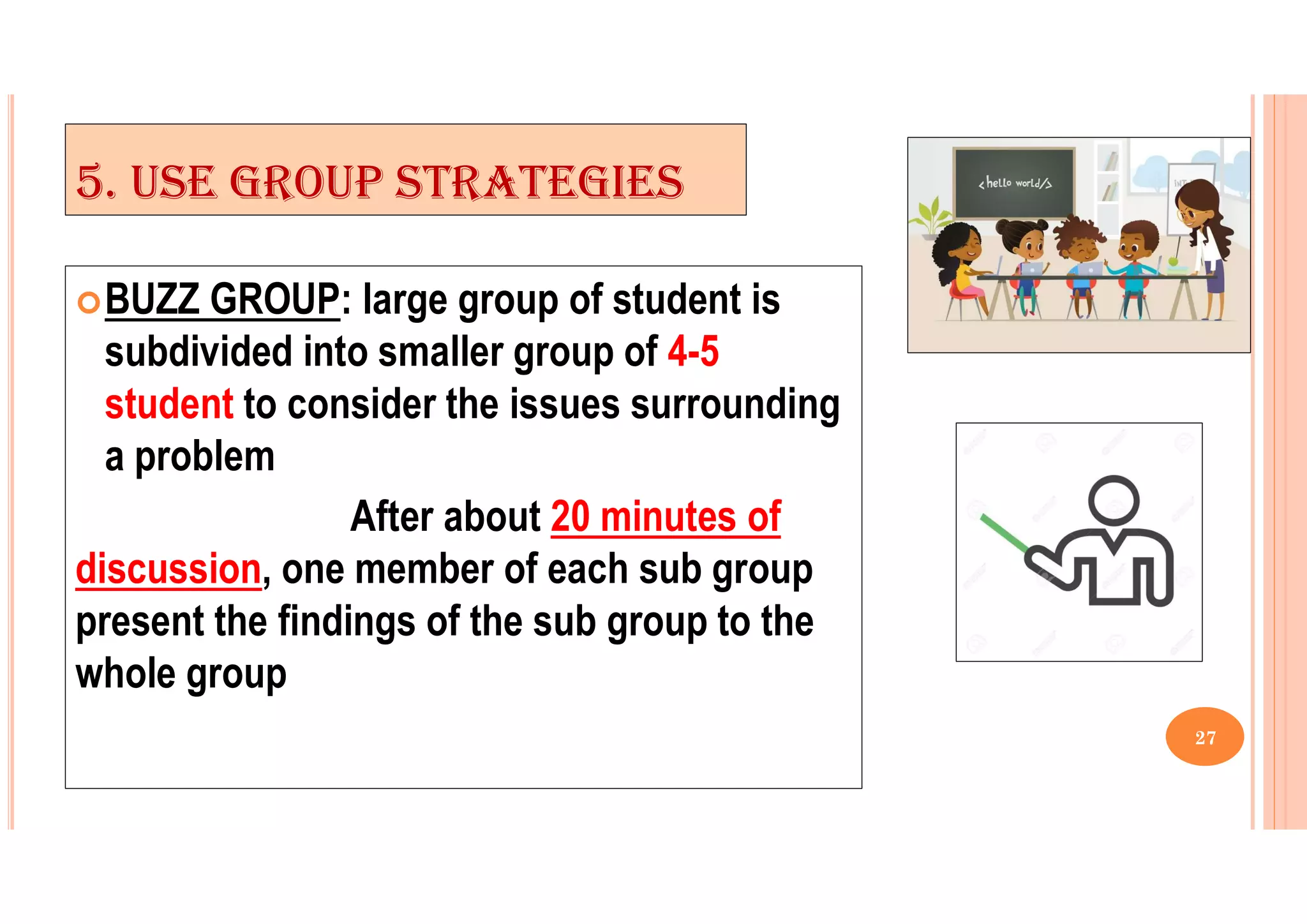
BUZZ GROUP: large group of student is
subdivided into smaller group of 4-5
student to consider the issues surrounding
a problem
After about 20 minutes of
discussion, one member of each sub group
present the findings of the sub group to the
whole group
27
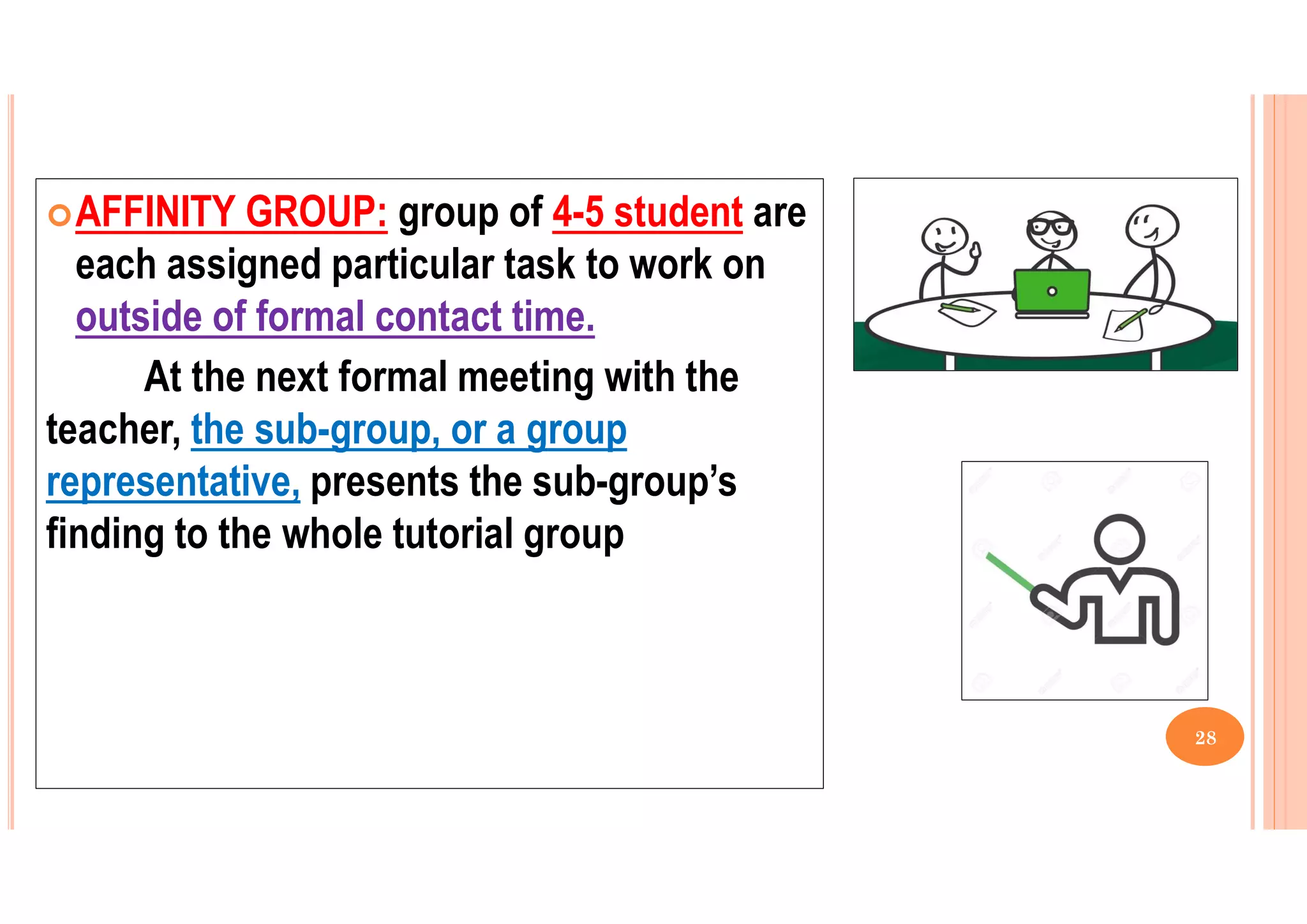
AFFINITY GROUP: group of 4-5 student are
each assigned particular task to work on
outside of formal contact time.
At the next formal meeting with the
teacher, the sub-group, or a group
representative, presents the sub-group’s
finding to the whole tutorial group
28
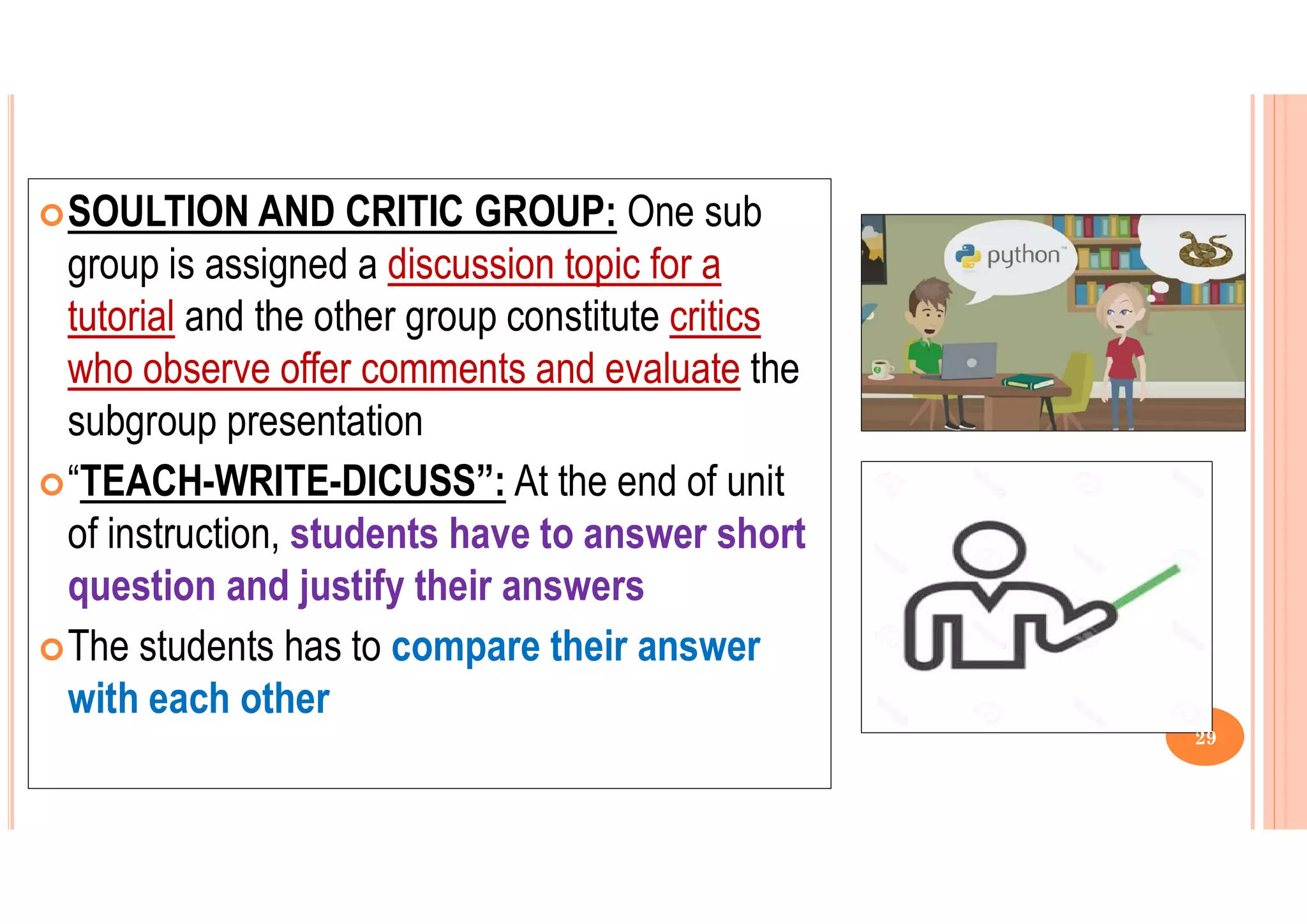
SOULTION AND CRITIC GROUP: One sub
group is assigned a discussion topic for a
tutorial and the other group constitute critics
who observe offer comments and evaluate the
subgroup presentation
“TEACH-WRITE-DICUSS”: At the end of unit
of instruction, students have to answer short
question and justify their answers
The students has to compare their answer
with each other
29
6. USE ROLE PLAYING AND MODELING
 In this method of peer teaching
during 1st week of 6th grade reading
program the program staff explains
the tutor the different procedure
 They use role playing to effectively
demonstrate ways to praise and
correct their peers
30
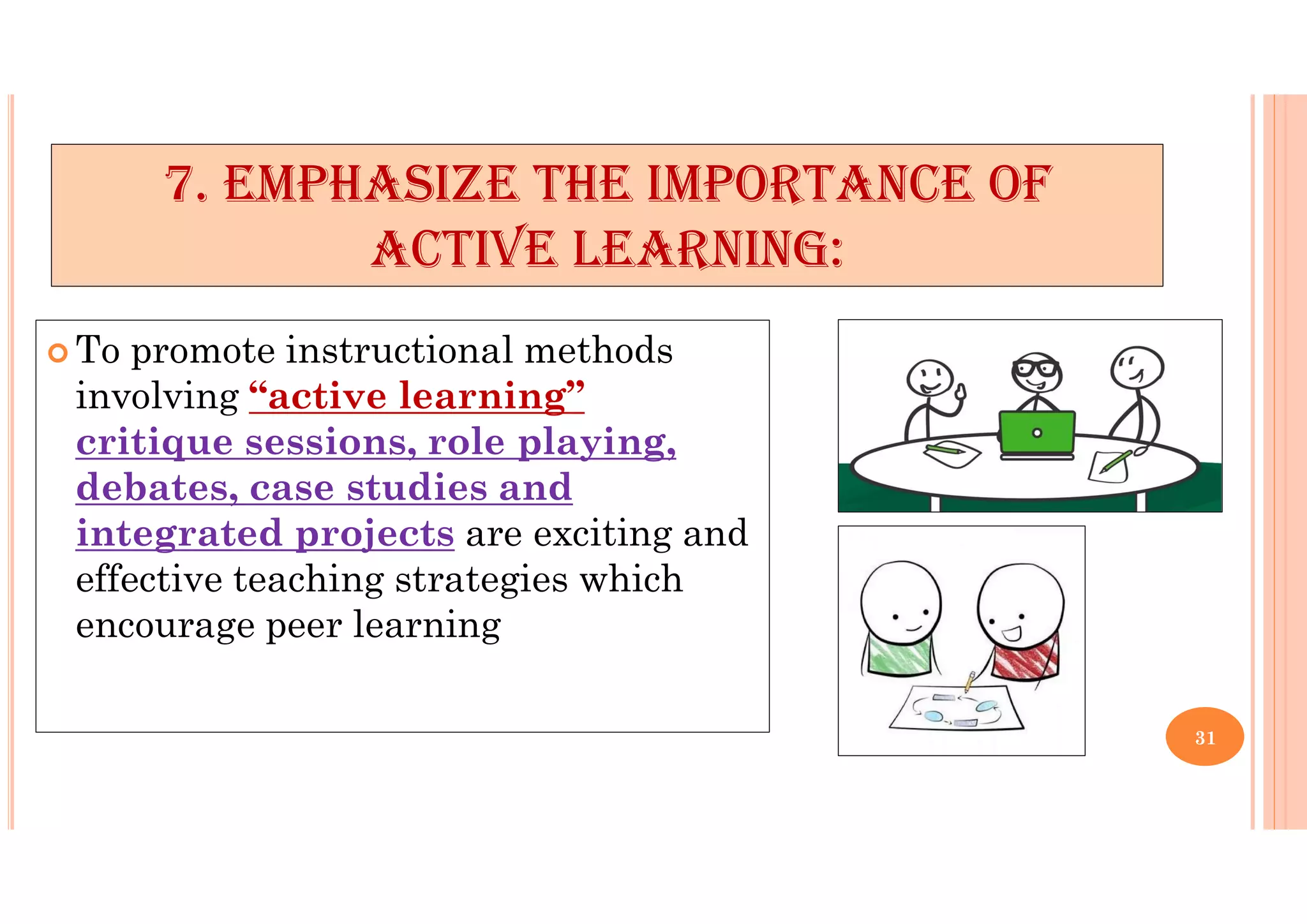
 To promote instructional methods
involving “active learning”
critique sessions, role playing,
debates, case studies and
integrated projects are exciting and
effective teaching strategies which
encourage peer learning
7. EMPHASIZE THE IMPORTANCE OF
ACTIVE LEARNING:
31
 To reap the benefits of peer teaching the
tutees mush reach a point where they
practicing a new task on their own
tutor can help prepare student for
independent demonstration by providing
instructional scaffolding
8. TEACH INSTRUCTIONAL SCOFFOLDING
32
9. DIRECTIVE VS NON DIRECTIVE
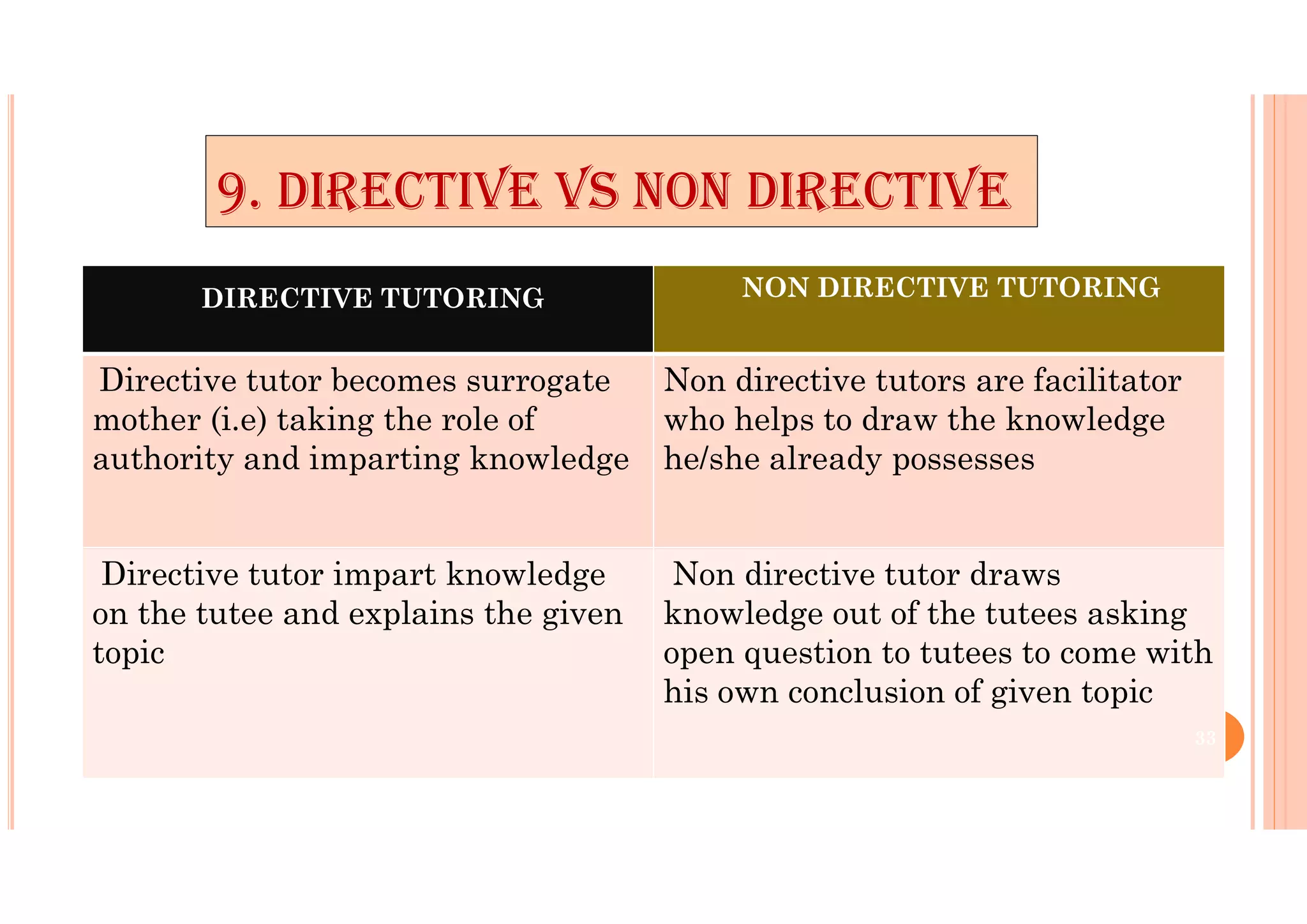
DIRECTIVE TUTORING NON DIRECTIVE TUTORING
Directive tutor becomes surrogate
mother (i.e) taking the role of
authority and imparting knowledge
Non directive tutors are facilitator
who helps to draw the knowledge
he/she already possesses
Directive tutor impart knowledge
on the tutee and explains the given
topic
Non directive tutor draws
knowledge out of the tutees asking
open question to tutees to come with
his own conclusion of given topic
33
 Teach tutors the importance of
positive feedback
o Teach tutors has to give genuine praise
after every third or fourth correct
response and after particularly difficult
problems
o Teach your tutor how to respond when
incorrect answer is given
10. EXPLAIN HOW TO PROVIDE FEEDBACK
34
BENEFITS OF PEER TUTORING
 Students receive more time for
individualized learning
 Direct interaction between students
promotes active learning
 Peer teacher reinforce their own learning
by instructing others
 Students feel more comfortable and open
when interacting with a peer
35
 Peers and student share a similar
discourse, allowing for greater
understanding
 Peer teaching is a financially effective
alternative to hiring more staff
members
 Teacher receive more time to focus on
the next lesson
 Research also indicates that peer
learning activities typically yield the
best result for both tutors and tutees
36
REFERENCE
37
“Teaching of Biological Science”
 TNTEU – Study Material
 Ram Publications
 Sri Krishna Publications
 Kaviyamala Publications
 Google Images

Peer tutoring

  • 1.
    PEER TUTORING DR. C.BEULAH JAYARANI M.Sc., M.A, M.Ed, M.Phil (Edn), M.Phil (ZOO), NET, Ph.D ASST. PROFESSOR, LOYOLA COLLEGE OF EDUCATION, CHENNAI - 34 Teaching By Students
  • 2.
    INTRODUCTION  Instructional strategy, Consists of student partnerships,  High achieving students with lower achieving students. 2
  • 3.
     Peer teachingis not a new concept. It was First Organized as a theory by Scotsman Andrew Bell in 1975,  Later implemented into French and English schools in the 19th Century.  Over the past 30-40 years, peer teaching is financially efficient methods of teaching. HISTORY OF PEER TUTORING … 3
  • 4.
  • 5.
    WHAT IS PEERTUTORING ? Peer tutoring is a flexible, peer-mediated strategy that involves students serving as academic tutors and tutees. Typically a higher performing student is paired with a lower performing students to behavioral concepts. 5
  • 6.
  • 7.
    WHY CHOOSE PEERTUTORING ?  It is widely practice across ages, grade levels, and subject areas.  The intervention allows students to receive one-to-one assistance.  Students have increased opportunities to respond in smaller groups.  Student engagement and time on task increases.  Peer tutoring increases self-confidence. 7
  • 8.
    MOST FREQUENTLY USEDPEER TUTORING MODELS Classwide Peer Tutoring Cross-age Peer Tutoring Peer Assisted Learning Strategies Reciprocal Peer Tutoring Same-age Peer Tutoring 8
  • 9.
    1. CLASS WIDEPEER TUTORING 9
  • 10.
    1. CLASS WIDEPEER TUTORING  It involves into groups of two to five students.  Students then act as tutors, tutees, or both tutors and tutees.  The entire class, it activities two or more times peer week for approximately 30 minutes.  Student pairing may change weekly or biweekly.  Student pairings may be based on achievement levels. 10
  • 11.
  • 12.
    2. CROSS- AGEPEER TUTORING  Older students are paired with younger students to teach.  The positions of tutor and tutee do not change.  The older student and the younger students can have similar skill levels.  Tutors serve to model appropriate behavior, ask questions, and encourage better study habit.  This arrangement is also beneficial for students, also serve as tutors for younger students. 12
  • 13.
    3. PEER ASSISTEDLEARNING STRATEGIES 13
  • 14.
    PEER ASSISTED LEARNINGSTRATEGIES  PALS is the version of CWPT (Class wide Peer Tutoring) involves teacher pairing students who need additional instruction.  Groups are flexible and change often across a variety of subject or skills.  Cue cards, small pieces of cardstock upon which are printed a list of tutoring steps, may help students to remember PALS steps  All students have the opportunity to function as a tutor or tutee at differing times. 14
  • 15.
  • 16.
    4. RECIPROCAL PEERTUTORING  Two or more students alternate between acting as the tutor and tutee during each session.  Higher Performing students are paired with lower performing students.  It encourages teaching material, monitoring answer, evaluating and encouraging peers.  Students in RPT may prepare the instructional materials and are responsible for their peer once they have selected a goal. 16
  • 17.
    5. SAME-AGE PEERTUTORING 17
  • 18.
    SAME-AGE PEER TUTORING More advanced student can be paired with a less advanced student.  Students who have similar ability should have an equal understanding of the content material and concepts.  The role of the tutor and tutee may be alternated, allowing the lower performing student to quiz the higher performing student. 18
  • 19.
     Answer shouldbe provided to the students who is lower achieving when acting as a tutor in order to assist with content knowledge.  Same-age peer tutoring, like class wide peer tutoring, can be completed within the students.  Procedures are more flexible than traditional classwide peer tutoring configurations. 19
  • 20.
    HOW TO PULLOFF PEER TEACHING?
  • 21.
    METHODS OF PEERTEACHING 1) Be sure your tutors are trained 2) Use a reward system 3) Emphasize confidentiality, positive reinforcement and adequate response time 4) Choose the learning exercise and the appropriate vehicle for it 5) Use group strategies 21
  • 22.
    6)Use role playingand modeling 7) Emphasize the importance of active learning 8) Teach instructional scaffolding 9) Explain directive versus nondirective tutoring 10) Explain how to provide feed back 22
  • 23.
    1. BE SUREYOUR TUTORS ARE TRAINED… Peer tutoring program was first implemented in a middle school in California This was called as student to student method In this method high grade student is paired with low grade student eg: 8th grade student is asked to teach 6th grade student This is matched by the program advisor based on the needs of the tutees 23
  • 24.
    2. USE AREWARD SYSTEM In this method of peer teaching student of equal grades are paired This system is implemented in mid western urban middle school The student of either equal ability or high achieving student are matched with low achieving student It encourages the student participation and on-task behavior 24
  • 25.
    3. EMPHASIZE CONFIDENTIALITY,POSITIVE REINFORCEMENT AND ADEQUATE RESPONSE TIME  The tutors at student to student are taught to demonstrate three important things during any given tutoring session.  confidentiality  positive reinforcement  adequate response time  The training process also instructed tutors on explaining directions, designing work, watching for correcting mistakes, positive feedback and encouragement 25
  • 26.
    4. CHOOSE THELEARNING EXERCISE AND THE APPROPRIATE VEHICLE FOR IT  Simply placing student in groups or Paired and telling them to work together is not going to yield result automatically. Teacher must consciously orchestrate the learning exercise and choose the appropriate vehicle for it. Student in fact engage in peer learning and reap the benefits of peer teaching 26
  • 27.
    5. USE GROUPSTRATEGIES BUZZ GROUP: large group of student is subdivided into smaller group of 4-5 student to consider the issues surrounding a problem After about 20 minutes of discussion, one member of each sub group present the findings of the sub group to the whole group 27
  • 28.
    AFFINITY GROUP: groupof 4-5 student are each assigned particular task to work on outside of formal contact time. At the next formal meeting with the teacher, the sub-group, or a group representative, presents the sub-group’s finding to the whole tutorial group 28
  • 29.
    SOULTION AND CRITICGROUP: One sub group is assigned a discussion topic for a tutorial and the other group constitute critics who observe offer comments and evaluate the subgroup presentation “TEACH-WRITE-DICUSS”: At the end of unit of instruction, students have to answer short question and justify their answers The students has to compare their answer with each other 29
  • 30.
    6. USE ROLEPLAYING AND MODELING  In this method of peer teaching during 1st week of 6th grade reading program the program staff explains the tutor the different procedure  They use role playing to effectively demonstrate ways to praise and correct their peers 30
  • 31.
     To promoteinstructional methods involving “active learning” critique sessions, role playing, debates, case studies and integrated projects are exciting and effective teaching strategies which encourage peer learning 7. EMPHASIZE THE IMPORTANCE OF ACTIVE LEARNING: 31
  • 32.
     To reapthe benefits of peer teaching the tutees mush reach a point where they practicing a new task on their own tutor can help prepare student for independent demonstration by providing instructional scaffolding 8. TEACH INSTRUCTIONAL SCOFFOLDING 32
  • 33.
    9. DIRECTIVE VSNON DIRECTIVE DIRECTIVE TUTORING NON DIRECTIVE TUTORING Directive tutor becomes surrogate mother (i.e) taking the role of authority and imparting knowledge Non directive tutors are facilitator who helps to draw the knowledge he/she already possesses Directive tutor impart knowledge on the tutee and explains the given topic Non directive tutor draws knowledge out of the tutees asking open question to tutees to come with his own conclusion of given topic 33
  • 34.
     Teach tutorsthe importance of positive feedback o Teach tutors has to give genuine praise after every third or fourth correct response and after particularly difficult problems o Teach your tutor how to respond when incorrect answer is given 10. EXPLAIN HOW TO PROVIDE FEEDBACK 34
  • 35.
    BENEFITS OF PEERTUTORING  Students receive more time for individualized learning  Direct interaction between students promotes active learning  Peer teacher reinforce their own learning by instructing others  Students feel more comfortable and open when interacting with a peer 35
  • 36.
     Peers andstudent share a similar discourse, allowing for greater understanding  Peer teaching is a financially effective alternative to hiring more staff members  Teacher receive more time to focus on the next lesson  Research also indicates that peer learning activities typically yield the best result for both tutors and tutees 36
  • 37.
    REFERENCE 37 “Teaching of BiologicalScience”  TNTEU – Study Material  Ram Publications  Sri Krishna Publications  Kaviyamala Publications  Google Images