ConstructivismTechnology Module 13 AssignmentAmy S.
What is Constructivism?“Constructivism is a philosophy of learning founded on the premise that, by reflecting on our experiences, we construct our own understanding of the world we live in” (Brooks & Brooks)It is “based on a type of learning in which the learner forms, or constructs, much of what she learns or comprehends” (Cashman et al 390)
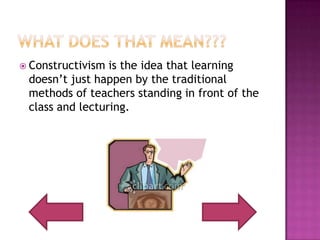
What does THAT mean???Constructivism is the idea that learning doesn’t just happen by the traditional methods of teachers standing in front of the class and lecturing.
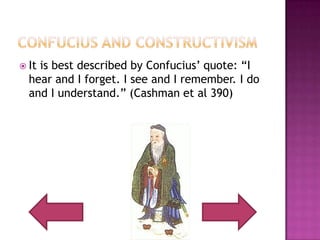
Confucius and ConstructivismIt is best described by Confucius’ quote: “I hear and I forget. I see and I remember. I do and I understand.” (Cashman et al 390)
Who Contributed to Constructivism?Jerome BrunerJean PiagetLev VygotskyJohn Dewey
Jerome BrunerVery influential psychologistHis concern with cognitive psychology “led to a particular interest in the cognitive development of children… and just what the appropriate forms of education might be” (Smith)
Jean PiagetDeveloped the cognitive learning theoryFelt children were “active learners” who constructed new knowledge “as they moved through different cognitive stages, building on what they already knew” (Cushman et al 392)
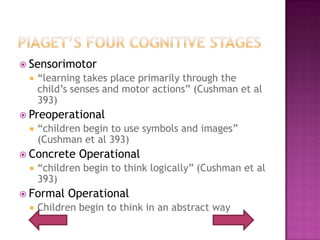
Piaget’s Four Cognitive StagesSensorimotor“learning takes place primarily through the child’s senses and motor actions” (Cushman et al 393)Preoperational“children begin to use symbols and images” (Cushman et al 393)Concrete Operational“children begin to think logically” (Cushman et al 393)Formal OperationalChildren begin to think in an abstract way
Lev VygotskyDeveloped the social cognition theory which “asserts that culture is the prime determinant of individual development” because humans are the only creatures to have created cultures and therefore it effects our learning development. (“Vygotsky and Social Cognition”)
Vygotskytheorized that a child’s cultural upbringing greatly effects their learning development.
John DeweyBelieved that learning should be engaging to the students… they will learn better if they are interested.Was a huge influence on our education systemBelieved in “educating the whole child, physically, mentally, and socially, and not just on the dispensation of facts and information” (Cushman et al 395)
What does this mean for Teachers?“In a constructivist setting… the role of the teacher is to organize information around conceptual clusters of problems, questions and discrepant situations in order to engage the student’s interest. Teachers assist the students in developing new insights and connecting them with their previous learning” (Hanley)
What does this mean for Students?In the classroom, students must work on building upon the knowledge they already have.“Inferences, elaborations, and relationships between old perceptions and new ideas must be personally drawn by the student in order for the new idea to become an integrated, useful part of his/her memory” (Hanley)
What does this mean for me?I would definitely use some constructivist methods in my classroom because I believe that it is a well-developed concept.  As a student, I definitely learn better when I am more focused, engaged, and interested.  As a teacher, it feels good to watch a student expand their knowledge in hands-on ways.
What does this mean for me?Some examples of things I would do in my classroom:Inquiry: “prompt students to formulate their own questions” (“Constructivism as a…”)Multiple intelligences: “allow multiple interpretations and expressions of learning” (“Constructivism as a…”)Collaborative learning: “encourage group work and the use of peers as resources” (“Constructivism as a…”)
Works CItedBrooks, Jaqueline, and Martin Brooks. "Constructivism." Funderstanding: Education and Training for Active Learners. N.p., n.d. Web. 15 Apr. 2010. <http://www.funderstanding.com/content/constructivism>.Cashman, Thomas J., Glenda A. Gunter, Randolph E. Gunter, and Gary B. Shelly. Teachers Discovering Computers: Integrating Technology and Digital Media in the Classroom, Fourth Edition (Shelly Cashman Series). 4 ed. Cambridge: Course Technology, 2005. Print."Constructivism as a Paradigm for Teaching and Learning."  THIRTEEN. N.p., n.d. Web. 16 Apr. 2010. <http://www.thirteen.org/edonline/concept2class/constructivism/index_sub2.html>.Hanley, Susan. "On Constructivism." Townson. N.p., n.d. Web. 15 Apr. 2010. <www.towson.edu/csme/mctp/Essays/Constructivism.txt>.Smith, Mark. " jeromebruner and the process of education ." contents @ the informal education homepage. N.p., n.d. Web. 15 Apr. 2010. <http://www.infed.org/thinkers/bruner.htm>."Vygotsky and Social Cognition." Funderstanding: Education and Training for Active Learners. N.p., n.d. Web. 15 Apr. 2010. <http://www.funderstanding.com/content/vygotsky-and-social-cognition>.

Constructivism ppt

  • 1.
  • 2.
    What is Constructivism?“Constructivismis a philosophy of learning founded on the premise that, by reflecting on our experiences, we construct our own understanding of the world we live in” (Brooks & Brooks)It is “based on a type of learning in which the learner forms, or constructs, much of what she learns or comprehends” (Cashman et al 390)
  • 3.
    What does THATmean???Constructivism is the idea that learning doesn’t just happen by the traditional methods of teachers standing in front of the class and lecturing.
  • 4.
    Confucius and ConstructivismItis best described by Confucius’ quote: “I hear and I forget. I see and I remember. I do and I understand.” (Cashman et al 390)
  • 5.
    Who Contributed toConstructivism?Jerome BrunerJean PiagetLev VygotskyJohn Dewey
  • 6.
    Jerome BrunerVery influentialpsychologistHis concern with cognitive psychology “led to a particular interest in the cognitive development of children… and just what the appropriate forms of education might be” (Smith)
  • 7.
    Jean PiagetDeveloped thecognitive learning theoryFelt children were “active learners” who constructed new knowledge “as they moved through different cognitive stages, building on what they already knew” (Cushman et al 392)
  • 8.
    Piaget’s Four CognitiveStagesSensorimotor“learning takes place primarily through the child’s senses and motor actions” (Cushman et al 393)Preoperational“children begin to use symbols and images” (Cushman et al 393)Concrete Operational“children begin to think logically” (Cushman et al 393)Formal OperationalChildren begin to think in an abstract way
  • 9.
    Lev VygotskyDeveloped thesocial cognition theory which “asserts that culture is the prime determinant of individual development” because humans are the only creatures to have created cultures and therefore it effects our learning development. (“Vygotsky and Social Cognition”)
  • 10.
    Vygotskytheorized that achild’s cultural upbringing greatly effects their learning development.
  • 11.
    John DeweyBelieved thatlearning should be engaging to the students… they will learn better if they are interested.Was a huge influence on our education systemBelieved in “educating the whole child, physically, mentally, and socially, and not just on the dispensation of facts and information” (Cushman et al 395)
  • 12.
    What does thismean for Teachers?“In a constructivist setting… the role of the teacher is to organize information around conceptual clusters of problems, questions and discrepant situations in order to engage the student’s interest. Teachers assist the students in developing new insights and connecting them with their previous learning” (Hanley)
  • 13.
    What does thismean for Students?In the classroom, students must work on building upon the knowledge they already have.“Inferences, elaborations, and relationships between old perceptions and new ideas must be personally drawn by the student in order for the new idea to become an integrated, useful part of his/her memory” (Hanley)
  • 14.
    What does thismean for me?I would definitely use some constructivist methods in my classroom because I believe that it is a well-developed concept. As a student, I definitely learn better when I am more focused, engaged, and interested. As a teacher, it feels good to watch a student expand their knowledge in hands-on ways.
  • 15.
    What does thismean for me?Some examples of things I would do in my classroom:Inquiry: “prompt students to formulate their own questions” (“Constructivism as a…”)Multiple intelligences: “allow multiple interpretations and expressions of learning” (“Constructivism as a…”)Collaborative learning: “encourage group work and the use of peers as resources” (“Constructivism as a…”)
  • 16.
    Works CItedBrooks, Jaqueline,and Martin Brooks. "Constructivism." Funderstanding: Education and Training for Active Learners. N.p., n.d. Web. 15 Apr. 2010. <http://www.funderstanding.com/content/constructivism>.Cashman, Thomas J., Glenda A. Gunter, Randolph E. Gunter, and Gary B. Shelly. Teachers Discovering Computers: Integrating Technology and Digital Media in the Classroom, Fourth Edition (Shelly Cashman Series). 4 ed. Cambridge: Course Technology, 2005. Print."Constructivism as a Paradigm for Teaching and Learning." THIRTEEN. N.p., n.d. Web. 16 Apr. 2010. <http://www.thirteen.org/edonline/concept2class/constructivism/index_sub2.html>.Hanley, Susan. "On Constructivism." Townson. N.p., n.d. Web. 15 Apr. 2010. <www.towson.edu/csme/mctp/Essays/Constructivism.txt>.Smith, Mark. " jeromebruner and the process of education ." contents @ the informal education homepage. N.p., n.d. Web. 15 Apr. 2010. <http://www.infed.org/thinkers/bruner.htm>."Vygotsky and Social Cognition." Funderstanding: Education and Training for Active Learners. N.p., n.d. Web. 15 Apr. 2010. <http://www.funderstanding.com/content/vygotsky-and-social-cognition>.