Dr. Archana Chaudhari
• Teaching derived from : to teach which means to instruct
• Process in which one individual makes something known to another
individual
• Teaching is a bipolar process- John Adam ( Narrow Meaning)
• Teaching is a tripolar process ( Broad Meaning)
Teacher Student
Students Curriculum/ Society
Teacher
• Teaching is an important part of the process of Education
• Its special function is to impart knowledge, develop understanding
and skill
• Teaching is communication between two or more persons, who
influence each other by ideas and learn something in the process of
interaction
• Teaching is a process in which learner, teacher curriculum and other
variables are organized in a systematic way to attain some pre
determined goals.
• Teaching includes all the activities of providing education to other.
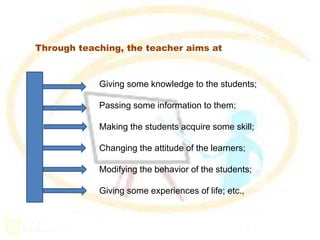
Through teaching, the teacher aims at
Giving some knowledge to the students;
Passing some information to them;
Making the students acquire some skill;
Changing the attitude of the learners;
Modifying the behavior of the students;
Giving some experiences of life; etc.,
H.C. Morrison (1934): “teaching is an intimate contact between a
more mature personality and less mature one which is designed to
further the education of the latter.”
N. L, Gage(1962): “Teaching is a form of interpersonal influence
aimed at changing the behavior potential of another person”
B.D. Smith (1961): “Teaching is a system of actions intended to
induce learning.”
Albert Einstein : The supreme art of teaching is to awaken joy in
creative expression and knowledge
 Teaching is an interactive process
 Teaching is both formal and informal
 Teaching is art, craft as well science
 Teaching is not one sided
 Teaching is not an independent activity
 Teaching is a planned activity
 Teaching is diagnostic and remedial
 Teaching is dominated by communication skills
 Good teaching is democratic
 Teaching causes motivation
 Teaching is professional in character
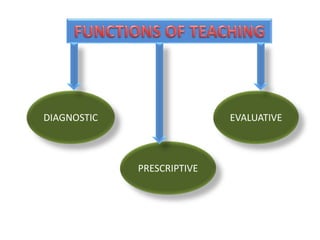
DIAGNOSTIC
PRESCRIPTIVE
EVALUATIVE
DIAGNOSTIC
•Entering behavior of the student
•Initial potential of the student
•Educational Objectives
•Content, instructional material &environment
•His own potentials and capabilities
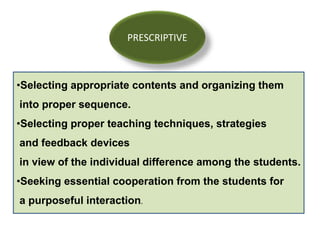
PRESCRIPTIVE
•Selecting appropriate contents and organizing them
into proper sequence.
•Selecting proper teaching techniques, strategies
and feedback devices
in view of the individual difference among the students.
•Seeking essential cooperation from the students for
a purposeful interaction.
EVALUATIVE
•Realization of the stipulated objectives.
•Various evaluation devices in the form of tests, observations,
interviews, rating scales, inventories and unstructured projective
techniques are help in exercising evaluative functions.
•Failure in the realization of the objectives is essentially a failure
in the prescriptive or diagnostic functions.
•Students are more active.
The other general functions of
teaching are:
• Creating learning situations.
• Motivating the child to learn.
• Diagnosing learning problems.
• Making curricular material.
• Explain and inform.
• Initiation, Direction and Administration.
What is teaching

What is teaching

  • 1.
  • 2.
    • Teaching derivedfrom : to teach which means to instruct • Process in which one individual makes something known to another individual • Teaching is a bipolar process- John Adam ( Narrow Meaning) • Teaching is a tripolar process ( Broad Meaning) Teacher Student Students Curriculum/ Society Teacher
  • 3.
    • Teaching isan important part of the process of Education • Its special function is to impart knowledge, develop understanding and skill • Teaching is communication between two or more persons, who influence each other by ideas and learn something in the process of interaction • Teaching is a process in which learner, teacher curriculum and other variables are organized in a systematic way to attain some pre determined goals. • Teaching includes all the activities of providing education to other.
  • 4.
    Through teaching, theteacher aims at Giving some knowledge to the students; Passing some information to them; Making the students acquire some skill; Changing the attitude of the learners; Modifying the behavior of the students; Giving some experiences of life; etc.,
  • 5.
    H.C. Morrison (1934):“teaching is an intimate contact between a more mature personality and less mature one which is designed to further the education of the latter.” N. L, Gage(1962): “Teaching is a form of interpersonal influence aimed at changing the behavior potential of another person” B.D. Smith (1961): “Teaching is a system of actions intended to induce learning.” Albert Einstein : The supreme art of teaching is to awaken joy in creative expression and knowledge
  • 6.
     Teaching isan interactive process  Teaching is both formal and informal  Teaching is art, craft as well science  Teaching is not one sided  Teaching is not an independent activity  Teaching is a planned activity  Teaching is diagnostic and remedial  Teaching is dominated by communication skills  Good teaching is democratic  Teaching causes motivation  Teaching is professional in character
  • 7.
  • 8.
    DIAGNOSTIC •Entering behavior ofthe student •Initial potential of the student •Educational Objectives •Content, instructional material &environment •His own potentials and capabilities
  • 9.
    PRESCRIPTIVE •Selecting appropriate contentsand organizing them into proper sequence. •Selecting proper teaching techniques, strategies and feedback devices in view of the individual difference among the students. •Seeking essential cooperation from the students for a purposeful interaction.
  • 10.
    EVALUATIVE •Realization of thestipulated objectives. •Various evaluation devices in the form of tests, observations, interviews, rating scales, inventories and unstructured projective techniques are help in exercising evaluative functions. •Failure in the realization of the objectives is essentially a failure in the prescriptive or diagnostic functions. •Students are more active.
  • 11.
    The other generalfunctions of teaching are: • Creating learning situations. • Motivating the child to learn. • Diagnosing learning problems. • Making curricular material. • Explain and inform. • Initiation, Direction and Administration.