



Constructivism In Education
ANJU GANDHI
What is Constructivism?
• “Constructivism is a philosophy of learning founded on the
premise that, by reflecting on our experiences, we construct
our own understanding of the world we live in” (Brooks &
Brooks).
• A view of learning based on the belief that knowledge isn't a
thing that can simply be given by the teacher at the front of
the room to students in their desks.
• Learning is social process, shaped with situations and
conditions of the environment.
• Learners are the builders and creators of
meaning and knowledge through an active,
mental process of development.
• Students learn by fitting new information
together with what they already know. They
share their ideas and communicate.
Constructivist’ theory of learning
• The essence of constructivist theory is the idea that
learners must individually discover and transform
complex information if they are to make it their own
(Anderson & Simon, 2000).
• Theories that state that learners must individually
discover and transform complex information,
checking new information against old rules and
revising rules when they no longer work( Padron, &
Arnold,2001).
• Because of the emphasis on students as active
learners, constructivist strategies are often
called student centered instruction.
What does student-centered mean?
• The students are the center of attention, not
the teacher
• Children are placed in groups, they work
together to find meaning
• Each student takes on a different objective or
part of the assignment or project
• They become “experts” on their subject
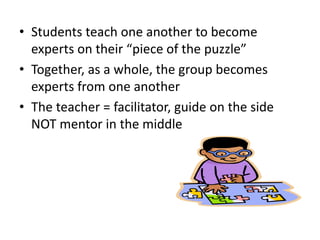
• Students teach one another to become
experts on their “piece of the puzzle”
• Together, as a whole, the group becomes
experts from one another
• The teacher = facilitator, guide on the side
NOT mentor in the middle
• Students learn content by building it
themselves.
• Students are encouraged to come to their
own conclusions
FIVE PRINCIPLES OF CONSTRUCTIVISM
• Create problems which has value to students
• Structure learning around primary concepts
• Seek and value student’s points of views
• Adapt curriculum to address student’s
suppositions
• Assess learning in the context of
teaching
Historical Roots of Constructivism
(based on Piaget’s Theory)
Piaget believed that children learn through organization and
schemas. He believed that by organizing concepts and ideas,
children place them into schemas. He believed that children
are in control of the knowledge that they are provided and
move forward in construct their own learning by taking part in
social activities and exploration
Historical Roots of Constructivism
(based on Vygotsky’s Theories)
Vygotsky believed that learning needs to be engaging.
Learning takes place as children are interacting with each
other and exploring their environment. He believed that
learning is simultaneous to social interaction and exploration.
In other words, he did not feel as though one was more
important than the other
Constructivist Learning
• Learning is an emotional process.
• Learning is student-centered.
• Learning is developmental. It is affected by students’ social,
physical and emotional developments.
• Learning is permanent.
• Learning includes conceptual changes.
• The quality of learning is important in learning process.
Approaches in Constructivist
Classroom
• Top-Down Processing
• Cooperative Learning
• Discovery Learning
• Self-Regulated Learning
• Scaffolding
• Project Based Learning
• Inquiry Based Learning
• Problem Based Learning
How does the constructivist teacher make
this style work?
• Create active environment.
• Observation and Listening
• Flexible and Provides Stimulation and Asks
Questions.
• Teacher creatively incorporates ongoing
experiences with real-life situations
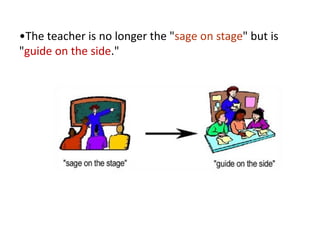
•The teacher is no longer the "sage on stage" but is
"guide on the side."
What about the constructivist classroom?
"Students should be presented with real life problems and then helped to
discover information required to solve them” John Dewey
Constructivist Classrooms are structured so that learners are
immersed in experiences with in which they may engage in
meaningful………
• Inquiry
• Action
• Imagination
• Invention
• Interaction
• Hypothesizing
• Personal reflection
Communication in a constructivist classroom:
• The interaction in the class is recipricol rather than teacher-
centered.
• Students are engage with their activities rather than listening.
• Teacher asks questions rather than giving directions.
• Students’ voices are heared mostly rather than the teacher’s.
• Teacher speaks less than the students.
• Teacher’s and students’ questions are not for only a single
word.
• Students’ speaking in normal tone is enough for taking the
other students’ or the teacher’s attention.
• Teacher’s speaking in normal tone is enough for taking the
students’ attention.
• Students help to each other.
Techniques and methods in a constructivist
classroom:
• Teacher encourage direct student intellectual involvement
trhough:
• Discussion
• Small group work
• Student presentation
• Debate
• Simultations
• Brain-storming
• Individul study
• Teacher acceptes and encourages students autonomy.
• Teacher acceptes individual differences.
• Students are asked open-ended questions and allowed time
for resdonding.
• Teacher encourages students to higher-level thinking.
• Students communicate with both teacher and classmates.
• Students engage in experince.
• Raw data, primary sources, malipulatives, physical and
interactive materials are used by students.
Evaluation in a constructivist classroom:
• The purpose is to help students for learning.
• Learned information are evaluated not memorized ones.
• During evaluation, learning continues.
• Whether the information is appropriate for situation or not is
evaluated.
• The process of learning is evaluated not the outcomes of the
learning.
• Performance, problem based learning, group works and
practical matters sare used for evaluation.
• The basic of evaluation is to direct them sharing and give
them opportunities.
Why and Why Not?
Why ?
• Fosters critical thinking
• Creates active and motivated learners
• Students are able to learn through constructing their own
understandings
• This approach frees teachers to make decisions which
enhance and enrich student’s development. students often
like when they are part of the decision making process
• Higher level of thinking occurs
• Students like hands-on activities
• Students feel a sense of ownership when hand-on learning
occurs rather then just being told something
Why Not?
• Teachers are ill prepared
• Difficult to break the cycle of those who have been taught in a
classroom where they were expected to solely absorb
information
• Belief that learning is based on the students ability to discover
new knowledge
• Teachers may not take responsibility for poor learning
• May lead students to take a majority rules attitude rather
then an individual approach to decision making
Constructivism

Constructivism

  • 2.
  • 3.
    What is Constructivism? •“Constructivism is a philosophy of learning founded on the premise that, by reflecting on our experiences, we construct our own understanding of the world we live in” (Brooks & Brooks). • A view of learning based on the belief that knowledge isn't a thing that can simply be given by the teacher at the front of the room to students in their desks. • Learning is social process, shaped with situations and conditions of the environment.
  • 4.
    • Learners arethe builders and creators of meaning and knowledge through an active, mental process of development. • Students learn by fitting new information together with what they already know. They share their ideas and communicate.
  • 5.
    Constructivist’ theory oflearning • The essence of constructivist theory is the idea that learners must individually discover and transform complex information if they are to make it their own (Anderson & Simon, 2000). • Theories that state that learners must individually discover and transform complex information, checking new information against old rules and revising rules when they no longer work( Padron, & Arnold,2001).
  • 6.
    • Because ofthe emphasis on students as active learners, constructivist strategies are often called student centered instruction.
  • 7.
    What does student-centeredmean? • The students are the center of attention, not the teacher • Children are placed in groups, they work together to find meaning • Each student takes on a different objective or part of the assignment or project • They become “experts” on their subject
  • 8.
    • Students teachone another to become experts on their “piece of the puzzle” • Together, as a whole, the group becomes experts from one another • The teacher = facilitator, guide on the side NOT mentor in the middle
  • 9.
    • Students learncontent by building it themselves. • Students are encouraged to come to their own conclusions
  • 10.
    FIVE PRINCIPLES OFCONSTRUCTIVISM • Create problems which has value to students • Structure learning around primary concepts • Seek and value student’s points of views • Adapt curriculum to address student’s suppositions • Assess learning in the context of teaching
  • 11.
    Historical Roots ofConstructivism (based on Piaget’s Theory) Piaget believed that children learn through organization and schemas. He believed that by organizing concepts and ideas, children place them into schemas. He believed that children are in control of the knowledge that they are provided and move forward in construct their own learning by taking part in social activities and exploration
  • 12.
    Historical Roots ofConstructivism (based on Vygotsky’s Theories) Vygotsky believed that learning needs to be engaging. Learning takes place as children are interacting with each other and exploring their environment. He believed that learning is simultaneous to social interaction and exploration. In other words, he did not feel as though one was more important than the other
  • 13.
    Constructivist Learning • Learningis an emotional process. • Learning is student-centered. • Learning is developmental. It is affected by students’ social, physical and emotional developments. • Learning is permanent. • Learning includes conceptual changes. • The quality of learning is important in learning process.
  • 14.
    Approaches in Constructivist Classroom •Top-Down Processing • Cooperative Learning • Discovery Learning • Self-Regulated Learning • Scaffolding • Project Based Learning • Inquiry Based Learning • Problem Based Learning
  • 15.
    How does theconstructivist teacher make this style work? • Create active environment. • Observation and Listening • Flexible and Provides Stimulation and Asks Questions. • Teacher creatively incorporates ongoing experiences with real-life situations
  • 16.
    •The teacher isno longer the "sage on stage" but is "guide on the side."
  • 17.
    What about theconstructivist classroom? "Students should be presented with real life problems and then helped to discover information required to solve them” John Dewey Constructivist Classrooms are structured so that learners are immersed in experiences with in which they may engage in meaningful……… • Inquiry • Action • Imagination • Invention • Interaction • Hypothesizing • Personal reflection
  • 18.
    Communication in aconstructivist classroom: • The interaction in the class is recipricol rather than teacher- centered. • Students are engage with their activities rather than listening. • Teacher asks questions rather than giving directions. • Students’ voices are heared mostly rather than the teacher’s.
  • 19.
    • Teacher speaksless than the students. • Teacher’s and students’ questions are not for only a single word. • Students’ speaking in normal tone is enough for taking the other students’ or the teacher’s attention. • Teacher’s speaking in normal tone is enough for taking the students’ attention. • Students help to each other.
  • 20.
    Techniques and methodsin a constructivist classroom: • Teacher encourage direct student intellectual involvement trhough: • Discussion • Small group work • Student presentation • Debate • Simultations • Brain-storming • Individul study
  • 21.
    • Teacher acceptesand encourages students autonomy. • Teacher acceptes individual differences. • Students are asked open-ended questions and allowed time for resdonding. • Teacher encourages students to higher-level thinking. • Students communicate with both teacher and classmates. • Students engage in experince. • Raw data, primary sources, malipulatives, physical and interactive materials are used by students.
  • 22.
    Evaluation in aconstructivist classroom: • The purpose is to help students for learning. • Learned information are evaluated not memorized ones. • During evaluation, learning continues. • Whether the information is appropriate for situation or not is evaluated.
  • 23.
    • The processof learning is evaluated not the outcomes of the learning. • Performance, problem based learning, group works and practical matters sare used for evaluation. • The basic of evaluation is to direct them sharing and give them opportunities.
  • 24.
  • 25.
    Why ? • Fosterscritical thinking • Creates active and motivated learners • Students are able to learn through constructing their own understandings • This approach frees teachers to make decisions which enhance and enrich student’s development. students often like when they are part of the decision making process • Higher level of thinking occurs • Students like hands-on activities • Students feel a sense of ownership when hand-on learning occurs rather then just being told something
  • 26.
    Why Not? • Teachersare ill prepared • Difficult to break the cycle of those who have been taught in a classroom where they were expected to solely absorb information • Belief that learning is based on the students ability to discover new knowledge • Teachers may not take responsibility for poor learning • May lead students to take a majority rules attitude rather then an individual approach to decision making