DOS&R IN ORGANIC CHEMISTRY
TUMKUR UNIVERSITY
Conformational analysis of
medium rings- Carbocycles
other than Cyclohexane
By
PRUTHVIRAJ K
Faculty
DOS&R in Organic Chemistry
KPR. DOS&R in ORGANIC CHEMISTRY TUT
Carbocycles other than cyclohexane
• Carbocyclic rings may be classified into four types:
small rings (3 and 4-membered), common rings (5 to
7 membered), medium rings (8 to 11 membered) and
large rings (12 membered and above).
• The cyclopropane ring is necessarily planar and there
is question of conformation, stereoisomers being
confined to rigid diastereomers and enantiomers.
• Conformational heterogeneity starts with the
cyclobutane ring, becomes well defined in
cyclohexane and grows more complex in medium and
large rings.
KPR. DOS&R in ORGANIC CHEMISTRY TUT
Cycloheptane
• With the increase of ring size in carbocycles (Cycloheptane and
above), the number of possible conformers increases due to the
greater degree of freedom.
• Usually more than one family of conformers are possible, in general
the members of a family pseudorotates into one another whereas a
member of one family is converted into a member of the other
family by ring inversion( high energy process)
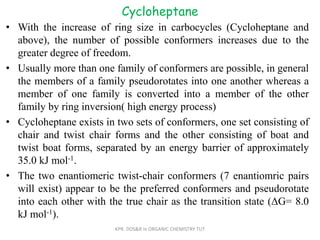
• Cycloheptane exists in two sets of conformers, one set consisting of
chair and twist chair forms and the other consisting of boat and
twist boat forms, separated by an energy barrier of approximately
35.0 kJ mol-1.
• The two enantiomeric twist-chair conformers (7 enantiomric pairs
will exist) appear to be the preferred conformers and pseudorotate
into each other with the true chair as the transition state (ΔG= 8.0
kJ mol-1).
KPR. DOS&R in ORGANIC CHEMISTRY TUT
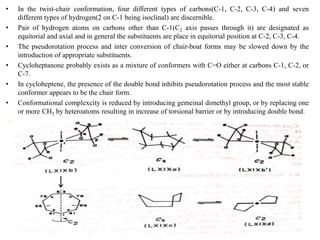
• In the twist-chair conformation, four different types of carbons(C-1, C-2, C-3, C-4) and seven
different types of hydrogen(2 on C-1 being isoclinal) are discernible.
• Pair of hydrogen atoms on carbons other than C-1(C2 axis passes through it) are designated as
equitorial and axial and in general the substituents are place in equitorial position at C-2, C-3, C-4.
• The pseudorotation process and inter conversion of chair-boat forms may be slowed down by the
introduction of appropriate substituents.
• Cycloheptanone probably exists as a mixture of conformers with C=O either at carbons C-1, C-2, or
C-7.
• In cycloheptene, the presence of the double bond inhibits pseudorotation process and the most stable
conformer appears to be the chair form.
• Conformational complexcity is reduced by introducing gemeinal dimethyl group, or by replacing one
or more CH2 by heteroatoms resulting in increase of torsional barrier or by introducing double bond.
KPR. DOS&R in ORGANIC CHEMISTRY TUT
Medium Rings: conformation
• The medium sized rings ( 8 to 11) show some unusual conformational features which
are not present in common and large rings.
• The strain per CH2 group in the medium ring compounds is appreciably higher (5.0-
6.0 kJ mol-1) than in seven membered (3.8 kJ mol-1) and 12 membered rings (1.3 kJ
mol-1).
• The conformation of these rings are such that some of the H’s are directed inside the
rings(intraannular H’s) and some of the H’s are directed outside the
rings(extraannular or peripheral H’s), interacts with one another sterically across the
ring leading to transannular strain.
Cyclooctane
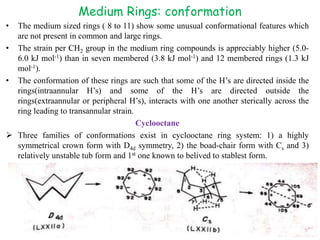
 Three families of conformations exist in cyclooctane ring system: 1) a highly
symmetrical crown form with D4d symmetry, 2) the boad-chair form with Cs and 3)
relatively unstable tub form and 1st one known to belived to stablest form.
KPR. DOS&R in ORGANIC CHEMISTRY TUT
• Intraannular H’s at C-1, C-1 and C-6 on the upper side and at C-3, C-5 and C-7 on the
lower side of the ring lead to transannular interaction.
Cyclononane
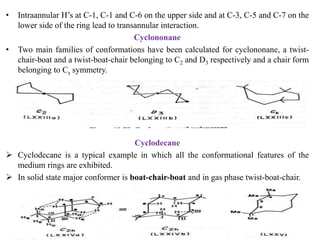
• Two main families of conformations have been calculated for cyclononane, a twist-
chair-boat and a twist-boat-chair belonging to C2 and D3 respectively and a chair form
belonging to Cs symmetry.
Cyclodecane
 Cyclodecane is a typical example in which all the conformational features of the
medium rings are exhibited.
 In solid state major conformer is boat-chair-boat and in gas phase twist-boat-chair.
KPR. DOS&R in ORGANIC CHEMISTRY TUT
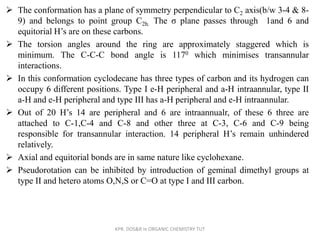
 The conformation has a plane of symmetry perpendicular to C2 axis(b/w 3-4 & 8-
9) and belongs to point group C2h. The σ plane passes through 1and 6 and
equitorial H’s are on these carbons.
 The torsion angles around the ring are approximately staggered which is
minimum. The C-C-C bond angle is 1170 which minimises transannular
interactions.
 In this conformation cyclodecane has three types of carbon and its hydrogen can
occupy 6 different positions. Type I e-H peripheral and a-H intraannular, type II
a-H and e-H peripheral and type III has a-H peripheral and e-H intraannular.
 Out of 20 H’s 14 are peripheral and 6 are intraannualr, of these 6 three are
attached to C-1,C-4 and C-8 and other three at C-3, C-6 and C-9 being
responsible for transannular interaction. 14 peripheral H’s remain unhindered
relatively.
 Axial and equitorial bonds are in same nature like cyclohexane.
 Pseudorotation can be inhibited by introduction of geminal dimethyl groups at
type II and hetero atoms O,N,S or C=O at type I and III carbon.
KPR. DOS&R in ORGANIC CHEMISTRY TUT

Conformational analysis of medium rings

  • 1.
    DOS&R IN ORGANICCHEMISTRY TUMKUR UNIVERSITY Conformational analysis of medium rings- Carbocycles other than Cyclohexane By PRUTHVIRAJ K Faculty DOS&R in Organic Chemistry KPR. DOS&R in ORGANIC CHEMISTRY TUT
  • 2.
    Carbocycles other thancyclohexane • Carbocyclic rings may be classified into four types: small rings (3 and 4-membered), common rings (5 to 7 membered), medium rings (8 to 11 membered) and large rings (12 membered and above). • The cyclopropane ring is necessarily planar and there is question of conformation, stereoisomers being confined to rigid diastereomers and enantiomers. • Conformational heterogeneity starts with the cyclobutane ring, becomes well defined in cyclohexane and grows more complex in medium and large rings. KPR. DOS&R in ORGANIC CHEMISTRY TUT
  • 3.
    Cycloheptane • With theincrease of ring size in carbocycles (Cycloheptane and above), the number of possible conformers increases due to the greater degree of freedom. • Usually more than one family of conformers are possible, in general the members of a family pseudorotates into one another whereas a member of one family is converted into a member of the other family by ring inversion( high energy process) • Cycloheptane exists in two sets of conformers, one set consisting of chair and twist chair forms and the other consisting of boat and twist boat forms, separated by an energy barrier of approximately 35.0 kJ mol-1. • The two enantiomeric twist-chair conformers (7 enantiomric pairs will exist) appear to be the preferred conformers and pseudorotate into each other with the true chair as the transition state (ΔG= 8.0 kJ mol-1). KPR. DOS&R in ORGANIC CHEMISTRY TUT
  • 4.
    • In thetwist-chair conformation, four different types of carbons(C-1, C-2, C-3, C-4) and seven different types of hydrogen(2 on C-1 being isoclinal) are discernible. • Pair of hydrogen atoms on carbons other than C-1(C2 axis passes through it) are designated as equitorial and axial and in general the substituents are place in equitorial position at C-2, C-3, C-4. • The pseudorotation process and inter conversion of chair-boat forms may be slowed down by the introduction of appropriate substituents. • Cycloheptanone probably exists as a mixture of conformers with C=O either at carbons C-1, C-2, or C-7. • In cycloheptene, the presence of the double bond inhibits pseudorotation process and the most stable conformer appears to be the chair form. • Conformational complexcity is reduced by introducing gemeinal dimethyl group, or by replacing one or more CH2 by heteroatoms resulting in increase of torsional barrier or by introducing double bond. KPR. DOS&R in ORGANIC CHEMISTRY TUT
  • 5.
    Medium Rings: conformation •The medium sized rings ( 8 to 11) show some unusual conformational features which are not present in common and large rings. • The strain per CH2 group in the medium ring compounds is appreciably higher (5.0- 6.0 kJ mol-1) than in seven membered (3.8 kJ mol-1) and 12 membered rings (1.3 kJ mol-1). • The conformation of these rings are such that some of the H’s are directed inside the rings(intraannular H’s) and some of the H’s are directed outside the rings(extraannular or peripheral H’s), interacts with one another sterically across the ring leading to transannular strain. Cyclooctane  Three families of conformations exist in cyclooctane ring system: 1) a highly symmetrical crown form with D4d symmetry, 2) the boad-chair form with Cs and 3) relatively unstable tub form and 1st one known to belived to stablest form. KPR. DOS&R in ORGANIC CHEMISTRY TUT
  • 6.
    • Intraannular H’sat C-1, C-1 and C-6 on the upper side and at C-3, C-5 and C-7 on the lower side of the ring lead to transannular interaction. Cyclononane • Two main families of conformations have been calculated for cyclononane, a twist- chair-boat and a twist-boat-chair belonging to C2 and D3 respectively and a chair form belonging to Cs symmetry. Cyclodecane  Cyclodecane is a typical example in which all the conformational features of the medium rings are exhibited.  In solid state major conformer is boat-chair-boat and in gas phase twist-boat-chair. KPR. DOS&R in ORGANIC CHEMISTRY TUT
  • 7.
     The conformationhas a plane of symmetry perpendicular to C2 axis(b/w 3-4 & 8- 9) and belongs to point group C2h. The σ plane passes through 1and 6 and equitorial H’s are on these carbons.  The torsion angles around the ring are approximately staggered which is minimum. The C-C-C bond angle is 1170 which minimises transannular interactions.  In this conformation cyclodecane has three types of carbon and its hydrogen can occupy 6 different positions. Type I e-H peripheral and a-H intraannular, type II a-H and e-H peripheral and type III has a-H peripheral and e-H intraannular.  Out of 20 H’s 14 are peripheral and 6 are intraannualr, of these 6 three are attached to C-1,C-4 and C-8 and other three at C-3, C-6 and C-9 being responsible for transannular interaction. 14 peripheral H’s remain unhindered relatively.  Axial and equitorial bonds are in same nature like cyclohexane.  Pseudorotation can be inhibited by introduction of geminal dimethyl groups at type II and hetero atoms O,N,S or C=O at type I and III carbon. KPR. DOS&R in ORGANIC CHEMISTRY TUT