
Conformational Isomerism
1
• Dr. Gurumeet C Wadhawa
• Department of Chemistry
• Karmaveer Bhaurao Patil ,College
• Vashi, Navi Mumbai
Representing Conformations
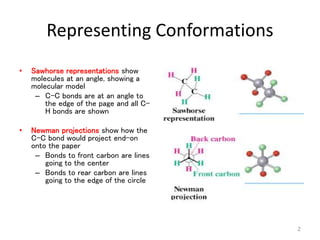
• Sawhorse representations show
molecules at an angle, showing a
molecular model
– C-C bonds are at an angle to
the edge of the page and all C-
H bonds are shown
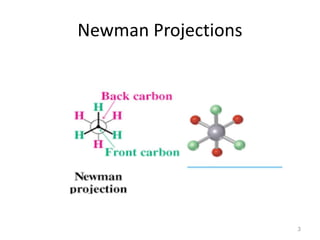
• Newman projections show how the
C-C bond would project end-on
onto the paper
– Bonds to front carbon are lines
going to the center
– Bonds to rear carbon are lines
going to the edge of the circle
2
Newman Projections
3
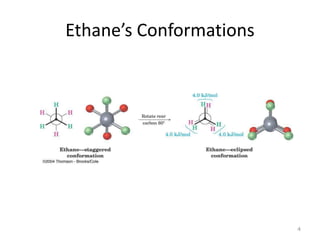
Ethane’s Conformations
4
Ethane’s Conformations
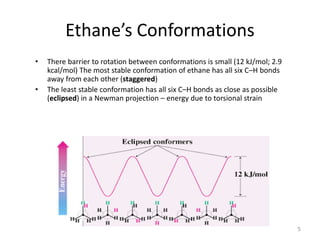
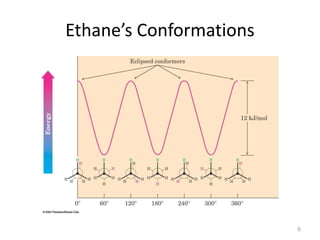
• There barrier to rotation between conformations is small (12 kJ/mol; 2.9
kcal/mol) The most stable conformation of ethane has all six C–H bonds
away from each other (staggered)
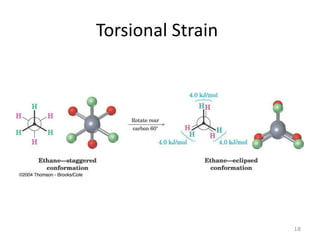
• The least stable conformation has all six C–H bonds as close as possible
(eclipsed) in a Newman projection – energy due to torsional strain
5
Ethane’s Conformations
6
Conformations of Propane
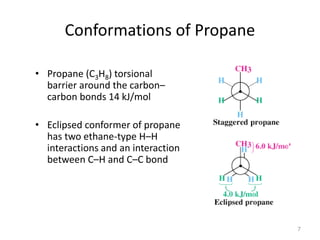
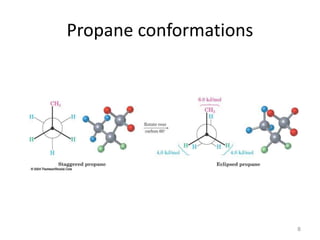
• Propane (C3H8) torsional
barrier around the carbon–
carbon bonds 14 kJ/mol
• Eclipsed conformer of propane
has two ethane-type H–H
interactions and an interaction
between C–H and C–C bond
7
Propane conformations
8
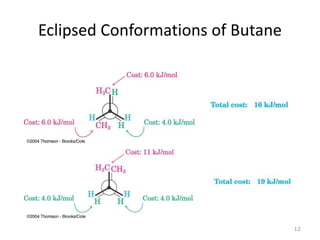
Conformations of Butane
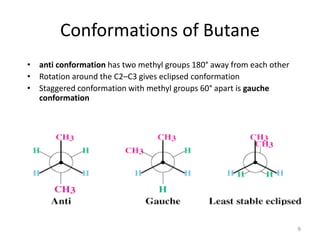
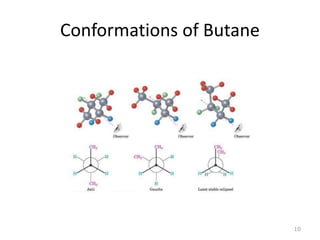
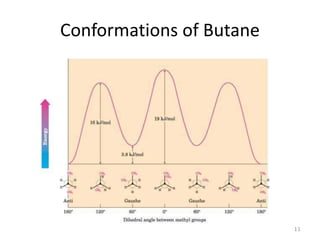
• anti conformation has two methyl groups 180° away from each other
• Rotation around the C2–C3 gives eclipsed conformation
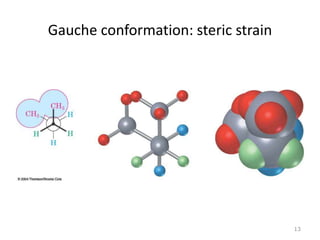
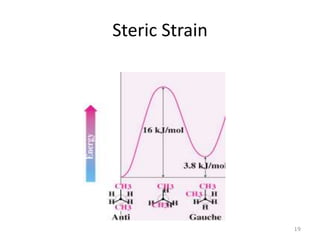
• Staggered conformation with methyl groups 60° apart is gauche
conformation
9
Conformations of Butane
10
Conformations of Butane
11
Eclipsed Conformations of Butane
12
Gauche conformation: steric strain
13
Stability of Cycloalkanes: The Baeyer
Strain Theory
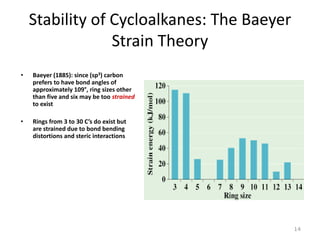
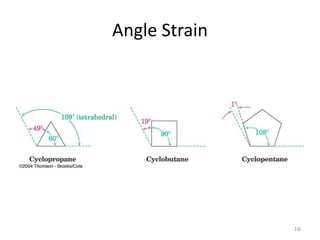
• Baeyer (1885): since (sp3) carbon
prefers to have bond angles of
approximately 109°, ring sizes other
than five and six may be too strained
to exist
• Rings from 3 to 30 C’s do exist but
are strained due to bond bending
distortions and steric interactions
14
The Nature of Ring Strain
• Rings larger than 3 atoms are not flat (planar)
• Cyclic molecules can assume nonplanar conformations to
minimize angle strain and torsional strain by ring-puckering
• Larger rings have many more possible conformations than
smaller rings and are more difficult to analyze
15
Angle Strain
16
Types of Strain
• Angle strain - expansion or compression of bond angles
away from most stable
• Torsional strain - eclipsing of bonds on neighboring
atoms
• Steric strain - repulsive interactions between nonbonded
atoms in close proximity
17
Torsional Strain
18
Steric Strain
19
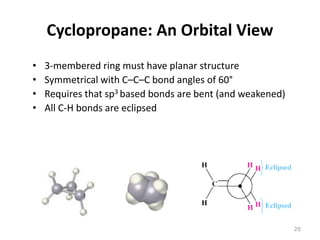
Cyclopropane: An Orbital View
• 3-membered ring must have planar structure
• Symmetrical with C–C–C bond angles of 60°
• Requires that sp3 based bonds are bent (and weakened)
• All C-H bonds are eclipsed
20
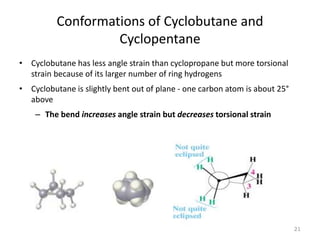
Conformations of Cyclobutane and
Cyclopentane
• Cyclobutane has less angle strain than cyclopropane but more torsional
strain because of its larger number of ring hydrogens
• Cyclobutane is slightly bent out of plane - one carbon atom is about 25°
above
– The bend increases angle strain but decreases torsional strain
21
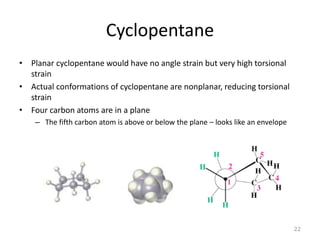
Cyclopentane
• Planar cyclopentane would have no angle strain but very high torsional
strain
• Actual conformations of cyclopentane are nonplanar, reducing torsional
strain
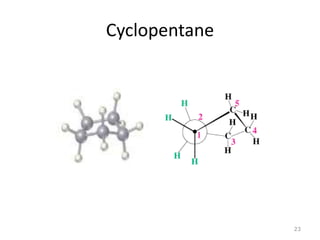
• Four carbon atoms are in a plane
– The fifth carbon atom is above or below the plane – looks like an envelope
22
Cyclopentane
23
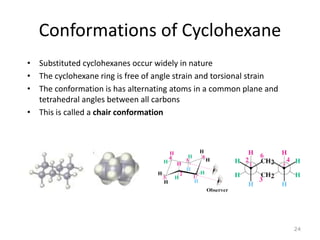
Conformations of Cyclohexane
• Substituted cyclohexanes occur widely in nature
• The cyclohexane ring is free of angle strain and torsional strain
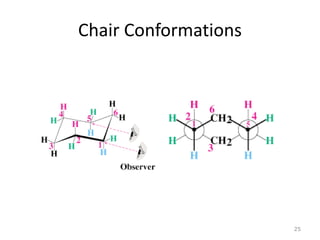
• The conformation is has alternating atoms in a common plane and
tetrahedral angles between all carbons
• This is called a chair conformation
24
Chair Conformations
25
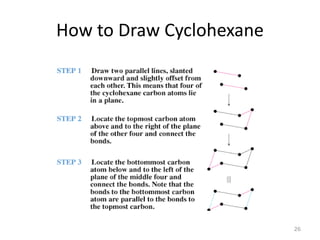
How to Draw Cyclohexane
26
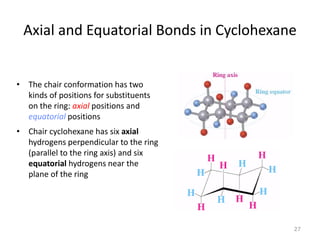
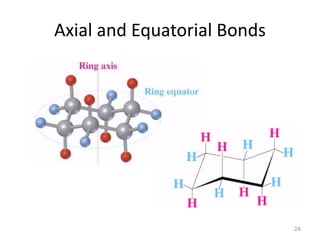
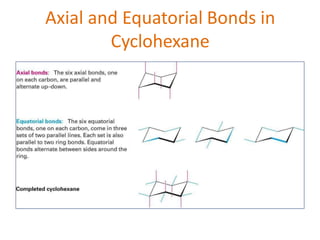
Axial and Equatorial Bonds in Cyclohexane
• The chair conformation has two
kinds of positions for substituents
on the ring: axial positions and
equatorial positions
• Chair cyclohexane has six axial
hydrogens perpendicular to the ring
(parallel to the ring axis) and six
equatorial hydrogens near the
plane of the ring
27
Axial and Equatorial Bonds
28
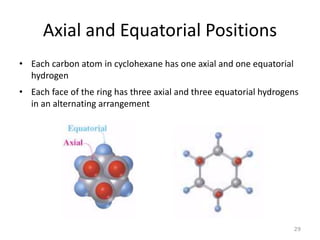
Axial and Equatorial Positions
• Each carbon atom in cyclohexane has one axial and one equatorial
hydrogen
• Each face of the ring has three axial and three equatorial hydrogens
in an alternating arrangement
29
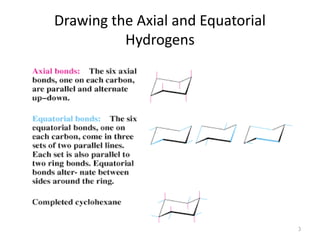
Drawing the Axial and Equatorial
Hydrogens
30
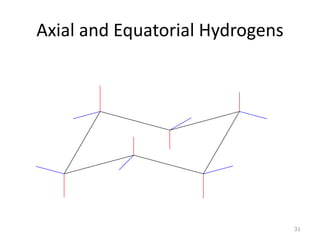
Axial and Equatorial Hydrogens
31
Conformations of Cyclohexane
• Chair Conformation
• Boat Conformation
• Twisted Boat Conformation
• Half Chair Conformation
32
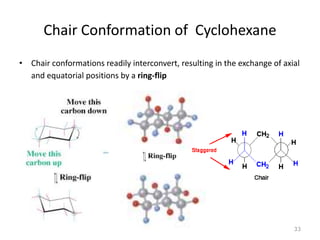
Chair Conformation of Cyclohexane
• Chair conformations readily interconvert, resulting in the exchange of axial
and equatorial positions by a ring-flip
33
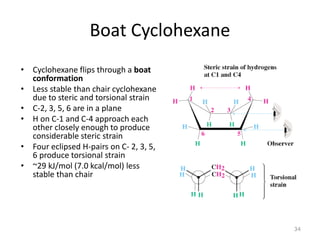
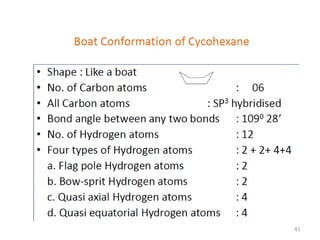
Boat Cyclohexane
• Cyclohexane flips through a boat
conformation
• Less stable than chair cyclohexane
due to steric and torsional strain
• C-2, 3, 5, 6 are in a plane
• H on C-1 and C-4 approach each
other closely enough to produce
considerable steric strain
• Four eclipsed H-pairs on C- 2, 3, 5,
6 produce torsional strain
• ~29 kJ/mol (7.0 kcal/mol) less
stable than chair
34
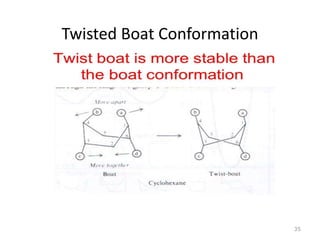
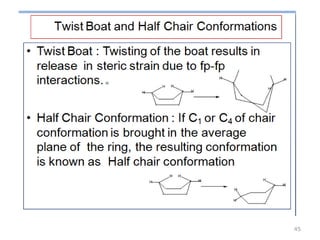
Twisted Boat Conformation
35
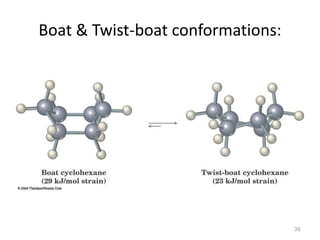
Boat & Twist-boat conformations:
36
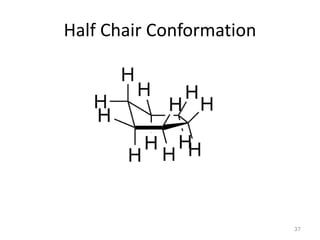
Half Chair Conformation
37
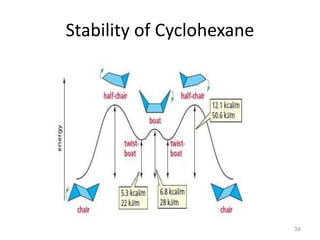
Stability of Cyclohexane
38
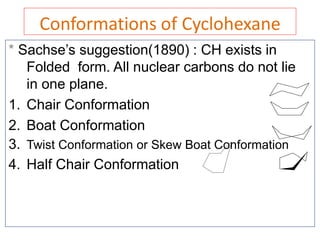
Conformations of Cyclohexane
* Sachse’s suggestion(1890) : CH exists in
Folded form. All nuclear carbons do not lie
in one plane.
1. Chair Conformation
2. Boat Conformation
3. Twist Conformation or Skew Boat Conformation
4. Half Chair Conformation
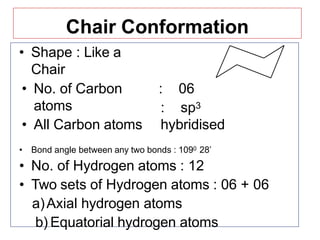
Chair Conformation
• Shape : Like a
Chair
• No. of Carbon
atoms
• All Carbon atoms
: 06
: sp3
hybridised
• Bond angle between any two bonds : 1090 28’
• No. of Hydrogen atoms : 12
• Two sets of Hydrogen atoms : 06 + 06
a)Axial hydrogen atoms
b) Equatorial hydrogen atoms
41
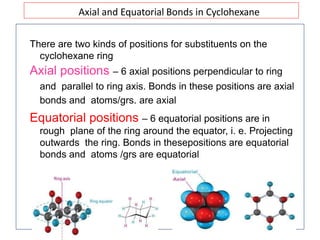
Axial and Equatorial Bonds in Cyclohexane
There are two kinds of positions for substituents on the
cyclohexane ring
Axial positions – 6 axial positions perpendicular to ring
and parallel to ring axis. Bonds in these positions are axial
bonds and atoms/grs. are axial
Equatorial positions – 6 equatorial positions are in
rough plane of the ring around the equator, i. e. Projecting
outwards the ring. Bonds in thesepositions are equatorial
bonds and atoms /grs are equatorial
Axial and Equatorial Bonds in
Cyclohexane
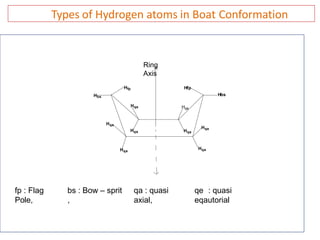
Types of Hydrogen atoms in Boat Conformation
Ring
Axis
fp : Flag
Pole,
bs : Bow – sprit
,
qa : quasi
axial,
qe : quasi
eqautorial
Hfp Hfp
Hbs Hbs
Hqe Hqe
Hqe
Hqe
Hqa Hqa
Hqa
Hqa
45
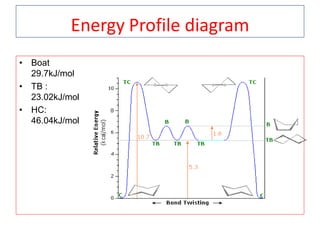
Energy Profile diagram
• Boat
29.7kJ/mol
• TB :
23.02kJ/mol
• HC:
46.04kJ/mol
47

Conformational isomers

  • 1.
    Conformational Isomerism 1 • Dr.Gurumeet C Wadhawa • Department of Chemistry • Karmaveer Bhaurao Patil ,College • Vashi, Navi Mumbai
  • 2.
    Representing Conformations • Sawhorserepresentations show molecules at an angle, showing a molecular model – C-C bonds are at an angle to the edge of the page and all C- H bonds are shown • Newman projections show how the C-C bond would project end-on onto the paper – Bonds to front carbon are lines going to the center – Bonds to rear carbon are lines going to the edge of the circle 2
  • 3.
  • 4.
  • 5.
    Ethane’s Conformations • Therebarrier to rotation between conformations is small (12 kJ/mol; 2.9 kcal/mol) The most stable conformation of ethane has all six C–H bonds away from each other (staggered) • The least stable conformation has all six C–H bonds as close as possible (eclipsed) in a Newman projection – energy due to torsional strain 5
  • 6.
  • 7.
    Conformations of Propane •Propane (C3H8) torsional barrier around the carbon– carbon bonds 14 kJ/mol • Eclipsed conformer of propane has two ethane-type H–H interactions and an interaction between C–H and C–C bond 7
  • 8.
  • 9.
    Conformations of Butane •anti conformation has two methyl groups 180° away from each other • Rotation around the C2–C3 gives eclipsed conformation • Staggered conformation with methyl groups 60° apart is gauche conformation 9
  • 10.
  • 11.
  • 12.
  • 13.
  • 14.
    Stability of Cycloalkanes:The Baeyer Strain Theory • Baeyer (1885): since (sp3) carbon prefers to have bond angles of approximately 109°, ring sizes other than five and six may be too strained to exist • Rings from 3 to 30 C’s do exist but are strained due to bond bending distortions and steric interactions 14
  • 15.
    The Nature ofRing Strain • Rings larger than 3 atoms are not flat (planar) • Cyclic molecules can assume nonplanar conformations to minimize angle strain and torsional strain by ring-puckering • Larger rings have many more possible conformations than smaller rings and are more difficult to analyze 15
  • 16.
  • 17.
    Types of Strain •Angle strain - expansion or compression of bond angles away from most stable • Torsional strain - eclipsing of bonds on neighboring atoms • Steric strain - repulsive interactions between nonbonded atoms in close proximity 17
  • 18.
  • 19.
  • 20.
    Cyclopropane: An OrbitalView • 3-membered ring must have planar structure • Symmetrical with C–C–C bond angles of 60° • Requires that sp3 based bonds are bent (and weakened) • All C-H bonds are eclipsed 20
  • 21.
    Conformations of Cyclobutaneand Cyclopentane • Cyclobutane has less angle strain than cyclopropane but more torsional strain because of its larger number of ring hydrogens • Cyclobutane is slightly bent out of plane - one carbon atom is about 25° above – The bend increases angle strain but decreases torsional strain 21
  • 22.
    Cyclopentane • Planar cyclopentanewould have no angle strain but very high torsional strain • Actual conformations of cyclopentane are nonplanar, reducing torsional strain • Four carbon atoms are in a plane – The fifth carbon atom is above or below the plane – looks like an envelope 22
  • 23.
  • 24.
    Conformations of Cyclohexane •Substituted cyclohexanes occur widely in nature • The cyclohexane ring is free of angle strain and torsional strain • The conformation is has alternating atoms in a common plane and tetrahedral angles between all carbons • This is called a chair conformation 24
  • 25.
  • 26.
    How to DrawCyclohexane 26
  • 27.
    Axial and EquatorialBonds in Cyclohexane • The chair conformation has two kinds of positions for substituents on the ring: axial positions and equatorial positions • Chair cyclohexane has six axial hydrogens perpendicular to the ring (parallel to the ring axis) and six equatorial hydrogens near the plane of the ring 27
  • 28.
  • 29.
    Axial and EquatorialPositions • Each carbon atom in cyclohexane has one axial and one equatorial hydrogen • Each face of the ring has three axial and three equatorial hydrogens in an alternating arrangement 29
  • 30.
    Drawing the Axialand Equatorial Hydrogens 30
  • 31.
  • 32.
    Conformations of Cyclohexane •Chair Conformation • Boat Conformation • Twisted Boat Conformation • Half Chair Conformation 32
  • 33.
    Chair Conformation ofCyclohexane • Chair conformations readily interconvert, resulting in the exchange of axial and equatorial positions by a ring-flip 33
  • 34.
    Boat Cyclohexane • Cyclohexaneflips through a boat conformation • Less stable than chair cyclohexane due to steric and torsional strain • C-2, 3, 5, 6 are in a plane • H on C-1 and C-4 approach each other closely enough to produce considerable steric strain • Four eclipsed H-pairs on C- 2, 3, 5, 6 produce torsional strain • ~29 kJ/mol (7.0 kcal/mol) less stable than chair 34
  • 35.
  • 36.
    Boat & Twist-boatconformations: 36
  • 37.
  • 38.
  • 39.
    Conformations of Cyclohexane *Sachse’s suggestion(1890) : CH exists in Folded form. All nuclear carbons do not lie in one plane. 1. Chair Conformation 2. Boat Conformation 3. Twist Conformation or Skew Boat Conformation 4. Half Chair Conformation
  • 40.
    Chair Conformation • Shape: Like a Chair • No. of Carbon atoms • All Carbon atoms : 06 : sp3 hybridised • Bond angle between any two bonds : 1090 28’ • No. of Hydrogen atoms : 12 • Two sets of Hydrogen atoms : 06 + 06 a)Axial hydrogen atoms b) Equatorial hydrogen atoms
  • 41.
  • 42.
    Axial and EquatorialBonds in Cyclohexane There are two kinds of positions for substituents on the cyclohexane ring Axial positions – 6 axial positions perpendicular to ring and parallel to ring axis. Bonds in these positions are axial bonds and atoms/grs. are axial Equatorial positions – 6 equatorial positions are in rough plane of the ring around the equator, i. e. Projecting outwards the ring. Bonds in thesepositions are equatorial bonds and atoms /grs are equatorial
  • 43.
    Axial and EquatorialBonds in Cyclohexane
  • 44.
    Types of Hydrogenatoms in Boat Conformation Ring Axis fp : Flag Pole, bs : Bow – sprit , qa : quasi axial, qe : quasi eqautorial Hfp Hfp Hbs Hbs Hqe Hqe Hqe Hqe Hqa Hqa Hqa Hqa
  • 45.
  • 46.
    Energy Profile diagram •Boat 29.7kJ/mol • TB : 23.02kJ/mol • HC: 46.04kJ/mol
  • 47.