Carbon and It’s Compounds
by
Pruthviraj K
Faculty in chemistry
Introduction
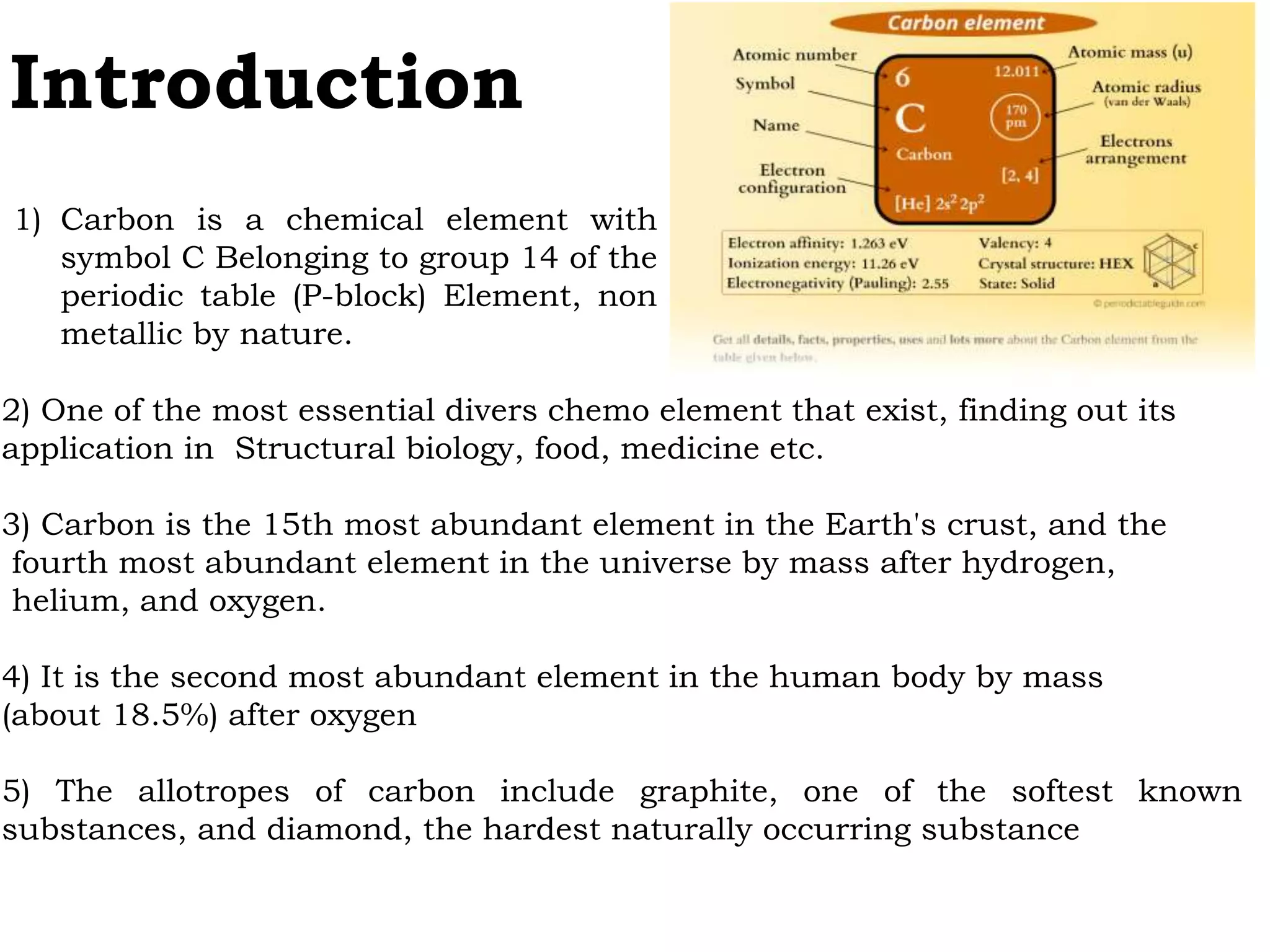
1) Carbon is a chemical element with
symbol C Belonging to group 14 of the
periodic table (P-block) Element, non
metallic by nature.
2) One of the most essential divers chemo element that exist, finding out its
application in Structural biology, food, medicine etc.
3) Carbon is the 15th most abundant element in the Earth's crust, and the
fourth most abundant element in the universe by mass after hydrogen,
helium, and oxygen.
4) It is the second most abundant element in the human body by mass
(about 18.5%) after oxygen
5) The allotropes of carbon include graphite, one of the softest known
substances, and diamond, the hardest naturally occurring substance
Bonding in Carbon- The Covalent Bond
 Carbon compounds posses low boiling and
melting point (Gradual or no sharp).
 These compounds does not conduct
electricity neither in molten nor in solution
state.
 Comparing above two properties with that
of Ionic compounds possessing exactly
opposite characters indicates, the weak
force of attraction b/w atoms or molecules
and this kind of bonding doesn’t leads to
ion formation.
Compound MP in K BP in K
Acetic Acid
CH3COOH
290 391
Chloroform CHCl3 209 334
Ethyl Alcohol
C2H5OH
156 351
Acetone CH3COCH3 178 329
 As we Write down electronic configuration
of Carbon i.e
6C = 1s2 2s2 2p2 or [He] 2s2 2p2
 We could see carbon is left out with 4 more
electrons to attain nearest noble gas
configuration of Neon, and as we know by
virtue every element tries to obtain noble
gas configuration to attain stability either
by gaining or losing of electrons
(Individually or by support)
 Carbon could form C4- anion but for a atom or nucleus with 6 electrons to
hold 4 more electrons is highly difficult and in the same way to form C4+
cation the successive ionization energies are drastically high and won’t
allow the formation.
 So in order to overcome these conditions and to attain stability carbon
will share its valance electrons with other elements , and both the
elements on bonding attains nearest noble gas configuration
 This sharing will continue until the valancy get satisfied either by the
same atoms or other involved in reaction
 Such bonds which are formed by the sharing of an electron pair between
two atoms are known as covalent bonds.
 Covalently bonded molecules are seen to have strong bonds within the
molecule, but intermolecular forces are weak.
 This gives rise to the low melting and boiling points of these compounds.
Since the electrons are shared between atoms and no charged particles
are formed, such covalent compounds are generally poor conductors of
electricity
Versatility of Carbon
As we know there are millions of compound that
exist in this universe are made up of carbon,
which is beyond for any other elements, there are
two factors which are responsible for carbon
to form this N number of compounds are,
1) Catenation 2) Tetra valance of carbon
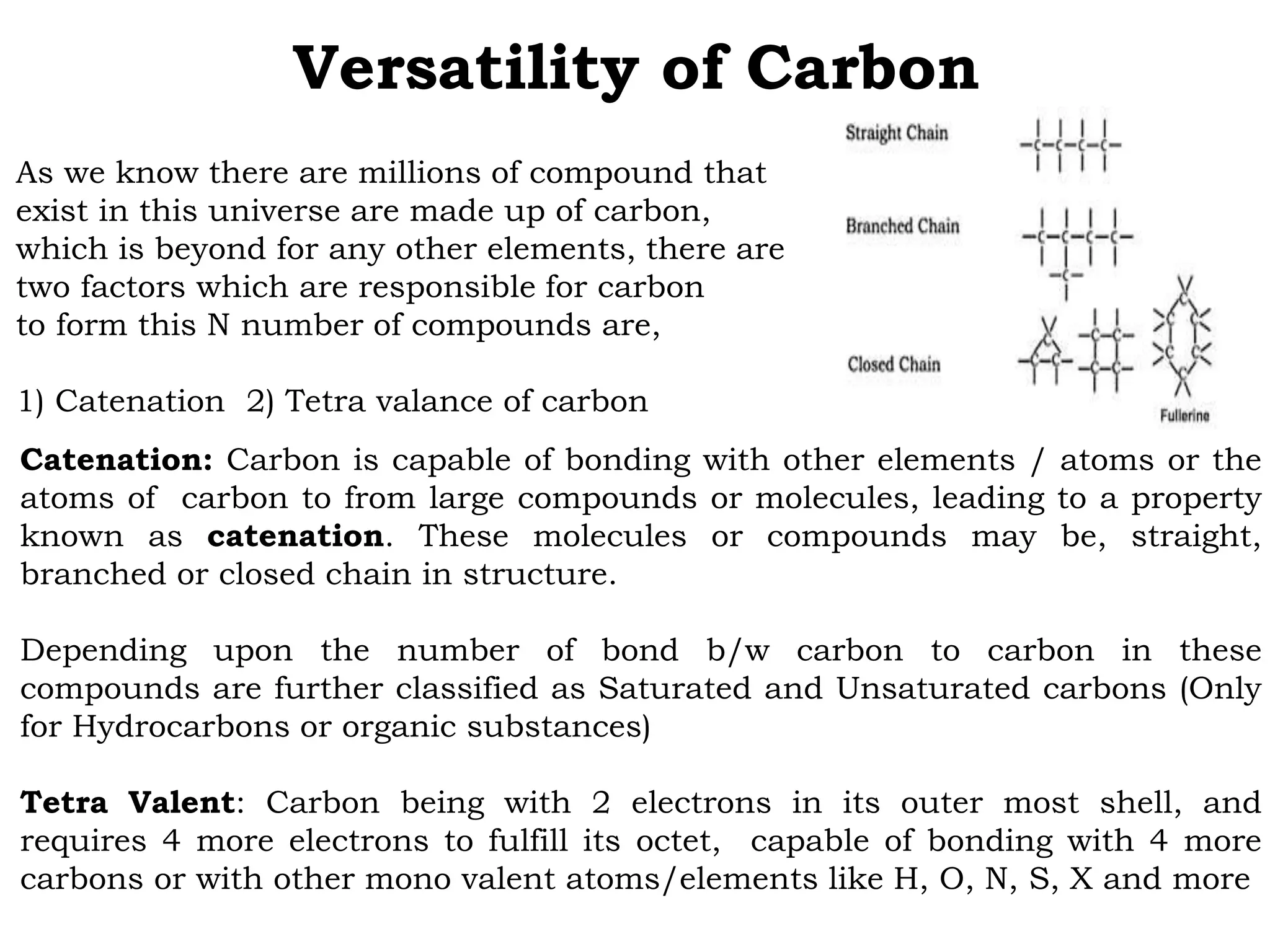
Catenation: Carbon is capable of bonding with other elements / atoms or the
atoms of carbon to from large compounds or molecules, leading to a property
known as catenation. These molecules or compounds may be, straight,
branched or closed chain in structure.
Depending upon the number of bond b/w carbon to carbon in these
compounds are further classified as Saturated and Unsaturated carbons (Only
for Hydrocarbons or organic substances)
Tetra Valent: Carbon being with 2 electrons in its outer most shell, and
requires 4 more electrons to fulfill its octet, capable of bonding with 4 more
carbons or with other mono valent atoms/elements like H, O, N, S, X and more
Saturated and Unsaturated Carbon Compounds
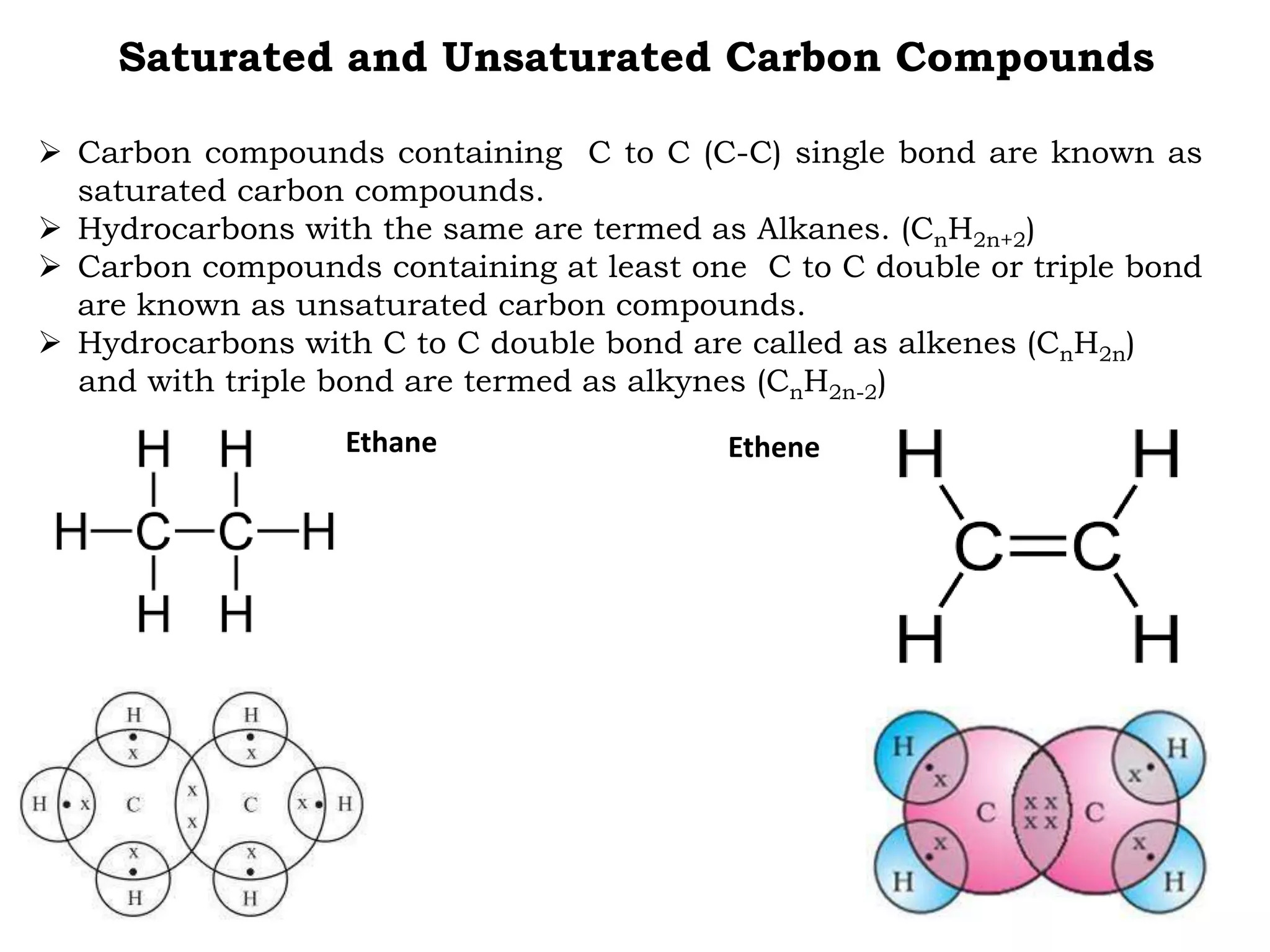
 Carbon compounds containing C to C (C-C) single bond are known as
saturated carbon compounds.
 Hydrocarbons with the same are termed as Alkanes. (CnH2n+2)
 Carbon compounds containing at least one C to C double or triple bond
are known as unsaturated carbon compounds.
 Hydrocarbons with C to C double bond are called as alkenes (CnH2n)
and with triple bond are termed as alkynes (CnH2n-2)
Ethane Ethene
Formula and structure of saturated hydrocarbon
Formula and structure of unsaturated
hydrocarbon (Alkenes)
Will You Be My Friend? / Other functional groups
In hydrocarbons like ethane or propane replacing one of the hydrogen
attached to carbon by other atoms or chemical groups leads to origin of new
carbon compounds with different character
Nomenclature of Organic Compounds
Chemical Properties of Carbon compounds
Combustion Reactions
2
C
6
H
6
1
5
O
2
1
2
C
O
2
+
6
H
2
O
+
H
e
a
t
a
n
d
L
i
g
h
t
Addition Reactions
H2C CH2
Pd/RT
H2
H3C CH3
Substitution Reactions
N
H
2
N
a
N
O
2
/
H
C
l
C
u
B
r
B
r
Ethanol / Ethyl alcohol- C2H5OH
Ethanol is a simple alcohol with the chemical formula C2H6O. Ethanol is
a volatile, flammable colorless liquid with a characteristic wine-like odor
and pungent taste
H
3
C
C
H
2
O
H
2
N
a
M
e
t
a
l
C
o
n
c
,H
2
S
O
4
 H
3
C
H
2
C
O
N
a
H
2
C
C
H
2
Ethanoic acid/ Aceti acid CH3COOH
Ethanoic acid is commonly called acetic acid and belongs to a group of
acids called carboxylic acids.
C
H
3
C
O
O
H+C
2
H
5
O
H C
H
3
C
O
O
C
2
H
5
C
o
n
cH
2
S
O
4

A
c
e
tic
A
c
id
E
th
y
l
A
lc
o
h
o
l
E
th
y
lA
c
e
ta
te
Reference
1) Karnataka State board 10th Science Book Part-2 Pg No- 1- 22
2) Images are downloaded from Google on 27-07-2022 and reserved to respective owners

Carbon and It’s Compounds.pptx

  • 1.
    Carbon and It’sCompounds by Pruthviraj K Faculty in chemistry
  • 2.
    Introduction 1) Carbon isa chemical element with symbol C Belonging to group 14 of the periodic table (P-block) Element, non metallic by nature. 2) One of the most essential divers chemo element that exist, finding out its application in Structural biology, food, medicine etc. 3) Carbon is the 15th most abundant element in the Earth's crust, and the fourth most abundant element in the universe by mass after hydrogen, helium, and oxygen. 4) It is the second most abundant element in the human body by mass (about 18.5%) after oxygen 5) The allotropes of carbon include graphite, one of the softest known substances, and diamond, the hardest naturally occurring substance
  • 3.
    Bonding in Carbon-The Covalent Bond  Carbon compounds posses low boiling and melting point (Gradual or no sharp).  These compounds does not conduct electricity neither in molten nor in solution state.  Comparing above two properties with that of Ionic compounds possessing exactly opposite characters indicates, the weak force of attraction b/w atoms or molecules and this kind of bonding doesn’t leads to ion formation. Compound MP in K BP in K Acetic Acid CH3COOH 290 391 Chloroform CHCl3 209 334 Ethyl Alcohol C2H5OH 156 351 Acetone CH3COCH3 178 329
  • 4.
     As weWrite down electronic configuration of Carbon i.e 6C = 1s2 2s2 2p2 or [He] 2s2 2p2  We could see carbon is left out with 4 more electrons to attain nearest noble gas configuration of Neon, and as we know by virtue every element tries to obtain noble gas configuration to attain stability either by gaining or losing of electrons (Individually or by support)  Carbon could form C4- anion but for a atom or nucleus with 6 electrons to hold 4 more electrons is highly difficult and in the same way to form C4+ cation the successive ionization energies are drastically high and won’t allow the formation.  So in order to overcome these conditions and to attain stability carbon will share its valance electrons with other elements , and both the elements on bonding attains nearest noble gas configuration  This sharing will continue until the valancy get satisfied either by the same atoms or other involved in reaction
  • 5.
     Such bondswhich are formed by the sharing of an electron pair between two atoms are known as covalent bonds.  Covalently bonded molecules are seen to have strong bonds within the molecule, but intermolecular forces are weak.  This gives rise to the low melting and boiling points of these compounds. Since the electrons are shared between atoms and no charged particles are formed, such covalent compounds are generally poor conductors of electricity
  • 6.
    Versatility of Carbon Aswe know there are millions of compound that exist in this universe are made up of carbon, which is beyond for any other elements, there are two factors which are responsible for carbon to form this N number of compounds are, 1) Catenation 2) Tetra valance of carbon Catenation: Carbon is capable of bonding with other elements / atoms or the atoms of carbon to from large compounds or molecules, leading to a property known as catenation. These molecules or compounds may be, straight, branched or closed chain in structure. Depending upon the number of bond b/w carbon to carbon in these compounds are further classified as Saturated and Unsaturated carbons (Only for Hydrocarbons or organic substances) Tetra Valent: Carbon being with 2 electrons in its outer most shell, and requires 4 more electrons to fulfill its octet, capable of bonding with 4 more carbons or with other mono valent atoms/elements like H, O, N, S, X and more
  • 7.
    Saturated and UnsaturatedCarbon Compounds  Carbon compounds containing C to C (C-C) single bond are known as saturated carbon compounds.  Hydrocarbons with the same are termed as Alkanes. (CnH2n+2)  Carbon compounds containing at least one C to C double or triple bond are known as unsaturated carbon compounds.  Hydrocarbons with C to C double bond are called as alkenes (CnH2n) and with triple bond are termed as alkynes (CnH2n-2) Ethane Ethene
  • 8.
    Formula and structureof saturated hydrocarbon
  • 9.
    Formula and structureof unsaturated hydrocarbon (Alkenes)
  • 10.
    Will You BeMy Friend? / Other functional groups In hydrocarbons like ethane or propane replacing one of the hydrogen attached to carbon by other atoms or chemical groups leads to origin of new carbon compounds with different character
  • 11.
  • 13.
    Chemical Properties ofCarbon compounds Combustion Reactions 2 C 6 H 6 1 5 O 2 1 2 C O 2 + 6 H 2 O + H e a t a n d L i g h t Addition Reactions H2C CH2 Pd/RT H2 H3C CH3 Substitution Reactions N H 2 N a N O 2 / H C l C u B r B r
  • 14.
    Ethanol / Ethylalcohol- C2H5OH Ethanol is a simple alcohol with the chemical formula C2H6O. Ethanol is a volatile, flammable colorless liquid with a characteristic wine-like odor and pungent taste H 3 C C H 2 O H 2 N a M e t a l C o n c ,H 2 S O 4  H 3 C H 2 C O N a H 2 C C H 2 Ethanoic acid/ Aceti acid CH3COOH Ethanoic acid is commonly called acetic acid and belongs to a group of acids called carboxylic acids. C H 3 C O O H+C 2 H 5 O H C H 3 C O O C 2 H 5 C o n cH 2 S O 4  A c e tic A c id E th y l A lc o h o l E th y lA c e ta te
  • 15.
    Reference 1) Karnataka Stateboard 10th Science Book Part-2 Pg No- 1- 22 2) Images are downloaded from Google on 27-07-2022 and reserved to respective owners