4. Organic Compounds:
Cycloalkanes and their
Stereochemistry
2
4.1 Naming Cycloalkanes
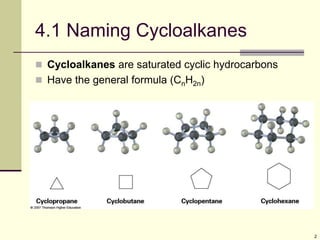
 Cycloalkanes are saturated cyclic hydrocarbons
 Have the general formula (CnH2n)
3
Naming Cycloalkanes
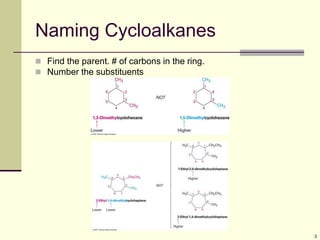
 Find the parent. # of carbons in the ring.
 Number the substituents
4
4.2 Cis-Trans Isomerism in
Cycloalkanes
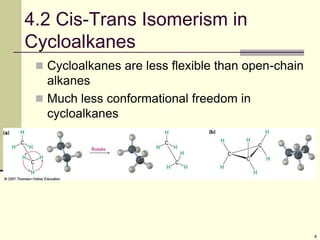
 Cycloalkanes are less flexible than open-chain
alkanes
 Much less conformational freedom in
cycloalkanes
5
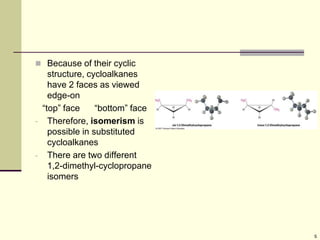
 Because of their cyclic
structure, cycloalkanes
have 2 faces as viewed
edge-on
“top” face “bottom” face
- Therefore, isomerism is
possible in substituted
cycloalkanes
- There are two different
1,2-dimethyl-cyclopropane
isomers
6
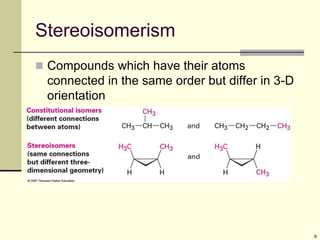
Stereoisomerism
 Compounds which have their atoms
connected in the same order but differ in 3-D
orientation
7
4.3 Stability of Cycloalkanes:
Ring Strain
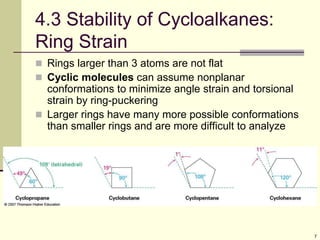
 Rings larger than 3 atoms are not flat
 Cyclic molecules can assume nonplanar
conformations to minimize angle strain and torsional
strain by ring-puckering
 Larger rings have many more possible conformations
than smaller rings and are more difficult to analyze
8
Stability of Cycloalkanes: The
Baeyer Strain Theory
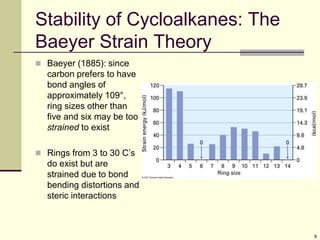
 Baeyer (1885): since
carbon prefers to have
bond angles of
approximately 109°,
ring sizes other than
five and six may be too
strained to exist
 Rings from 3 to 30 C’s
do exist but are
strained due to bond
bending distortions and
steric interactions
9
Summary: Types of Strain
 Angle strain - expansion or compression of bond
angles away from most stable
 Torsional strain - eclipsing of bonds on neighboring
atoms
 Steric strain - repulsive interactions between
nonbonded atoms in close proximity
10
4.4 Conformations of Cycloalkanes
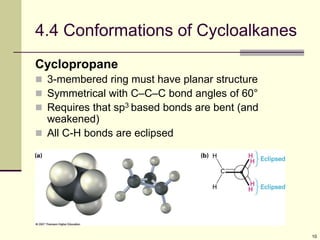
Cyclopropane
 3-membered ring must have planar structure
 Symmetrical with C–C–C bond angles of 60°
 Requires that sp3 based bonds are bent (and
weakened)
 All C-H bonds are eclipsed
11
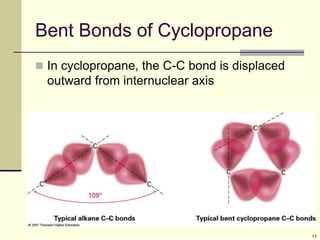
Bent Bonds of Cyclopropane
 In cyclopropane, the C-C bond is displaced
outward from internuclear axis
12
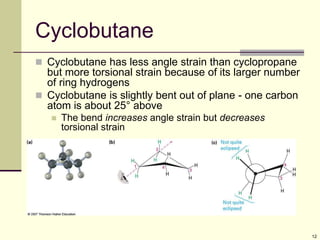
Cyclobutane
 Cyclobutane has less angle strain than cyclopropane
but more torsional strain because of its larger number
of ring hydrogens
 Cyclobutane is slightly bent out of plane - one carbon
atom is about 25° above
 The bend increases angle strain but decreases
torsional strain
13
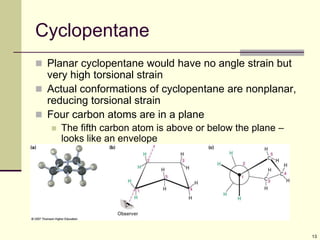
Cyclopentane
 Planar cyclopentane would have no angle strain but
very high torsional strain
 Actual conformations of cyclopentane are nonplanar,
reducing torsional strain
 Four carbon atoms are in a plane
 The fifth carbon atom is above or below the plane –
looks like an envelope
14
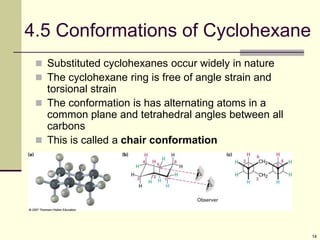
4.5 Conformations of Cyclohexane
 Substituted cyclohexanes occur widely in nature
 The cyclohexane ring is free of angle strain and
torsional strain
 The conformation is has alternating atoms in a
common plane and tetrahedral angles between all
carbons
 This is called a chair conformation
15
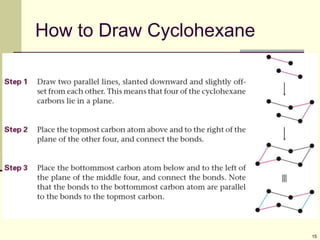
How to Draw Cyclohexane
16
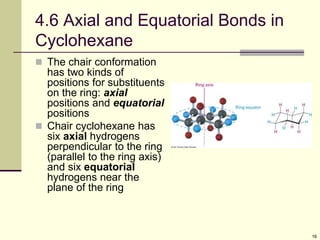
4.6 Axial and Equatorial Bonds in
Cyclohexane
 The chair conformation
has two kinds of
positions for substituents
on the ring: axial
positions and equatorial
positions
 Chair cyclohexane has
six axial hydrogens
perpendicular to the ring
(parallel to the ring axis)
and six equatorial
hydrogens near the
plane of the ring
17
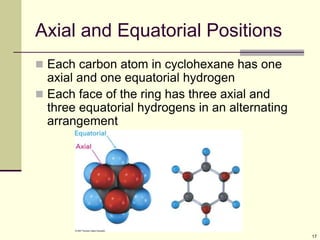
Axial and Equatorial Positions
 Each carbon atom in cyclohexane has one
axial and one equatorial hydrogen
 Each face of the ring has three axial and
three equatorial hydrogens in an alternating
arrangement
18
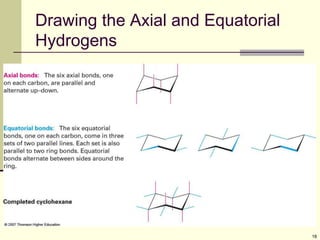
Drawing the Axial and Equatorial
Hydrogens
19
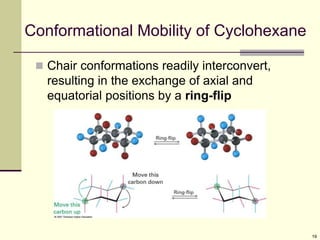
Conformational Mobility of Cyclohexane
 Chair conformations readily interconvert,
resulting in the exchange of axial and
equatorial positions by a ring-flip
20
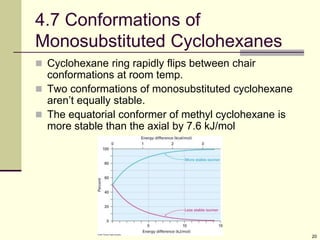
4.7 Conformations of
Monosubstituted Cyclohexanes
 Cyclohexane ring rapidly flips between chair
conformations at room temp.
 Two conformations of monosubstituted cyclohexane
aren’t equally stable.
 The equatorial conformer of methyl cyclohexane is
more stable than the axial by 7.6 kJ/mol
21
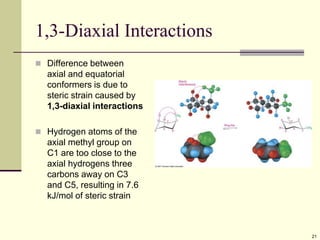
1,3-Diaxial Interactions
 Difference between
axial and equatorial
conformers is due to
steric strain caused by
1,3-diaxial interactions
 Hydrogen atoms of the
axial methyl group on
C1 are too close to the
axial hydrogens three
carbons away on C3
and C5, resulting in 7.6
kJ/mol of steric strain
22
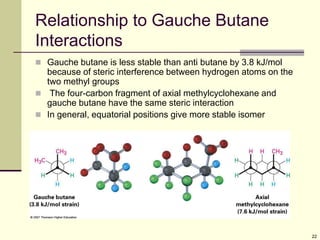
Relationship to Gauche Butane
Interactions
 Gauche butane is less stable than anti butane by 3.8 kJ/mol
because of steric interference between hydrogen atoms on the
two methyl groups
 The four-carbon fragment of axial methylcyclohexane and
gauche butane have the same steric interaction
 In general, equatorial positions give more stable isomer
23
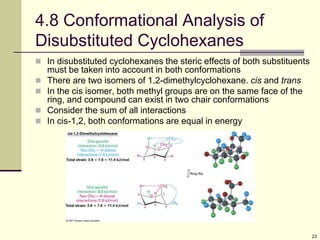
4.8 Conformational Analysis of
Disubstituted Cyclohexanes
 In disubstituted cyclohexanes the steric effects of both substituents
must be taken into account in both conformations
 There are two isomers of 1,2-dimethylcyclohexane. cis and trans
 In the cis isomer, both methyl groups are on the same face of the
ring, and compound can exist in two chair conformations
 Consider the sum of all interactions
 In cis-1,2, both conformations are equal in energy
24
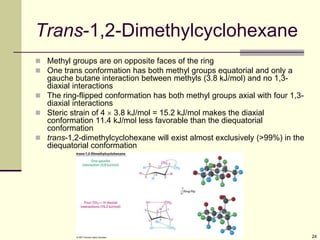
Trans-1,2-Dimethylcyclohexane
 Methyl groups are on opposite faces of the ring
 One trans conformation has both methyl groups equatorial and only a
gauche butane interaction between methyls (3.8 kJ/mol) and no 1,3-
diaxial interactions
 The ring-flipped conformation has both methyl groups axial with four 1,3-
diaxial interactions
 Steric strain of 4  3.8 kJ/mol = 15.2 kJ/mol makes the diaxial
conformation 11.4 kJ/mol less favorable than the diequatorial
conformation
 trans-1,2-dimethylcyclohexane will exist almost exclusively (>99%) in the
diequatorial conformation

Stereochemistry 12 ug

  • 1.
    4. Organic Compounds: Cycloalkanesand their Stereochemistry
  • 2.
    2 4.1 Naming Cycloalkanes Cycloalkanes are saturated cyclic hydrocarbons  Have the general formula (CnH2n)
  • 3.
    3 Naming Cycloalkanes  Findthe parent. # of carbons in the ring.  Number the substituents
  • 4.
    4 4.2 Cis-Trans Isomerismin Cycloalkanes  Cycloalkanes are less flexible than open-chain alkanes  Much less conformational freedom in cycloalkanes
  • 5.
    5  Because oftheir cyclic structure, cycloalkanes have 2 faces as viewed edge-on “top” face “bottom” face - Therefore, isomerism is possible in substituted cycloalkanes - There are two different 1,2-dimethyl-cyclopropane isomers
  • 6.
    6 Stereoisomerism  Compounds whichhave their atoms connected in the same order but differ in 3-D orientation
  • 7.
    7 4.3 Stability ofCycloalkanes: Ring Strain  Rings larger than 3 atoms are not flat  Cyclic molecules can assume nonplanar conformations to minimize angle strain and torsional strain by ring-puckering  Larger rings have many more possible conformations than smaller rings and are more difficult to analyze
  • 8.
    8 Stability of Cycloalkanes:The Baeyer Strain Theory  Baeyer (1885): since carbon prefers to have bond angles of approximately 109°, ring sizes other than five and six may be too strained to exist  Rings from 3 to 30 C’s do exist but are strained due to bond bending distortions and steric interactions
  • 9.
    9 Summary: Types ofStrain  Angle strain - expansion or compression of bond angles away from most stable  Torsional strain - eclipsing of bonds on neighboring atoms  Steric strain - repulsive interactions between nonbonded atoms in close proximity
  • 10.
    10 4.4 Conformations ofCycloalkanes Cyclopropane  3-membered ring must have planar structure  Symmetrical with C–C–C bond angles of 60°  Requires that sp3 based bonds are bent (and weakened)  All C-H bonds are eclipsed
  • 11.
    11 Bent Bonds ofCyclopropane  In cyclopropane, the C-C bond is displaced outward from internuclear axis
  • 12.
    12 Cyclobutane  Cyclobutane hasless angle strain than cyclopropane but more torsional strain because of its larger number of ring hydrogens  Cyclobutane is slightly bent out of plane - one carbon atom is about 25° above  The bend increases angle strain but decreases torsional strain
  • 13.
    13 Cyclopentane  Planar cyclopentanewould have no angle strain but very high torsional strain  Actual conformations of cyclopentane are nonplanar, reducing torsional strain  Four carbon atoms are in a plane  The fifth carbon atom is above or below the plane – looks like an envelope
  • 14.
    14 4.5 Conformations ofCyclohexane  Substituted cyclohexanes occur widely in nature  The cyclohexane ring is free of angle strain and torsional strain  The conformation is has alternating atoms in a common plane and tetrahedral angles between all carbons  This is called a chair conformation
  • 15.
    15 How to DrawCyclohexane
  • 16.
    16 4.6 Axial andEquatorial Bonds in Cyclohexane  The chair conformation has two kinds of positions for substituents on the ring: axial positions and equatorial positions  Chair cyclohexane has six axial hydrogens perpendicular to the ring (parallel to the ring axis) and six equatorial hydrogens near the plane of the ring
  • 17.
    17 Axial and EquatorialPositions  Each carbon atom in cyclohexane has one axial and one equatorial hydrogen  Each face of the ring has three axial and three equatorial hydrogens in an alternating arrangement
  • 18.
    18 Drawing the Axialand Equatorial Hydrogens
  • 19.
    19 Conformational Mobility ofCyclohexane  Chair conformations readily interconvert, resulting in the exchange of axial and equatorial positions by a ring-flip
  • 20.
    20 4.7 Conformations of MonosubstitutedCyclohexanes  Cyclohexane ring rapidly flips between chair conformations at room temp.  Two conformations of monosubstituted cyclohexane aren’t equally stable.  The equatorial conformer of methyl cyclohexane is more stable than the axial by 7.6 kJ/mol
  • 21.
    21 1,3-Diaxial Interactions  Differencebetween axial and equatorial conformers is due to steric strain caused by 1,3-diaxial interactions  Hydrogen atoms of the axial methyl group on C1 are too close to the axial hydrogens three carbons away on C3 and C5, resulting in 7.6 kJ/mol of steric strain
  • 22.
    22 Relationship to GaucheButane Interactions  Gauche butane is less stable than anti butane by 3.8 kJ/mol because of steric interference between hydrogen atoms on the two methyl groups  The four-carbon fragment of axial methylcyclohexane and gauche butane have the same steric interaction  In general, equatorial positions give more stable isomer
  • 23.
    23 4.8 Conformational Analysisof Disubstituted Cyclohexanes  In disubstituted cyclohexanes the steric effects of both substituents must be taken into account in both conformations  There are two isomers of 1,2-dimethylcyclohexane. cis and trans  In the cis isomer, both methyl groups are on the same face of the ring, and compound can exist in two chair conformations  Consider the sum of all interactions  In cis-1,2, both conformations are equal in energy
  • 24.
    24 Trans-1,2-Dimethylcyclohexane  Methyl groupsare on opposite faces of the ring  One trans conformation has both methyl groups equatorial and only a gauche butane interaction between methyls (3.8 kJ/mol) and no 1,3- diaxial interactions  The ring-flipped conformation has both methyl groups axial with four 1,3- diaxial interactions  Steric strain of 4  3.8 kJ/mol = 15.2 kJ/mol makes the diaxial conformation 11.4 kJ/mol less favorable than the diequatorial conformation  trans-1,2-dimethylcyclohexane will exist almost exclusively (>99%) in the diequatorial conformation