ADVANCED ORGANIC CHEMISTRY
Presented by : Niket D.Bajare [M.pharm First year]
Guided by :Dr S. Pekamwar
School of Pharmcy ,Nanded.
Mechanism and Synthetic Application of Naming
reaction
• DIECKMANN REACTION
• OZONOLYSIS REACTION
DIECKMANN REACTION
-It is named after the german chemist Walter
Dieckmann (1869-1925)
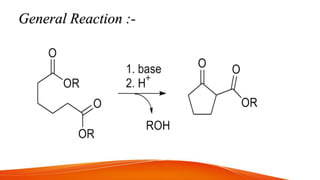
-certain diesters undergoes intramolecular condensation
in the presence of strong base to produce B-keto esters
this called as “Dieckmann condensation reaction”.
-its ring forming reaction.
General Reaction :-
Mechanism.......
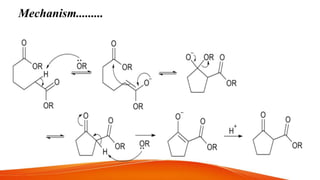
-Deprotonation of an ester at the alpha-position
generates an enolate ion which then undergoes a 5-
exo-trig nucleophilic attack to give a cyclic enol.
-protonation with a Bronsted-Lowry acid reforms
the Beta-keto ester.
Mechanism.........
synthetic application..........
• It is used in the synthesis of various
cyclopentane &cyclohexane derivative.
• it is used in preparation of cyclic
indole.(active against cancer)
OZONOLYSIS
what is ozonolysis ?
• OZONOLYSIS is an organic reaction where the unsaturated
bonds of alkenes,alkynes or azo compound are cleaved with
ozone .
• alkenes and alkynes form organic compound in which the
multiple carbon-carbon bond has been replaced by a carbonyl
group.while azo compound form nitrosamines.
• the out come of reaction depends on the type of multiple bond
being oxidised and work up condition.
ozonolysis of alkenes.............
• alkenes can oxidised with ozone to form
alcohol,aldehyde,or ketone or carboxylic acid.
• e.g- tetramethyl alkene which is undergoes
ozonolysis in methanol at -78dc. to form the prop-
2-one and small amount of acids.
reaction
Mechanism ....
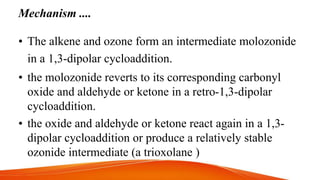
• The alkene and ozone form an intermediate molozonide
in a 1,3-dipolar cycloaddition.
• the molozonide reverts to its corresponding carbonyl
oxide and aldehyde or ketone in a retro-1,3-dipolar
cycloaddition.
• the oxide and aldehyde or ketone react again in a 1,3-
dipolar cycloaddition or produce a relatively stable
ozonide intermediate (a trioxolane )
Synthetic application....
• It is used for structure elucidation of unknown organic
compound containing carbon carbon double bond(c=c).
CH3 (CH2)7 CH CH (CH2)7 COOH CH3 (CH2)7 COOH
pelargonic acid
O31)
2) H2O2
Oleic acid
HOOC (CH2)7 COOH
Azelaric acid
+
References :-
• Organic chemistry Clayden, Greeves,Warren & Woihers .,
Oxford University.
• Wikipedia
organic reaction

organic reaction

  • 1.
    ADVANCED ORGANIC CHEMISTRY Presentedby : Niket D.Bajare [M.pharm First year] Guided by :Dr S. Pekamwar School of Pharmcy ,Nanded.
  • 2.
    Mechanism and SyntheticApplication of Naming reaction • DIECKMANN REACTION • OZONOLYSIS REACTION
  • 3.
    DIECKMANN REACTION -It isnamed after the german chemist Walter Dieckmann (1869-1925) -certain diesters undergoes intramolecular condensation in the presence of strong base to produce B-keto esters this called as “Dieckmann condensation reaction”. -its ring forming reaction.
  • 4.
  • 5.
    Mechanism....... -Deprotonation of anester at the alpha-position generates an enolate ion which then undergoes a 5- exo-trig nucleophilic attack to give a cyclic enol. -protonation with a Bronsted-Lowry acid reforms the Beta-keto ester.
  • 6.
  • 7.
    synthetic application.......... • Itis used in the synthesis of various cyclopentane &cyclohexane derivative. • it is used in preparation of cyclic indole.(active against cancer)
  • 8.
  • 9.
    what is ozonolysis? • OZONOLYSIS is an organic reaction where the unsaturated bonds of alkenes,alkynes or azo compound are cleaved with ozone . • alkenes and alkynes form organic compound in which the multiple carbon-carbon bond has been replaced by a carbonyl group.while azo compound form nitrosamines. • the out come of reaction depends on the type of multiple bond being oxidised and work up condition.
  • 10.
    ozonolysis of alkenes............. •alkenes can oxidised with ozone to form alcohol,aldehyde,or ketone or carboxylic acid. • e.g- tetramethyl alkene which is undergoes ozonolysis in methanol at -78dc. to form the prop- 2-one and small amount of acids.
  • 11.
  • 12.
    Mechanism .... • Thealkene and ozone form an intermediate molozonide in a 1,3-dipolar cycloaddition. • the molozonide reverts to its corresponding carbonyl oxide and aldehyde or ketone in a retro-1,3-dipolar cycloaddition. • the oxide and aldehyde or ketone react again in a 1,3- dipolar cycloaddition or produce a relatively stable ozonide intermediate (a trioxolane )
  • 14.
    Synthetic application.... • Itis used for structure elucidation of unknown organic compound containing carbon carbon double bond(c=c). CH3 (CH2)7 CH CH (CH2)7 COOH CH3 (CH2)7 COOH pelargonic acid O31) 2) H2O2 Oleic acid HOOC (CH2)7 COOH Azelaric acid +
  • 15.
    References :- • Organicchemistry Clayden, Greeves,Warren & Woihers ., Oxford University. • Wikipedia

Editor's Notes

  • #13 monozolite - molecular ozonite