CONFORMATIONAL ISOMERISM IN
CYCLOHEXANE
BY: AMANDEEP KAUR
MSc. Chemistry Semester 1
Roll No. 17001
POINTS TO BE COVERED
 Introduction to the molecule(Cyclohexane).
 Structure of Cyclohexane
 Conformational isomerism in Cyclohexane
 Chair conformation
 Boat confirmation
 Half Chair conformation.
 Twisted Boat conformation.
 Cause of conformational isomerism in cyclohexane.
 Stability of cyclohexane conformers(Energy diagram)
 Effect of conformers on chemical reactivity
 PYQs and important links.
INTRODUCTION TO CYCLOHEXANE
 Cyclohexane is an organic compound
with the chemical formula C6 H12. It's a
colorless, flammable liquid with a
distinctive detergent-like odor,
reminiscent of cleaning products. It
belongs to the cycloalkanes family, also
known as naphthenes, which are
saturated hydrocarbons forming a ring
structure.
 Cyclohexane is an alicyclic hydrocarbon
and highly volatile in nature.
STRUCTURE OF CYCLOHEXANE
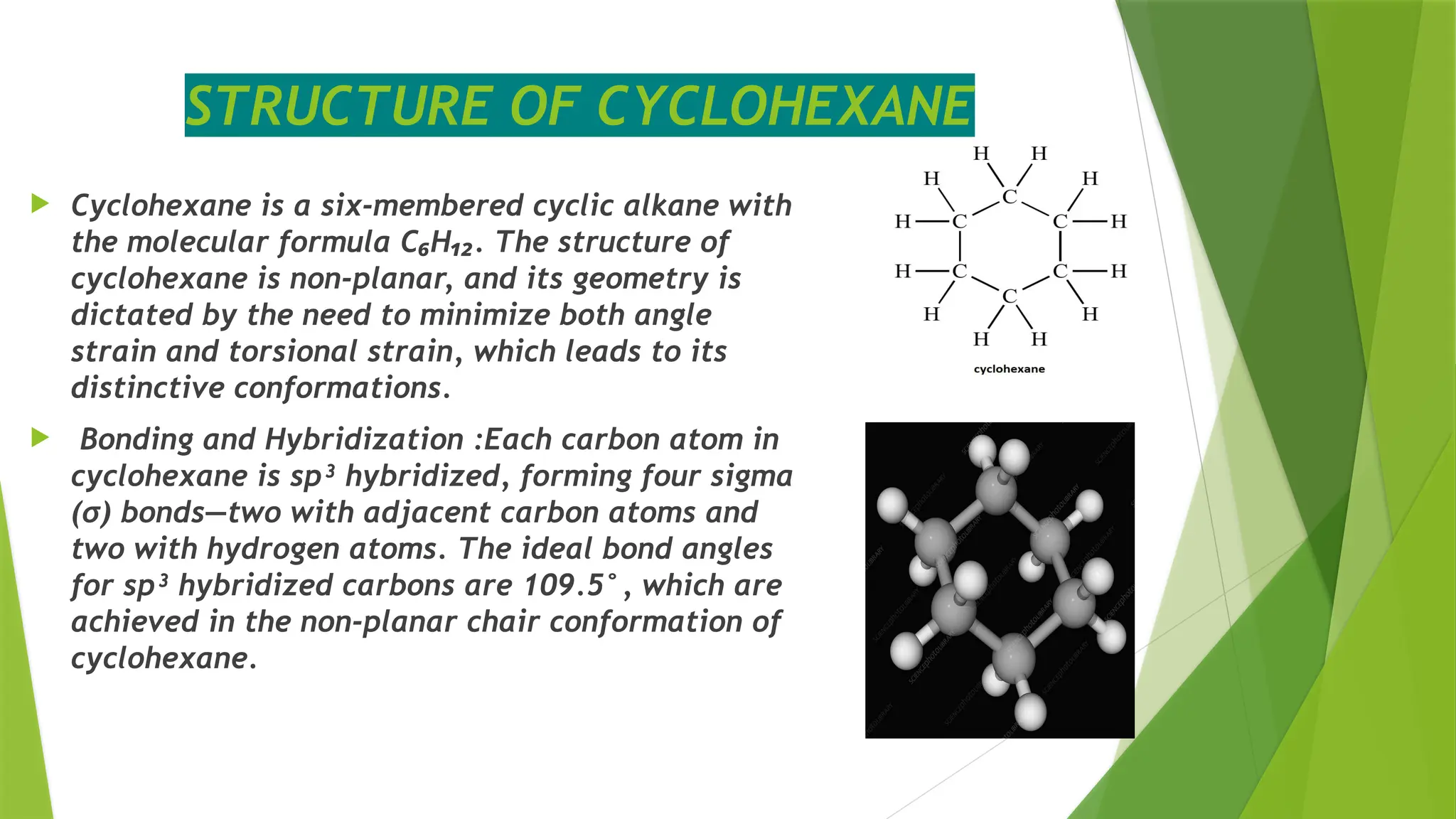
 Cyclohexane is a six-membered cyclic alkane with
the molecular formula C H . The structure of
₆ ₁₂
cyclohexane is non-planar, and its geometry is
dictated by the need to minimize both angle
strain and torsional strain, which leads to its
distinctive conformations.
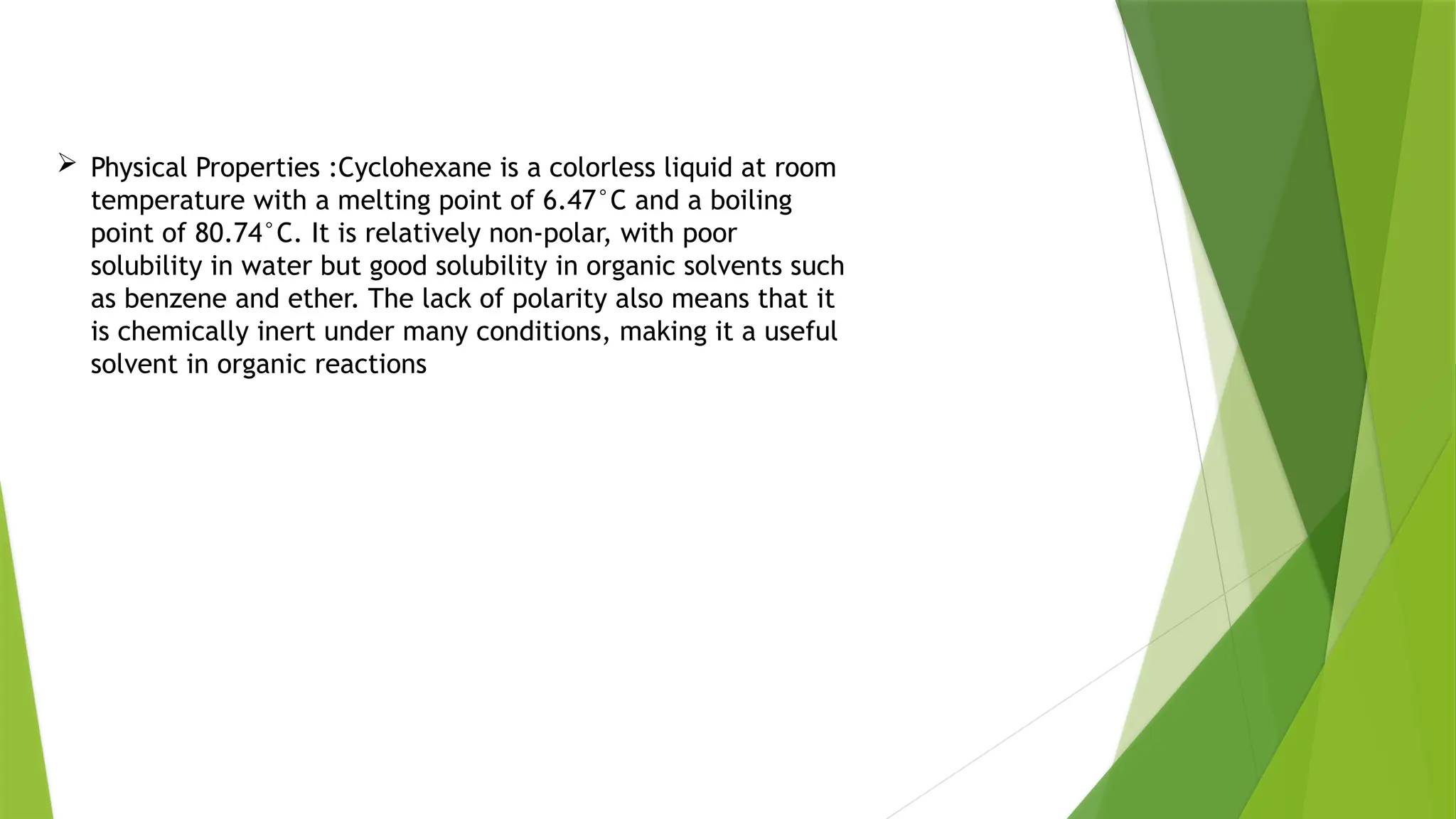
 Bonding and Hybridization :Each carbon atom in
cyclohexane is sp³ hybridized, forming four sigma
(σ) bonds—two with adjacent carbon atoms and
two with hydrogen atoms. The ideal bond angles
for sp³ hybridized carbons are 109.5°, which are
achieved in the non-planar chair conformation of
cyclohexane.
 Steric Interactions and Substituent Effects :When substituents are attached
to the cyclohexane ring, the preference for the chair conformation with
equatorial substituents becomes significant due to 1,3-diaxial interactions. In
the axial position, large substituents experience steric repulsion with the
axial hydrogens on the 1,3-positions (i.e., the carbon atoms separated by
two bonds).This steric hindrance is absent or minimized when the substituent
occupies the equatorial position, making the equatorial orientation
energetically more favorable for bulky groups. For example, in
methylcyclohexane, the chair conformation with the methyl group in the
equatorial position is more stable than the conformation with the methyl
group in the axial position due to the absence of 1,3-diaxial interactions.5.
 . Symmetry and Chirality in Cyclohexane :Cyclohexane is often used to
illustrate principles of symmetry and chirality in organic chemistry. The chair
conformation of cyclohexane is achiral and possesses D d symmetry when no
₃
substituents are present. However, when substituents are attached to the
ring, depending on their positions and the nature of the substituents, the
molecule may lose symmetry and become chiral (e.g., in the case of 1,2-
disubstituted cyclohexane derivatives with different substituents in axial and
equatorial positions).
 Physical Properties :Cyclohexane is a colorless liquid at room
temperature with a melting point of 6.47°C and a boiling
point of 80.74°C. It is relatively non-polar, with poor
solubility in water but good solubility in organic solvents such
as benzene and ether. The lack of polarity also means that it
is chemically inert under many conditions, making it a useful
solvent in organic reactions
CONFORMATIONAL ISOMERISM IN
CYCLOHEXANE
 Cyclohexane is a classic example in conformational analysis due to its ability to adopt
non-planar, strain-free conformations. This flexibility arises from the fact that
cyclohexane’s six-membered ring avoids angle strain (angles close to the ideal 109.5°
tetrahedral angle) and torsional strain (staggered interactions between adjacent bonds).
The two most important conformations of cyclohexane are the *chair* and the *boat*
forms, but other forms like the *twist-boat* and *half-chair* are also significant. Below is
an in-depth exploration of these conformations, their stability, and the related energy
profiles.
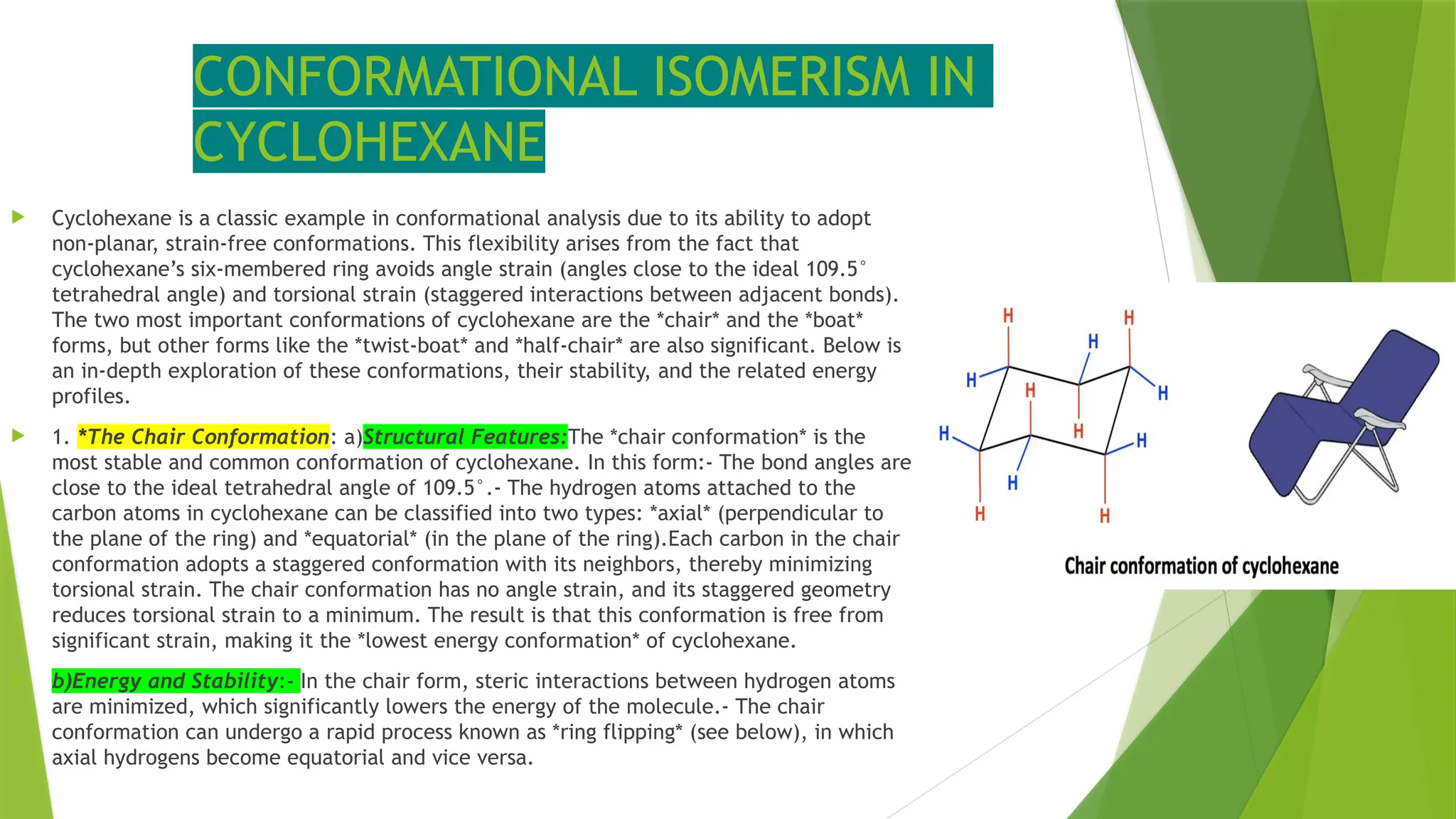
 1. *The Chair Conformation: a)Structural Features:The *chair conformation* is the
most stable and common conformation of cyclohexane. In this form:- The bond angles are
close to the ideal tetrahedral angle of 109.5°.- The hydrogen atoms attached to the
carbon atoms in cyclohexane can be classified into two types: *axial* (perpendicular to
the plane of the ring) and *equatorial* (in the plane of the ring).Each carbon in the chair
conformation adopts a staggered conformation with its neighbors, thereby minimizing
torsional strain. The chair conformation has no angle strain, and its staggered geometry
reduces torsional strain to a minimum. The result is that this conformation is free from
significant strain, making it the *lowest energy conformation* of cyclohexane.
 b)Energy and Stability:- In the chair form, steric interactions between hydrogen atoms
are minimized, which significantly lowers the energy of the molecule.- The chair
conformation can undergo a rapid process known as *ring flipping* (see below), in which
axial hydrogens become equatorial and vice versa.
Boat Conformation:-
 Structural Features:The *boat conformation* is less stable than the chair
conformation and is higher in energy. In this conformation:- Four carbon atoms lie
in a plane, while the other two carbons (at positions 1 and 4) are bent out of the
plane, forming a boat-like structure.- This conformation introduces *torsional
strain* due to eclipsed hydrogens on adjacent carbons.- The two hydrogens at the
bow and stern of the boat are in close proximity, leading to *steric strain* known
as the *flagpole interaction*
 Energy and Stability:- The boat conformation is about *7 kcal/mol higher in
energy* than the chair conformation due to the flagpole interaction and torsional
strain.- Despite this higher energy, the boat form is important as an intermediate
in the ring-flipping process.
3. *Twist-Boat Conformation*
 Structural Features: The *twist-boat* is a slightly distorted version of the boat
conformation and is lower in energy than the boat. In this form:- The two carbons
that were previously aligned in the boat are twisted out of alignment, reducing
the flagpole interaction.- The twist-boat conformation still contains some
torsional strain, but the steric strain is significantly reduced compared to the
boat.
 Energy and Stability:- The twist-boat conformation is about *5.5 kcal/mol higher*
in energy than the chair conformation but lower in energy than the pure boat.-
This conformation is important as an intermediate in the pathway between the
chair conformations during ring inversion.
4. Half-Chair Conformation:-
a) Structural Features:The *half-chair* conformation is a transition state that exists
during the ring-flipping process between chair forms. In this conformation:- One of
the carbon atoms is almost coplanar with four other carbons, while one carbon is
raised above the plane.- The half-chair is highly strained due to both torsional and
angle strain, as some bonds are eclipsed.
b) Energy and Stability:- The half-chair is the *highest-energy* conformation of
cyclohexane, with an energy approximately *10.8 kcal/mol higher* than the chair
form.- This form exists only fleetingly as a transition state in the chair-to-chair
interconversion.
*Conformational Energy Profile:
*The energy profile of cyclohexane’s conformations
during a *ring flip* can be represented as a series of
energy minima and maxima:- Starting in the *chair
conformation* (global minimum), the molecule passes
through the *half-chair* (highest energy point) as it
transforms into the *twist-boat*.- The energy then
slightly decreases as the molecule adopts the *boat
conformation*, but this is still higher in energy
compared to the chair.- Finally, after passing through
another *twist-boat* and *half-chair, the molecule flips
into the alternate **chair conformation* (another
global minimum).
*1,3-Diaxial Interactions in Monosubstituted
Cyclohexanes*
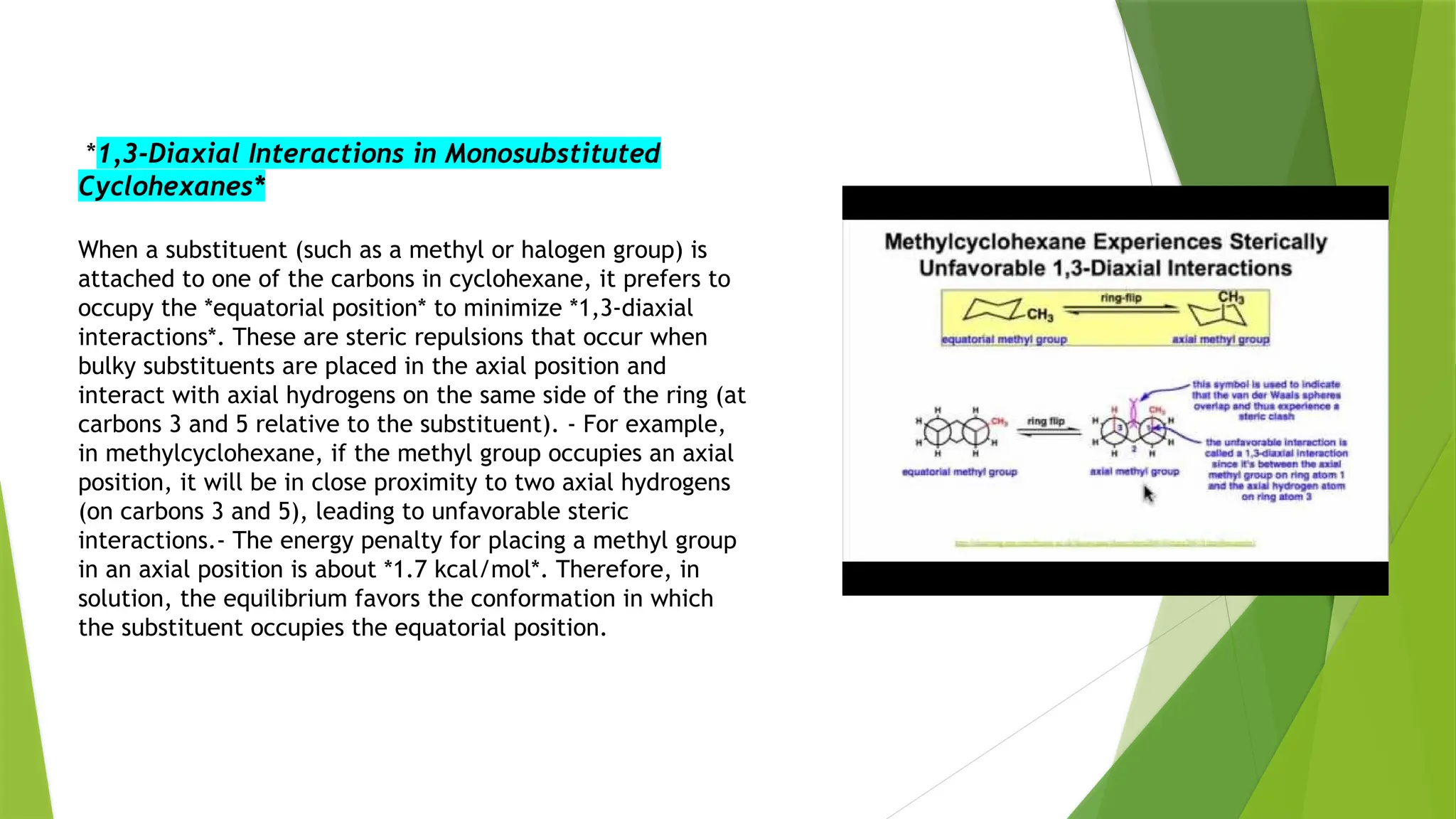
When a substituent (such as a methyl or halogen group) is
attached to one of the carbons in cyclohexane, it prefers to
occupy the *equatorial position* to minimize *1,3-diaxial
interactions*. These are steric repulsions that occur when
bulky substituents are placed in the axial position and
interact with axial hydrogens on the same side of the ring (at
carbons 3 and 5 relative to the substituent). - For example,
in methylcyclohexane, if the methyl group occupies an axial
position, it will be in close proximity to two axial hydrogens
(on carbons 3 and 5), leading to unfavorable steric
interactions.- The energy penalty for placing a methyl group
in an axial position is about *1.7 kcal/mol*. Therefore, in
solution, the equilibrium favors the conformation in which
the substituent occupies the equatorial position.
*Disubstituted Cyclohexanes: Cis vs. Trans*-
For *disubstituted cyclohexanes: the relative
stereochemistry (cis vs. trans) influences the stability of the
conformations.- In the *cis* configuration, both substituents
are on the same side of the ring. Depending on their size, one
or both may occupy axial or equatorial positions.- In the
*trans* configuration, the two groups are on opposite sides of
the ring, which can lead to a more stable conformation if
both groups can occupy equatorial positions, minimizing
steric interactions.
*Conformational Preferences of Cyclohexane
Derivatives:Different substituents exert different steric and
electronic effects, influencing their preference for equatorial
or axial positions. For example:- *Small groups* like fluorine
or hydroxyl may show less preference between axial and
equatorial positions.- *Bulky groups* like t-butyl strongly
prefer the equatorial position due to their large steric
demands.- *Polar groups* may also have electronic
preferences for particular positions due to dipole interactions
CAUSE OF CONFORMATIONAL ISOMERISM
IN CYCLOHEXANE
 Confirmation isomerism (or conformational isomerism) in *cyclohexane* arises from the
molecule's flexibility, allowing different spatial arrangements of its atoms without
breaking bonds. The cause of this type of isomerism is the ability of cyclohexane to
adopt different conformations as it seeks to minimize strain.The key causes of
conformational isomerism in cyclohexane are:
 1. *Angle Strain*: Cyclohexane in its planar form would have bond angles of 120°,
deviating from the ideal tetrahedral bond angle of 109.5° for sp³-hybridized carbon
atoms. To reduce this strain, cyclohexane adopts non-planar conformations.
 2.*Torsional Strain*: In a planar structure, adjacent bonds would experience torsional
strain due to eclipsing interactions. By adopting staggered conformations, cyclohexane
minimizes this strain.
 3.*Steric Interactions*: Different conformations of cyclohexane place substituents in
different positions relative to each other. This results in steric strain depending on the
proximity of atoms or groups.The most stable conformation of cyclohexane is the *chair
conformation, which minimizes both angle strain and torsional strain by allowing
staggered bonds and angles close to 109.5°.
SOME IMPORTANT POINTS
 Stability order of cyclohexane conformers :-
 CHAIR > TWISTED BOAT > BOAT > HALF CHAIR.
 Equitorial bonds are more stables than the axial bonds.
EQUITORIAL BONDS > AXIAL BONDS.
 The phenomenon when one chair isomer of cyclohexane gets converted to
the other is known as “ring flipping” or “chair flipping”.
 Ring flipping of chair isomers of cyclohexane is always in equilibrium.
 In disubstituted cyclohexane the stability depends upon the cis and trans
position of the substituted bulky group. Trans one is more stable.
 In monosubstitued cycloalkanes the stability is decided by the bond
position of methyl group . Whether it is axial or equatorial. Methyl group
substituted at equatorial position is more stable.
PYQs and IMPORTANT LINKS
SOME USEFUL LINKS FOR BETTER UNDERSTANDING OF THE TOPIC :
https://youtu.be/czaVKE1t_1o?si=YjbGDwVHOH42aAVZ
https://youtu.be/ijsEqdp-9lI?si=b94ubQmVfbDQ4TVW
https://youtu.be/4m0acZmBA-w?si=g5Wd71gtCtbc9pK4
Describe the effect of confirmation on reactivity of cyclohexane.
Discuss the conformational analysis and stereoisomerism in cyclohexane.
Discuss the conformational analysis of cyclohexane

conformational isomerism in cyclohexane CHEM 102.pptx

  • 1.
    CONFORMATIONAL ISOMERISM IN CYCLOHEXANE BY:AMANDEEP KAUR MSc. Chemistry Semester 1 Roll No. 17001
  • 2.
    POINTS TO BECOVERED  Introduction to the molecule(Cyclohexane).  Structure of Cyclohexane  Conformational isomerism in Cyclohexane  Chair conformation  Boat confirmation  Half Chair conformation.  Twisted Boat conformation.  Cause of conformational isomerism in cyclohexane.  Stability of cyclohexane conformers(Energy diagram)  Effect of conformers on chemical reactivity  PYQs and important links.
  • 3.
    INTRODUCTION TO CYCLOHEXANE Cyclohexane is an organic compound with the chemical formula C6 H12. It's a colorless, flammable liquid with a distinctive detergent-like odor, reminiscent of cleaning products. It belongs to the cycloalkanes family, also known as naphthenes, which are saturated hydrocarbons forming a ring structure.  Cyclohexane is an alicyclic hydrocarbon and highly volatile in nature.
  • 4.
    STRUCTURE OF CYCLOHEXANE Cyclohexane is a six-membered cyclic alkane with the molecular formula C H . The structure of ₆ ₁₂ cyclohexane is non-planar, and its geometry is dictated by the need to minimize both angle strain and torsional strain, which leads to its distinctive conformations.  Bonding and Hybridization :Each carbon atom in cyclohexane is sp³ hybridized, forming four sigma (σ) bonds—two with adjacent carbon atoms and two with hydrogen atoms. The ideal bond angles for sp³ hybridized carbons are 109.5°, which are achieved in the non-planar chair conformation of cyclohexane.
  • 5.
     Steric Interactionsand Substituent Effects :When substituents are attached to the cyclohexane ring, the preference for the chair conformation with equatorial substituents becomes significant due to 1,3-diaxial interactions. In the axial position, large substituents experience steric repulsion with the axial hydrogens on the 1,3-positions (i.e., the carbon atoms separated by two bonds).This steric hindrance is absent or minimized when the substituent occupies the equatorial position, making the equatorial orientation energetically more favorable for bulky groups. For example, in methylcyclohexane, the chair conformation with the methyl group in the equatorial position is more stable than the conformation with the methyl group in the axial position due to the absence of 1,3-diaxial interactions.5.  . Symmetry and Chirality in Cyclohexane :Cyclohexane is often used to illustrate principles of symmetry and chirality in organic chemistry. The chair conformation of cyclohexane is achiral and possesses D d symmetry when no ₃ substituents are present. However, when substituents are attached to the ring, depending on their positions and the nature of the substituents, the molecule may lose symmetry and become chiral (e.g., in the case of 1,2- disubstituted cyclohexane derivatives with different substituents in axial and equatorial positions).
  • 6.
     Physical Properties:Cyclohexane is a colorless liquid at room temperature with a melting point of 6.47°C and a boiling point of 80.74°C. It is relatively non-polar, with poor solubility in water but good solubility in organic solvents such as benzene and ether. The lack of polarity also means that it is chemically inert under many conditions, making it a useful solvent in organic reactions
  • 7.
    CONFORMATIONAL ISOMERISM IN CYCLOHEXANE Cyclohexane is a classic example in conformational analysis due to its ability to adopt non-planar, strain-free conformations. This flexibility arises from the fact that cyclohexane’s six-membered ring avoids angle strain (angles close to the ideal 109.5° tetrahedral angle) and torsional strain (staggered interactions between adjacent bonds). The two most important conformations of cyclohexane are the *chair* and the *boat* forms, but other forms like the *twist-boat* and *half-chair* are also significant. Below is an in-depth exploration of these conformations, their stability, and the related energy profiles.  1. *The Chair Conformation: a)Structural Features:The *chair conformation* is the most stable and common conformation of cyclohexane. In this form:- The bond angles are close to the ideal tetrahedral angle of 109.5°.- The hydrogen atoms attached to the carbon atoms in cyclohexane can be classified into two types: *axial* (perpendicular to the plane of the ring) and *equatorial* (in the plane of the ring).Each carbon in the chair conformation adopts a staggered conformation with its neighbors, thereby minimizing torsional strain. The chair conformation has no angle strain, and its staggered geometry reduces torsional strain to a minimum. The result is that this conformation is free from significant strain, making it the *lowest energy conformation* of cyclohexane.  b)Energy and Stability:- In the chair form, steric interactions between hydrogen atoms are minimized, which significantly lowers the energy of the molecule.- The chair conformation can undergo a rapid process known as *ring flipping* (see below), in which axial hydrogens become equatorial and vice versa.
  • 8.
    Boat Conformation:-  StructuralFeatures:The *boat conformation* is less stable than the chair conformation and is higher in energy. In this conformation:- Four carbon atoms lie in a plane, while the other two carbons (at positions 1 and 4) are bent out of the plane, forming a boat-like structure.- This conformation introduces *torsional strain* due to eclipsed hydrogens on adjacent carbons.- The two hydrogens at the bow and stern of the boat are in close proximity, leading to *steric strain* known as the *flagpole interaction*  Energy and Stability:- The boat conformation is about *7 kcal/mol higher in energy* than the chair conformation due to the flagpole interaction and torsional strain.- Despite this higher energy, the boat form is important as an intermediate in the ring-flipping process. 3. *Twist-Boat Conformation*  Structural Features: The *twist-boat* is a slightly distorted version of the boat conformation and is lower in energy than the boat. In this form:- The two carbons that were previously aligned in the boat are twisted out of alignment, reducing the flagpole interaction.- The twist-boat conformation still contains some torsional strain, but the steric strain is significantly reduced compared to the boat.  Energy and Stability:- The twist-boat conformation is about *5.5 kcal/mol higher* in energy than the chair conformation but lower in energy than the pure boat.- This conformation is important as an intermediate in the pathway between the chair conformations during ring inversion.
  • 9.
    4. Half-Chair Conformation:- a)Structural Features:The *half-chair* conformation is a transition state that exists during the ring-flipping process between chair forms. In this conformation:- One of the carbon atoms is almost coplanar with four other carbons, while one carbon is raised above the plane.- The half-chair is highly strained due to both torsional and angle strain, as some bonds are eclipsed. b) Energy and Stability:- The half-chair is the *highest-energy* conformation of cyclohexane, with an energy approximately *10.8 kcal/mol higher* than the chair form.- This form exists only fleetingly as a transition state in the chair-to-chair interconversion.
  • 10.
    *Conformational Energy Profile: *Theenergy profile of cyclohexane’s conformations during a *ring flip* can be represented as a series of energy minima and maxima:- Starting in the *chair conformation* (global minimum), the molecule passes through the *half-chair* (highest energy point) as it transforms into the *twist-boat*.- The energy then slightly decreases as the molecule adopts the *boat conformation*, but this is still higher in energy compared to the chair.- Finally, after passing through another *twist-boat* and *half-chair, the molecule flips into the alternate **chair conformation* (another global minimum).
  • 11.
    *1,3-Diaxial Interactions inMonosubstituted Cyclohexanes* When a substituent (such as a methyl or halogen group) is attached to one of the carbons in cyclohexane, it prefers to occupy the *equatorial position* to minimize *1,3-diaxial interactions*. These are steric repulsions that occur when bulky substituents are placed in the axial position and interact with axial hydrogens on the same side of the ring (at carbons 3 and 5 relative to the substituent). - For example, in methylcyclohexane, if the methyl group occupies an axial position, it will be in close proximity to two axial hydrogens (on carbons 3 and 5), leading to unfavorable steric interactions.- The energy penalty for placing a methyl group in an axial position is about *1.7 kcal/mol*. Therefore, in solution, the equilibrium favors the conformation in which the substituent occupies the equatorial position.
  • 12.
    *Disubstituted Cyclohexanes: Cisvs. Trans*- For *disubstituted cyclohexanes: the relative stereochemistry (cis vs. trans) influences the stability of the conformations.- In the *cis* configuration, both substituents are on the same side of the ring. Depending on their size, one or both may occupy axial or equatorial positions.- In the *trans* configuration, the two groups are on opposite sides of the ring, which can lead to a more stable conformation if both groups can occupy equatorial positions, minimizing steric interactions. *Conformational Preferences of Cyclohexane Derivatives:Different substituents exert different steric and electronic effects, influencing their preference for equatorial or axial positions. For example:- *Small groups* like fluorine or hydroxyl may show less preference between axial and equatorial positions.- *Bulky groups* like t-butyl strongly prefer the equatorial position due to their large steric demands.- *Polar groups* may also have electronic preferences for particular positions due to dipole interactions
  • 13.
    CAUSE OF CONFORMATIONALISOMERISM IN CYCLOHEXANE  Confirmation isomerism (or conformational isomerism) in *cyclohexane* arises from the molecule's flexibility, allowing different spatial arrangements of its atoms without breaking bonds. The cause of this type of isomerism is the ability of cyclohexane to adopt different conformations as it seeks to minimize strain.The key causes of conformational isomerism in cyclohexane are:  1. *Angle Strain*: Cyclohexane in its planar form would have bond angles of 120°, deviating from the ideal tetrahedral bond angle of 109.5° for sp³-hybridized carbon atoms. To reduce this strain, cyclohexane adopts non-planar conformations.  2.*Torsional Strain*: In a planar structure, adjacent bonds would experience torsional strain due to eclipsing interactions. By adopting staggered conformations, cyclohexane minimizes this strain.  3.*Steric Interactions*: Different conformations of cyclohexane place substituents in different positions relative to each other. This results in steric strain depending on the proximity of atoms or groups.The most stable conformation of cyclohexane is the *chair conformation, which minimizes both angle strain and torsional strain by allowing staggered bonds and angles close to 109.5°.
  • 14.
    SOME IMPORTANT POINTS Stability order of cyclohexane conformers :-  CHAIR > TWISTED BOAT > BOAT > HALF CHAIR.  Equitorial bonds are more stables than the axial bonds. EQUITORIAL BONDS > AXIAL BONDS.  The phenomenon when one chair isomer of cyclohexane gets converted to the other is known as “ring flipping” or “chair flipping”.  Ring flipping of chair isomers of cyclohexane is always in equilibrium.  In disubstituted cyclohexane the stability depends upon the cis and trans position of the substituted bulky group. Trans one is more stable.  In monosubstitued cycloalkanes the stability is decided by the bond position of methyl group . Whether it is axial or equatorial. Methyl group substituted at equatorial position is more stable.
  • 15.
    PYQs and IMPORTANTLINKS SOME USEFUL LINKS FOR BETTER UNDERSTANDING OF THE TOPIC : https://youtu.be/czaVKE1t_1o?si=YjbGDwVHOH42aAVZ https://youtu.be/ijsEqdp-9lI?si=b94ubQmVfbDQ4TVW https://youtu.be/4m0acZmBA-w?si=g5Wd71gtCtbc9pK4 Describe the effect of confirmation on reactivity of cyclohexane. Discuss the conformational analysis and stereoisomerism in cyclohexane. Discuss the conformational analysis of cyclohexane