Presented By
Shubham Sharma
M .Pharm (1sem)
(Pharmaceutical Chemistry)
Roll No-20029
Presented To
Dr. Ashok Kumar Yadav
UGC Assistant Professor
UIPS, Panjab University
CONTENTS
 CHEMICAL STRUCTURE AND SYNTHESIS
 INTRODUCTION
 PHYSICAL PROPERTIES
 APPLICATIONS WITH THEIR MECHANISM
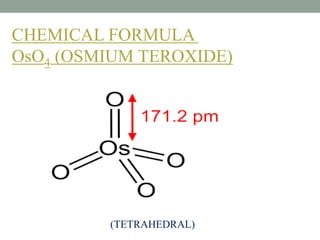
CHEMICAL FORMULA
OsO4 (OSMIUM TEROXIDE)
(TETRAHEDRAL)
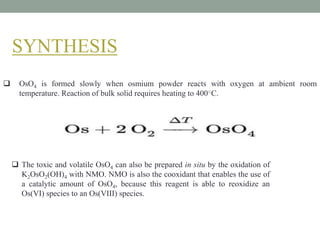
SYNTHESIS
 OsO4 is formed slowly when osmium powder reacts with oxygen at ambient room
temperature. Reaction of bulk solid requires heating to 400○C.
 The toxic and volatile OsO4 can also be prepared in situ by the oxidation of
K2OsO2(OH)4 with NMO. NMO is also the cooxidant that enables the use of
a catalytic amount of OsO4, because this reagent is able to reoxidize an
Os(VI) species to an Os(VIII) species.
INTRODUCTION
1. The compound is noteworthy for its many uses, despite its toxicity
and the rarity of osmium.
2. It also has a number of interesting properties, one being that the
solid is volatile.
3. The compound is colourless, but most samples appear yellow.
This is most likely due to the presence of the impurity OsO2,
which is yellow –brown in colour.
4. Osmium oxide(Ⅷ) forms monoclinic crystals. It has a
characteristic acrid chlorine –like odour. The element name
osmium is derived from osme, Greek for odour.
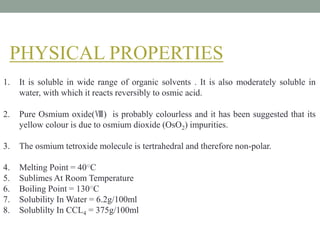
PHYSICAL PROPERTIES
1. It is soluble in wide range of organic solvents . It is also moderately soluble in
water, with which it reacts reversibly to osmic acid.
2. Pure Osmium oxide(Ⅷ) is probably colourless and it has been suggested that its
yellow colour is due to osmium dioxide (OsO2) impurities.
3. The osmium tetroxide molecule is tertrahedral and therefore non-polar.
4. Melting Point = 40○C
5. Sublimes At Room Temperature
6. Boiling Point = 130○C
7. Solubility In Water = 6.2g/100ml
8. Solublilty In CCL4 = 375g/100ml
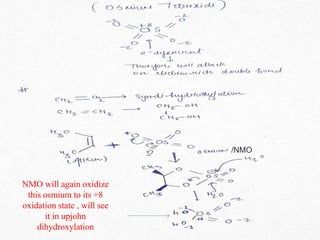
/NMO
NMO will again oxidize
this osmium to its +8
oxidation state , will see
it in upjohn
dihydroxylation
APPLICATIONS OF OSMIUM TETROXIDE
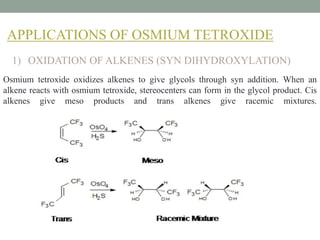
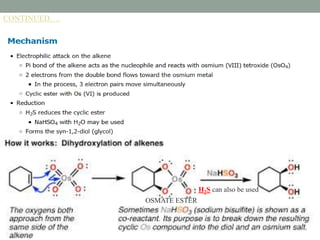
1) OXIDATION OF ALKENES (SYN DIHYDROXYLATION)
Osmium tetroxide oxidizes alkenes to give glycols through syn addition. When an
alkene reacts with osmium tetroxide, stereocenters can form in the glycol product. Cis
alkenes give meso products and trans alkenes give racemic mixtures.
CONTINUED….
OSMATE ESTER
H2S can also be used
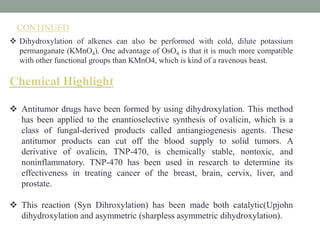
 Dihydroxylation of alkenes can also be performed with cold, dilute potassium
permanganate (KMnO4). One advantage of OsO4 is that it is much more compatible
with other functional groups than KMnO4, which is kind of a ravenous beast.
Chemical Highlight
 Antitumor drugs have been formed by using dihydroxylation. This method
has been applied to the enantioselective synthesis of ovalicin, which is a
class of fungal-derived products called antiangiogenesis agents. These
antitumor products can cut off the blood supply to solid tumors. A
derivative of ovalicin, TNP-470, is chemically stable, nontoxic, and
noninflammatory. TNP-470 has been used in research to determine its
effectiveness in treating cancer of the breast, brain, cervix, liver, and
prostate.
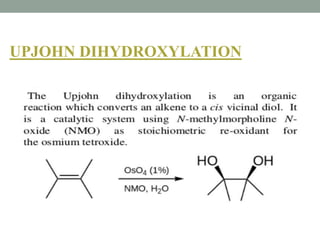
 This reaction (Syn Dihroxylation) has been made both catalytic(Upjohn
dihydroxylation and asymmetric (sharpless asymmetric dihydroxylation).
CONTINUED
UPJOHN DIHYDROXYLATION
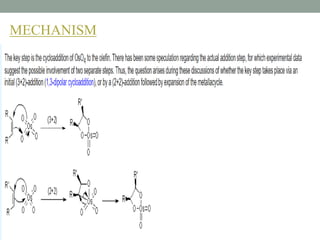
MECHANISM
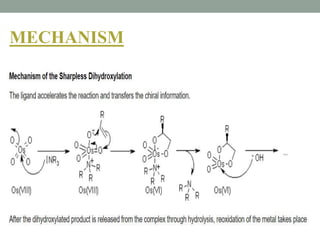
The Sharpless Dihydroxylation or Bishydroxylation is used in the enantioselective
preparation of 1,2-diols from prochiral olefins. This procedure is performed with
an osmium catalyst and a stoichiometric oxidant [e.g. K3Fe(CN)6 or N-
methylmorpholine oxide (NMO)]; it is carried out in a buffered solution to ensure a
stable pH, since the reaction proceeds more rapidly under slightly basic conditions.
Enantioselectivity is achieved through the addition of enantiomerically-enriched
chiral ligands [(DHQD)2PHAL(β), (DHQ)2PHAL(α) or their derivatives]. These
reagents are also available as stable, prepackaged mixtures (AD-mix α and AD-mix
β, AD = asymmetric dihydroxylation) for either enantiopreference.
SHARPLESS ASYMMETRIC DIHROXYLATION
MECHANISM
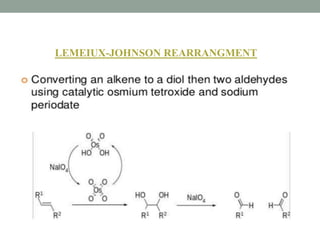
LEMEIUX-JOHNSON REARRANGMENT
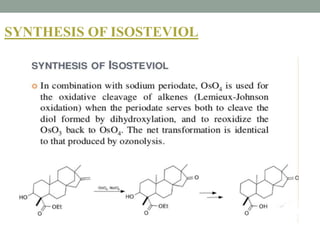
SYNTHESIS OF ISOSTEVIOL
THANK YOU

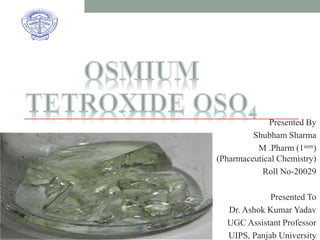
Osmium tetroxide

  • 1.
    Presented By Shubham Sharma M.Pharm (1sem) (Pharmaceutical Chemistry) Roll No-20029 Presented To Dr. Ashok Kumar Yadav UGC Assistant Professor UIPS, Panjab University
  • 2.
    CONTENTS  CHEMICAL STRUCTUREAND SYNTHESIS  INTRODUCTION  PHYSICAL PROPERTIES  APPLICATIONS WITH THEIR MECHANISM
  • 3.
    CHEMICAL FORMULA OsO4 (OSMIUMTEROXIDE) (TETRAHEDRAL)
  • 4.
    SYNTHESIS  OsO4 isformed slowly when osmium powder reacts with oxygen at ambient room temperature. Reaction of bulk solid requires heating to 400○C.  The toxic and volatile OsO4 can also be prepared in situ by the oxidation of K2OsO2(OH)4 with NMO. NMO is also the cooxidant that enables the use of a catalytic amount of OsO4, because this reagent is able to reoxidize an Os(VI) species to an Os(VIII) species.
  • 5.
    INTRODUCTION 1. The compoundis noteworthy for its many uses, despite its toxicity and the rarity of osmium. 2. It also has a number of interesting properties, one being that the solid is volatile. 3. The compound is colourless, but most samples appear yellow. This is most likely due to the presence of the impurity OsO2, which is yellow –brown in colour. 4. Osmium oxide(Ⅷ) forms monoclinic crystals. It has a characteristic acrid chlorine –like odour. The element name osmium is derived from osme, Greek for odour.
  • 6.
    PHYSICAL PROPERTIES 1. Itis soluble in wide range of organic solvents . It is also moderately soluble in water, with which it reacts reversibly to osmic acid. 2. Pure Osmium oxide(Ⅷ) is probably colourless and it has been suggested that its yellow colour is due to osmium dioxide (OsO2) impurities. 3. The osmium tetroxide molecule is tertrahedral and therefore non-polar. 4. Melting Point = 40○C 5. Sublimes At Room Temperature 6. Boiling Point = 130○C 7. Solubility In Water = 6.2g/100ml 8. Solublilty In CCL4 = 375g/100ml
  • 7.
    /NMO NMO will againoxidize this osmium to its +8 oxidation state , will see it in upjohn dihydroxylation
  • 8.
    APPLICATIONS OF OSMIUMTETROXIDE 1) OXIDATION OF ALKENES (SYN DIHYDROXYLATION) Osmium tetroxide oxidizes alkenes to give glycols through syn addition. When an alkene reacts with osmium tetroxide, stereocenters can form in the glycol product. Cis alkenes give meso products and trans alkenes give racemic mixtures.
  • 9.
  • 10.
     Dihydroxylation ofalkenes can also be performed with cold, dilute potassium permanganate (KMnO4). One advantage of OsO4 is that it is much more compatible with other functional groups than KMnO4, which is kind of a ravenous beast. Chemical Highlight  Antitumor drugs have been formed by using dihydroxylation. This method has been applied to the enantioselective synthesis of ovalicin, which is a class of fungal-derived products called antiangiogenesis agents. These antitumor products can cut off the blood supply to solid tumors. A derivative of ovalicin, TNP-470, is chemically stable, nontoxic, and noninflammatory. TNP-470 has been used in research to determine its effectiveness in treating cancer of the breast, brain, cervix, liver, and prostate.  This reaction (Syn Dihroxylation) has been made both catalytic(Upjohn dihydroxylation and asymmetric (sharpless asymmetric dihydroxylation). CONTINUED
  • 11.
  • 12.
  • 13.
    The Sharpless Dihydroxylationor Bishydroxylation is used in the enantioselective preparation of 1,2-diols from prochiral olefins. This procedure is performed with an osmium catalyst and a stoichiometric oxidant [e.g. K3Fe(CN)6 or N- methylmorpholine oxide (NMO)]; it is carried out in a buffered solution to ensure a stable pH, since the reaction proceeds more rapidly under slightly basic conditions. Enantioselectivity is achieved through the addition of enantiomerically-enriched chiral ligands [(DHQD)2PHAL(β), (DHQ)2PHAL(α) or their derivatives]. These reagents are also available as stable, prepackaged mixtures (AD-mix α and AD-mix β, AD = asymmetric dihydroxylation) for either enantiopreference. SHARPLESS ASYMMETRIC DIHROXYLATION
  • 14.
  • 15.
  • 16.
  • 17.