Conformational Isomers
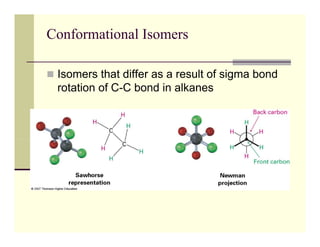
 Isomers that differ as a result of sigma bond
rotation of C-C bond in alkanes
Bond Rotation and Newman Projections
 As carbon-carbon bond rotates, interconvert
 As carbon carbon bond rotates, interconvert
between staggered and eclipsed conformers
E li d f i 12 0 kJ/ l hi h i
Eclipsed conformer is 12.0 kJ/mol higher in energy
('free' rotation at room temperature)
Torsional Strain Energy
Force that opposes rotation due to the repulsion
of bonding electrons
 We do not observe perfectly free rotation
 There is a barrier to rotation, and some
,
conformers are more stable than others
 Small energy barrier easily overcome at RT
 Each eclipsed H-H costs 4 kJ/mol of
Torsional Energy
Strain Energy in Alkanes
 Torsional Strain
 Steric strain- repulsive interaction occurring between
atoms that are forced closer together than their
t i dii ll
atomic radii allow
In Class: Conformations of Higher and
Branched Alkanes
 Propane
 Propane
 Butane
 2-methylbutane
 2-methylbutane
 2-chlorobutane
 draw conformers (id most/least stable)
 define anti and gauche staggered conformers
 predict relative energies and draw diagrams
d t i l ti t f f
 determine relative percentages of conformers
What does E tell us?
 G = -RTlnK
= -2.303RTlogK
 which can rearrange to
logK = G/1 36 where R = 0 001987 kcal/K*mol
(1 kcal = 4.14 kJ)
logK = -G/1.36 where R = 0.001987 kcal/K mol
or T = 298 K
K 10 (G/1 36)
K = 10 -(G/1.36)
less stable more stable
K = 10 -(-0.9/1.36) = 4.5
0.9 kcal 0.0 kcal
G = -0.9 kcal/mol
K 10 4.5
so product : reactant is 4.5:1
(product - reactant) or 82% pdt and 18% reactant
What does E tell us?
Cycloalkanes
Cycloalkanes
 Cycloalkanes are alkanes that have carbon atoms
th t f i ( ll d li li d )
that form a ring (called alicyclic compounds)
 Simple cycloalkanes rings of CH2 units, (CH2)n,
or CnH2n
Cis-Trans Isomerism in Cycloalkanes
Cis Trans Isomerism in Cycloalkanes
 Rotation about C-C bonds in cycloalkanes is limited by the
ring structure
 Rings have two “faces” and substituents are labeled as to
their relative facial positions
 There are two different 1,2-dimethyl-cyclopropane
isomers, one with the two methyls on the same side (cis)
of the ring and one with the methyls on opposite sides
(trans)
Stereoisomers
Stereoisomers
 Compounds with atoms connected in the same order
b t hi h diff i th di i l i t ti
but which differ in three-dimensional orientation, are
stereoisomers
 The terms “cis” and “trans” should be used to specify
t i i i t t
stereoisomeric ring structures
Naming Cycloalkanes
Naming Cycloalkanes
 Count the number of carbon atoms in the ring and the number in
h l b i h i If h b f b i
the largest substituent chain. If the number of carbon atoms in
the ring is equal to or greater than the number in the substituent,
the compound is named as an alkyl-substituted cycloalkane
 For an alkyl or halo substituted cycloalkane start at a point of
 For an alkyl- or halo-substituted cycloalkane, start at a point of
attachment as C1 and number the substituents on the ring so
that the second substituent has as low a number as possible.
 If choice, give substituent that comes first alphabetically lower
, g p y
number
 Number the substituents and write the name adding prefix
"cyclo"
cis-1-isopropyl-3-methylcyclohexane
Cl
trans 1 2 dichlorocyclobutane
Cl
trans-1,2-dichlorocyclobutane
Complex Cycloalkanes
 Naturally occurring materials contain cycloalkane structures
 Examples: chrysanthemic acid (cyclopropane),
prostaglandins (cyclopentane), steroids (cyclohexanes and
cyclopentane)
Properties of Cycloalkanes
 Melting points are affected by the shapes and the
g p y p
way that crystals pack so they do not change
uniformly
Stability of Cycloalkanes: Ring Strain
 Rings larger than 3 atoms are not flat
g g
 Cyclic molecules can assume nonplanar
conformations to minimize angle strain and torsional
strain by ring-puckering
strain by ring puckering
 Larger rings have many more possible conformations
than smaller rings and are more difficult to analyze
Stability of Cycloalkanes: The Baeyer
St i Th
Strain Theory
 Baeyer (1885): since
carbon prefers to have
bond angles of
approximately 109°,
i i th th
ring sizes other than
five and six may be too
strained to exist
 Rings from 3 to 30 C’s
do exist but are
strained due to bond
bending distortions and
steric interactions [ H/CH2 (ring) - H/CH2 (acyclic) ] * n
(CH2)n + 3n/2 O2 n CO2 + n H2O + Heat
Summary: Types of Strain
 Angle strain - expansion or compression of bond
g p p
angles away from most stable
 Torsional strain - eclipsing of bonds on neighboring
t
atoms
 Steric strain - repulsive interactions between
nonbonded atoms in close proximity
 RING STRAIN = combination of Angle Strain +
Torsional Strain
Conformations of Cycloalkanes
Cyclopropane
y p p
 3-membered ring must have planar structure
 Symmetrical with C–C–C bond angles of 60°
3
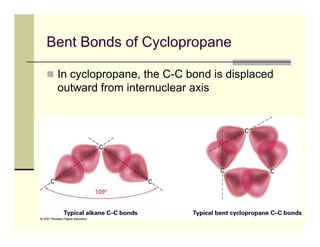
 Requires that sp3 based bonds are bent (and
weakened)
 All C-H bonds are eclipsed
p
Bent Bonds of Cyclopropane
 In cyclopropane, the C-C bond is displaced
 In cyclopropane, the C C bond is displaced
outward from internuclear axis
Cyclobutane
Cyclobutane
 Cyclobutane has less angle strain than cyclopropane
b t t i l t i b f it l b
but more torsional strain because of its larger number
of ring hydrogens
 Cyclobutane is slightly bent out of plane - one carbon
t i b t 25° b
atom is about 25° above
 The bend increases angle strain but decreases
torsional strain
Cyclopentane
Cyclopentane
 Planar cyclopentane would have no angle strain but
y p g
very high torsional strain
 Actual conformations of cyclopentane are nonplanar,
reducing torsional strain
 Four carbon atoms are in a plane
 The fifth carbon atom is above or below the plane –
looks like an envelope
Conformations of Cyclohexane
 Substituted cyclohexanes occur widely in nature
y y
 The cyclohexane ring is free of angle strain and
torsional strain
 The conformation is has alternating atoms in a
common plane and tetrahedral angles between all
carbons
Thi i ll d h i f ti
 This is called a chair conformation
All bond angles 109.5o, and all hydrogens staggered
How to Draw Chair Cyclohexane
Axial and Equatorial Bonds in
C l h
Cyclohexane
 The chair conformation
h t ki d f
has two kinds of
positions for substituents
on the ring: axial
positions and equatorial
positions
 Chair cyclohexane has
six axial hydrogens
six axial hydrogens
perpendicular to the ring
(parallel to the ring axis)
and six equatorial
q
hydrogens near the
plane of the ring
You must be able to clearly indicate axial and equatorial positions
Axial and Equatorial Positions
 Each carbon atom in cyclohexane has one
y
axial and one equatorial hydrogen
 Each face of the ring has three axial and
h i l h d i l i
three equatorial hydrogens in an alternating
arrangement
Drawing the Axial and Equatorial
H d
Hydrogens
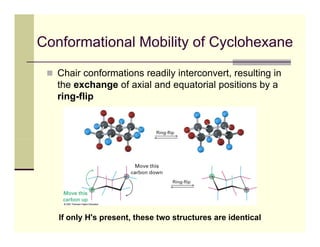
Conformational Mobility of Cyclohexane
 Chair conformations readily interconvert, resulting in
y , g
the exchange of axial and equatorial positions by a
ring-flip
If only H's present, these two structures are identical
Conformations of Monosubstituted
C l h
Cyclohexanes
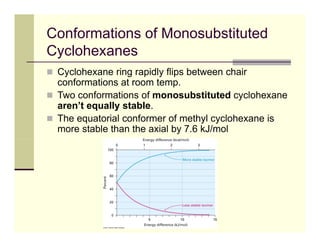
 Cyclohexane ring rapidly flips between chair
y g p y p
conformations at room temp.
 Two conformations of monosubstituted cyclohexane
aren’t equally stable.
aren t equally stable.
 The equatorial conformer of methyl cyclohexane is
more stable than the axial by 7.6 kJ/mol
1,3-Diaxial Interactions
1,3 Diaxial Interactions
 Difference between
axial and equatorial
conformers is due to
steric strain caused by
1 3 di i l i t ti
1,3-diaxial interactions
 Hydrogen atoms of the
axial methyl group on
C1 are too close to the
axial hydrogens three
b C3
carbons away on C3
and C5, resulting in 7.6
kJ/mol of steric strain
7.6 kJ/mol higher
in energy
Relationship to Gauche Butane
I t ti
Interactions
 Gauche butane is less stable than anti butane by 3.8 kJ/mol
b f i i f b h d h
because of steric interference between hydrogen atoms on the
two methyl groups
 The four-carbon fragment of axial methylcyclohexane and
gauche butane have the same steric interaction
 In general, equatorial positions give more stable isomer
Conformational Analysis of
Di b tit t d C l h
Disubstituted Cyclohexanes
 In disubstituted cyclohexanes the steric effects of both substituents
must be taken into account in both conformations
 There are two isomers of 1,2-dimethylcyclohexane. cis and trans
 In the cis isomer, both methyl groups are on the same face of the
ring, and compound can exist in two chair conformations
g, p
 Consider the sum of all interactions
 In cis-1,2, both conformations are equal in energy
Trans-1,2-Dimethylcyclohexane
Trans 1,2 Dimethylcyclohexane
 Methyl groups are on opposite faces of the ring
 O t f ti h b th th l t i l d l
 One trans conformation has both methyl groups equatorial and only a
gauche butane interaction between methyls (3.8 kJ/mol) and no 1,3-
diaxial interactions
 The ring-flipped conformation has both methyl groups axial with four 1,3-
diaxial interactions
 Steric strain of 4  3.8 kJ/mol = 15.2 kJ/mol makes the diaxial
conformation 11.4 kJ/mol less favorable than the diequatorial
conformation
 trans 1 2 dimethylcyclohexane will exist almost exclusively (>99%) in the
 trans-1,2-dimethylcyclohexane will exist almost exclusively (>99%) in the
diequatorial conformation
Cl
Cl
(H3C)C
(H3C)C
Draw the two chair conformers and calculate the strain
f h h i Whi h i t bl ?
energy for each chair. Which is more stable?
Additional Cyclic Structures
H H
Additional Cyclic Structures
H
H
H
H
Boat Cyclohexane
H H
H H
Fused Polycycles
H
H
H H
trans-decalin cis-decalin
Bridged Polycycles
bicyclo[2.2.1]heptane

day 4 lecture.pdf

  • 1.
    Conformational Isomers  Isomersthat differ as a result of sigma bond  Isomers that differ as a result of sigma bond rotation of C-C bond in alkanes
  • 2.
    Bond Rotation andNewman Projections  As carbon-carbon bond rotates, interconvert  As carbon carbon bond rotates, interconvert between staggered and eclipsed conformers E li d f i 12 0 kJ/ l hi h i Eclipsed conformer is 12.0 kJ/mol higher in energy ('free' rotation at room temperature)
  • 3.
    Torsional Strain Energy Forcethat opposes rotation due to the repulsion Force that opposes rotation due to the repulsion of bonding electrons  We do not observe perfectly free rotation  There is a barrier to rotation, and some , conformers are more stable than others  Small energy barrier easily overcome at RT  Each eclipsed H-H costs 4 kJ/mol of Torsional Energy
  • 5.
    Strain Energy inAlkanes  Torsional Strain  Steric strain- repulsive interaction occurring between atoms that are forced closer together than their t i dii ll atomic radii allow
  • 6.
    In Class: Conformationsof Higher and Branched Alkanes  Propane  Propane  Butane  2-methylbutane  2-methylbutane  2-chlorobutane  draw conformers (id most/least stable)  define anti and gauche staggered conformers  define anti and gauche staggered conformers  predict relative energies and draw diagrams d t i l ti t f f  determine relative percentages of conformers
  • 7.
    What does Etell us?  G = -RTlnK = -2.303RTlogK  which can rearrange to logK = G/1 36 where R = 0 001987 kcal/K*mol (1 kcal = 4.14 kJ) logK = -G/1.36 where R = 0.001987 kcal/K mol or T = 298 K K 10 (G/1 36) K = 10 -(G/1.36) less stable more stable K = 10 -(-0.9/1.36) = 4.5 0.9 kcal 0.0 kcal G = -0.9 kcal/mol K 10 4.5 so product : reactant is 4.5:1 (product - reactant) or 82% pdt and 18% reactant
  • 8.
  • 9.
    Cycloalkanes Cycloalkanes  Cycloalkanes arealkanes that have carbon atoms th t f i ( ll d li li d ) that form a ring (called alicyclic compounds)  Simple cycloalkanes rings of CH2 units, (CH2)n, or CnH2n
  • 10.
    Cis-Trans Isomerism inCycloalkanes Cis Trans Isomerism in Cycloalkanes  Rotation about C-C bonds in cycloalkanes is limited by the ring structure  Rings have two “faces” and substituents are labeled as to their relative facial positions  There are two different 1,2-dimethyl-cyclopropane isomers, one with the two methyls on the same side (cis) of the ring and one with the methyls on opposite sides (trans)
  • 11.
    Stereoisomers Stereoisomers  Compounds withatoms connected in the same order b t hi h diff i th di i l i t ti but which differ in three-dimensional orientation, are stereoisomers  The terms “cis” and “trans” should be used to specify t i i i t t stereoisomeric ring structures
  • 12.
    Naming Cycloalkanes Naming Cycloalkanes Count the number of carbon atoms in the ring and the number in h l b i h i If h b f b i the largest substituent chain. If the number of carbon atoms in the ring is equal to or greater than the number in the substituent, the compound is named as an alkyl-substituted cycloalkane  For an alkyl or halo substituted cycloalkane start at a point of  For an alkyl- or halo-substituted cycloalkane, start at a point of attachment as C1 and number the substituents on the ring so that the second substituent has as low a number as possible.  If choice, give substituent that comes first alphabetically lower , g p y number  Number the substituents and write the name adding prefix "cyclo"
  • 14.
    cis-1-isopropyl-3-methylcyclohexane Cl trans 1 2dichlorocyclobutane Cl trans-1,2-dichlorocyclobutane
  • 15.
    Complex Cycloalkanes Complex Cycloalkanes Naturally occurring materials contain cycloalkane structures  Examples: chrysanthemic acid (cyclopropane), prostaglandins (cyclopentane), steroids (cyclohexanes and cyclopentane)
  • 16.
    Properties of Cycloalkanes Propertiesof Cycloalkanes  Melting points are affected by the shapes and the g p y p way that crystals pack so they do not change uniformly
  • 17.
    Stability of Cycloalkanes:Ring Strain Stability of Cycloalkanes: Ring Strain  Rings larger than 3 atoms are not flat g g  Cyclic molecules can assume nonplanar conformations to minimize angle strain and torsional strain by ring-puckering strain by ring puckering  Larger rings have many more possible conformations than smaller rings and are more difficult to analyze
  • 18.
    Stability of Cycloalkanes:The Baeyer St i Th Strain Theory  Baeyer (1885): since carbon prefers to have bond angles of approximately 109°, i i th th ring sizes other than five and six may be too strained to exist  Rings from 3 to 30 C’s do exist but are strained due to bond bending distortions and steric interactions [ H/CH2 (ring) - H/CH2 (acyclic) ] * n (CH2)n + 3n/2 O2 n CO2 + n H2O + Heat
  • 19.
    Summary: Types ofStrain Summary: Types of Strain  Angle strain - expansion or compression of bond g p p angles away from most stable  Torsional strain - eclipsing of bonds on neighboring t atoms  Steric strain - repulsive interactions between nonbonded atoms in close proximity nonbonded atoms in close proximity  RING STRAIN = combination of Angle Strain + Torsional Strain
  • 20.
    Conformations of Cycloalkanes Conformationsof Cycloalkanes Cyclopropane y p p  3-membered ring must have planar structure  Symmetrical with C–C–C bond angles of 60° 3  Requires that sp3 based bonds are bent (and weakened)  All C-H bonds are eclipsed p
  • 21.
    Bent Bonds ofCyclopropane Bent Bonds of Cyclopropane  In cyclopropane, the C-C bond is displaced  In cyclopropane, the C C bond is displaced outward from internuclear axis
  • 22.
    Cyclobutane Cyclobutane  Cyclobutane hasless angle strain than cyclopropane b t t i l t i b f it l b but more torsional strain because of its larger number of ring hydrogens  Cyclobutane is slightly bent out of plane - one carbon t i b t 25° b atom is about 25° above  The bend increases angle strain but decreases torsional strain
  • 23.
    Cyclopentane Cyclopentane  Planar cyclopentanewould have no angle strain but y p g very high torsional strain  Actual conformations of cyclopentane are nonplanar, reducing torsional strain reducing torsional strain  Four carbon atoms are in a plane  The fifth carbon atom is above or below the plane – looks like an envelope looks like an envelope
  • 24.
    Conformations of Cyclohexane Conformationsof Cyclohexane  Substituted cyclohexanes occur widely in nature y y  The cyclohexane ring is free of angle strain and torsional strain  The conformation is has alternating atoms in a  The conformation is has alternating atoms in a common plane and tetrahedral angles between all carbons Thi i ll d h i f ti  This is called a chair conformation All bond angles 109.5o, and all hydrogens staggered
  • 25.
    How to DrawChair Cyclohexane How to Draw Chair Cyclohexane
  • 26.
    Axial and EquatorialBonds in C l h Cyclohexane  The chair conformation h t ki d f has two kinds of positions for substituents on the ring: axial positions and equatorial positions and equatorial positions  Chair cyclohexane has six axial hydrogens six axial hydrogens perpendicular to the ring (parallel to the ring axis) and six equatorial q hydrogens near the plane of the ring You must be able to clearly indicate axial and equatorial positions
  • 27.
    Axial and EquatorialPositions Axial and Equatorial Positions  Each carbon atom in cyclohexane has one y axial and one equatorial hydrogen  Each face of the ring has three axial and h i l h d i l i three equatorial hydrogens in an alternating arrangement
  • 28.
    Drawing the Axialand Equatorial H d Hydrogens
  • 29.
    Conformational Mobility ofCyclohexane Conformational Mobility of Cyclohexane  Chair conformations readily interconvert, resulting in y , g the exchange of axial and equatorial positions by a ring-flip If only H's present, these two structures are identical
  • 30.
    Conformations of Monosubstituted Cl h Cyclohexanes  Cyclohexane ring rapidly flips between chair y g p y p conformations at room temp.  Two conformations of monosubstituted cyclohexane aren’t equally stable. aren t equally stable.  The equatorial conformer of methyl cyclohexane is more stable than the axial by 7.6 kJ/mol
  • 31.
    1,3-Diaxial Interactions 1,3 DiaxialInteractions  Difference between axial and equatorial conformers is due to steric strain caused by 1 3 di i l i t ti 1,3-diaxial interactions  Hydrogen atoms of the axial methyl group on C1 are too close to the axial hydrogens three b C3 carbons away on C3 and C5, resulting in 7.6 kJ/mol of steric strain 7.6 kJ/mol higher in energy
  • 33.
    Relationship to GaucheButane I t ti Interactions  Gauche butane is less stable than anti butane by 3.8 kJ/mol b f i i f b h d h because of steric interference between hydrogen atoms on the two methyl groups  The four-carbon fragment of axial methylcyclohexane and gauche butane have the same steric interaction gauche butane have the same steric interaction  In general, equatorial positions give more stable isomer
  • 34.
    Conformational Analysis of Dib tit t d C l h Disubstituted Cyclohexanes  In disubstituted cyclohexanes the steric effects of both substituents must be taken into account in both conformations must be taken into account in both conformations  There are two isomers of 1,2-dimethylcyclohexane. cis and trans  In the cis isomer, both methyl groups are on the same face of the ring, and compound can exist in two chair conformations g, p  Consider the sum of all interactions  In cis-1,2, both conformations are equal in energy
  • 35.
    Trans-1,2-Dimethylcyclohexane Trans 1,2 Dimethylcyclohexane Methyl groups are on opposite faces of the ring  O t f ti h b th th l t i l d l  One trans conformation has both methyl groups equatorial and only a gauche butane interaction between methyls (3.8 kJ/mol) and no 1,3- diaxial interactions  The ring-flipped conformation has both methyl groups axial with four 1,3- diaxial interactions diaxial interactions  Steric strain of 4  3.8 kJ/mol = 15.2 kJ/mol makes the diaxial conformation 11.4 kJ/mol less favorable than the diequatorial conformation  trans 1 2 dimethylcyclohexane will exist almost exclusively (>99%) in the  trans-1,2-dimethylcyclohexane will exist almost exclusively (>99%) in the diequatorial conformation
  • 36.
  • 37.
    Draw the twochair conformers and calculate the strain f h h i Whi h i t bl ? energy for each chair. Which is more stable?
  • 38.
    Additional Cyclic Structures HH Additional Cyclic Structures H H H H Boat Cyclohexane H H H H Fused Polycycles H H H H trans-decalin cis-decalin Bridged Polycycles bicyclo[2.2.1]heptane