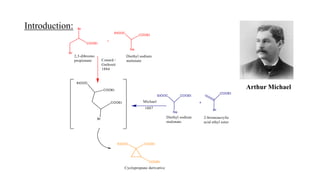
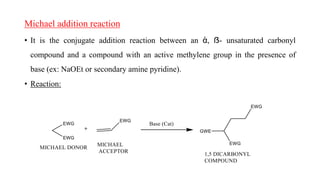
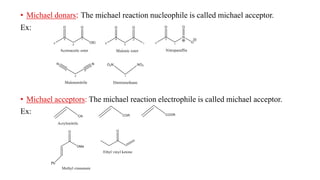
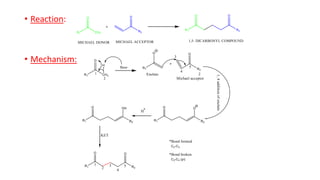
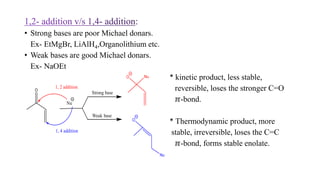
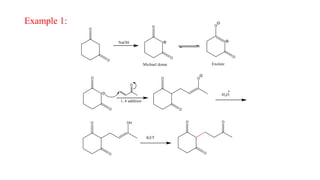
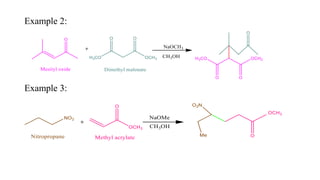
Michael addition reaction involves the conjugate addition of a nucleophile to an α,β-unsaturated carbonyl compound. It proceeds through a reversible 1,2-addition of the nucleophile to the β-carbon, which can then undergo irreversible proton elimination to form the more stable thermodynamic enolate product by removing the π-bond of the C=C. This reaction is useful for forming C-C bonds and natural products, with examples given of its application in multi-step syntheses using further carbonyl reactions like aldol condensation.



![Reaction Mechanism inorganic By [ZK].pptx](https://cdn.slidesharecdn.com/ss_thumbnails/reactionmechanismbyzk-250524043224-f69f6df6-thumbnail.jpg?width=640&height=640&fit=bounds)


