Reaction Intermediates
• Carbocation
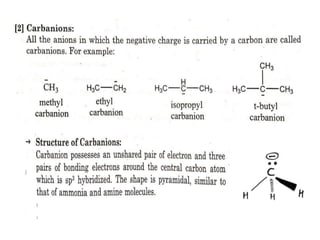
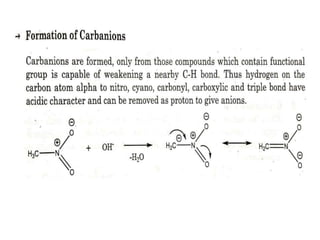
• Carbanion
• Free radical
• Carbene
• Benzyne
Ms. Celeste Pereira
(Chemistry faculty)
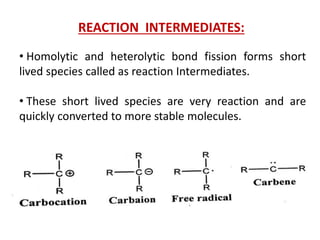
REACTION INTERMEDIATES:
• Homolytic and heterolytic bond fission forms short
lived species called as reaction Intermediates.
• These short lived species are very reaction and are
quickly converted to more stable molecules.
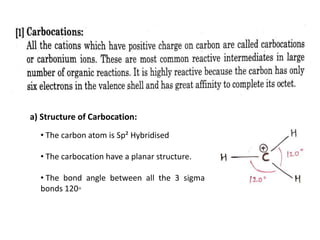
• The carbon atom is Sp² Hybridised
• The carbocation have a planar structure.
• The bond angle between all the 3 sigma
bonds 120◦
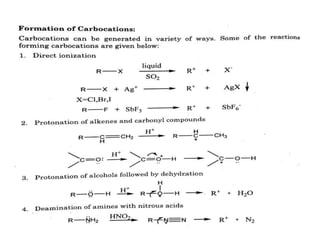
a) Structure of Carbocation:
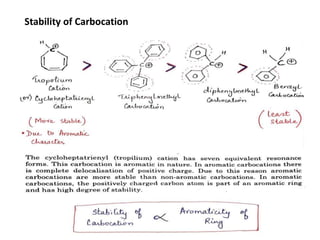
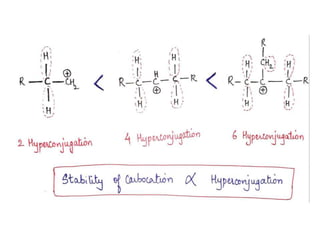
Stability of Carbocation
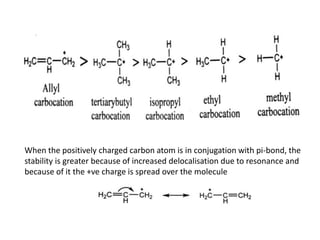
When the positively charged carbon atom is in conjugation with pi-bond, the
stability is greater because of increased delocalisation due to resonance and
because of it the +ve charge is spread over the molecule
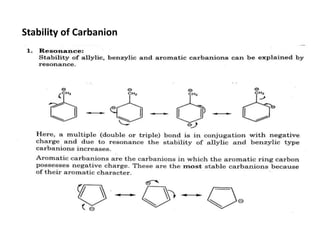
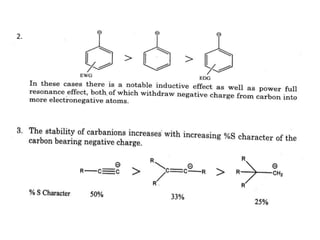
Stability of Carbanion
2.
Free Radicals
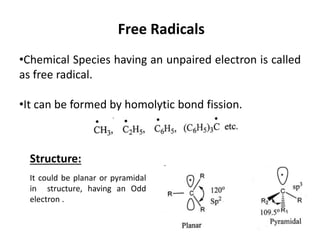
•Chemical Species having an unpaired electron is called
as free radical.
•It can be formed by homolytic bond fission.
Structure:
It could be planar or pyramidal
in structure, having an Odd
electron .
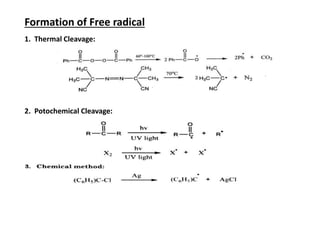
Formation of Free radical
1. Thermal Cleavage:
2. Potochemical Cleavage:
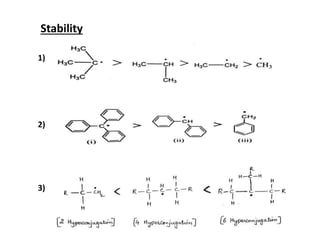
Stability
1)
2)
3)
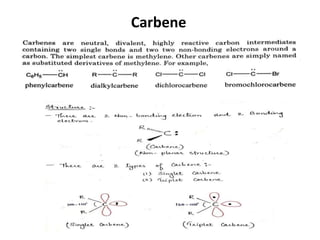
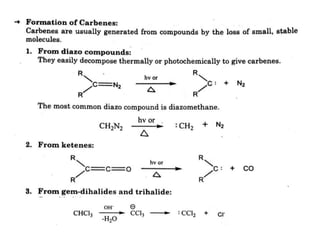
Carbene
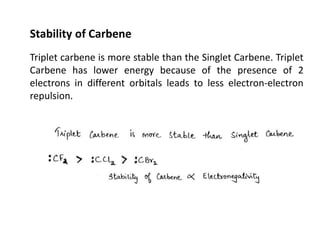
Stability of Carbene
Triplet carbene is more stable than the Singlet Carbene. Triplet
Carbene has lower energy because of the presence of 2
electrons in different orbitals leads to less electron-electron
repulsion.
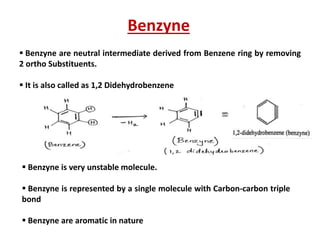
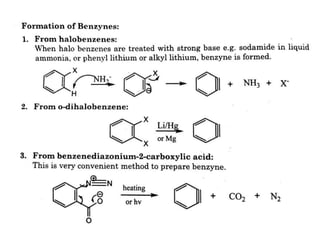
Benzyne
 Benzyne are neutral intermediate derived from Benzene ring by removing
2 ortho Substituents.
 It is also called as 1,2 Didehydrobenzene
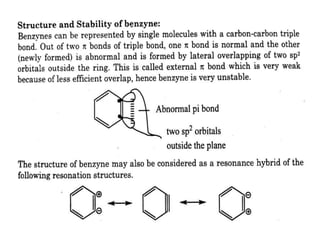
 Benzyne is very unstable molecule.
 Benzyne is represented by a single molecule with Carbon-carbon triple
bond
 Benzyne are aromatic in nature
Reaction Intermediate

Reaction Intermediate

  • 1.
    Reaction Intermediates • Carbocation •Carbanion • Free radical • Carbene • Benzyne Ms. Celeste Pereira (Chemistry faculty)
  • 2.
    REACTION INTERMEDIATES: • Homolyticand heterolytic bond fission forms short lived species called as reaction Intermediates. • These short lived species are very reaction and are quickly converted to more stable molecules.
  • 3.
    • The carbonatom is Sp² Hybridised • The carbocation have a planar structure. • The bond angle between all the 3 sigma bonds 120◦ a) Structure of Carbocation:
  • 5.
  • 6.
    When the positivelycharged carbon atom is in conjugation with pi-bond, the stability is greater because of increased delocalisation due to resonance and because of it the +ve charge is spread over the molecule
  • 10.
  • 11.
  • 12.
    Free Radicals •Chemical Specieshaving an unpaired electron is called as free radical. •It can be formed by homolytic bond fission. Structure: It could be planar or pyramidal in structure, having an Odd electron .
  • 13.
    Formation of Freeradical 1. Thermal Cleavage: 2. Potochemical Cleavage:
  • 14.
  • 15.
  • 17.
    Stability of Carbene Tripletcarbene is more stable than the Singlet Carbene. Triplet Carbene has lower energy because of the presence of 2 electrons in different orbitals leads to less electron-electron repulsion.
  • 18.
    Benzyne  Benzyne areneutral intermediate derived from Benzene ring by removing 2 ortho Substituents.  It is also called as 1,2 Didehydrobenzene  Benzyne is very unstable molecule.  Benzyne is represented by a single molecule with Carbon-carbon triple bond  Benzyne are aromatic in nature