4/10/2018
1
 Stereo selectivity
Regio selectivity
Chemo selectivity
Diastereo selectivity
Cram’s Rule
Felkin Anh Model
CONTENTS
4/10/2018
2
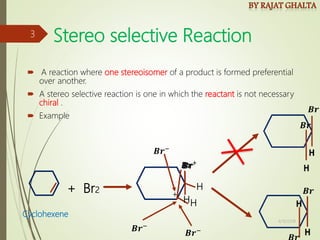
Stereo selective Reaction
 A reaction where one stereoisomer of a product is formed preferential
over another.
 A stereo selective reaction is one in which the reactant is not necessary
chiral .
 Example
𝑩𝒓+
+ Br2
H
H
𝑩𝒓−
Cyclohexene
+
𝑩𝒓
H
𝑩𝒓−
𝑩𝒓−
4/10/2018
3
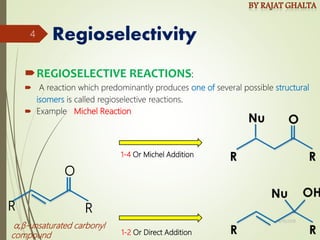
Regioselectivity
REGIOSELECTIVE REACTIONS:
 A reaction which predominantly produces one of several possible structural
isomers is called regioselective reactions.
 Example Michel Reaction
R R
O
1-4 Or Michel Addition
1-2 Or Direct Addition
α,β-unsaturated carbonyl
compound
4/10/2018
4
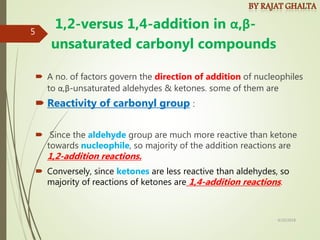
1,2-versus 1,4-addition in α,β-
unsaturated carbonyl compounds
 A no. of factors govern the direction of addition of nucleophiles
to α,β-unsaturated aldehydes & ketones. some of them are
 Reactivity of carbonyl group :
 Since the aldehyde group are much more reactive than ketone
towards nucleophile, so majority of the addition reactions are
1,2-addition reactions.
 Conversely, since ketones are less reactive than aldehydes, so
majority of reactions of ketones are 1,4-addition reactions.
4/10/2018
5
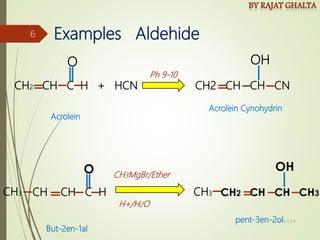
Examples Aldehide
CH2 CH C H + HCN CH2 CH CH CN
O OH
CH CH C H
CH3 CH3
Ph 9-10
CH3MgBr/Ether
H+/H2O
pent-3en-2ol
Acrolein Cynohydrin
Acrolein
But-2en-1al
4/10/2018
6
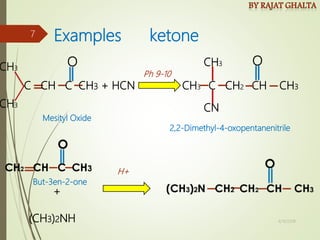
Examples ketone
(CH3)2NH
C CH2 CH CH3
O O
Ph 9-10
H+
CH3
CH3
CH3
CH3
CN
+
C CH C CH3 + HCN
Mesityl Oxide
2,2-Dimethyl-4-oxopentanenitrile
But-3en-2-one
4/10/2018
7
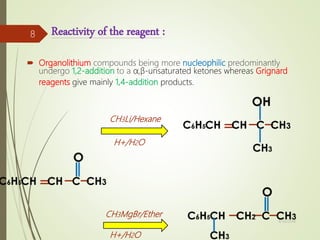
Reactivity of the reagent :
 Organolithium compounds being more nucleophilic predominantly
undergo 1,2-addition to a α,β-unsaturated ketones whereas Grignard
reagents give mainly 1,4-addition products.
CH3MgBr/Ether
CH3Li/Hexane
H+/H2O
H+/H2O
4/10/2018
8
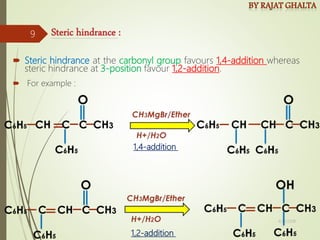
 Steric hindrance at the carbonyl group favours 1,4-addition whereas
steric hindrance at 3-position favour 1,2-addition.
 For example :
1,4-addition
1,2-addition
4/10/2018
9
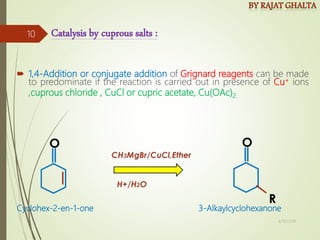
 1,4-Addition or conjugate addition of Grignard reagents can be made
to predominate if the reaction is carried out in presence of Cu+ ions
,cuprous chloride , CuCl or cupric acetate, Cu(OAc)2.
Catalysis by cuprous salts :
Cyclohex-2-en-1-one 3-Alkaylcyclohexanone
4/10/2018
10
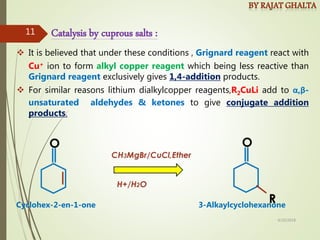
 It is believed that under these conditions , Grignard reagent react with
Cu+ ion to form alkyl copper reagent which being less reactive than
Grignard reagent exclusively gives 1,4-addition products.
 For similar reasons lithium dialkylcopper reagents,R2CuLi add to α,β-
unsaturated aldehydes & ketones to give conjugate addition
products.
Catalysis by cuprous salts :
Cyclohex-2-en-1-one 3-Alkaylcyclohexanone
4/10/2018
11
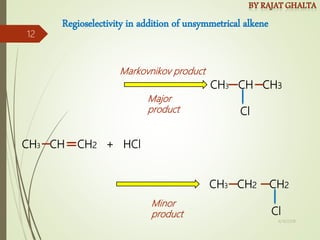
Regioselectivity in addition of unsymmetrical alkene
CH3 CH CH2 + HCl
CH3 CH CH3
Cl
CH3 CH2 CH2
Cl
Markovnikov product
Major
product
Minor
product
4/10/2018
12
Markovnikov rule
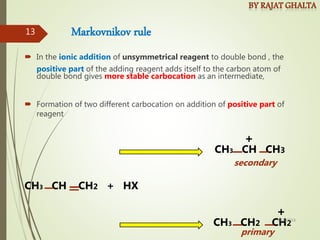
 In the ionic addition of unsymmetrical reagent to double bond , the
positive part of the adding reagent adds itself to the carbon atom of
double bond gives more stable carbocation as an intermediate,
 Formation of two different carbocation on addition of positive part of
reagent
CH3 CH CH2 + HX
CH3 CH CH3
CH3 CH2 CH2
+
+
secondary
primary
4/10/2018
13
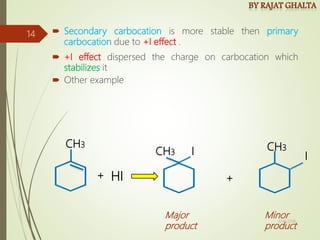
 Secondary carbocation is more stable then primary
carbocation due to +I effect .
 +I effect dispersed the charge on carbocation which
stabilizes it
 Other example
CH3
CH3
CH3
I
HI
I
+ +
Major
product
Minor
product
4/10/2018
14
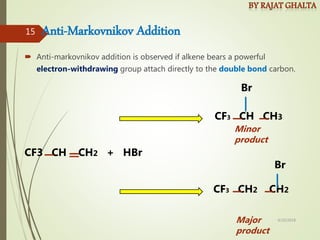
Anti-Markovnikov Addition
 Anti-markovnikov addition is observed if alkene bears a powerful
electron-withdrawing group attach directly to the double bond carbon.
CF3 CH CH2 + HBr
CF3 CH CH3
CF3 CH2 CH2
Br
Br
Major
product
Minor
product
4/10/2018
15
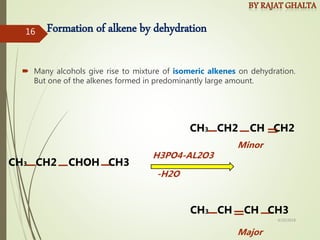
Formation of alkene by dehydration
 Many alcohols give rise to mixture of isomeric alkenes on dehydration.
But one of the alkenes formed in predominantly large amount.
CH3 CH2 CHOH CH3
CH3 CH2 CH CH2
CH3 CH CH CH3
H3PO4-AL2O3
-H2O
Major
Minor
4/10/2018
16
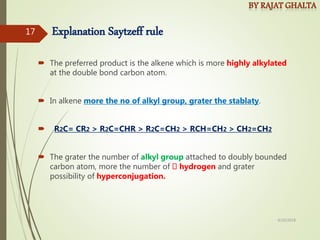
Explanation Saytzeff rule
 The preferred product is the alkene which is more highly alkylated
at the double bond carbon atom.
 In alkene more the no of alkyl group, grater the stablaty.
 R2C= CR2 > R2C=CHR > R2C=CH2 > RCH=CH2 > CH2=CH2
 The grater the number of alkyl group attached to doubly bounded
carbon atom, more the number of hydrogen and grater
possibility of hyperconjugation.
4/10/2018
17
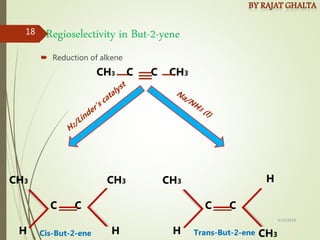
 Reduction of alkene
Regioselectivity in But-2-yene
CH3 C C CH3
C C
C C
CH3
CH3
CH3
CH3 H
H
H
H Cis-But-2-ene Trans-But-2-ene
4/10/2018
18
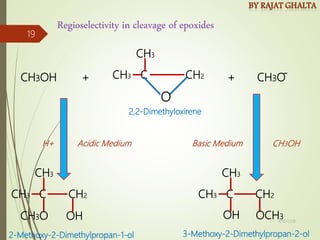
Regioselectivity in cleavage of epoxides
CH3 C CH2
O
CH3
CH3OH + + CH3O
-
CH3OH
Basic Medium
H+ Acidic Medium
CH3 C CH2
CH3
OH
CH3O
CH3 C CH2
CH3
OH OCH3
2,2-Dimethyloxirene
2-Methoxy-2-Dimethylpropan-1-ol 3-Methoxy-2-Dimethylpropan-2-ol
4/10/2018
19
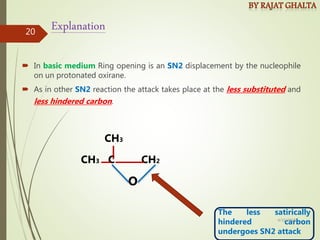
 In basic medium Ring opening is an SN2 displacement by the nucleophile
on un protonated oxirane.
 As in other SN2 reaction the attack takes place at the less substituted and
less hindered carbon.
Explanation
CH3 C CH2
O
CH3
The less satirically
hindered carbon
undergoes SN2 attack
4/10/2018
20
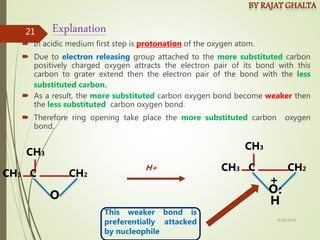
 In acidic medium first step is protonation of the oxygen atom.
 Due to electron releasing group attached to the more substituted carbon
positively charged oxygen attracts the electron pair of its bond with this
carbon to grater extend then the electron pair of the bond with the less
substituted carbon.
 As a result, the more substituted carbon oxygen bond become weaker then
the less substituted carbon oxygen bond.
 Therefore ring opening take place the more substituted carbon oxygen
bond.
Explanation
CH3 C CH2
O
CH3
This weaker bond is
preferentially attacked
by nucleophile
H+ CH3 C CH2
O
CH3
H
:
+
4/10/2018
21
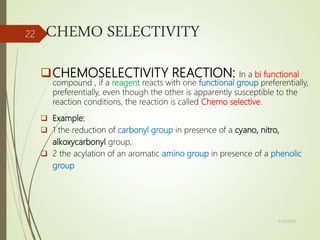
CHEMO SELECTIVITY
CHEMOSELECTIVITY REACTION: In a bi functional
compound , if a reagent reacts with one functional group preferentially,
preferentially, even though the other is apparently susceptible to the
reaction conditions, the reaction is called Chemo selective.
 Example:
 1 the reduction of carbonyl group in presence of a cyano, nitro,
alkoxycarbonyl group,
 2 the acylation of an aromatic amino group in presence of a phenolic
group
4/10/2018
22
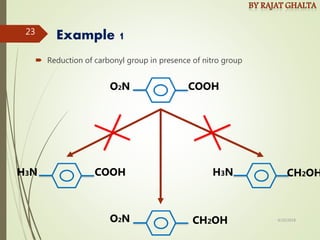
Example 1
 Reduction of carbonyl group in presence of nitro group
O2N COOH
COOH
O2N CH2OH
CH2OH
H3N H3N
4/10/2018
23
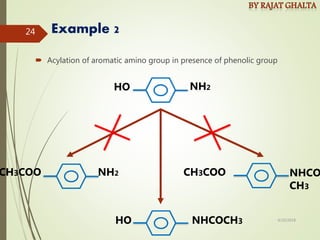
Example 2
 Acylation of aromatic amino group in presence of phenolic group
HO NH2
HO NHCOCH3
NH2
CH3COO NHCO
CH3
CH3COO
4/10/2018
24
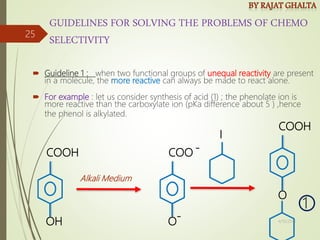
 Guideline 1 : when two functional groups of unequal reactivity are present
in a molecule, the more reactive can always be made to react alone.
 For example : let us consider synthesis of acid (1) ; the phenolate ion is
more reactive than the carboxylate ion (pKa difference about 5 ) ,hence
the phenol is alkylated.
GUIDELINES FOR SOLVING THE PROBLEMS OF CHEMO
SELECTIVITY
COOH
OH
COO
O-
-
I
COOH
O
Alkali Medium
1
4/10/2018
25
GUIDELINES FOR SOLVING THE PROBLEMS OF CHEMO
SELECTIVITY
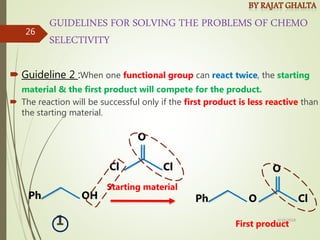
 Guideline 2 :When one functional group can react twice, the starting
material & the first product will compete for the product.
 The reaction will be successful only if the first product is less reactive than
the starting material.
O Cl
Ph
O
OH
Ph
Cl
O
Cl
First product
Starting material
1 4/10/2018
26
GUIDELINES FOR SOLVING THE PROBLEMS OF CHEMO
SELECTIVITY
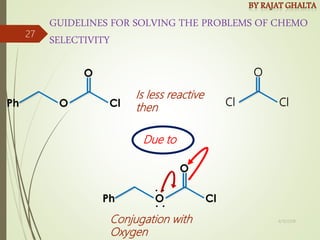
Is less reactive
then Cl
O
Cl
Conjugation with
Oxygen
Due to
:
:
4/10/2018
27
GUIDELINES FOR SOLVING THE PROBLEMS OF CHEMO
SELECTIVITY
Guideline : 3
 Unfavourable cases from guidelines 1 & 2 may be solved
by the use of protecting groups.
 Protecting group : A group whose use makes possible to
react a less reactive functional group selectively in the
presence of a more reactive group is known as a
protecting group.
 Protecting group blocks the reactivity of a functional group
group by converting it into a different group which is inert
to the conditions of some reaction(s) that is to be carried
out as part of a synthetic route. 4/10/2018
28
For example :
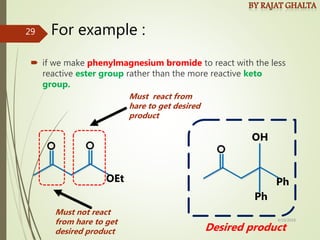
 if we make phenylmagnesium bromide to react with the less
reactive ester group rather than the more reactive keto
group.
OEt
OH
Ph
Ph
Desired product
Must not react
from hare to get
desired product
Must react from
hare to get desired
product
4/10/2018
29
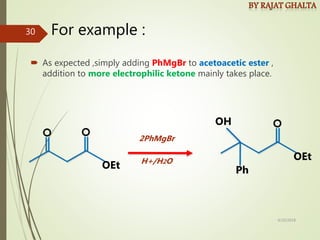
For example :
 As expected ,simply adding PhMgBr to acetoacetic ester ,
addition to more electrophilic ketone mainly takes place.
OEt
OEt
Ph
OH
2PhMgBr
H+/H2O
4/10/2018
30
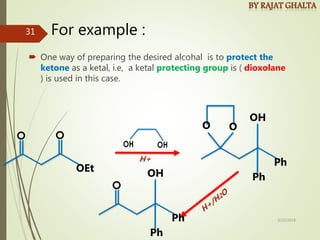
For example :
 One way of preparing the desired alcohal is to protect the
ketone as a ketal, i.e, a ketal protecting group is ( dioxolane
) is used in this case.
OEt
H+
OH
Ph
Ph
O O
OH
Ph
Ph
4/10/2018
31
GUIDELINES FOR SOLVING THE PROBLEMS OF CHEMO
SELECTIVITY
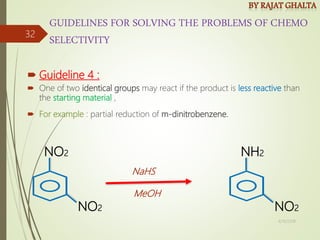
 Guideline 4 :
 One of two identical groups may react if the product is less reactive than
the starting material ,
 For example : partial reduction of m-dinitrobenzene.
NO2
NO2
NH2
NO2
NaHS
MeOH
4/10/2018
32
GUIDELINES FOR SOLVING THE PROBLEMS OF CHEMO
SELECTIVITY
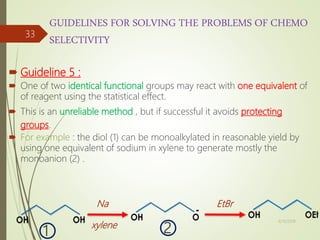
 Guideline 5 :
 One of two identical functional groups may react with one equivalent of
of reagent using the statistical effect.
 This is an unreliable method , but if successful it avoids protecting
groups.
 For example : the diol (1) can be monoalkylated in reasonable yield by
using one equivalent of sodium in xylene to generate mostly the
monoanion (2) .
Na
xylene
EtBr
1 2
4/10/2018
33
GUIDELINES FOR SOLVING THE PROBLEMS OF CHEMO
SELECTIVITY
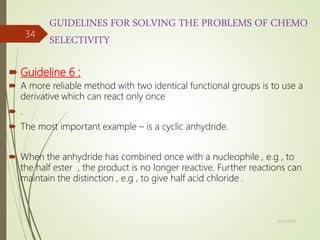
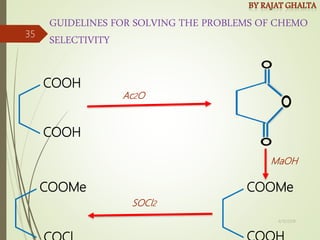
 Guideline 6 :
 A more reliable method with two identical functional groups is to use a
derivative which can react only once
 .
 The most important example – is a cyclic anhydride.
 When the anhydride has combined once with a nucleophile , e.g , to
the half ester , the product is no longer reactive. Further reactions can
maintain the distinction , e.g , to give half acid chloride .
4/10/2018
34
GUIDELINES FOR SOLVING THE PROBLEMS OF CHEMO
SELECTIVITY
COOH
COOH
COOMe
COOMe
Ac2O
MaOH
SOCl2
4/10/2018
35
GUIDELINES FOR SOLVING THE PROBLEMS OF CHEMO
SELECTIVITY
 Guideline 7:
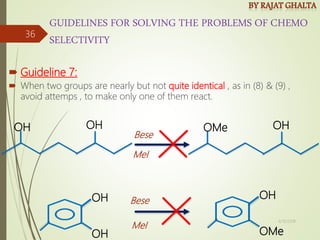
 When two groups are nearly but not quite identical , as in (8) & (9) ,
avoid attemps , to make only one of them react.
OH OH OMe OH
OH
OH
OMe
OH
Bese
Bese
MeI
MeI
4/10/2018
36
DIASTEREOSELECTIVITY
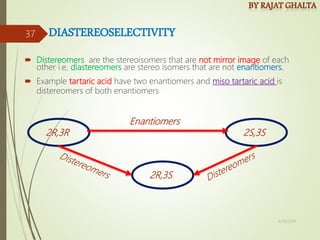
 Distereomers are the stereoisomers that are not mirror image of each
other i.e, diastereomers are stereo isomers that are not enantiomers.
 Example tartaric acid have two enantiomers and miso tartaric acid is
distereomers of both enantiomers
2R,3R 2S,3S
2R,3S
Enantiomers
4/10/2018
37
DIASTEREOSELECTIVITY
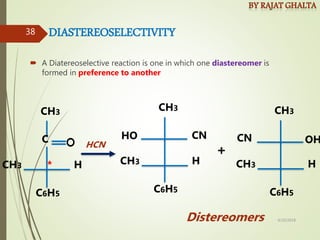
 A Diatereoselective reaction is one in which one diastereomer is
formed in preference to another
CH3
C6H5
CH3 H
C
*
HO CN
CH3
C6H5
CH3 H
OH
CN
CH3
C6H5
CH3 H
+
HCN
Distereomers 4/10/2018
38
DIASTEREOSELECTIVITY
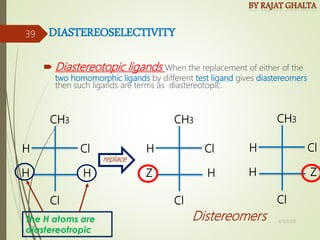
 Diastereotopic ligands When the replacement of either of the
two homomorphic ligands by different test ligand gives diastereomers
then such ligands are terms as diastereotopic.
Cl
H
CH3
Cl
H H
Cl
H
CH3
Cl
Z H
Cl
H
CH3
Cl
H Z
Distereomers
replace
4/10/2018
39
DIASTEREOSELECTIVITY
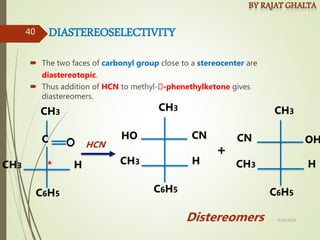
 The two faces of carbonyl group close to a stereocenter are
diastereotopic.
 Thus addition of HCN to methyl- -phenethylketone gives
diastereomers.
CH3
C6H5
CH3 H
C
*
HO CN
CH3
C6H5
CH3 H
OH
CN
CH3
C6H5
CH3 H
+
HCN
Distereomers 4/10/2018
40
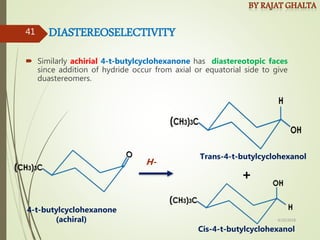
 Similarly achirial 4-t-butylcyclohexanone has diastereotopic faces
since addition of hydride occur from axial or equatorial side to give
duastereomers.
+
H-
DIASTEREOSELECTIVITY
4-t-butylcyclohexanone
(achiral)
Trans-4-t-butylcyclohexanol
Cis-4-t-butylcyclohexanol
4/10/2018
41
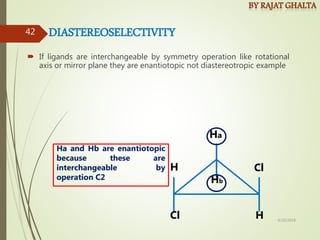
 If ligands are interchangeable by symmetry operation like rotational
axis or mirror plane they are enantiotopic not diastereotropic example
DIASTEREOSELECTIVITY
Cl
H
Hb
H
Ha
Cl
Ha and Hb are enantiotopic
because these are
interchangeable by
operation C2
4/10/2018
42
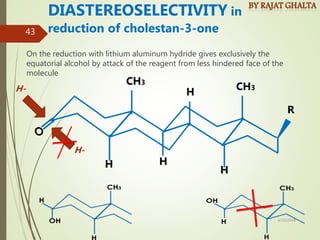
On the reduction with lithium aluminum hydride gives exclusively the
equatorial alcohol by attack of the reagent from less hindered face of the
molecule
DIASTEREOSELECTIVITY in
reduction of cholestan-3-one
H H
H
H
CH3
CH3
R
H-
H-
4/10/2018
43
Nucleophilic attack on acyclic carbonyl compound
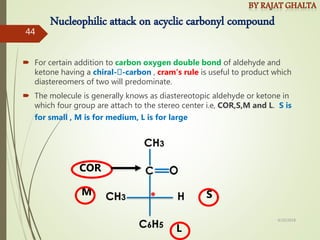
 For certain addition to carbon oxygen double bond of aldehyde and
ketone having a chiral- -carbon , cram’s rule is useful to product which
diastereomers of two will predominate.
 The molecule is generally knows as diastereotopic aldehyde or ketone in
which four group are attach to the stereo center i.e, COR,S,M and L. S is
for small , M is for medium, L is for large
L
M S
COR
4/10/2018
44
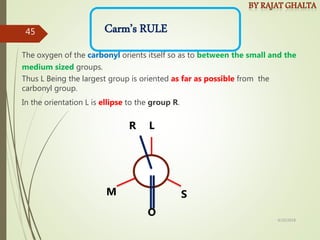
Carm’s RULE
The oxygen of the carbonyl orients itself so as to between the small and the
medium sized groups.
Thus L Being the largest group is oriented as far as possible from the
carbonyl group.
In the orientation L is ellipse to the group R.
M S
L
O
R
4/10/2018
45
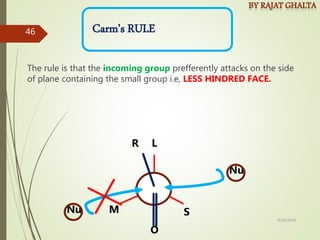
The rule is that the incoming group prefferently attacks on the side
of plane containing the small group i.e, LESS HINDRED FACE.
Carm’s RULE
M S
L
O
R
Nu
Nu
4/10/2018
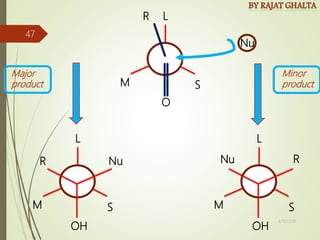
46
M S
L
R
Nu
M S
L
OH
R
O
Nu
M S
L
OH
R
Nu
Major
product
Minor
product
4/10/2018
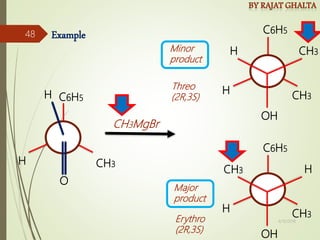
47
H CH3
C6H5
H
O
OH
H CH3
C6H5
H CH3
OH
H
CH3
C6H5
H CH3
CH3MgBr
Major
product
Minor
product
Example
Erythro
(2R,3S)
Threo
(2R,3S)
4/10/2018
48
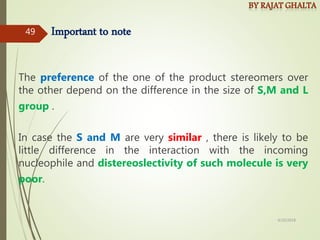
Important to note
The preference of the one of the product stereomers over
the other depend on the difference in the size of S,M and L
group .
In case the S and M are very similar , there is likely to be
little difference in the interaction with the incoming
nucleophile and distereoslectivity of such molecule is very
poor.
4/10/2018
49
 Stereo selectivity
Regio selectivity
Chemo selectivity
Diastereo selectivity
Cram’s Rule
Felkin Anh Model
CONTENTS
4/10/2018
50
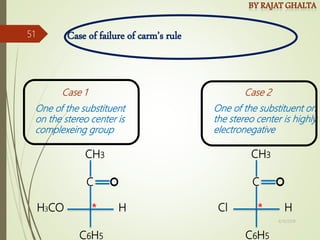
Case of failure of carm’s rule
Case 1 Case 2
One of the substituent
on the stereo center is
complexeing group
One of the substituent on
the stereo center is highly
electronegative
CH3
C6H5
H3CO H
C
*
CH3
C6H5
Cl H
C
*
4/10/2018
51
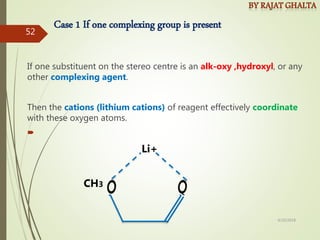
Case 1 If one complexing group is present
If one substituent on the stereo centre is an alk-oxy ,hydroxyl, or any
other complexing agent.
Then the cations (lithium cations) of reagent effectively coordinate
with these oxygen atoms.

CH3
Li+
4/10/2018
52
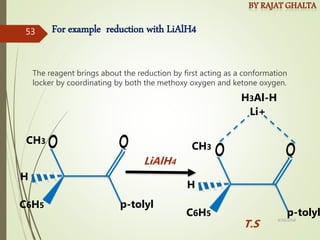
For example reduction with LiAlH4
The reagent brings about the reduction by first acting as a conformation
locker by coordinating by both the methoxy oxygen and ketone oxygen.
CH3
C6H5 p-tolyl
H
Li+
CH3
C6H5 p-tolyl
H
LiAlH4
H3Al-H
T.S
4/10/2018
53
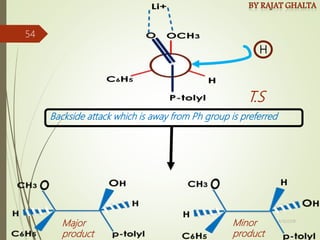
H
T.S
Backside attack which is away from Ph group is preferred
Minor
product
Major
product
4/10/2018
54
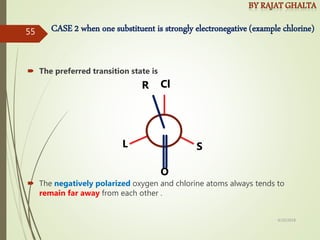
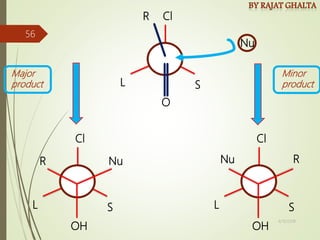
CASE 2 when one substituent is strongly electronegative (example chlorine)
 The preferred transition state is
 The negatively polarized oxygen and chlorine atoms always tends to
remain far away from each other .
L S
Cl
O
R
4/10/2018
55
L S
Cl
R
Nu
L S
Cl
OH
R
O
Nu
L S
Cl
OH
R
Nu
Major
product
Minor
product
4/10/2018
56
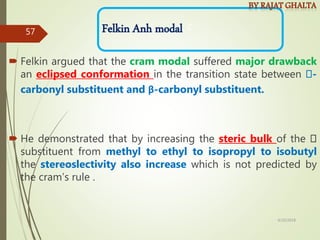
 Felkin argued that the cram modal suffered major drawback
an eclipsed conformation in the transition state between -
carbonyl substituent and β-carbonyl substituent.
 He demonstrated that by increasing the steric bulk of the
substituent from methyl to ethyl to isopropyl to isobutyl
the stereoslectivity also increase which is not predicted by
the cram’s rule .
C
Felkin Anh modal
4/10/2018
57
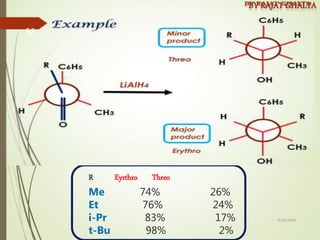
R Eyrthro Threo
Me 74% 26%
Et 76% 24%
i-Pr 83% 17%
t-Bu 98% 2%
4/10/2018
58
C
Felkin Anh modal
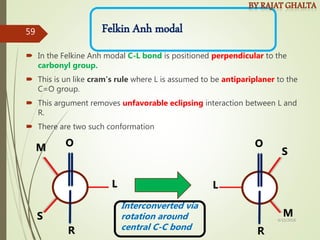
 In the Felkine Anh modal C-L bond is positioned perpendicular to the
carbonyl group.
 This is un like cram’s rule where L is assumed to be antipariplaner to the
C=O group.
 This argument removes unfavorable eclipsing interaction between L and
R.
 There are two such conformation
L
S
R
O
M
L
S
R
O
M
Interconverted via
rotation around
central C-C bond
4/10/2018
59
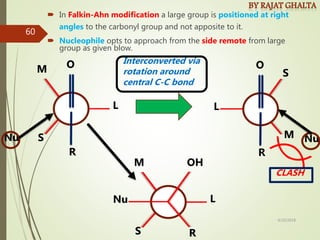
 In Falkin-Ahn modification a large group is positioned at right
angles to the carbonyl group and not apposite to it.
 Nucleophile opts to approach from the side remote from large
group as given blow.
L
S
R
O
M
L
S
R
O
M
Interconverted via
rotation around
central C-C bond
Nu Nu
L
S R
OH
M
Nu
CLASH
4/10/2018
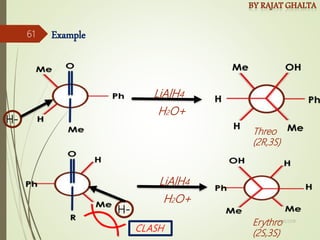
60
Example
H2O+
LiAlH4
H2O+
LiAlH4
H-
H-
CLASH
4/10/2018
61
Threo
(2R,3S)
Erythro
(2S,3S)
FACTORS AFFECTING FELKIN
AHN MODEL
Size of nucleophile greatly effects diastereo
selectivity of addition .
Larger the nucleophile generally give rise to
greater diastereoselectivity.
The size of substituent on the substrate will also
effect the diastereoselectivity
Larger group result in greater selectivity. 4/10/2018
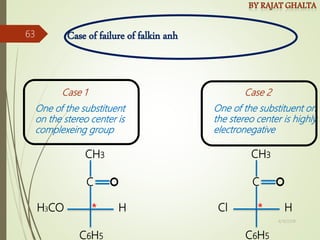
62
Case of failure of falkin anh
Case 1 Case 2
One of the substituent
on the stereo center is
complexeing group
One of the substituent on
the stereo center is highly
electronegative
CH3
C6H5
H3CO H
C
*
CH3
C6H5
Cl H
C
*
4/10/2018
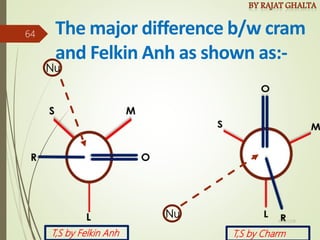
63
The major difference b/w cram
and Felkin Anh as shown as:-
Nu
Nu
T,S by Felkin Anh T,S by Charm
4/10/2018
64
4/10/2018
65
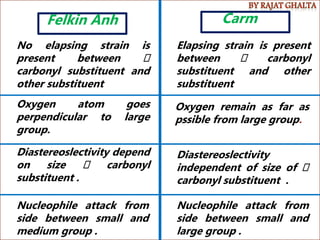
65
No elapsing strain is
present between
carbonyl substituent and
other substituent
Elapsing strain is present
between carbonyl
substituent and other
substituent
Oxygen atom goes
perpendicular to large
group.
Oxygen remain as far as
pssible from large group.
Diastereoslectivity depend
on size carbonyl
substituent .
Diastereoslectivity
independent of size of
carbonyl substituent .
Nucleophile attack from
side between small and
medium group .
Nucleophile attack from
side between small and
large group .
Felkin Anh Carm
Me
Et H O
Me
H
Et H OH
LiAlH4
(1) 3R,6S (2) 3S,6S
(2) 3R,6R (4) 3S,6R
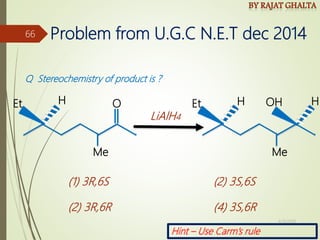
Hint – Use Carm’s rule
Q Stereochemistry of product is ?
Problem from U.G.C N.E.T dec 2014
4/10/2018
66
 Stereo selectivity(P
.S. Kalsi stereochemistry)
Regio selectivity(B.Sc.Books)
Chemo selectivity(Jagdamba singh O.S)
Diastereo selectivity(P
.S. Kalsi stereochemistry)
Cram’s Rule(P
.S. Kalsi stereochemistry)
Felkin Anh Model(P
.S. Kalsi stereochemistry)
References
4/10/2018
67
Jai hind 4/10/2018
68

Chemoselectivity and Regioselectivity.pdf

  • 1.
  • 2.
     Stereo selectivity Regioselectivity Chemo selectivity Diastereo selectivity Cram’s Rule Felkin Anh Model CONTENTS 4/10/2018 2
  • 3.
    Stereo selective Reaction A reaction where one stereoisomer of a product is formed preferential over another.  A stereo selective reaction is one in which the reactant is not necessary chiral .  Example 𝑩𝒓+ + Br2 H H 𝑩𝒓− Cyclohexene + 𝑩𝒓 H 𝑩𝒓− 𝑩𝒓− 4/10/2018 3
  • 4.
    Regioselectivity REGIOSELECTIVE REACTIONS:  Areaction which predominantly produces one of several possible structural isomers is called regioselective reactions.  Example Michel Reaction R R O 1-4 Or Michel Addition 1-2 Or Direct Addition α,β-unsaturated carbonyl compound 4/10/2018 4
  • 5.
    1,2-versus 1,4-addition inα,β- unsaturated carbonyl compounds  A no. of factors govern the direction of addition of nucleophiles to α,β-unsaturated aldehydes & ketones. some of them are  Reactivity of carbonyl group :  Since the aldehyde group are much more reactive than ketone towards nucleophile, so majority of the addition reactions are 1,2-addition reactions.  Conversely, since ketones are less reactive than aldehydes, so majority of reactions of ketones are 1,4-addition reactions. 4/10/2018 5
  • 6.
    Examples Aldehide CH2 CHC H + HCN CH2 CH CH CN O OH CH CH C H CH3 CH3 Ph 9-10 CH3MgBr/Ether H+/H2O pent-3en-2ol Acrolein Cynohydrin Acrolein But-2en-1al 4/10/2018 6
  • 7.
    Examples ketone (CH3)2NH C CH2CH CH3 O O Ph 9-10 H+ CH3 CH3 CH3 CH3 CN + C CH C CH3 + HCN Mesityl Oxide 2,2-Dimethyl-4-oxopentanenitrile But-3en-2-one 4/10/2018 7
  • 8.
    Reactivity of thereagent :  Organolithium compounds being more nucleophilic predominantly undergo 1,2-addition to a α,β-unsaturated ketones whereas Grignard reagents give mainly 1,4-addition products. CH3MgBr/Ether CH3Li/Hexane H+/H2O H+/H2O 4/10/2018 8
  • 9.
     Steric hindranceat the carbonyl group favours 1,4-addition whereas steric hindrance at 3-position favour 1,2-addition.  For example : 1,4-addition 1,2-addition 4/10/2018 9
  • 10.
     1,4-Addition orconjugate addition of Grignard reagents can be made to predominate if the reaction is carried out in presence of Cu+ ions ,cuprous chloride , CuCl or cupric acetate, Cu(OAc)2. Catalysis by cuprous salts : Cyclohex-2-en-1-one 3-Alkaylcyclohexanone 4/10/2018 10
  • 11.
     It isbelieved that under these conditions , Grignard reagent react with Cu+ ion to form alkyl copper reagent which being less reactive than Grignard reagent exclusively gives 1,4-addition products.  For similar reasons lithium dialkylcopper reagents,R2CuLi add to α,β- unsaturated aldehydes & ketones to give conjugate addition products. Catalysis by cuprous salts : Cyclohex-2-en-1-one 3-Alkaylcyclohexanone 4/10/2018 11
  • 12.
    Regioselectivity in additionof unsymmetrical alkene CH3 CH CH2 + HCl CH3 CH CH3 Cl CH3 CH2 CH2 Cl Markovnikov product Major product Minor product 4/10/2018 12
  • 13.
    Markovnikov rule  Inthe ionic addition of unsymmetrical reagent to double bond , the positive part of the adding reagent adds itself to the carbon atom of double bond gives more stable carbocation as an intermediate,  Formation of two different carbocation on addition of positive part of reagent CH3 CH CH2 + HX CH3 CH CH3 CH3 CH2 CH2 + + secondary primary 4/10/2018 13
  • 14.
     Secondary carbocationis more stable then primary carbocation due to +I effect .  +I effect dispersed the charge on carbocation which stabilizes it  Other example CH3 CH3 CH3 I HI I + + Major product Minor product 4/10/2018 14
  • 15.
    Anti-Markovnikov Addition  Anti-markovnikovaddition is observed if alkene bears a powerful electron-withdrawing group attach directly to the double bond carbon. CF3 CH CH2 + HBr CF3 CH CH3 CF3 CH2 CH2 Br Br Major product Minor product 4/10/2018 15
  • 16.
    Formation of alkeneby dehydration  Many alcohols give rise to mixture of isomeric alkenes on dehydration. But one of the alkenes formed in predominantly large amount. CH3 CH2 CHOH CH3 CH3 CH2 CH CH2 CH3 CH CH CH3 H3PO4-AL2O3 -H2O Major Minor 4/10/2018 16
  • 17.
    Explanation Saytzeff rule The preferred product is the alkene which is more highly alkylated at the double bond carbon atom.  In alkene more the no of alkyl group, grater the stablaty.  R2C= CR2 > R2C=CHR > R2C=CH2 > RCH=CH2 > CH2=CH2  The grater the number of alkyl group attached to doubly bounded carbon atom, more the number of hydrogen and grater possibility of hyperconjugation. 4/10/2018 17
  • 18.
     Reduction ofalkene Regioselectivity in But-2-yene CH3 C C CH3 C C C C CH3 CH3 CH3 CH3 H H H H Cis-But-2-ene Trans-But-2-ene 4/10/2018 18
  • 19.
    Regioselectivity in cleavageof epoxides CH3 C CH2 O CH3 CH3OH + + CH3O - CH3OH Basic Medium H+ Acidic Medium CH3 C CH2 CH3 OH CH3O CH3 C CH2 CH3 OH OCH3 2,2-Dimethyloxirene 2-Methoxy-2-Dimethylpropan-1-ol 3-Methoxy-2-Dimethylpropan-2-ol 4/10/2018 19
  • 20.
     In basicmedium Ring opening is an SN2 displacement by the nucleophile on un protonated oxirane.  As in other SN2 reaction the attack takes place at the less substituted and less hindered carbon. Explanation CH3 C CH2 O CH3 The less satirically hindered carbon undergoes SN2 attack 4/10/2018 20
  • 21.
     In acidicmedium first step is protonation of the oxygen atom.  Due to electron releasing group attached to the more substituted carbon positively charged oxygen attracts the electron pair of its bond with this carbon to grater extend then the electron pair of the bond with the less substituted carbon.  As a result, the more substituted carbon oxygen bond become weaker then the less substituted carbon oxygen bond.  Therefore ring opening take place the more substituted carbon oxygen bond. Explanation CH3 C CH2 O CH3 This weaker bond is preferentially attacked by nucleophile H+ CH3 C CH2 O CH3 H : + 4/10/2018 21
  • 22.
    CHEMO SELECTIVITY CHEMOSELECTIVITY REACTION:In a bi functional compound , if a reagent reacts with one functional group preferentially, preferentially, even though the other is apparently susceptible to the reaction conditions, the reaction is called Chemo selective.  Example:  1 the reduction of carbonyl group in presence of a cyano, nitro, alkoxycarbonyl group,  2 the acylation of an aromatic amino group in presence of a phenolic group 4/10/2018 22
  • 23.
    Example 1  Reductionof carbonyl group in presence of nitro group O2N COOH COOH O2N CH2OH CH2OH H3N H3N 4/10/2018 23
  • 24.
    Example 2  Acylationof aromatic amino group in presence of phenolic group HO NH2 HO NHCOCH3 NH2 CH3COO NHCO CH3 CH3COO 4/10/2018 24
  • 25.
     Guideline 1: when two functional groups of unequal reactivity are present in a molecule, the more reactive can always be made to react alone.  For example : let us consider synthesis of acid (1) ; the phenolate ion is more reactive than the carboxylate ion (pKa difference about 5 ) ,hence the phenol is alkylated. GUIDELINES FOR SOLVING THE PROBLEMS OF CHEMO SELECTIVITY COOH OH COO O- - I COOH O Alkali Medium 1 4/10/2018 25
  • 26.
    GUIDELINES FOR SOLVINGTHE PROBLEMS OF CHEMO SELECTIVITY  Guideline 2 :When one functional group can react twice, the starting material & the first product will compete for the product.  The reaction will be successful only if the first product is less reactive than the starting material. O Cl Ph O OH Ph Cl O Cl First product Starting material 1 4/10/2018 26
  • 27.
    GUIDELINES FOR SOLVINGTHE PROBLEMS OF CHEMO SELECTIVITY Is less reactive then Cl O Cl Conjugation with Oxygen Due to : : 4/10/2018 27
  • 28.
    GUIDELINES FOR SOLVINGTHE PROBLEMS OF CHEMO SELECTIVITY Guideline : 3  Unfavourable cases from guidelines 1 & 2 may be solved by the use of protecting groups.  Protecting group : A group whose use makes possible to react a less reactive functional group selectively in the presence of a more reactive group is known as a protecting group.  Protecting group blocks the reactivity of a functional group group by converting it into a different group which is inert to the conditions of some reaction(s) that is to be carried out as part of a synthetic route. 4/10/2018 28
  • 29.
    For example : if we make phenylmagnesium bromide to react with the less reactive ester group rather than the more reactive keto group. OEt OH Ph Ph Desired product Must not react from hare to get desired product Must react from hare to get desired product 4/10/2018 29
  • 30.
    For example : As expected ,simply adding PhMgBr to acetoacetic ester , addition to more electrophilic ketone mainly takes place. OEt OEt Ph OH 2PhMgBr H+/H2O 4/10/2018 30
  • 31.
    For example : One way of preparing the desired alcohal is to protect the ketone as a ketal, i.e, a ketal protecting group is ( dioxolane ) is used in this case. OEt H+ OH Ph Ph O O OH Ph Ph 4/10/2018 31
  • 32.
    GUIDELINES FOR SOLVINGTHE PROBLEMS OF CHEMO SELECTIVITY  Guideline 4 :  One of two identical groups may react if the product is less reactive than the starting material ,  For example : partial reduction of m-dinitrobenzene. NO2 NO2 NH2 NO2 NaHS MeOH 4/10/2018 32
  • 33.
    GUIDELINES FOR SOLVINGTHE PROBLEMS OF CHEMO SELECTIVITY  Guideline 5 :  One of two identical functional groups may react with one equivalent of of reagent using the statistical effect.  This is an unreliable method , but if successful it avoids protecting groups.  For example : the diol (1) can be monoalkylated in reasonable yield by using one equivalent of sodium in xylene to generate mostly the monoanion (2) . Na xylene EtBr 1 2 4/10/2018 33
  • 34.
    GUIDELINES FOR SOLVINGTHE PROBLEMS OF CHEMO SELECTIVITY  Guideline 6 :  A more reliable method with two identical functional groups is to use a derivative which can react only once  .  The most important example – is a cyclic anhydride.  When the anhydride has combined once with a nucleophile , e.g , to the half ester , the product is no longer reactive. Further reactions can maintain the distinction , e.g , to give half acid chloride . 4/10/2018 34
  • 35.
    GUIDELINES FOR SOLVINGTHE PROBLEMS OF CHEMO SELECTIVITY COOH COOH COOMe COOMe Ac2O MaOH SOCl2 4/10/2018 35
  • 36.
    GUIDELINES FOR SOLVINGTHE PROBLEMS OF CHEMO SELECTIVITY  Guideline 7:  When two groups are nearly but not quite identical , as in (8) & (9) , avoid attemps , to make only one of them react. OH OH OMe OH OH OH OMe OH Bese Bese MeI MeI 4/10/2018 36
  • 37.
    DIASTEREOSELECTIVITY  Distereomers arethe stereoisomers that are not mirror image of each other i.e, diastereomers are stereo isomers that are not enantiomers.  Example tartaric acid have two enantiomers and miso tartaric acid is distereomers of both enantiomers 2R,3R 2S,3S 2R,3S Enantiomers 4/10/2018 37
  • 38.
    DIASTEREOSELECTIVITY  A Diatereoselectivereaction is one in which one diastereomer is formed in preference to another CH3 C6H5 CH3 H C * HO CN CH3 C6H5 CH3 H OH CN CH3 C6H5 CH3 H + HCN Distereomers 4/10/2018 38
  • 39.
    DIASTEREOSELECTIVITY  Diastereotopic ligandsWhen the replacement of either of the two homomorphic ligands by different test ligand gives diastereomers then such ligands are terms as diastereotopic. Cl H CH3 Cl H H Cl H CH3 Cl Z H Cl H CH3 Cl H Z Distereomers replace 4/10/2018 39
  • 40.
    DIASTEREOSELECTIVITY  The twofaces of carbonyl group close to a stereocenter are diastereotopic.  Thus addition of HCN to methyl- -phenethylketone gives diastereomers. CH3 C6H5 CH3 H C * HO CN CH3 C6H5 CH3 H OH CN CH3 C6H5 CH3 H + HCN Distereomers 4/10/2018 40
  • 41.
     Similarly achirial4-t-butylcyclohexanone has diastereotopic faces since addition of hydride occur from axial or equatorial side to give duastereomers. + H- DIASTEREOSELECTIVITY 4-t-butylcyclohexanone (achiral) Trans-4-t-butylcyclohexanol Cis-4-t-butylcyclohexanol 4/10/2018 41
  • 42.
     If ligandsare interchangeable by symmetry operation like rotational axis or mirror plane they are enantiotopic not diastereotropic example DIASTEREOSELECTIVITY Cl H Hb H Ha Cl Ha and Hb are enantiotopic because these are interchangeable by operation C2 4/10/2018 42
  • 43.
    On the reductionwith lithium aluminum hydride gives exclusively the equatorial alcohol by attack of the reagent from less hindered face of the molecule DIASTEREOSELECTIVITY in reduction of cholestan-3-one H H H H CH3 CH3 R H- H- 4/10/2018 43
  • 44.
    Nucleophilic attack onacyclic carbonyl compound  For certain addition to carbon oxygen double bond of aldehyde and ketone having a chiral- -carbon , cram’s rule is useful to product which diastereomers of two will predominate.  The molecule is generally knows as diastereotopic aldehyde or ketone in which four group are attach to the stereo center i.e, COR,S,M and L. S is for small , M is for medium, L is for large L M S COR 4/10/2018 44
  • 45.
    Carm’s RULE The oxygenof the carbonyl orients itself so as to between the small and the medium sized groups. Thus L Being the largest group is oriented as far as possible from the carbonyl group. In the orientation L is ellipse to the group R. M S L O R 4/10/2018 45
  • 46.
    The rule isthat the incoming group prefferently attacks on the side of plane containing the small group i.e, LESS HINDRED FACE. Carm’s RULE M S L O R Nu Nu 4/10/2018 46
  • 47.
    M S L R Nu M S L OH R O Nu MS L OH R Nu Major product Minor product 4/10/2018 47
  • 48.
    H CH3 C6H5 H O OH H CH3 C6H5 HCH3 OH H CH3 C6H5 H CH3 CH3MgBr Major product Minor product Example Erythro (2R,3S) Threo (2R,3S) 4/10/2018 48
  • 49.
    Important to note Thepreference of the one of the product stereomers over the other depend on the difference in the size of S,M and L group . In case the S and M are very similar , there is likely to be little difference in the interaction with the incoming nucleophile and distereoslectivity of such molecule is very poor. 4/10/2018 49
  • 50.
     Stereo selectivity Regioselectivity Chemo selectivity Diastereo selectivity Cram’s Rule Felkin Anh Model CONTENTS 4/10/2018 50
  • 51.
    Case of failureof carm’s rule Case 1 Case 2 One of the substituent on the stereo center is complexeing group One of the substituent on the stereo center is highly electronegative CH3 C6H5 H3CO H C * CH3 C6H5 Cl H C * 4/10/2018 51
  • 52.
    Case 1 Ifone complexing group is present If one substituent on the stereo centre is an alk-oxy ,hydroxyl, or any other complexing agent. Then the cations (lithium cations) of reagent effectively coordinate with these oxygen atoms.  CH3 Li+ 4/10/2018 52
  • 53.
    For example reductionwith LiAlH4 The reagent brings about the reduction by first acting as a conformation locker by coordinating by both the methoxy oxygen and ketone oxygen. CH3 C6H5 p-tolyl H Li+ CH3 C6H5 p-tolyl H LiAlH4 H3Al-H T.S 4/10/2018 53
  • 54.
    H T.S Backside attack whichis away from Ph group is preferred Minor product Major product 4/10/2018 54
  • 55.
    CASE 2 whenone substituent is strongly electronegative (example chlorine)  The preferred transition state is  The negatively polarized oxygen and chlorine atoms always tends to remain far away from each other . L S Cl O R 4/10/2018 55
  • 56.
    L S Cl R Nu L S Cl OH R O Nu LS Cl OH R Nu Major product Minor product 4/10/2018 56
  • 57.
     Felkin arguedthat the cram modal suffered major drawback an eclipsed conformation in the transition state between - carbonyl substituent and β-carbonyl substituent.  He demonstrated that by increasing the steric bulk of the substituent from methyl to ethyl to isopropyl to isobutyl the stereoslectivity also increase which is not predicted by the cram’s rule . C Felkin Anh modal 4/10/2018 57
  • 58.
    R Eyrthro Threo Me74% 26% Et 76% 24% i-Pr 83% 17% t-Bu 98% 2% 4/10/2018 58
  • 59.
    C Felkin Anh modal In the Felkine Anh modal C-L bond is positioned perpendicular to the carbonyl group.  This is un like cram’s rule where L is assumed to be antipariplaner to the C=O group.  This argument removes unfavorable eclipsing interaction between L and R.  There are two such conformation L S R O M L S R O M Interconverted via rotation around central C-C bond 4/10/2018 59
  • 60.
     In Falkin-Ahnmodification a large group is positioned at right angles to the carbonyl group and not apposite to it.  Nucleophile opts to approach from the side remote from large group as given blow. L S R O M L S R O M Interconverted via rotation around central C-C bond Nu Nu L S R OH M Nu CLASH 4/10/2018 60
  • 61.
  • 62.
    FACTORS AFFECTING FELKIN AHNMODEL Size of nucleophile greatly effects diastereo selectivity of addition . Larger the nucleophile generally give rise to greater diastereoselectivity. The size of substituent on the substrate will also effect the diastereoselectivity Larger group result in greater selectivity. 4/10/2018 62
  • 63.
    Case of failureof falkin anh Case 1 Case 2 One of the substituent on the stereo center is complexeing group One of the substituent on the stereo center is highly electronegative CH3 C6H5 H3CO H C * CH3 C6H5 Cl H C * 4/10/2018 63
  • 64.
    The major differenceb/w cram and Felkin Anh as shown as:- Nu Nu T,S by Felkin Anh T,S by Charm 4/10/2018 64
  • 65.
    4/10/2018 65 65 No elapsing strainis present between carbonyl substituent and other substituent Elapsing strain is present between carbonyl substituent and other substituent Oxygen atom goes perpendicular to large group. Oxygen remain as far as pssible from large group. Diastereoslectivity depend on size carbonyl substituent . Diastereoslectivity independent of size of carbonyl substituent . Nucleophile attack from side between small and medium group . Nucleophile attack from side between small and large group . Felkin Anh Carm
  • 66.
    Me Et H O Me H EtH OH LiAlH4 (1) 3R,6S (2) 3S,6S (2) 3R,6R (4) 3S,6R Hint – Use Carm’s rule Q Stereochemistry of product is ? Problem from U.G.C N.E.T dec 2014 4/10/2018 66
  • 67.
     Stereo selectivity(P .S.Kalsi stereochemistry) Regio selectivity(B.Sc.Books) Chemo selectivity(Jagdamba singh O.S) Diastereo selectivity(P .S. Kalsi stereochemistry) Cram’s Rule(P .S. Kalsi stereochemistry) Felkin Anh Model(P .S. Kalsi stereochemistry) References 4/10/2018 67
  • 68.