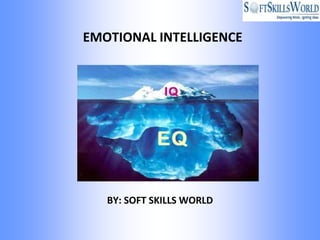
EMOTIONAL INTELLIGENCE


   BY: SOFT SKILLS WORLD
What is Intelligence?


• Typically focused on
   –   analytic reasoning
   –   verbal skills
   –   spatial ability
   –   attention
   –   memory
   –   judgement
• Murky concept with
  definitions by many
  experts...
What is Emotional Intelligence?

                    EI – “Street Smarts”

• Not aptitude, vocational interest, or personality
• Can be improved by coaching, training and experiences


           A program for intra and inter
           personal effectiveness of the
                       people
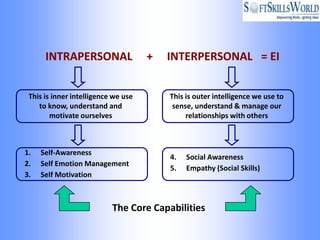
INTRAPERSONAL                  +   INTERPERSONAL = EI


 This is inner intelligence we use       This is outer intelligence we use to
    to know, understand and               sense, understand & manage our
        motivate ourselves                    relationships with others


1.   Self-Awareness
                                         4.   Social Awareness
2.   Self Emotion Management
                                         5.   Empathy (Social Skills)
3.   Self Motivation


                           The Core Capabilities
Short Clip on EI Vs IQ
Difference Between EQ and IQ

 IQ has been the traditional measure of ‘intelligence’ i.e.
  technical skills

 EQ means - how well a person can perform in a particular job.
  It is the capacity to recognize our own feelings and feelings of
  others, to motivate ourselves, and to manage our emotions
  and our relationship

 EQ has two major dimensions of competence:
      1. Personal Competencies
      2. Social Competencies
Another viewpoint for
   Emotional Intelligence (EI)?


The capacity for recognizing our own
feelings and those of others, for motivating
ourselves, and for managing emotions well
in ourselves and in our relationships.


                          •“Being nice”
                         •Letting feelings
                             hang out”
Personal Competence
(How well we manage ourselves)


 There are three components of Personal Competence
       I.    Self-Awareness
       II.   Self-Regulation
       III. Motivation

 Know one’s own strengths and limitations
 Focus on professional and personal improvement
 Look for opportunities to improve a development area
 Seek feedback from staff, at all levels
 Acknowledge strengths, personal attributes as well as
  areas for improvement
 Capable of showing restraint when working under
  conditions of stress, frustration and tension

 Maintain a balance between one’s professional and
  personal lives

 Know when and how to say “No”

 Be open to candid feedback, continuous learning and self-
  development

 Thirst for constructive criticism

 Present oneself with self-assurance
Value of taking time for self- awareness
                 requires abilities
• To recognize appropriate body cues and emotions
• To label cues and emotions accurately
• To stay open to unpleasant as well as pleasant
  emotions
• Includes the capacity for experiencing and
  recognizing multiple and conflicting emotions
 Manage one’s impulsive feelings and distressing emotions
  during stressful situations by staying calm and composed
 Build trust by demonstrating reliability
 Admit one’s own mistakes and assume responsibility for
  them.
 Take tough, principled stands, even if they are unpopular
 Follow through on promises and commitments
 Tactfully confront other colleagues, if their behavior is less
  than ethical
 A passion to reach goals with energy
 Maintain a result-oriented, high drive in order to meet
  standards and objectives
 Make sacrifices and contributions above and beyond
  the call of normal duty to meet larger organizational
  goals
 Take pride in and be passionate above your own work
 Deviate from established rules and procedures, when
  necessary, to get the job done
 Mobilize others, through extraordinary, enterprising
  efforts
 Persist in reaching goals, despite obstacles and
  setbacks
Social Competence
It has two competencies


     I.    Social Awareness / Empathy – Understanding others’
           feelings and concerns and treating them accordingly

     II.   Social Skills – Ability to find common ground and
           building rapport to induce desirable responses in
           others
 Be attentive to emotional signals, listen well, be
  sensitive and understanding of others’ perspectives

 Offer to help out based on an understanding of others’
  needs and feelings.

 Give timely and regular guidance / coaching

 Seek ways to increase colleagues’ satisfaction and
  loyalty
 Respect and relate well to individuals of varied
  backgrounds

 Understand diverse work views and be sensitive to
  group difference

 Generously and gladly offer appropriate assistance

 Challenge others’ biases and intolerances

 Understand a colleague’s perspectives and act as a
  trusted advisor
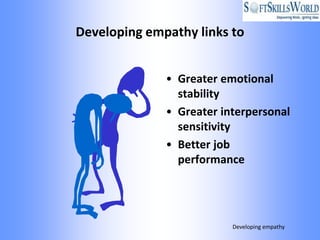
Developing empathy links to


              • Greater emotional
                stability
              • Greater interpersonal
                sensitivity
              • Better job
                performance


                          Developing empathy
 Develop skills at influencing and winning people over

 Seek mutual understanding

 Welcome the sharing of information, plans and
  resources with other colleagues fully

 Deal with difficult issues in a straightforward manner

 Foster open communication, stay open-minded to
  negative, as well as positive news.
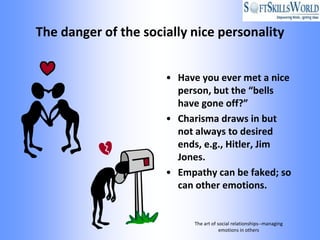
The danger of the socially nice personality


                      • Have you ever met a nice
                        person, but the “bells
                        have gone off?”
                      • Charisma draws in but
                        not always to desired
                        ends, e.g., Hitler, Jim
                        Jones.
                      • Empathy can be faked; so
                        can other emotions.


                           The art of social relationships--managing
                                       emotions in others
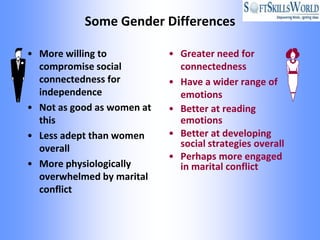
Some Gender Differences

• More willing to           • Greater need for
  compromise social           connectedness
  connectedness for         • Have a wider range of
  independence                emotions
• Not as good as women at   • Better at reading
  this                        emotions
• Less adept than women     • Better at developing
  overall                     social strategies overall
                            • Perhaps more engaged
• More physiologically        in marital conflict
  overwhelmed by marital
  conflict
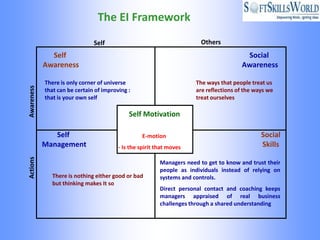
The EI Framework
                               Self                                      Others
              Self                                                                       Social
            Awareness                                                                   Awareness

            There is only corner of universe                           The ways that people treat us
Awareness


            that can be certain of improving :                         are reflections of the ways we
            that is your own self                                      treat ourselves

                                             Self Motivation

               Self                               E-motion                                      Social
            Management                   - Is the spirit that moves                             Skills
Actions


                                                          Managers need to get to know and trust their
                                                          people as individuals instead of relying on
               There is nothing either good or bad        systems and controls.
               but thinking makes It so
                                                          Direct personal contact and coaching keeps
                                                          managers appraised of real business
                                                          challenges through a shared understanding
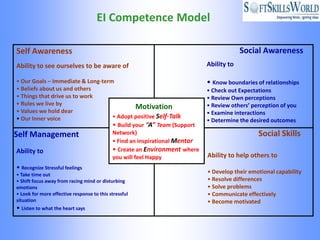
EI Competence Model

Self Awareness                                                                    Social Awareness
Ability to see ourselves to be aware of                              Ability to

 • Our Goals – Immediate & Long-term                                 • Know boundaries of relationships
 • Beliefs about us and others                                       • Check out Expectations
 • Things that drive us to work                                      • Review Own perceptions
 • Rules we live by                                                  • Review others’ perception of you
                                              Motivation
 • Values we hold dear                                               • Examine interactions
 • Our Inner voice                  • Adopt positive Self-Talk
                                                                     • Determine the desired outcomes
                                    • Build your “A” Team (Support
Self Management                     Network)                                            Social Skills
                                    • Find an inspirational Mentor
 Ability to                         • Create an Environment where
                                    you will feel Happy              Ability to help others to
• Recognize Stressful feelings
• Take time out
                                                                     • Develop their emotional capability
• Shift focus away from racing mind or disturbing                    • Resolve differences
emotions                                                             • Solve problems
• Look for more effective response to this stressful                 • Communicate effectively
situation                                                            • Become motivated
• Listen to what the heart says
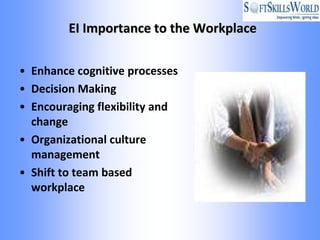
EI Importance to the Workplace

• Enhance cognitive processes
• Decision Making
• Encouraging flexibility and
  change
• Organizational culture
  management
• Shift to team based
  workplace
Importance of EI in Organizations

 The higher you go, the more EI matters--the more SOCIAL
  COMPETENCE matters
• Workplace EQ traits
   – influence, communication, leadership, change catalyst, conflict
     management, building bonds, collaboration and cooperation;
     team capabilities
• Army Values
   – leadership, duty, respect, selfless service, honor, integrity,
     personal courage
Importance of EI to Organizations, too

• 50% of work satisfaction is determined by the
  relationship a worker has with… his/her boss.
• EI is a prerequisite for effective leadership across
  borders.
   – Requires a high level of self-mastery and people skills;
     ability to put yourself into the positions of others.
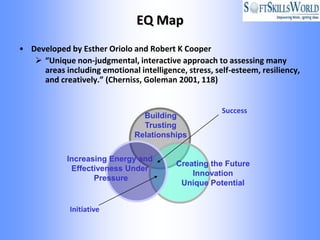
EQ Map
• Developed by Esther Oriolo and Robert K Cooper
    “Unique non-judgmental, interactive approach to assessing many
     areas including emotional intelligence, stress, self-esteem, resiliency,
     and creatively.” (Cherniss, Goleman 2001, 118)


                                                       Success
                                 Building
                                 Trusting
                               Relationships


             Increasing Energy and
                                           Creating the Future
              Effectiveness Under
                                               Innovation
                    Pressure
                                            Unique Potential


             Initiative
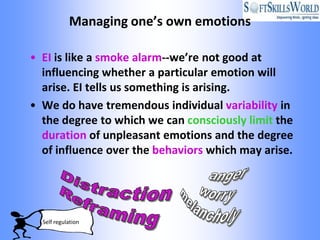
Managing one’s own emotions

• EI is like a smoke alarm--we’re not good at
  influencing whether a particular emotion will
  arise. EI tells us something is arising.
• We do have tremendous individual variability in
  the degree to which we can consciously limit the
  duration of unpleasant emotions and the degree
  of influence over the behaviors which may arise.


  Self regulation
Out of control emotions


• Impair reasoning (even smart people sometimes act
  stupidly)
• May increase the likelihood that chronic emotional
  problems will result, (e.g., clinical depression or chronic
  anxiety or hostility)


                                               Managing one’s own emotions
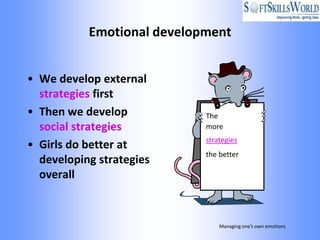
Emotional development


• We develop external
  strategies first
• Then we develop           The
  social strategies         more
                            strategies
• Girls do better at
                            the better
  developing strategies
  overall


                                Managing one’s own emotions
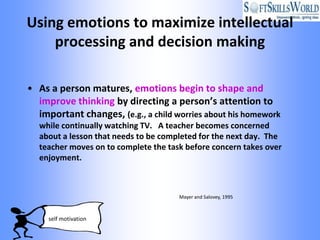
Using emotions to maximize intellectual
    processing and decision making

• As a person matures, emotions begin to shape and
  improve thinking by directing a person’s attention to
  important changes, (e.g., a child worries about his homework
  while continually watching TV. A teacher becomes concerned
  about a lesson that needs to be completed for the next day. The
  teacher moves on to complete the task before concern takes over
  enjoyment.


                                      Mayer and Salovey, 1995


     self motivation
Utilizing mild emotional swings to perform
       one’s options more effectively

 • “Gut feeling” can be used to effectively guide
   decisions--a neurological understanding of how
   unconscious and conscious gut feelings guide
   decisions, e.g., when prioritizing, emotions help
   move the decisions.
 • Harness emotions to promote or hinder
 motivation. (Anxiety, hostility, sadness)
 • Emotional swings to increase the accuracy
   of one’s perspective on future events.


                     Using emotions to maximize intellectual processing and decision making
What is Your EQ???

 Let’s Have a Test
There are instruments to measure EI...

•   Take time for mindfulness
•   Recognize and name emotions
•   ID the causes of feelings
•   Differentiate having the
    emotion and doing something
    about it
•   Learn optimism to challenge
    distortion
•   Learn distraction techniques
•   Listen to voice of experience
•   Develop Listening skills
Advantages of Using EI


• Paper appearances can be deceiving
• Candidates aware of emphasis placed on
  emotional intelligence within the organization
• IQ can indicate what profession an individual
  can hold, EQ will be a more powerful predictor
  of performance
Disadvantages of Using EI


• EI dependent on situational factors
• Assumes stability across all situations
• Length of testing – sufficient proof?
• Congruency between self-evaluation and recruiter
  evaluation
• Certain jobs not dependent on level of Emotional
  Intelligence
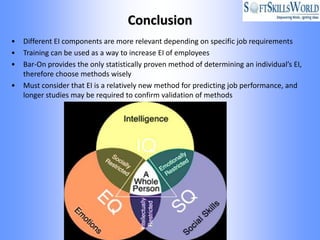
Conclusion
•   Different EI components are more relevant depending on specific job requirements
•   Training can be used as a way to increase EI of employees
•   Bar-On provides the only statistically proven method of determining an individual’s EI,
    therefore choose methods wisely
•   Must consider that EI is a relatively new method for predicting job performance, and
    longer studies may be required to confirm validation of methods
Tan Q

Emotional intelligence

  • 1.
    EMOTIONAL INTELLIGENCE BY: SOFT SKILLS WORLD
  • 2.
    What is Intelligence? •Typically focused on – analytic reasoning – verbal skills – spatial ability – attention – memory – judgement • Murky concept with definitions by many experts...
  • 3.
    What is EmotionalIntelligence? EI – “Street Smarts” • Not aptitude, vocational interest, or personality • Can be improved by coaching, training and experiences A program for intra and inter personal effectiveness of the people
  • 4.
    INTRAPERSONAL + INTERPERSONAL = EI This is inner intelligence we use This is outer intelligence we use to to know, understand and sense, understand & manage our motivate ourselves relationships with others 1. Self-Awareness 4. Social Awareness 2. Self Emotion Management 5. Empathy (Social Skills) 3. Self Motivation The Core Capabilities
  • 5.
    Short Clip onEI Vs IQ
  • 6.
    Difference Between EQand IQ  IQ has been the traditional measure of ‘intelligence’ i.e. technical skills  EQ means - how well a person can perform in a particular job. It is the capacity to recognize our own feelings and feelings of others, to motivate ourselves, and to manage our emotions and our relationship  EQ has two major dimensions of competence: 1. Personal Competencies 2. Social Competencies
  • 7.
    Another viewpoint for Emotional Intelligence (EI)? The capacity for recognizing our own feelings and those of others, for motivating ourselves, and for managing emotions well in ourselves and in our relationships. •“Being nice” •Letting feelings hang out”
  • 8.
    Personal Competence (How wellwe manage ourselves)  There are three components of Personal Competence I. Self-Awareness II. Self-Regulation III. Motivation  Know one’s own strengths and limitations
  • 9.
     Focus onprofessional and personal improvement  Look for opportunities to improve a development area  Seek feedback from staff, at all levels  Acknowledge strengths, personal attributes as well as areas for improvement
  • 10.
     Capable ofshowing restraint when working under conditions of stress, frustration and tension  Maintain a balance between one’s professional and personal lives  Know when and how to say “No”  Be open to candid feedback, continuous learning and self- development  Thirst for constructive criticism  Present oneself with self-assurance
  • 11.
    Value of takingtime for self- awareness requires abilities • To recognize appropriate body cues and emotions • To label cues and emotions accurately • To stay open to unpleasant as well as pleasant emotions • Includes the capacity for experiencing and recognizing multiple and conflicting emotions
  • 12.
     Manage one’simpulsive feelings and distressing emotions during stressful situations by staying calm and composed  Build trust by demonstrating reliability  Admit one’s own mistakes and assume responsibility for them.  Take tough, principled stands, even if they are unpopular  Follow through on promises and commitments  Tactfully confront other colleagues, if their behavior is less than ethical
  • 13.
     A passionto reach goals with energy  Maintain a result-oriented, high drive in order to meet standards and objectives  Make sacrifices and contributions above and beyond the call of normal duty to meet larger organizational goals  Take pride in and be passionate above your own work  Deviate from established rules and procedures, when necessary, to get the job done  Mobilize others, through extraordinary, enterprising efforts  Persist in reaching goals, despite obstacles and setbacks
  • 14.
    Social Competence It hastwo competencies I. Social Awareness / Empathy – Understanding others’ feelings and concerns and treating them accordingly II. Social Skills – Ability to find common ground and building rapport to induce desirable responses in others
  • 15.
     Be attentiveto emotional signals, listen well, be sensitive and understanding of others’ perspectives  Offer to help out based on an understanding of others’ needs and feelings.  Give timely and regular guidance / coaching  Seek ways to increase colleagues’ satisfaction and loyalty
  • 16.
     Respect andrelate well to individuals of varied backgrounds  Understand diverse work views and be sensitive to group difference  Generously and gladly offer appropriate assistance  Challenge others’ biases and intolerances  Understand a colleague’s perspectives and act as a trusted advisor
  • 17.
    Developing empathy linksto • Greater emotional stability • Greater interpersonal sensitivity • Better job performance Developing empathy
  • 18.
     Develop skillsat influencing and winning people over  Seek mutual understanding  Welcome the sharing of information, plans and resources with other colleagues fully  Deal with difficult issues in a straightforward manner  Foster open communication, stay open-minded to negative, as well as positive news.
  • 19.
    The danger ofthe socially nice personality • Have you ever met a nice person, but the “bells have gone off?” • Charisma draws in but not always to desired ends, e.g., Hitler, Jim Jones. • Empathy can be faked; so can other emotions. The art of social relationships--managing emotions in others
  • 20.
    Some Gender Differences •More willing to • Greater need for compromise social connectedness connectedness for • Have a wider range of independence emotions • Not as good as women at • Better at reading this emotions • Less adept than women • Better at developing overall social strategies overall • Perhaps more engaged • More physiologically in marital conflict overwhelmed by marital conflict
  • 21.
    The EI Framework Self Others Self Social Awareness Awareness There is only corner of universe The ways that people treat us Awareness that can be certain of improving : are reflections of the ways we that is your own self treat ourselves Self Motivation Self E-motion Social Management - Is the spirit that moves Skills Actions Managers need to get to know and trust their people as individuals instead of relying on There is nothing either good or bad systems and controls. but thinking makes It so Direct personal contact and coaching keeps managers appraised of real business challenges through a shared understanding
  • 22.
    EI Competence Model SelfAwareness Social Awareness Ability to see ourselves to be aware of Ability to • Our Goals – Immediate & Long-term • Know boundaries of relationships • Beliefs about us and others • Check out Expectations • Things that drive us to work • Review Own perceptions • Rules we live by • Review others’ perception of you Motivation • Values we hold dear • Examine interactions • Our Inner voice • Adopt positive Self-Talk • Determine the desired outcomes • Build your “A” Team (Support Self Management Network) Social Skills • Find an inspirational Mentor Ability to • Create an Environment where you will feel Happy Ability to help others to • Recognize Stressful feelings • Take time out • Develop their emotional capability • Shift focus away from racing mind or disturbing • Resolve differences emotions • Solve problems • Look for more effective response to this stressful • Communicate effectively situation • Become motivated • Listen to what the heart says
  • 23.
    EI Importance tothe Workplace • Enhance cognitive processes • Decision Making • Encouraging flexibility and change • Organizational culture management • Shift to team based workplace
  • 24.
    Importance of EIin Organizations  The higher you go, the more EI matters--the more SOCIAL COMPETENCE matters • Workplace EQ traits – influence, communication, leadership, change catalyst, conflict management, building bonds, collaboration and cooperation; team capabilities • Army Values – leadership, duty, respect, selfless service, honor, integrity, personal courage
  • 25.
    Importance of EIto Organizations, too • 50% of work satisfaction is determined by the relationship a worker has with… his/her boss. • EI is a prerequisite for effective leadership across borders. – Requires a high level of self-mastery and people skills; ability to put yourself into the positions of others.
  • 26.
    EQ Map • Developedby Esther Oriolo and Robert K Cooper  “Unique non-judgmental, interactive approach to assessing many areas including emotional intelligence, stress, self-esteem, resiliency, and creatively.” (Cherniss, Goleman 2001, 118) Success Building Trusting Relationships Increasing Energy and Creating the Future Effectiveness Under Innovation Pressure Unique Potential Initiative
  • 27.
    Managing one’s ownemotions • EI is like a smoke alarm--we’re not good at influencing whether a particular emotion will arise. EI tells us something is arising. • We do have tremendous individual variability in the degree to which we can consciously limit the duration of unpleasant emotions and the degree of influence over the behaviors which may arise. Self regulation
  • 28.
    Out of controlemotions • Impair reasoning (even smart people sometimes act stupidly) • May increase the likelihood that chronic emotional problems will result, (e.g., clinical depression or chronic anxiety or hostility) Managing one’s own emotions
  • 29.
    Emotional development • Wedevelop external strategies first • Then we develop The social strategies more strategies • Girls do better at the better developing strategies overall Managing one’s own emotions
  • 30.
    Using emotions tomaximize intellectual processing and decision making • As a person matures, emotions begin to shape and improve thinking by directing a person’s attention to important changes, (e.g., a child worries about his homework while continually watching TV. A teacher becomes concerned about a lesson that needs to be completed for the next day. The teacher moves on to complete the task before concern takes over enjoyment. Mayer and Salovey, 1995 self motivation
  • 31.
    Utilizing mild emotionalswings to perform one’s options more effectively • “Gut feeling” can be used to effectively guide decisions--a neurological understanding of how unconscious and conscious gut feelings guide decisions, e.g., when prioritizing, emotions help move the decisions. • Harness emotions to promote or hinder motivation. (Anxiety, hostility, sadness) • Emotional swings to increase the accuracy of one’s perspective on future events. Using emotions to maximize intellectual processing and decision making
  • 32.
    What is YourEQ??? Let’s Have a Test
  • 34.
    There are instrumentsto measure EI... • Take time for mindfulness • Recognize and name emotions • ID the causes of feelings • Differentiate having the emotion and doing something about it • Learn optimism to challenge distortion • Learn distraction techniques • Listen to voice of experience • Develop Listening skills
  • 35.
    Advantages of UsingEI • Paper appearances can be deceiving • Candidates aware of emphasis placed on emotional intelligence within the organization • IQ can indicate what profession an individual can hold, EQ will be a more powerful predictor of performance
  • 36.
    Disadvantages of UsingEI • EI dependent on situational factors • Assumes stability across all situations • Length of testing – sufficient proof? • Congruency between self-evaluation and recruiter evaluation • Certain jobs not dependent on level of Emotional Intelligence
  • 37.
    Conclusion • Different EI components are more relevant depending on specific job requirements • Training can be used as a way to increase EI of employees • Bar-On provides the only statistically proven method of determining an individual’s EI, therefore choose methods wisely • Must consider that EI is a relatively new method for predicting job performance, and longer studies may be required to confirm validation of methods
  • 38.

Editor's Notes

  • #27 Managing feelings so that they are expressed appropriately and effectively, enabling people to work together smoothly towards their common goals