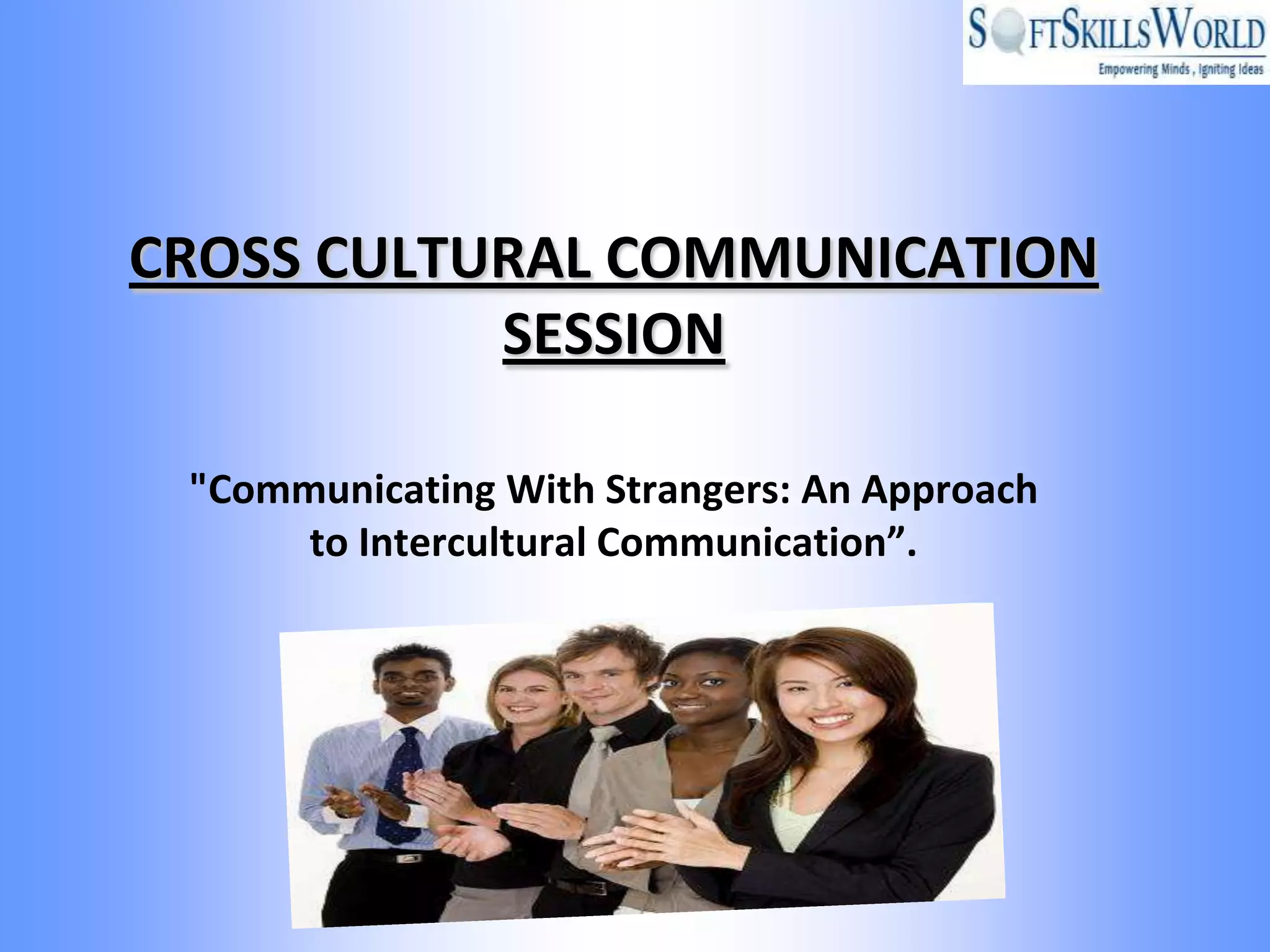
CROSS CULTURAL COMMUNICATION
           SESSION

 "Communicating With Strangers: An Approach
      to Intercultural Communication”.
CULTURE DEFINED

• Culture is a group which shapes a person's values and
  identity. Cultural identities can stem from the following
  differences: race, ethnicity, gender, class, religion, country
  of origin, and geographic region

• The collection of values, beliefs, behaviors, customs, and
  attitudes that distinguish a society

• Its core is to establish and understand how people from
  different cultures communicate with each other
Corporate Culture


• The beliefs and values shared by people who work
  in an organisation
  – How people behave with each other
  – How people behave with customers/clients
  – How people view their relationship with stakeholders
  – People’s responses to energy use, community
    involvement, absence, work ethic, etc.
  – How the organisation behaves to its employees –
    training, professional development, etc.
Corporate Culture


• May be reflected in:
  – Attitude and behaviour of the leadership
  – Attitude to the role of individuals in the workplace –
    open plan offices, team based working, etc.
  – Logo of the organisation
  – The image it presents to the outside world
  – Its attitude to change
Corporate Culture


• May be driven by:
• Vision – where the organisation wants to go in the future
• Mission Statement – summary
  of the beliefs of the organisation and where it is now
CULTURAL CONFLICTS IN WORKPLACE

• Cultural conflicts arise because of the differences in values
  and norms of behavior of people from different cultures. A
  person acts according to the values and norms of his or her
  culture; another person holding a different worldview might
  interpret his or her behavior from an opposite standpoint.
  This situation creates misunderstanding and can lead to
  conflict.
CROSS-CULTURAL COMMUNICATION

• We communicate the way we do because we are raised in a
  particular culture and learn its language, rules, and norms.
  Different cultures (and subcultures) may have different rules
  and norms. Understanding the other's culture facilitates
  cross-cultural communication.
Determinants Of Cultural Differences


• Power Distance

• Masculinity v/s Feminism

• Individualism v/s Collectivism
Impact Of Cultural Differences


• Motivational Factors

• Organisational Structure and Design

• Cultural Shock

• Loneliness
Cultural Differences
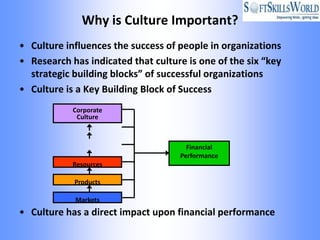
Why is Culture Important?
• Culture influences the success of people in organizations
• Research has indicated that culture is one of the six “key
  strategic building blocks” of successful organizations
• Culture is a Key Building Block of Success
            Corporate
             Culture


                                      Financial
                                    Performance
            Resources

            Products

            Markets
• Culture has a direct impact upon financial performance
Five Key Aspects of Culture


• Customer-Client Orientation.

• Employee Orientation.

• Performance Standards/Accountability.

• Openness to Change.

• Company Norms.
Problems Faced

• Perception

• Groupism

• Ego

• During Festivals
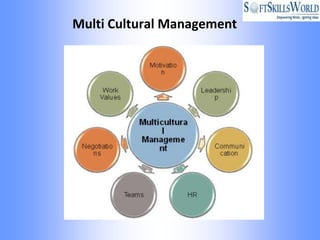
Multi Cultural Management
UNCERTAINTY & ANXIETY


• Generally, in communication, we seek to reduce
  uncertainty. Communication with strangers involves

  relatively greater degrees of uncertainty, due to the
  difficulty in predicting a stranger's responses.
STRATEGIES TO REDUCE ANXIETY

• We may reduce our uncertainty by following three basic
  strategies.

• One may passively observe the stranger.

• One may actively seek out information from other friends of
  the stranger, or from books.

• Finally, one may seek information directly from the stranger
  by interacting with them and asking questions.

• Also, offering information about one's self often prompts
  reciprocal offerings of information from another
How To Resolve Conflicts


• (1) the parties describe what they find offensive in each
  other's behavior;

• (2) they get an understanding of the other party's cultural
  perceptions;

• (3) they learn how the problem would be handled in the
  culture of the opponent;

• (4) they develop conflict solutions.
5. Learning about other cultures

• People can prevent cross-cultural conflicts by learning about
  cultures that they come in contact with. This knowledge can
  be obtained through training programs, general reading,
  talking to people from different cultures, and learning from
  past experiences.
6. Altering organizational practices and
                    procedures
• Often the organizational structure reflects the norms of just
  one culture and gives rise to cultural conflict in the
  workplace . In such cases, structural change in the
  organization becomes necessary to make the system more
  sensitive to cultural norms of other people
Discrimination


• Cultural conflicts lead to Discrimination toward or against a
  person or group is the prejudicial treatment of them based
  on certain characteristics.
Dealing with Discrimination in the Workplace

• In the last few years, charges of gender discrimination (man
  vs woman) in the workplace have increased. Racial bias,
  while no longer the most common complaint among
  employees, remains a problem, as does age discrimination.
Dealing With Discrimination At Workplace

• Dealing effectively with discrimination is a twofold process:

• Become knowledgeable with regard to antidiscrimination
  laws,

• Pay close attention to what’s happening in your company
Types Of Discrimination
               1.Gender discrimination
• Socially, sexual differences have been used to justify
  different roles for men and women, in some cases giving rise
  to claims of primary and secondary roles.
GENDER STEREOTYPING


• The United Nations had concluded that women often
  experience a "glass ceiling" and that there are no societies in
  which women enjoy the same opportunities as men. The
  term "glass ceiling" is used to describe a perceived barrier to
  advancement in employment based on discrimination,
  especially sex discrimination.
2. Language discrimination

• Diversity of language is protected and respected by most
  nations who value cultural diversity. However, people are
  sometimes subjected to different treatment because their
  preferred language is associated with a particular group,
  class or category. Discrimination exists if there is prejudicial
  treatment against a person or a group of people who speak
  a particular language or dialect.
3. Disability Discrimination


• People with disabilities face discrimination in all levels of
  society. The attitude that disabled individuals are inferior to
  non-disabled individuals is called "ableism".
CONTD……


• Disabled people face discrimination by employers. They may
  find problems with securing employment as their handicap
  can be seen as a risk to the company,

• Once in employment they may find they are overlooked for
  promotion opportunities.

• Similarly, if an employee becomes disabled while employed
  they may also find themselves being managed out the
  company by HR departments.
Managing Cultural Conflicts
Here are some general guidelines for managers to
 overcome conflicts in workplace due discriminatory
                   attitudes of employees

• Pay attention to what you don’t always see. You can’t always
  see it, prove it, or stop it, but if you ignore even the hint of
  discriminatory behavior, you and your company could suffer
  in the long run. Low morale, employee conflicts, and even
  lawsuits are just a few of the serious problems that could
  arise.
Don’t play favorites


• If you offer certain benefits to employees, make sure these
  perks are available to everyone. For instance, if you want to
  provide a flexible work arrangement for your older workers,
  avoid appearing discriminatory by being sure to offer this
  option to everyone
Keep your personal beliefs personal

• Your personal opinion regarding race, religion, sexual
  orientation, and other potentially contentious issues should
  not affect your duty to monitor workplace discrimination.
Be careful of what you say and to whom you
                     say it
• It’s easy for an off-the-cuff remark — said by either you or an
  employee — to start a torrent of bad feelings and even a
  charge of discrimination. Think before you say something that
  might be misunderstood, and teach your employees to
  conduct themselves similarly.
Respond quickly

• If an employee expresses concern about possible
  workplace discrimination, do what you can in the
  shortest period of time to resolve the issue. Allowing it
  to linger will only add to the employee’s anxiety and
  allow whatever may be occurring to continue. Talk to
  the accuser and the accused trying to find out what
  exactly happened.
Educate yourself


• Stay informed about workplace discrimination. Talk with your
  peers in similar and different industries, read your daily
  newspaper for information about what’s happening locally,
  and conduct research on discrimination and harassment law.
Formalize the policy and the consequence

Create an antidiscrimination policy (or consider paying an
  expert to create one). Keep in mind that no
  antidiscrimination policy will be taken seriously unless you
  take concrete action against any possible wrongdoing.. If you
  discover that some kind of discrimination has taken place,
  decide if you will start with a warning, insist on counseling, or
  formally terminate the accused.
HOW TO DEAL WITH DIFFERENTLY ABLED
         PEOPLE AT WORKPLACE
• Most of the time, the way we interact with these people
  means a lot. There are tactful ways to approach them.

• For example, people in wheel chairs definitely sit at a lower
  eye-level than the rest of the walking population. So when
  interacting with them, be sure not to lean over them since
  this might be an encroachment of their personal space. If it’s
  just for a few moments, consider squatting. If the
  conversation would take long, pull out a chair. This way you’d
  still be eye-to-eye with the person.
DEALING WITH HEARING IMPAIRMENT

• You should also be very careful with how you communicate
  for people with hearing problems for their benefit of
  course. Speak slowly to make sure that the person can hold
  on to every word. Some can lip-read so be sure not to
  cover your mouth while speaking. Hearing aids tend to
  magnify all sounds, so better go to a more quiet place and
  converse there.
DEALING WITH SPEECH IMPAIRED

• Problems may also affect speech. Stroke victims for example,
  may have speech impairments causing them to speak slowly.
  Be a patient listener and avoid cutting them off in the middle
  of their sentence.
DEALING WITH VISUALLY IMPAIRED

• For the blind or those with visual impairments, be sure to
  identify yourself. Use your normal speaking voice so that the
  person will be able to recognize you. If the person was born
  blind, avoid making references to visual cues like describing
  things like color or starting conversation with “Have you
  seen…?”
Be Sensitive


• It may seem like tough work but being sensitive to these
  things would make interacting with them a lot better.
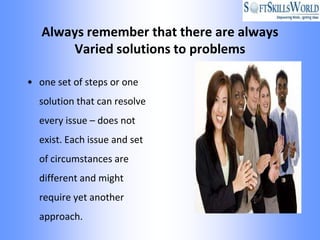
Always remember that there are always
       Varied solutions to problems

• one set of steps or one
  solution that can resolve
  every issue – does not
  exist. Each issue and set
  of circumstances are
  different and might
  require yet another
  approach.
How Can Culture be Managed?


                              42
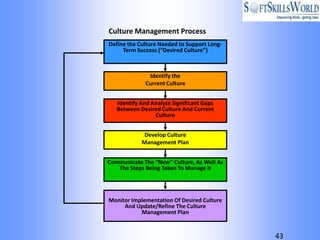
Culture Management Process
Define the Culture Needed to Support Long-
     Term Success (“Desired Culture”)


              Identify the
             Current Culture


   Identify And Analyze Significant Gaps
   Between Desired Culture And Current
                 Culture


             Develop Culture
            Management Plan


Communicate The “New” Culture, As Well As
   The Steps Being Taken To Manage It


Monitor Implementation Of Desired Culture
     And Update/Refine The Culture
           Management Plan


                                             43
Step 1: Define the Culture Needed to Support
      Long-Term Success (“Desired Culture”)


                      Key Question:
What should our culture be, given our current stage of
development and our future goals?


                                                         44
Define the Culture Needed to Support Long-Term
             Success (“Desired Culture”)
• Identify The Elements of Your Organization’s Culture
  With Respect to:
   –   Treatment of Employees
   –   Treatment of Customers/Clients
   –   Performance Standards/Accountability
   –   Openness to Change
   –   Company Norms


                                                 45
Step 2: Identify Your Current Culture

• Methods to Identify Your Current Culture
   – Stories – What is life like here?
   – Interviews.
   – Analysis of
     symbols, language, rites/rituals, rewards, heroes, and
     web sites (“Artifacts”).
   – Surveys to Measure Culture.


                                                         46
Step 3: Identify and Analyze Significant Gaps Between
             Desired and Current Culture
               Identifying Gaps Using Qualitative Methods


• Analyze information collected about the organization’s
  current culture.
• Identify the “key elements” of the current culture, based on
  this analysis.
• Compare current to desired culture and identify gaps.


                                                            47
Steps 4 to 6: Develop, Implement and Monitor a
               Culture Management Plan

• Identify Strengths and Opportunities to Improve
• Identify Areas of Focus and Analyze
• Develop the Culture Management Plan
• Implement the Culture Management Plan
• Monitor Results


                                                    48
Corporate culture management training

Corporate culture management training

  • 1.
    CROSS CULTURAL COMMUNICATION SESSION "Communicating With Strangers: An Approach to Intercultural Communication”.
  • 2.
    CULTURE DEFINED • Cultureis a group which shapes a person's values and identity. Cultural identities can stem from the following differences: race, ethnicity, gender, class, religion, country of origin, and geographic region • The collection of values, beliefs, behaviors, customs, and attitudes that distinguish a society • Its core is to establish and understand how people from different cultures communicate with each other
  • 3.
    Corporate Culture • Thebeliefs and values shared by people who work in an organisation – How people behave with each other – How people behave with customers/clients – How people view their relationship with stakeholders – People’s responses to energy use, community involvement, absence, work ethic, etc. – How the organisation behaves to its employees – training, professional development, etc.
  • 4.
    Corporate Culture • Maybe reflected in: – Attitude and behaviour of the leadership – Attitude to the role of individuals in the workplace – open plan offices, team based working, etc. – Logo of the organisation – The image it presents to the outside world – Its attitude to change
  • 5.
    Corporate Culture • Maybe driven by: • Vision – where the organisation wants to go in the future • Mission Statement – summary of the beliefs of the organisation and where it is now
  • 6.
    CULTURAL CONFLICTS INWORKPLACE • Cultural conflicts arise because of the differences in values and norms of behavior of people from different cultures. A person acts according to the values and norms of his or her culture; another person holding a different worldview might interpret his or her behavior from an opposite standpoint. This situation creates misunderstanding and can lead to conflict.
  • 7.
    CROSS-CULTURAL COMMUNICATION • Wecommunicate the way we do because we are raised in a particular culture and learn its language, rules, and norms. Different cultures (and subcultures) may have different rules and norms. Understanding the other's culture facilitates cross-cultural communication.
  • 8.
    Determinants Of CulturalDifferences • Power Distance • Masculinity v/s Feminism • Individualism v/s Collectivism
  • 9.
    Impact Of CulturalDifferences • Motivational Factors • Organisational Structure and Design • Cultural Shock • Loneliness
  • 10.
  • 11.
    Why is CultureImportant? • Culture influences the success of people in organizations • Research has indicated that culture is one of the six “key strategic building blocks” of successful organizations • Culture is a Key Building Block of Success Corporate Culture Financial Performance Resources Products Markets • Culture has a direct impact upon financial performance
  • 12.
    Five Key Aspectsof Culture • Customer-Client Orientation. • Employee Orientation. • Performance Standards/Accountability. • Openness to Change. • Company Norms.
  • 13.
    Problems Faced • Perception •Groupism • Ego • During Festivals
  • 14.
  • 15.
    UNCERTAINTY & ANXIETY •Generally, in communication, we seek to reduce uncertainty. Communication with strangers involves relatively greater degrees of uncertainty, due to the difficulty in predicting a stranger's responses.
  • 16.
    STRATEGIES TO REDUCEANXIETY • We may reduce our uncertainty by following three basic strategies. • One may passively observe the stranger. • One may actively seek out information from other friends of the stranger, or from books. • Finally, one may seek information directly from the stranger by interacting with them and asking questions. • Also, offering information about one's self often prompts reciprocal offerings of information from another
  • 17.
    How To ResolveConflicts • (1) the parties describe what they find offensive in each other's behavior; • (2) they get an understanding of the other party's cultural perceptions; • (3) they learn how the problem would be handled in the culture of the opponent; • (4) they develop conflict solutions.
  • 18.
    5. Learning aboutother cultures • People can prevent cross-cultural conflicts by learning about cultures that they come in contact with. This knowledge can be obtained through training programs, general reading, talking to people from different cultures, and learning from past experiences.
  • 19.
    6. Altering organizationalpractices and procedures • Often the organizational structure reflects the norms of just one culture and gives rise to cultural conflict in the workplace . In such cases, structural change in the organization becomes necessary to make the system more sensitive to cultural norms of other people
  • 20.
    Discrimination • Cultural conflictslead to Discrimination toward or against a person or group is the prejudicial treatment of them based on certain characteristics.
  • 21.
    Dealing with Discriminationin the Workplace • In the last few years, charges of gender discrimination (man vs woman) in the workplace have increased. Racial bias, while no longer the most common complaint among employees, remains a problem, as does age discrimination.
  • 22.
    Dealing With DiscriminationAt Workplace • Dealing effectively with discrimination is a twofold process: • Become knowledgeable with regard to antidiscrimination laws, • Pay close attention to what’s happening in your company
  • 23.
    Types Of Discrimination 1.Gender discrimination • Socially, sexual differences have been used to justify different roles for men and women, in some cases giving rise to claims of primary and secondary roles.
  • 24.
    GENDER STEREOTYPING • TheUnited Nations had concluded that women often experience a "glass ceiling" and that there are no societies in which women enjoy the same opportunities as men. The term "glass ceiling" is used to describe a perceived barrier to advancement in employment based on discrimination, especially sex discrimination.
  • 25.
    2. Language discrimination •Diversity of language is protected and respected by most nations who value cultural diversity. However, people are sometimes subjected to different treatment because their preferred language is associated with a particular group, class or category. Discrimination exists if there is prejudicial treatment against a person or a group of people who speak a particular language or dialect.
  • 26.
    3. Disability Discrimination •People with disabilities face discrimination in all levels of society. The attitude that disabled individuals are inferior to non-disabled individuals is called "ableism".
  • 27.
    CONTD…… • Disabled peopleface discrimination by employers. They may find problems with securing employment as their handicap can be seen as a risk to the company, • Once in employment they may find they are overlooked for promotion opportunities. • Similarly, if an employee becomes disabled while employed they may also find themselves being managed out the company by HR departments.
  • 28.
  • 29.
    Here are somegeneral guidelines for managers to overcome conflicts in workplace due discriminatory attitudes of employees • Pay attention to what you don’t always see. You can’t always see it, prove it, or stop it, but if you ignore even the hint of discriminatory behavior, you and your company could suffer in the long run. Low morale, employee conflicts, and even lawsuits are just a few of the serious problems that could arise.
  • 30.
    Don’t play favorites •If you offer certain benefits to employees, make sure these perks are available to everyone. For instance, if you want to provide a flexible work arrangement for your older workers, avoid appearing discriminatory by being sure to offer this option to everyone
  • 31.
    Keep your personalbeliefs personal • Your personal opinion regarding race, religion, sexual orientation, and other potentially contentious issues should not affect your duty to monitor workplace discrimination.
  • 32.
    Be careful ofwhat you say and to whom you say it • It’s easy for an off-the-cuff remark — said by either you or an employee — to start a torrent of bad feelings and even a charge of discrimination. Think before you say something that might be misunderstood, and teach your employees to conduct themselves similarly.
  • 33.
    Respond quickly • Ifan employee expresses concern about possible workplace discrimination, do what you can in the shortest period of time to resolve the issue. Allowing it to linger will only add to the employee’s anxiety and allow whatever may be occurring to continue. Talk to the accuser and the accused trying to find out what exactly happened.
  • 34.
    Educate yourself • Stayinformed about workplace discrimination. Talk with your peers in similar and different industries, read your daily newspaper for information about what’s happening locally, and conduct research on discrimination and harassment law.
  • 35.
    Formalize the policyand the consequence Create an antidiscrimination policy (or consider paying an expert to create one). Keep in mind that no antidiscrimination policy will be taken seriously unless you take concrete action against any possible wrongdoing.. If you discover that some kind of discrimination has taken place, decide if you will start with a warning, insist on counseling, or formally terminate the accused.
  • 36.
    HOW TO DEALWITH DIFFERENTLY ABLED PEOPLE AT WORKPLACE • Most of the time, the way we interact with these people means a lot. There are tactful ways to approach them. • For example, people in wheel chairs definitely sit at a lower eye-level than the rest of the walking population. So when interacting with them, be sure not to lean over them since this might be an encroachment of their personal space. If it’s just for a few moments, consider squatting. If the conversation would take long, pull out a chair. This way you’d still be eye-to-eye with the person.
  • 37.
    DEALING WITH HEARINGIMPAIRMENT • You should also be very careful with how you communicate for people with hearing problems for their benefit of course. Speak slowly to make sure that the person can hold on to every word. Some can lip-read so be sure not to cover your mouth while speaking. Hearing aids tend to magnify all sounds, so better go to a more quiet place and converse there.
  • 38.
    DEALING WITH SPEECHIMPAIRED • Problems may also affect speech. Stroke victims for example, may have speech impairments causing them to speak slowly. Be a patient listener and avoid cutting them off in the middle of their sentence.
  • 39.
    DEALING WITH VISUALLYIMPAIRED • For the blind or those with visual impairments, be sure to identify yourself. Use your normal speaking voice so that the person will be able to recognize you. If the person was born blind, avoid making references to visual cues like describing things like color or starting conversation with “Have you seen…?”
  • 40.
    Be Sensitive • Itmay seem like tough work but being sensitive to these things would make interacting with them a lot better.
  • 41.
    Always remember thatthere are always Varied solutions to problems • one set of steps or one solution that can resolve every issue – does not exist. Each issue and set of circumstances are different and might require yet another approach.
  • 42.
    How Can Culturebe Managed? 42
  • 43.
    Culture Management Process Definethe Culture Needed to Support Long- Term Success (“Desired Culture”) Identify the Current Culture Identify And Analyze Significant Gaps Between Desired Culture And Current Culture Develop Culture Management Plan Communicate The “New” Culture, As Well As The Steps Being Taken To Manage It Monitor Implementation Of Desired Culture And Update/Refine The Culture Management Plan 43
  • 44.
    Step 1: Definethe Culture Needed to Support Long-Term Success (“Desired Culture”) Key Question: What should our culture be, given our current stage of development and our future goals? 44
  • 45.
    Define the CultureNeeded to Support Long-Term Success (“Desired Culture”) • Identify The Elements of Your Organization’s Culture With Respect to: – Treatment of Employees – Treatment of Customers/Clients – Performance Standards/Accountability – Openness to Change – Company Norms 45
  • 46.
    Step 2: IdentifyYour Current Culture • Methods to Identify Your Current Culture – Stories – What is life like here? – Interviews. – Analysis of symbols, language, rites/rituals, rewards, heroes, and web sites (“Artifacts”). – Surveys to Measure Culture. 46
  • 47.
    Step 3: Identifyand Analyze Significant Gaps Between Desired and Current Culture Identifying Gaps Using Qualitative Methods • Analyze information collected about the organization’s current culture. • Identify the “key elements” of the current culture, based on this analysis. • Compare current to desired culture and identify gaps. 47
  • 48.
    Steps 4 to6: Develop, Implement and Monitor a Culture Management Plan • Identify Strengths and Opportunities to Improve • Identify Areas of Focus and Analyze • Develop the Culture Management Plan • Implement the Culture Management Plan • Monitor Results 48