INTERPERSONAL SKILLS –
THE TRANSACTION ANALYSIS


    BY: SOFT SKILLS WORLD
What is a Transaction?


• Is an interaction between two people A & B

• Technically in an interaction two factors are involved:
  Stimuli and Response

Stimuli – No control
Response – Absolute & Management (Partial) control
More on Interpersonal Skills…

• Effectively Translating and conveying information

• Being able to accurately interpret other

• people’s emotions

• Being sensitive to other people’s feelings

• Calmly arriving at resolutions to conflict

• Avoiding gossip

• Being polite
Need for IP Skills
•   Families stay nuclear. Help is scarce
•   Friends change faster
•   Colleagues change faster than friends
•   Clients now call up and ask rather
•   than wait for your fax/ email
•   Your team interacts with other teams
•   Hierarchy is flattened, so your
•   Co-workers increase
•   People work as team
•   Collective intellect is very effective for all types of problems
•   A good interpersonal skill will allow you to network
    effortlessly and effectively
Understanding Interpersonal Relationships…
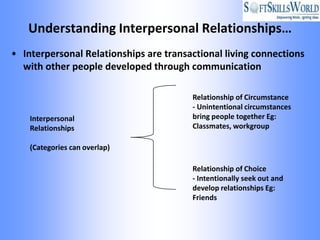
• Interpersonal Relationships are transactional living connections
  with other people developed through communication

                                        Relationship of Circumstance
                                        - Unintentional circumstances
    Interpersonal                       bring people together Eg:
    Relationships                       Classmates, workgroup

    (Categories can overlap)

                                        Relationship of Choice
                                        - Intentionally seek out and
                                        develop relationships Eg:
                                        Friends
Self Disclosure…


• Self-disclosure is seen as a useful strategy
  for sharing information with others. By
  sharing information, we become more
  intimate with other people and our
  interpersonal relationship is strengthened

• Self Disclosure means purposefully
  provide information to others about
  yourself that they otherwise would not
  know or discover
Functions of Self-Disclosure …
• Self-disclosure is a way of gaining information
  about another person. We want to be able to
  predict the thoughts and actions of people we
  know
• Self-disclosure is one way to learn about how
  another person thinks and feels. Once one
  person engages in self-disclosure, it is implied
  that the other person will also disclose personal
  information. This is known as the norm of
  reciprocity
• Mutual disclosure deepens trust in the
  relationships and helps both people understand
  each other more. You also come to feel better
  about yourself and your relationship when the
  other person accepts what you tell them
Let’s Take a Test
What is TA?


Transactional analysis is an analytical thinking process that
provides insight and gives control over actions and
reactions.

In dealings with the people around you, it is helpful to
understand what emotional states they are coming from,
and how important your own reactions are.
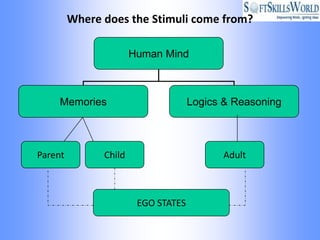
Where does the Stimuli come from?

                       Human Mind


     Memories                        Logics & Reasoning


Parent         Child                       Adult


                        EGO STATES
Objectives of the Program


• Explain the concept of Stimuli and Response

• Identify the types of transactional behavior

• Considering the best ways of responses
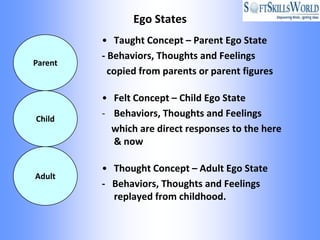
Ego States
         • Taught Concept – Parent Ego State
         - Behaviors, Thoughts and Feelings
Parent
           copied from parents or parent figures

         • Felt Concept – Child Ego State
Child
         - Behaviors, Thoughts and Feelings
           which are direct responses to the here
           & now

         • Thought Concept – Adult Ego State
Adult
         - Behaviors, Thoughts and Feelings
           replayed from childhood.
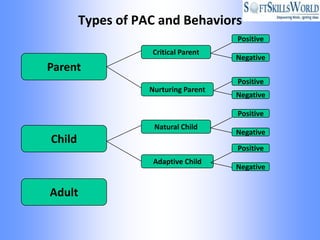
Types of PAC and Behaviors
                                      Positive
                   Critical Parent
                                      Negative
Parent
                                      Positive
                   Nurturing Parent
                                      Negative

                                      Positive
                    Natural Child
                                      Negative
Child
                                      Positive
                    Adaptive Child
                                      Negative


Adult
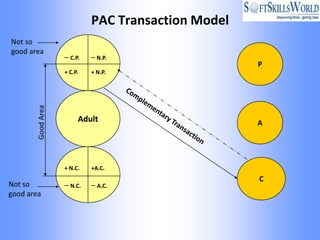
PAC Transaction Model
Not so
good area
                    – C.P.   – N.P.
                                                     P
                    + C.P.   + N.P.
        Good Area


                         Adult                       A


                    + N.C.   +A.C.
                                                     C
Not so              – N.C.   – A.C.
good area
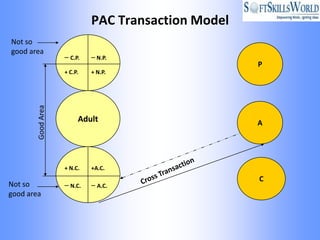
PAC Transaction Model
Not so
good area
                    – C.P.   – N.P.
                                                     P
                    + C.P.   + N.P.
        Good Area


                         Adult                       A


                    + N.C.   +A.C.
                                                     C
Not so              – N.C.   – A.C.
good area
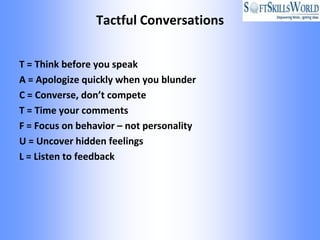
Tactful Conversations


T = Think before you speak
A = Apologize quickly when you blunder
C = Converse, don’t compete
T = Time your comments
F = Focus on behavior – not personality
U = Uncover hidden feelings
L = Listen to feedback
JOHARI WINDOW
Objectives


• Understanding the concept

• Differentiating an Individual’s behaviors with different level
  of people

• Defining the process of increasing the size of ideal pane

• Identifying the key points in seeking feedback
Questionnaire


• Refer your workbook
Background


• The Johari Window model was developed by American
  psychologists Joseph Luft and Harry Ingham in the 1950s,
  while researching group dynamics

• The Johari Window model is a simple and useful tool for
  illustrating and improving self-awareness, and mutual
  understanding between individuals within a group. The
  Johari Window tool can also be used to assess and improve
  an individual's relationship with others.
Relevance


• What is the biggest differentiator of human race
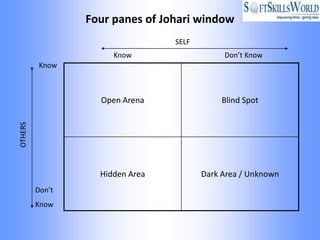
Four panes of Johari window
                                 SELF
                      Know                   Don’t Know
          Know


                   Open Arena                Blind Spot
OTHERS


                   Hidden Area          Dark Area / Unknown
         Don’t
         Know
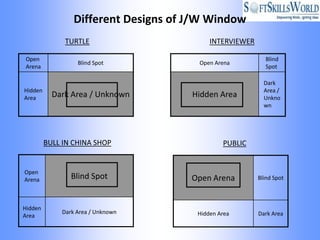
Different Designs of J/W Window
              TURTLE                       INTERVIEWER

Open                                                        Blind
                  Blind Spot           Open Arena
Arena                                                       Spot

                                                           Dark
Hidden                                                     Area /
Area       Dark Area / Unknown        Hidden Area          Unkno
                                                           wn


         BULL IN CHINA SHOP                    PUBLIC


Open
Arena           Blind Spot            Open Arena         Blind Spot


Hidden
             Dark Area / Unknown       Hidden Area       Dark Area
Area
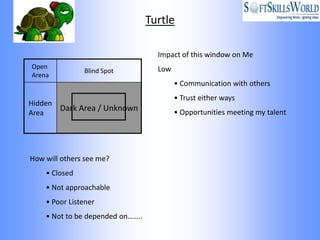
Turtle

                                    Impact of this window on Me
Open                                Low
               Blind Spot
Arena
                                          • Communication with others
                                          • Trust either ways
Hidden
         Dark Area / Unknown              • Opportunities meeting my talent
Area


How will others see me?
    • Closed
    • Not approachable
    • Poor Listener
    • Not to be depended on……..
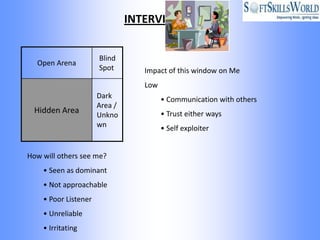
INTERVIEWER


                      Blind
  Open Arena
                      Spot        Impact of this window on Me
                                  Low
                      Dark              • Communication with others
                      Area /
  Hidden Area                           • Trust either ways
                      Unkno
                      wn                • Self exploiter


How will others see me?
    • Seen as dominant
    • Not approachable
    • Poor Listener
    • Unreliable
    • Irritating
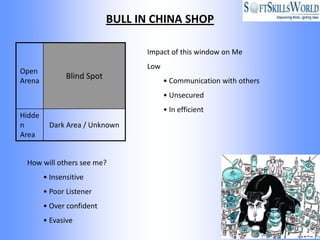
BULL IN CHINA SHOP

                                  Impact of this window on Me
                                  Low
Open
               Blind Spot
Arena                                   • Communication with others
                                        • Unsecured
                                        • In efficient
Hidde
n        Dark Area / Unknown
Area


 How will others see me?
        • Insensitive
        • Poor Listener
        • Over confident
        • Evasive
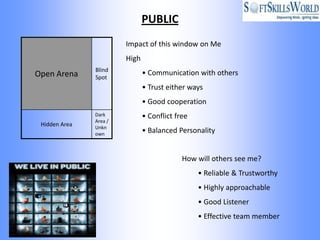
PUBLIC
                        Impact of this window on Me
                        High
               Blind
Open Arena                     • Communication with others
               Spot
                               • Trust either ways
                               • Good cooperation
               Dark            • Conflict free
               Area /
 Hidden Area   Unkn
               own
                               • Balanced Personality


                                            How will others see me?
                                                 • Reliable & Trustworthy
                                                 • Highly approachable
                                                 • Good Listener
                                                 • Effective team member
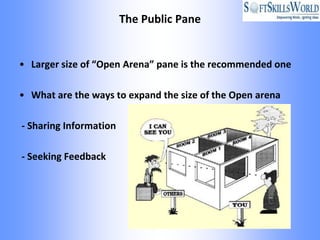
The Public Pane


• Larger size of “Open Arena” pane is the recommended one

• What are the ways to expand the size of the Open arena

- Sharing Information

- Seeking Feedback
Key points in seeking feedback


• Keep open mind              • Take notes of the discussion

• Be an active listener       • Commit to change

• Do not defend / Argue       • Follow up on notes

• Seek clarification          • Courtesy
TIPS TO DEVELOP GOOD INTERPERSONAL
                  SKILLS

• SMILE

• BE APPRECIATIVE

• PAY ATTENTION TO OTHERS

• PRACTICE ACTIVE LISTENING

• BRING PEOPLE TOGETHER
TIPS TO DEVELOP GOOD INTERPERSONAL
                  SKILLS

• RESOLVE CONFLICTS AMICABLY

• COMMUNICATE CLEARLY

• HAVE A SENSE OF HUMOUR

• SEE IT FROM THEIR SIDE –EMPATHY

• DON’T COMPLAIN
transactional analysis

transactional analysis

  • 1.
    INTERPERSONAL SKILLS – THETRANSACTION ANALYSIS BY: SOFT SKILLS WORLD
  • 2.
    What is aTransaction? • Is an interaction between two people A & B • Technically in an interaction two factors are involved: Stimuli and Response Stimuli – No control Response – Absolute & Management (Partial) control
  • 3.
    More on InterpersonalSkills… • Effectively Translating and conveying information • Being able to accurately interpret other • people’s emotions • Being sensitive to other people’s feelings • Calmly arriving at resolutions to conflict • Avoiding gossip • Being polite
  • 4.
    Need for IPSkills • Families stay nuclear. Help is scarce • Friends change faster • Colleagues change faster than friends • Clients now call up and ask rather • than wait for your fax/ email • Your team interacts with other teams • Hierarchy is flattened, so your • Co-workers increase • People work as team • Collective intellect is very effective for all types of problems • A good interpersonal skill will allow you to network effortlessly and effectively
  • 5.
    Understanding Interpersonal Relationships… •Interpersonal Relationships are transactional living connections with other people developed through communication Relationship of Circumstance - Unintentional circumstances Interpersonal bring people together Eg: Relationships Classmates, workgroup (Categories can overlap) Relationship of Choice - Intentionally seek out and develop relationships Eg: Friends
  • 6.
    Self Disclosure… • Self-disclosureis seen as a useful strategy for sharing information with others. By sharing information, we become more intimate with other people and our interpersonal relationship is strengthened • Self Disclosure means purposefully provide information to others about yourself that they otherwise would not know or discover
  • 7.
    Functions of Self-Disclosure… • Self-disclosure is a way of gaining information about another person. We want to be able to predict the thoughts and actions of people we know • Self-disclosure is one way to learn about how another person thinks and feels. Once one person engages in self-disclosure, it is implied that the other person will also disclose personal information. This is known as the norm of reciprocity • Mutual disclosure deepens trust in the relationships and helps both people understand each other more. You also come to feel better about yourself and your relationship when the other person accepts what you tell them
  • 8.
  • 9.
    What is TA? Transactionalanalysis is an analytical thinking process that provides insight and gives control over actions and reactions. In dealings with the people around you, it is helpful to understand what emotional states they are coming from, and how important your own reactions are.
  • 10.
    Where does theStimuli come from? Human Mind Memories Logics & Reasoning Parent Child Adult EGO STATES
  • 11.
    Objectives of theProgram • Explain the concept of Stimuli and Response • Identify the types of transactional behavior • Considering the best ways of responses
  • 12.
    Ego States • Taught Concept – Parent Ego State - Behaviors, Thoughts and Feelings Parent copied from parents or parent figures • Felt Concept – Child Ego State Child - Behaviors, Thoughts and Feelings which are direct responses to the here & now • Thought Concept – Adult Ego State Adult - Behaviors, Thoughts and Feelings replayed from childhood.
  • 13.
    Types of PACand Behaviors Positive Critical Parent Negative Parent Positive Nurturing Parent Negative Positive Natural Child Negative Child Positive Adaptive Child Negative Adult
  • 14.
    PAC Transaction Model Notso good area – C.P. – N.P. P + C.P. + N.P. Good Area Adult A + N.C. +A.C. C Not so – N.C. – A.C. good area
  • 15.
    PAC Transaction Model Notso good area – C.P. – N.P. P + C.P. + N.P. Good Area Adult A + N.C. +A.C. C Not so – N.C. – A.C. good area
  • 17.
    Tactful Conversations T =Think before you speak A = Apologize quickly when you blunder C = Converse, don’t compete T = Time your comments F = Focus on behavior – not personality U = Uncover hidden feelings L = Listen to feedback
  • 18.
  • 19.
    Objectives • Understanding theconcept • Differentiating an Individual’s behaviors with different level of people • Defining the process of increasing the size of ideal pane • Identifying the key points in seeking feedback
  • 20.
  • 21.
    Background • The JohariWindow model was developed by American psychologists Joseph Luft and Harry Ingham in the 1950s, while researching group dynamics • The Johari Window model is a simple and useful tool for illustrating and improving self-awareness, and mutual understanding between individuals within a group. The Johari Window tool can also be used to assess and improve an individual's relationship with others.
  • 22.
    Relevance • What isthe biggest differentiator of human race
  • 23.
    Four panes ofJohari window SELF Know Don’t Know Know Open Arena Blind Spot OTHERS Hidden Area Dark Area / Unknown Don’t Know
  • 24.
    Different Designs ofJ/W Window TURTLE INTERVIEWER Open Blind Blind Spot Open Arena Arena Spot Dark Hidden Area / Area Dark Area / Unknown Hidden Area Unkno wn BULL IN CHINA SHOP PUBLIC Open Arena Blind Spot Open Arena Blind Spot Hidden Dark Area / Unknown Hidden Area Dark Area Area
  • 25.
    Turtle Impact of this window on Me Open Low Blind Spot Arena • Communication with others • Trust either ways Hidden Dark Area / Unknown • Opportunities meeting my talent Area How will others see me? • Closed • Not approachable • Poor Listener • Not to be depended on……..
  • 26.
    INTERVIEWER Blind Open Arena Spot Impact of this window on Me Low Dark • Communication with others Area / Hidden Area • Trust either ways Unkno wn • Self exploiter How will others see me? • Seen as dominant • Not approachable • Poor Listener • Unreliable • Irritating
  • 27.
    BULL IN CHINASHOP Impact of this window on Me Low Open Blind Spot Arena • Communication with others • Unsecured • In efficient Hidde n Dark Area / Unknown Area How will others see me? • Insensitive • Poor Listener • Over confident • Evasive
  • 28.
    PUBLIC Impact of this window on Me High Blind Open Arena • Communication with others Spot • Trust either ways • Good cooperation Dark • Conflict free Area / Hidden Area Unkn own • Balanced Personality How will others see me? • Reliable & Trustworthy • Highly approachable • Good Listener • Effective team member
  • 29.
    The Public Pane •Larger size of “Open Arena” pane is the recommended one • What are the ways to expand the size of the Open arena - Sharing Information - Seeking Feedback
  • 30.
    Key points inseeking feedback • Keep open mind • Take notes of the discussion • Be an active listener • Commit to change • Do not defend / Argue • Follow up on notes • Seek clarification • Courtesy
  • 31.
    TIPS TO DEVELOPGOOD INTERPERSONAL SKILLS • SMILE • BE APPRECIATIVE • PAY ATTENTION TO OTHERS • PRACTICE ACTIVE LISTENING • BRING PEOPLE TOGETHER
  • 32.
    TIPS TO DEVELOPGOOD INTERPERSONAL SKILLS • RESOLVE CONFLICTS AMICABLY • COMMUNICATE CLEARLY • HAVE A SENSE OF HUMOUR • SEE IT FROM THEIR SIDE –EMPATHY • DON’T COMPLAIN