#Communication and Conflict Resolution Skills
Contents
 Communication and Leadership
 Inspirational Speaking and Writing
 Six Principles of Persuasion
 Nonverbal Communication and Videoconferencing
 Listening as a Leadership Skill
 How to Make the Rounds
 Overcoming Cross-Cultural Communication Barriers
 Conflict-Handling Styles
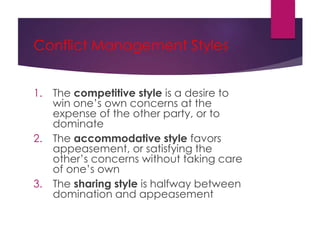
 Conflict Management Styles
 Negotiating and Bargaining
 Negotiation Techniques
 Summary
Presentation Sections
 Part One : The Body
 Part Two : The Heart
 Part Three : The Brain
 Part Four : The Terminals
Part One
 Communication and
Leadership
 Inspirational Speaking
and Writing
 Six Principles of
Persuasion
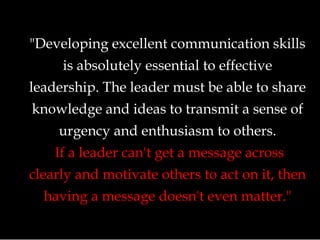
"Developing excellent communication skills
is absolutely essential to effective
leadership. The leader must be able to share
knowledge and ideas to transmit a sense of
urgency and enthusiasm to others.
If a leader can't get a message across
clearly and motivate others to act on it, then
having a message doesn't even matter."
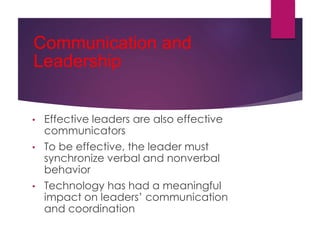
Communication and
Leadership
• Effective leaders are also effective
communicators
• To be effective, the leader must
synchronize verbal and nonverbal
behavior
• Technology has had a meaningful
impact on leaders’ communication
and coordination
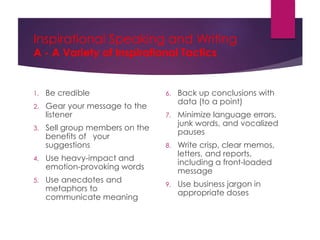
Inspirational Speaking and Writing
A - A Variety of Inspirational Tactics
1. Be credible
2. Gear your message to the
listener
3. Sell group members on the
benefits of your
suggestions
4. Use heavy-impact and
emotion-provoking words
5. Use anecdotes and
metaphors to
communicate meaning
6. Back up conclusions with
data (to a point)
7. Minimize language errors,
junk words, and vocalized
pauses
8. Write crisp, clear memos,
letters, and reports,
including a front-loaded
message
9. Use business jargon in
appropriate doses
Inspirational Speaking and Writing
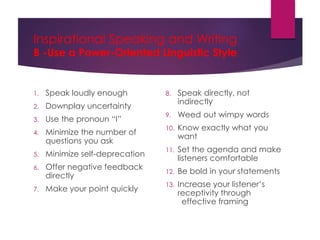
B -Use a Power-Oriented Linguistic Style
1. Speak loudly enough
2. Downplay uncertainty
3. Use the pronoun “I”
4. Minimize the number of
questions you ask
5. Minimize self-deprecation
6. Offer negative feedback
directly
7. Make your point quickly
8. Speak directly, not
indirectly
9. Weed out wimpy words
10. Know exactly what you
want
11. Set the agenda and make
listeners comfortable
12. Be bold in your statements
13. Increase your listener’s
receptivity through
effective framing
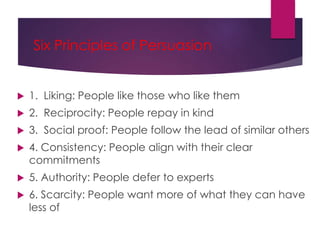
Six Principles of Persuasion
 1. Liking: People like those who like them
 2. Reciprocity: People repay in kind
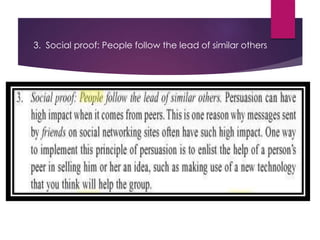
 3. Social proof: People follow the lead of similar others
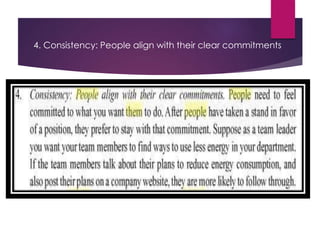
 4. Consistency: People align with their clear
commitments
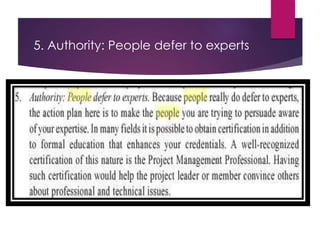
 5. Authority: People defer to experts
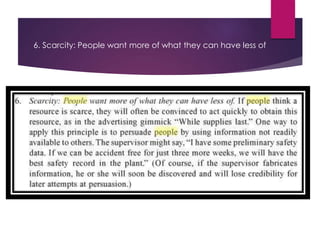
 6. Scarcity: People want more of what they can have
less of
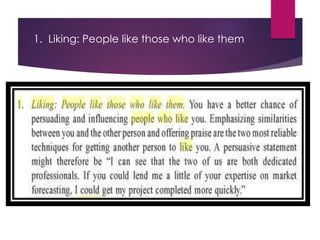
1. Liking: People like those who like them
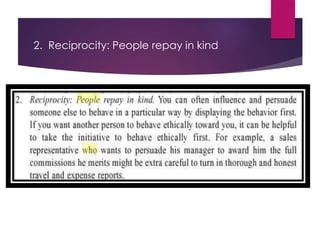
2. Reciprocity: People repay in kind
3. Social proof: People follow the lead of similar others
4. Consistency: People align with their clear commitments
5. Authority: People defer to experts
6. Scarcity: People want more of what they can have less of
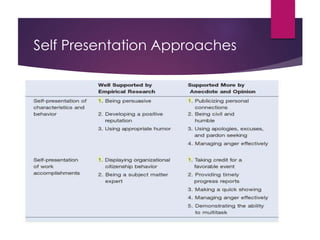
Self Presentation Approaches
End of Part one
Any Questions ?
Thank you for your great participation
Part Two
 Nonverbal Communication
and Videoconferencing
 Listening as a Leadership
Skill
 How to Make the Rounds
Take advantage of every
opportunity to practice your
communication skills so that
when important occasions
arise, you will have the gift,
the style, the sharpness, the
clarity, and the emotions to
affect other people.
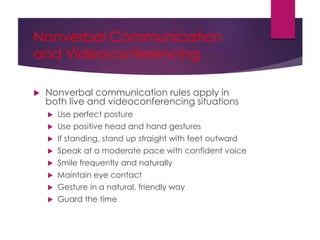
Nonverbal Communication
and Videoconferencing
 Nonverbal communication rules apply in
both live and videoconferencing situations
 Use perfect posture
 Use positive head and hand gestures
 If standing, stand up straight with feet outward
 Speak at a moderate pace with confident voice
 Smile frequently and naturally
 Maintain eye contact
 Gesture in a natural, friendly way
 Guard the time
Nonverbal Communication
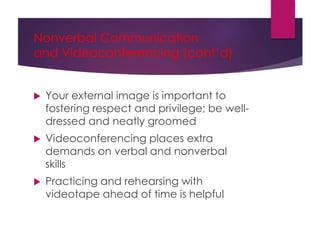
and Videoconferencing (cont’d)
 Your external image is important to
fostering respect and privilege; be well-
dressed and neatly groomed
 Videoconferencing places extra
demands on verbal and nonverbal
skills
 Practicing and rehearsing with
videotape ahead of time is helpful
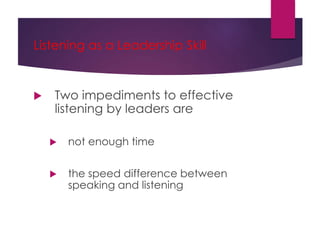
Listening as a Leadership Skill
 Two impediments to effective
listening by leaders are
 not enough time
 the speed difference between
speaking and listening
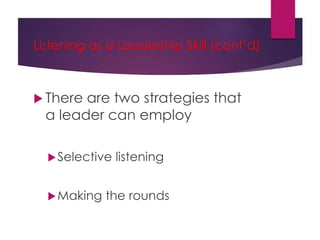
Listening as a Leadership Skill (cont’d)
 There are two strategies that
a leader can employ
Selective listening
Making the rounds
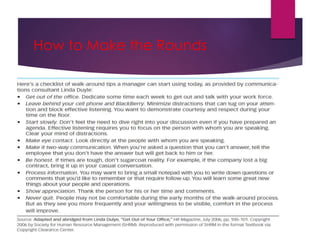
How to Make the Rounds
End of Part Two
Any Questions ?
Thank you for your Effective participation
Part Three
 Overcoming Cross-Cultural
Communication Barriers
 Conflict-Handling Styles
 Conflict Management Styles
To effectively
communicate, we must
realize that we are all
different in the way we
perceive the world and use
this understanding as a
guide to our
communication with
others.
Overcoming Cross-Cultural
Communication Barriers
1. Be aware that differences exist and are
important
2. Challenge your cultural assumptions
3. Show respect for all workers
4. Use straightforward language and speak
slowly and clearly
5. Look for signs of misunderstanding
6. When appropriate speak in their language
Overcoming Cross-Cultural
Communication Barriers (cont’d)
7. Observe cross-cultural differences in etiquette
8. Do not judge style, accent, grammar or
personal appearance
9. Avoid racial or ethnic identification
10. Learn cultural nonverbal customs
11. Look for uniqueness in individuals, not race,
ethnic, or culturally-based physical attributes
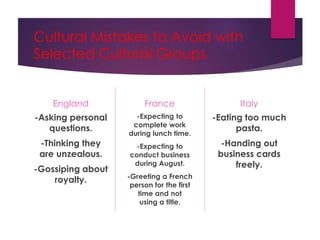
Cultural Mistakes to Avoid with
Selected Cultural Groups
England
-Asking personal
questions.
-Thinking they
are unzealous.
-Gossiping about
royalty.
France
-Expecting to
complete work
during lunch time.
-Expecting to
conduct business
during August.
-Greeting a French
person for the first
time and not
using a title.
Italy
-Eating too much
pasta.
-Handing out
business cards
freely.
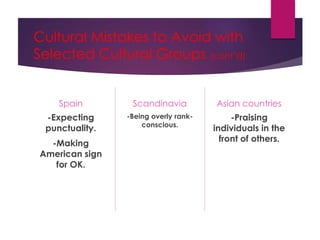
Cultural Mistakes to Avoid with
Selected Cultural Groups (cont’d)
Spain
-Expecting
punctuality.
-Making
American sign
for OK.
Scandinavia
-Being overly rank-
conscious.
Asian countries
-Praising
individuals in the
front of others.
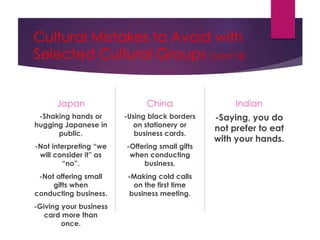
Cultural Mistakes to Avoid with
Selected Cultural Groups (cont’d)
Japan
-Shaking hands or
hugging Japanese in
public.
-Not interpreting “we
will consider it” as
“no”.
-Not offering small
gifts when
conducting business.
-Giving your business
card more than
once.
China
-Using black borders
on stationery or
business cards.
-Offering small gifts
when conducting
business.
-Making cold calls
on the first time
business meeting.
Indian
-Saying, you do
not prefer to eat
with your hands.
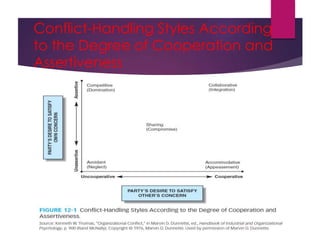
Conflict-Handling Styles According
to the Degree of Cooperation and
Assertiveness
Conflict Management Styles
1. The competitive style is a desire to
win one’s own concerns at the
expense of the other party, or to
dominate
2. The accommodative style favors
appeasement, or satisfying the
other’s concerns without taking care
of one’s own
3. The sharing style is halfway between
domination and appeasement
Conflict Management Styles (cont’d)
4. The collaborative style reflects a
desire to fully satisfy the desires
of both parties
5. The avoidant style combines
unassertiveness and a lack of
cooperation
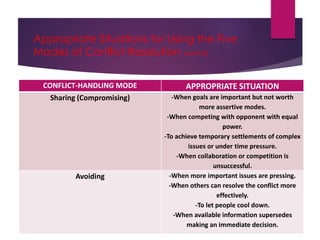
Appropriate Situations for Using the
Five Modes of Conflict Resolution
APPROPRIATE SITUATIONCONFLICT-HANDLING MODE
-In emergency
-On important and vital
organizational issues
-Against people who take
undeserved advantage.
Competing
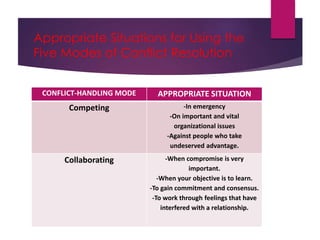
-When compromise is very
important.
-When your objective is to learn.
-To gain commitment and consensus.
-To work through feelings that have
interfered with a relationship.
Collaborating
Appropriate Situations for Using the Five
Modes of Conflict Resolution (cont’d)
APPROPRIATE SITUATIONCONFLICT-HANDLING MODE
-When goals are important but not worth
more assertive modes.
-When competing with opponent with equal
power.
-To achieve temporary settlements of complex
issues or under time pressure.
-When collaboration or competition is
unsuccessful.
Sharing (Compromising)
-When more important issues are pressing.
-When others can resolve the conflict more
effectively.
-To let people cool down.
-When available information supersedes
making an immediate decision.
Avoiding
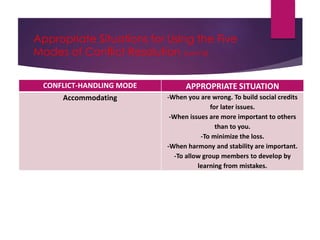
Appropriate Situations for Using the Five
Modes of Conflict Resolution (cont’d)
APPROPRIATE SITUATIONCONFLICT-HANDLING MODE
-When you are wrong. To build social credits
for later issues.
-When issues are more important to others
than to you.
-To minimize the loss.
-When harmony and stability are important.
-To allow group members to develop by
learning from mistakes.
Accommodating
End of Part Three
Any Questions ?
Thank you for your attractive participation
Part Four
 Negotiating and
Bargaining
 Negotiation
Techniques
 Summary
Negotiation is not a policy.
It's a technique. It's
something you use when
it's to your advantage, and
something that you don't
use when it's not to your
advantage.
Negotiating and Bargaining
 Conflicts can be considered situations
calling for negotiating and bargaining,
or conferring with another person in
order to resolve a problem
 Two approaches to negotiation:
 Distributive bargaining
 Integrative bargaining
Negotiation Techniques
 Listen first to investigate what the other side
wants
 Begin with a plausible demand or offer
 Focus on interests, not position
 Search for the value in differences between
the two sides
 Be sensitive to international differences in
negotiating style
Summary
 Effective leaders are effective
communicators
 Leaders may develop inspirational and
powerful speaking and writing by
following a set of suggestions
 A power-oriented linguistic style is one
way to communicate with inspiration
and power
Summary (cont’d)
 Leaders can improve their
communication by following the
six principles of persuasion
 Skill can also be developed in
using nonverbal communication
Summary (cont’d)
 Overcoming cross-cultural
communication barriers is
another leadership challenge
 Leaders must also be skilled in
conflict management and
negotiations
End of Part four
Any Questions ?
Thank you for your participation

Communication and conflict resolution skills

  • 1.
    #Communication and ConflictResolution Skills
  • 2.
    Contents  Communication andLeadership  Inspirational Speaking and Writing  Six Principles of Persuasion  Nonverbal Communication and Videoconferencing  Listening as a Leadership Skill  How to Make the Rounds  Overcoming Cross-Cultural Communication Barriers  Conflict-Handling Styles  Conflict Management Styles  Negotiating and Bargaining  Negotiation Techniques  Summary
  • 3.
    Presentation Sections  PartOne : The Body  Part Two : The Heart  Part Three : The Brain  Part Four : The Terminals
  • 4.
    Part One  Communicationand Leadership  Inspirational Speaking and Writing  Six Principles of Persuasion
  • 5.
    "Developing excellent communicationskills is absolutely essential to effective leadership. The leader must be able to share knowledge and ideas to transmit a sense of urgency and enthusiasm to others. If a leader can't get a message across clearly and motivate others to act on it, then having a message doesn't even matter."
  • 6.
    Communication and Leadership • Effectiveleaders are also effective communicators • To be effective, the leader must synchronize verbal and nonverbal behavior • Technology has had a meaningful impact on leaders’ communication and coordination
  • 7.
    Inspirational Speaking andWriting A - A Variety of Inspirational Tactics 1. Be credible 2. Gear your message to the listener 3. Sell group members on the benefits of your suggestions 4. Use heavy-impact and emotion-provoking words 5. Use anecdotes and metaphors to communicate meaning 6. Back up conclusions with data (to a point) 7. Minimize language errors, junk words, and vocalized pauses 8. Write crisp, clear memos, letters, and reports, including a front-loaded message 9. Use business jargon in appropriate doses
  • 9.
    Inspirational Speaking andWriting B -Use a Power-Oriented Linguistic Style 1. Speak loudly enough 2. Downplay uncertainty 3. Use the pronoun “I” 4. Minimize the number of questions you ask 5. Minimize self-deprecation 6. Offer negative feedback directly 7. Make your point quickly 8. Speak directly, not indirectly 9. Weed out wimpy words 10. Know exactly what you want 11. Set the agenda and make listeners comfortable 12. Be bold in your statements 13. Increase your listener’s receptivity through effective framing
  • 11.
    Six Principles ofPersuasion  1. Liking: People like those who like them  2. Reciprocity: People repay in kind  3. Social proof: People follow the lead of similar others  4. Consistency: People align with their clear commitments  5. Authority: People defer to experts  6. Scarcity: People want more of what they can have less of
  • 12.
    1. Liking: Peoplelike those who like them
  • 13.
  • 14.
    3. Social proof:People follow the lead of similar others
  • 15.
    4. Consistency: Peoplealign with their clear commitments
  • 16.
    5. Authority: Peopledefer to experts
  • 17.
    6. Scarcity: Peoplewant more of what they can have less of
  • 18.
  • 19.
    End of Partone Any Questions ? Thank you for your great participation
  • 20.
    Part Two  NonverbalCommunication and Videoconferencing  Listening as a Leadership Skill  How to Make the Rounds
  • 21.
    Take advantage ofevery opportunity to practice your communication skills so that when important occasions arise, you will have the gift, the style, the sharpness, the clarity, and the emotions to affect other people.
  • 22.
    Nonverbal Communication and Videoconferencing Nonverbal communication rules apply in both live and videoconferencing situations  Use perfect posture  Use positive head and hand gestures  If standing, stand up straight with feet outward  Speak at a moderate pace with confident voice  Smile frequently and naturally  Maintain eye contact  Gesture in a natural, friendly way  Guard the time
  • 23.
    Nonverbal Communication and Videoconferencing(cont’d)  Your external image is important to fostering respect and privilege; be well- dressed and neatly groomed  Videoconferencing places extra demands on verbal and nonverbal skills  Practicing and rehearsing with videotape ahead of time is helpful
  • 24.
    Listening as aLeadership Skill  Two impediments to effective listening by leaders are  not enough time  the speed difference between speaking and listening
  • 25.
    Listening as aLeadership Skill (cont’d)  There are two strategies that a leader can employ Selective listening Making the rounds
  • 26.
    How to Makethe Rounds
  • 27.
    End of PartTwo Any Questions ? Thank you for your Effective participation
  • 28.
    Part Three  OvercomingCross-Cultural Communication Barriers  Conflict-Handling Styles  Conflict Management Styles
  • 29.
    To effectively communicate, wemust realize that we are all different in the way we perceive the world and use this understanding as a guide to our communication with others.
  • 30.
    Overcoming Cross-Cultural Communication Barriers 1.Be aware that differences exist and are important 2. Challenge your cultural assumptions 3. Show respect for all workers 4. Use straightforward language and speak slowly and clearly 5. Look for signs of misunderstanding 6. When appropriate speak in their language
  • 31.
    Overcoming Cross-Cultural Communication Barriers(cont’d) 7. Observe cross-cultural differences in etiquette 8. Do not judge style, accent, grammar or personal appearance 9. Avoid racial or ethnic identification 10. Learn cultural nonverbal customs 11. Look for uniqueness in individuals, not race, ethnic, or culturally-based physical attributes
  • 32.
    Cultural Mistakes toAvoid with Selected Cultural Groups England -Asking personal questions. -Thinking they are unzealous. -Gossiping about royalty. France -Expecting to complete work during lunch time. -Expecting to conduct business during August. -Greeting a French person for the first time and not using a title. Italy -Eating too much pasta. -Handing out business cards freely.
  • 33.
    Cultural Mistakes toAvoid with Selected Cultural Groups (cont’d) Spain -Expecting punctuality. -Making American sign for OK. Scandinavia -Being overly rank- conscious. Asian countries -Praising individuals in the front of others.
  • 34.
    Cultural Mistakes toAvoid with Selected Cultural Groups (cont’d) Japan -Shaking hands or hugging Japanese in public. -Not interpreting “we will consider it” as “no”. -Not offering small gifts when conducting business. -Giving your business card more than once. China -Using black borders on stationery or business cards. -Offering small gifts when conducting business. -Making cold calls on the first time business meeting. Indian -Saying, you do not prefer to eat with your hands.
  • 35.
    Conflict-Handling Styles According tothe Degree of Cooperation and Assertiveness
  • 36.
    Conflict Management Styles 1.The competitive style is a desire to win one’s own concerns at the expense of the other party, or to dominate 2. The accommodative style favors appeasement, or satisfying the other’s concerns without taking care of one’s own 3. The sharing style is halfway between domination and appeasement
  • 37.
    Conflict Management Styles(cont’d) 4. The collaborative style reflects a desire to fully satisfy the desires of both parties 5. The avoidant style combines unassertiveness and a lack of cooperation
  • 38.
    Appropriate Situations forUsing the Five Modes of Conflict Resolution APPROPRIATE SITUATIONCONFLICT-HANDLING MODE -In emergency -On important and vital organizational issues -Against people who take undeserved advantage. Competing -When compromise is very important. -When your objective is to learn. -To gain commitment and consensus. -To work through feelings that have interfered with a relationship. Collaborating
  • 39.
    Appropriate Situations forUsing the Five Modes of Conflict Resolution (cont’d) APPROPRIATE SITUATIONCONFLICT-HANDLING MODE -When goals are important but not worth more assertive modes. -When competing with opponent with equal power. -To achieve temporary settlements of complex issues or under time pressure. -When collaboration or competition is unsuccessful. Sharing (Compromising) -When more important issues are pressing. -When others can resolve the conflict more effectively. -To let people cool down. -When available information supersedes making an immediate decision. Avoiding
  • 40.
    Appropriate Situations forUsing the Five Modes of Conflict Resolution (cont’d) APPROPRIATE SITUATIONCONFLICT-HANDLING MODE -When you are wrong. To build social credits for later issues. -When issues are more important to others than to you. -To minimize the loss. -When harmony and stability are important. -To allow group members to develop by learning from mistakes. Accommodating
  • 41.
    End of PartThree Any Questions ? Thank you for your attractive participation
  • 42.
    Part Four  Negotiatingand Bargaining  Negotiation Techniques  Summary
  • 43.
    Negotiation is nota policy. It's a technique. It's something you use when it's to your advantage, and something that you don't use when it's not to your advantage.
  • 44.
    Negotiating and Bargaining Conflicts can be considered situations calling for negotiating and bargaining, or conferring with another person in order to resolve a problem  Two approaches to negotiation:  Distributive bargaining  Integrative bargaining
  • 45.
    Negotiation Techniques  Listenfirst to investigate what the other side wants  Begin with a plausible demand or offer  Focus on interests, not position  Search for the value in differences between the two sides  Be sensitive to international differences in negotiating style
  • 46.
    Summary  Effective leadersare effective communicators  Leaders may develop inspirational and powerful speaking and writing by following a set of suggestions  A power-oriented linguistic style is one way to communicate with inspiration and power
  • 47.
    Summary (cont’d)  Leaderscan improve their communication by following the six principles of persuasion  Skill can also be developed in using nonverbal communication
  • 48.
    Summary (cont’d)  Overcomingcross-cultural communication barriers is another leadership challenge  Leaders must also be skilled in conflict management and negotiations
  • 49.
    End of Partfour Any Questions ? Thank you for your participation