Time Management:
Making the Most of Your Time

       BY: SOFT SKILLS WORLD
Module Instructions


• You are encouraged to write down the
  answers to the questions you see throughout
  the workshop.

• Complete the included inventories and
  assessments.

• Contact our office to schedule an
  appointment if you need to discuss anything
  further with a staff member.
Objectives


• To define why time management is
  important
• To define what time management is and
  involves
• To identify what makes time management
  difficult
• To identify useful strategies for managing
  your time
Why is Time Management
        Important?

Why is it important to you to manage or
have control over your time? What do you
hope to accomplish by managing your time?
In what situations or areas of your life is it
important to be able to manage your time?
Importance of
    Time Management

• Time management is important to different
  individuals for different reasons.

   – Make sure you have time for all your
     important activities

   – Give structure to your days and weeks

   – Assist in setting goals

   – Assist in planning for the semester

   – Assist in determining priorities
To Realize the Value of:

• ONE YEAR, ask a student who failed a grade.
• ONE MONTH, ask a mother who gave birth to a
  premature baby.
• ONE WEEK, ask the editor of a weekly newspaper.
• ONE DAY, ask a daily wage laborer with kids to
  feed.
• ONE HOUR, ask the lovers who are waiting to
  meet.
• ONE MINUTE, ask a person who missed the train.
• ONE SECOND, ask a person who just avoided an
  accident.
• ONE MILLISECOND, ask the person who won a
  silver medal in the Olympics.
What is Time Management?

• Awareness of your time

• Awareness of your time wasters

• Use of priorities

• Self-management or the management
  of your personal resources

• Goal setting & achievement

• Planning
Personal Time Management

Time management is different for
  everyone

• How do you define time management?

• If you are managing your time
  well, what does that look like for you?
  What does that mean?

• What skills are required for you to
  manage your time well?
What makes time
 management difficult?
Managing our time is not always easy.

There are a variety of things that make

time management difficult. Below are

some of the things that often make it

challenging for us to manage our time.

Review the following list of common time

wasters and identify which ones are

challenges for you.
Time Wasters


• Stress

• Anxiety

• Burnout

• Procrastination

• Perfectionism

• Lack of planning

• Unexpected events (such as phone calls or
  drop-in visitors)
Additional Time Wasters

• Depression

• Being unorganized

• Working against your natural tendencies

• Bad habits

• Email or IM

• Loosing track of time

• Television

• Ineffective studying (have to repeat what you
  studied or re-read material)
Let’s get personal…

• Take a few moments to complete the
  following assessments:
   – “Self-Evaluation of Time Management”
   – “My Time Wasters”
• What did you learn about the way you
  manage your time?
• What did you learn about your time
  wasters?
Take a 10 minute break


                       Study Tip
                       Take a short break
                       each hour to
                       refresh your mind
                       and body.
                       You’ll do better.
                       Set an alarm clock
                       or timer and come
                       back!
exit
Knowing is Half the
        Battle
Understanding what time management is and

what your time management strengths and

challenges are can assist you in determining what

strategies will be most useful as you develop your

time management skills.

The following slides offer some time

management tips and strategies that you may

find useful.
Strategies:
Define your values and determine
         your priorities.

Knowing what is important to you (what
you value) and what your priorities are
allows you to put those things first as
you schedule your time, therefore
guiding the way you manage your time.
Values


• Complete the attached Values
  Assessment to identify your values.
Priorities
• Prioritizing, or determining your priorities, is a
  process of deciding which of several options or
  tasks is most important.

• Prioritizing involves deciding that Activity A is
  more important than Activity B.

• Priorities change over time.

• Priorities are influenced by your values and
  your goals.

• Your priorities may not be the same as
  important others (family or friends) in your life.
Guiding questions for
   determining priorities:
• What are the costs vs. the benefits of doing this
  activity?

• How well does this activity fit into my goals?

• Does this activity have a deadline for completion?

• How much do I enjoy doing this activity?

• Have I promised or agreed to do this activity?

• What needs of mine will be satisfied by doing this
  activity?

• How much time does this activity require?
Determining Your Priorities
• Priority activities can include
  studying, attending
  class, worship, meditation, exercising, spendin
  g one day a week with family, or other
  activities important to you.

• With this in mind, take a few minutes and
  write down your answers to the questions on
  the previous slide.

• What are your priorities?
Strategies:
Set goals & make action plans
• Use the system SMART when setting your
  goals
   – S = Specific
   – M = Measurable
   – A = Action-oriented
   – R = Realistic or Reasonable
   – T = Time Phased
• It is okay, and often helpful, to re-evaluate
  your goals periodically and change or update
  them or re-set them
• Action plans are step by step plans of how you
  are going to accomplish your goal – what are
  you going to do to reach your goal

• Action plans allow you to break the goal down
  into smaller, more manageable portions and
  give you the chance to make and record
  progress towards your goals
The 80/20 Rule


• The 80/20 rule, also known as Pareto’s
  Principle, states that 80% of your results come
  from only 20% of your actions.

• For most people, it really comes down to
  analyzing what you are spending your time on.

• Are you focusing in on the 20% of activities that
  produce 80% of the results in your life?
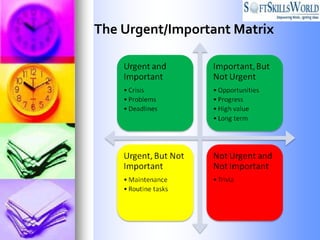
The Urgent/Important Matrix
• Managing time effectively, and achieving the
  things that you want to achieve, means spending
  your time on things that are important and not
  just urgent.

   – IMPORTANT: These are activities that lead to the
     achieving your goals and have the greatest
     impact on your life.

   – URGENT: These activities demand immediate
     attention, but are often associated with
     someone else’s goals rather than our own.
The Urgent/Important Matrix
Additional Strategies for
  Time Management

• Use a system that works for you

• Learn to say no

• Plan to do the biggest projects during your
  most energized times
• Be proactive not reactive
Learn when to say “NO”


 • You can’t do everything

 • Don’t undertake things you can’t
   complete

 • Remain consistent to your goals
More Strategies & Tips

• Tackle the big projects first, even if it is step by
   step (don’t get lost in the little things)

• Use an A-B-C system to plan your day

• Handle papers only once

• Make use of “waiting” time

• Make “want to do” lists not “have to do” lists
   (“have to do” lists can often cause pressure
   and lead to guilt if items are left undone)
Use your waiting time

• On public transportation

• At the doctor’s office

• Waiting for your plane

• On hold

• When you are early
Strategies & Tips
       continued…

• Focus on one thing at a time

• Assess the BIG PICTURE – what’s most
  important overall

• Get & stayed organized

• Set time limits and mini-deadlines

• Practice positive self-talk

• Know your learning style & use study
  techniques that fit that style
Why We Procrastinate

• No clear deadline

• Inadequate resources available

• Don’t know where to begin

• Task feels overwhelming

• No passion for doing the work

• Fear of failure or success
Nine Ways to Overcome
    Procrastination
1.   DELETE IT
2.   DELEGATE
3.   DO IT NOW
4.   ASK FOR ADVICE
5.   CHOP IT UP
6.   OBEY THE 15 MINUTE RULE
7.   HAVE CLEAR DEADLINES
8.   GIVE YOURSELF A REWARD
9.   REMOVE DISTRACTIONS
Eat That Frog!


• "If the first thing you do each morning is to
   eat a live frog, you can go through the day
   with the satisfaction of knowing that that is
   probably the worst thing that is going to
   happen to you all day long!"
• "If you have to eat two frogs, eat the ugliest
   one first!"
• "If you have to eat a live frog, it does not pay
   to sit and look at it for a very long time!"
Avoid Being a Perfectionist

• Yes, some things need
  to be closer to perfect
  than others, but
  perfectionism, paying
  unnecessary attention
  to detail, can be a form
  of procrastination.
Review

• Set goals

• Prioritize

• Organize

• Learn when to say “NO”

• Use your waiting time

• Concentrate on the task at hand

• Consider your personal prime time

• Celebrate success
The Big Rocks of Life


Time                                 35
Management
Case Studies

• You are doing dual courses simultaneously. You
  have your exams of course 1 approaching in the
  first week of the next month; and you also have
  to submit your assignment for the course 2 at
  the same time. Which one will you choose?

• Your mother have asked you this evening to get
  the wheat flour from the market else the dinner
  will be hampered; on the other hand your best
  friend has just called you up to accompany
  her/him for shopping of the clothes that he/she
  wants to wear on his/her date
Time management

Time management

  • 1.
    Time Management: Making theMost of Your Time BY: SOFT SKILLS WORLD
  • 2.
    Module Instructions • Youare encouraged to write down the answers to the questions you see throughout the workshop. • Complete the included inventories and assessments. • Contact our office to schedule an appointment if you need to discuss anything further with a staff member.
  • 3.
    Objectives • To definewhy time management is important • To define what time management is and involves • To identify what makes time management difficult • To identify useful strategies for managing your time
  • 4.
    Why is TimeManagement Important? Why is it important to you to manage or have control over your time? What do you hope to accomplish by managing your time? In what situations or areas of your life is it important to be able to manage your time?
  • 5.
    Importance of Time Management • Time management is important to different individuals for different reasons. – Make sure you have time for all your important activities – Give structure to your days and weeks – Assist in setting goals – Assist in planning for the semester – Assist in determining priorities
  • 6.
    To Realize theValue of: • ONE YEAR, ask a student who failed a grade. • ONE MONTH, ask a mother who gave birth to a premature baby. • ONE WEEK, ask the editor of a weekly newspaper. • ONE DAY, ask a daily wage laborer with kids to feed. • ONE HOUR, ask the lovers who are waiting to meet. • ONE MINUTE, ask a person who missed the train. • ONE SECOND, ask a person who just avoided an accident. • ONE MILLISECOND, ask the person who won a silver medal in the Olympics.
  • 7.
    What is TimeManagement? • Awareness of your time • Awareness of your time wasters • Use of priorities • Self-management or the management of your personal resources • Goal setting & achievement • Planning
  • 8.
    Personal Time Management Timemanagement is different for everyone • How do you define time management? • If you are managing your time well, what does that look like for you? What does that mean? • What skills are required for you to manage your time well?
  • 9.
    What makes time management difficult? Managing our time is not always easy. There are a variety of things that make time management difficult. Below are some of the things that often make it challenging for us to manage our time. Review the following list of common time wasters and identify which ones are challenges for you.
  • 10.
    Time Wasters • Stress •Anxiety • Burnout • Procrastination • Perfectionism • Lack of planning • Unexpected events (such as phone calls or drop-in visitors)
  • 11.
    Additional Time Wasters •Depression • Being unorganized • Working against your natural tendencies • Bad habits • Email or IM • Loosing track of time • Television • Ineffective studying (have to repeat what you studied or re-read material)
  • 12.
    Let’s get personal… •Take a few moments to complete the following assessments: – “Self-Evaluation of Time Management” – “My Time Wasters” • What did you learn about the way you manage your time? • What did you learn about your time wasters?
  • 13.
    Take a 10minute break Study Tip Take a short break each hour to refresh your mind and body. You’ll do better. Set an alarm clock or timer and come back! exit
  • 14.
    Knowing is Halfthe Battle Understanding what time management is and what your time management strengths and challenges are can assist you in determining what strategies will be most useful as you develop your time management skills. The following slides offer some time management tips and strategies that you may find useful.
  • 15.
    Strategies: Define your valuesand determine your priorities. Knowing what is important to you (what you value) and what your priorities are allows you to put those things first as you schedule your time, therefore guiding the way you manage your time.
  • 16.
    Values • Complete theattached Values Assessment to identify your values.
  • 17.
    Priorities • Prioritizing, ordetermining your priorities, is a process of deciding which of several options or tasks is most important. • Prioritizing involves deciding that Activity A is more important than Activity B. • Priorities change over time. • Priorities are influenced by your values and your goals. • Your priorities may not be the same as important others (family or friends) in your life.
  • 18.
    Guiding questions for determining priorities: • What are the costs vs. the benefits of doing this activity? • How well does this activity fit into my goals? • Does this activity have a deadline for completion? • How much do I enjoy doing this activity? • Have I promised or agreed to do this activity? • What needs of mine will be satisfied by doing this activity? • How much time does this activity require?
  • 19.
    Determining Your Priorities •Priority activities can include studying, attending class, worship, meditation, exercising, spendin g one day a week with family, or other activities important to you. • With this in mind, take a few minutes and write down your answers to the questions on the previous slide. • What are your priorities?
  • 20.
    Strategies: Set goals &make action plans • Use the system SMART when setting your goals – S = Specific – M = Measurable – A = Action-oriented – R = Realistic or Reasonable – T = Time Phased • It is okay, and often helpful, to re-evaluate your goals periodically and change or update them or re-set them
  • 21.
    • Action plansare step by step plans of how you are going to accomplish your goal – what are you going to do to reach your goal • Action plans allow you to break the goal down into smaller, more manageable portions and give you the chance to make and record progress towards your goals
  • 22.
    The 80/20 Rule •The 80/20 rule, also known as Pareto’s Principle, states that 80% of your results come from only 20% of your actions. • For most people, it really comes down to analyzing what you are spending your time on. • Are you focusing in on the 20% of activities that produce 80% of the results in your life?
  • 23.
    The Urgent/Important Matrix •Managing time effectively, and achieving the things that you want to achieve, means spending your time on things that are important and not just urgent. – IMPORTANT: These are activities that lead to the achieving your goals and have the greatest impact on your life. – URGENT: These activities demand immediate attention, but are often associated with someone else’s goals rather than our own.
  • 24.
  • 25.
    Additional Strategies for Time Management • Use a system that works for you • Learn to say no • Plan to do the biggest projects during your most energized times • Be proactive not reactive
  • 26.
    Learn when tosay “NO” • You can’t do everything • Don’t undertake things you can’t complete • Remain consistent to your goals
  • 27.
    More Strategies &Tips • Tackle the big projects first, even if it is step by step (don’t get lost in the little things) • Use an A-B-C system to plan your day • Handle papers only once • Make use of “waiting” time • Make “want to do” lists not “have to do” lists (“have to do” lists can often cause pressure and lead to guilt if items are left undone)
  • 28.
    Use your waitingtime • On public transportation • At the doctor’s office • Waiting for your plane • On hold • When you are early
  • 29.
    Strategies & Tips continued… • Focus on one thing at a time • Assess the BIG PICTURE – what’s most important overall • Get & stayed organized • Set time limits and mini-deadlines • Practice positive self-talk • Know your learning style & use study techniques that fit that style
  • 30.
    Why We Procrastinate •No clear deadline • Inadequate resources available • Don’t know where to begin • Task feels overwhelming • No passion for doing the work • Fear of failure or success
  • 31.
    Nine Ways toOvercome Procrastination 1. DELETE IT 2. DELEGATE 3. DO IT NOW 4. ASK FOR ADVICE 5. CHOP IT UP 6. OBEY THE 15 MINUTE RULE 7. HAVE CLEAR DEADLINES 8. GIVE YOURSELF A REWARD 9. REMOVE DISTRACTIONS
  • 32.
    Eat That Frog! •"If the first thing you do each morning is to eat a live frog, you can go through the day with the satisfaction of knowing that that is probably the worst thing that is going to happen to you all day long!" • "If you have to eat two frogs, eat the ugliest one first!" • "If you have to eat a live frog, it does not pay to sit and look at it for a very long time!"
  • 33.
    Avoid Being aPerfectionist • Yes, some things need to be closer to perfect than others, but perfectionism, paying unnecessary attention to detail, can be a form of procrastination.
  • 34.
    Review • Set goals •Prioritize • Organize • Learn when to say “NO” • Use your waiting time • Concentrate on the task at hand • Consider your personal prime time • Celebrate success
  • 35.
    The Big Rocksof Life Time 35 Management
  • 36.
    Case Studies • Youare doing dual courses simultaneously. You have your exams of course 1 approaching in the first week of the next month; and you also have to submit your assignment for the course 2 at the same time. Which one will you choose? • Your mother have asked you this evening to get the wheat flour from the market else the dinner will be hampered; on the other hand your best friend has just called you up to accompany her/him for shopping of the clothes that he/she wants to wear on his/her date

Editor's Notes

  • #21 The first, and most important strategy you can employ to manage your time is to set clear goals for yourself. As a Lions leader, you will want to accomplish many things in your time of office. The best favor you can do for yourself is to determine what those goals are and make sure your efforts are always directed toward their achievement.Effective goals share a number of characteristics in common. Effective goals are:Specific – When a goal is too vague, you may never know how to reach it or even when you have reached it. Make sure that you know exactly what you hope to achieveMeasurable – When you have a goal that is measurable, you will know how far you have to go to reach the goal, and when you get there Achievable – It is commendable to set your sights high, but sometimes we try to accomplish more than we can actually do. Training and certifying ten Certified Guiding Lions in your district in one year may or may not be achievable at this time for a number of reasons. Your goals should be such that, if you “extend yourself” you can just reach them.Realistic – Can you establish a program in your district to help everyone with vision problems? It is certainly a worthwhile goal, but it may not be realistic at this time. It might be better to work on setting up a program with schools to provide vision testing and eyeglasses for disadvantaged children.Time-based – Most of the goals that you establish in your position as a Lions leader will not be long-term. It is important to set time guidelines for your goals, so that you can keep track of your progress as you are going along and can be alert to when you are falling behind schedule.


  • #23 Across the board, you will find that the 80/20 principle is pretty much right on with most things in your life.
  • #24 This concept, coined the Eisenhower Principle, is said to be how former US President Dwight Eisenhower organized his tasks. It was rediscovered and brought into the mainstream as the Urgent/Important Matrix by Stephen Covey in his 1994 business classic, The Seven Habits of Highly Effective People.
  • #25 Urgent And Important: Activities in this area relate to dealing with critical issues as they arise and meeting significant commitments. Perform these duties now.Important, But Not Urgent: These success-oriented tasks are critical to achieving goals. Plan to do these tasks next.Urgent, But Not Important: These chores do not move you forward toward your own goals.Manage by delaying them, cutting them short, and rejecting requests from others. Postpone these chores.Not Urgent And Not Important: These trivial interruptions are just a distraction, and should be avoided if possible. However, be careful not to mislabel things like time with family and recreational activities as not important. Avoid these distractions altogether.
  • #33 Your frog is the task that will have the greatest impact on achieving your goals, and the task that you are most likely to procrastinate starting.The key to reaching high levels of performance and productivity is for you to develop the lifelong habit of tackling your major task first thing each morning. Don’t spend excessive time planning what you will do. You must develop the routine of "eating your frog" before you do anything else and without taking too much time to think about it.