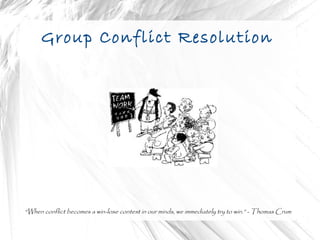
Group Conflict Resolution “ When conflict becomes a win-lose contest in our minds, we immediately try to win.” - Thomas Crum
Styles Of Conflict Competitive : This style work well when decisions need to be made fast, decision is unpopular, or when defending against someone. But it can leave people unsatisfied and resentful. Collaborative : This style incorporates everyone, but slightly assertive. This style is useful when you need to bring everyone together from a variety of viewpoints to get the best solution.  Comprising : This style wants to try and partially satisfy everyone. This style is useful when the cost of conflict is higher than the cost of losing progress.  Accommodating : Meets everyone’s standards at the expense of their own needs, very cooperative. Very easily persuaded to surrender a position even if they don't want to. This style is unlikely to have the best outcomes. Avoiding : This style is is used when you don't want to hurt anyone’s feelings. It is useful if it is impossible to win the battle or when someone else is in a better position to solve the problem. This style is highly ineffective.
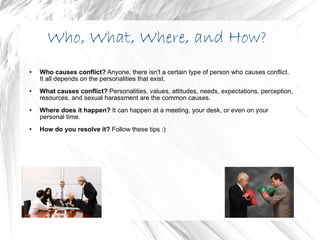
Who, What, Where, and How? Who causes conflict?  Anyone, there isn't a certain type of person who causes conflict. It all depends on the personalities that exist. What causes conflict?  Personalities, values, attitudes, needs, expectations, perception, resources, and sexual harassment are the common causes. Where does it happen?  It can happen at a meeting, your desk, or even on your personal time. How do you resolve it?  Follow these tips :)
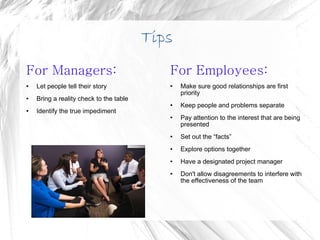
Tips For Managers: Let people tell their story Bring a reality check to the table Identify the true impediment For Employees: Make sure good relationships are first priority Keep people and problems separate Pay attention to the interest that are being presented Set out the “facts” Explore options together Have a designated project manager Don't allow disagreements to interfere with the effectiveness of the team
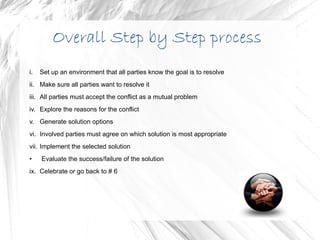
Overall Step by Step process Set up an environment that all parties know the goal is to resolve Make sure all parties want to resolve it All parties must accept the conflict as a mutual problem Explore the reasons for the conflict Generate solution options Involved parties must agree on which solution is most appropriate Implement the selected solution Evaluate the success/failure of the solution Celebrate or go back to # 6
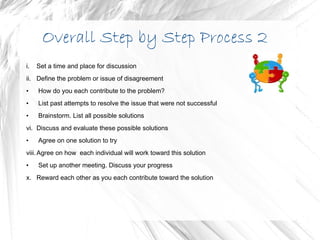
Overall Step by Step Process 2  Set a time and place for discussion Define the problem or issue of disagreement How do you each contribute to the problem? List past attempts to resolve the issue that were not successful Brainstorm. List all possible solutions Discuss and evaluate these possible solutions Agree on one solution to try Agree on how  each individual will work toward this solution Set up another meeting. Discuss your progress Reward each other as you each contribute toward the solution
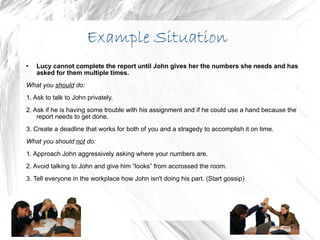
Example Situation Lucy cannot complete the report until John gives her the numbers she needs and has asked for them multiple times. What you  should  do:  1. Ask to talk to John privately. 2. Ask if he is having some trouble with his assignment and if he could use a hand because the report needs to get done. 3. Create a deadline that works for both of you and a stragedy to accomplish it on time. What you should  not  do: 1. Approach John aggressively asking where your numbers are. 2. Avoid talking to John and give him “looks” from accrossed the room.  3. Tell everyone in the workplace how John isn't doing his part. (Start gossip)
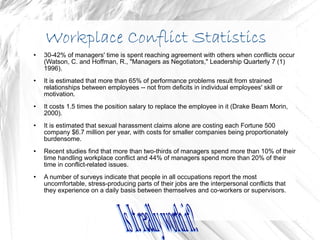
Workplace Conflict Statistics 30-42% of managers' time is spent reaching agreement with others when conflicts occur (Watson, C. and Hoffman, R., "Managers as Negotiators," Leadership Quarterly 7 (1) 1996).  It is estimated that more than 65% of performance problems result from strained relationships between employees -- not from deficits in individual employees' skill or motivation.  It costs 1.5 times the position salary to replace the employee in it (Drake Beam Morin, 2000).  It is estimated that sexual harassment claims alone are costing each Fortune 500 company $6.7 million per year, with costs for smaller companies being proportionately burdensome.  Recent studies find that more than two-thirds of managers spend more than 10% of their time handling workplace conflict and 44% of managers spend more than 20% of their time in conflict-related issues.  A number of surveys indicate that people in all occupations report the most uncomfortable, stress-producing parts of their jobs are the interpersonal conflicts that they experience on a daily basis between themselves and co-workers or supervisors.  Is It really worth it?
Options What Other Options are there?  “ If we manage conflict constructively, we harness it's energy for creativity and development.”-Kenneth Kaye

Group conflict Resolution

  • 1.
    Group Conflict Resolution“ When conflict becomes a win-lose contest in our minds, we immediately try to win.” - Thomas Crum
  • 2.
    Styles Of ConflictCompetitive : This style work well when decisions need to be made fast, decision is unpopular, or when defending against someone. But it can leave people unsatisfied and resentful. Collaborative : This style incorporates everyone, but slightly assertive. This style is useful when you need to bring everyone together from a variety of viewpoints to get the best solution. Comprising : This style wants to try and partially satisfy everyone. This style is useful when the cost of conflict is higher than the cost of losing progress. Accommodating : Meets everyone’s standards at the expense of their own needs, very cooperative. Very easily persuaded to surrender a position even if they don't want to. This style is unlikely to have the best outcomes. Avoiding : This style is is used when you don't want to hurt anyone’s feelings. It is useful if it is impossible to win the battle or when someone else is in a better position to solve the problem. This style is highly ineffective.
  • 3.
    Who, What, Where,and How? Who causes conflict? Anyone, there isn't a certain type of person who causes conflict. It all depends on the personalities that exist. What causes conflict? Personalities, values, attitudes, needs, expectations, perception, resources, and sexual harassment are the common causes. Where does it happen? It can happen at a meeting, your desk, or even on your personal time. How do you resolve it? Follow these tips :)
  • 4.
    Tips For Managers:Let people tell their story Bring a reality check to the table Identify the true impediment For Employees: Make sure good relationships are first priority Keep people and problems separate Pay attention to the interest that are being presented Set out the “facts” Explore options together Have a designated project manager Don't allow disagreements to interfere with the effectiveness of the team
  • 5.
    Overall Step byStep process Set up an environment that all parties know the goal is to resolve Make sure all parties want to resolve it All parties must accept the conflict as a mutual problem Explore the reasons for the conflict Generate solution options Involved parties must agree on which solution is most appropriate Implement the selected solution Evaluate the success/failure of the solution Celebrate or go back to # 6
  • 6.
    Overall Step byStep Process 2 Set a time and place for discussion Define the problem or issue of disagreement How do you each contribute to the problem? List past attempts to resolve the issue that were not successful Brainstorm. List all possible solutions Discuss and evaluate these possible solutions Agree on one solution to try Agree on how each individual will work toward this solution Set up another meeting. Discuss your progress Reward each other as you each contribute toward the solution
  • 7.
    Example Situation Lucycannot complete the report until John gives her the numbers she needs and has asked for them multiple times. What you should do: 1. Ask to talk to John privately. 2. Ask if he is having some trouble with his assignment and if he could use a hand because the report needs to get done. 3. Create a deadline that works for both of you and a stragedy to accomplish it on time. What you should not do: 1. Approach John aggressively asking where your numbers are. 2. Avoid talking to John and give him “looks” from accrossed the room. 3. Tell everyone in the workplace how John isn't doing his part. (Start gossip)
  • 8.
    Workplace Conflict Statistics30-42% of managers' time is spent reaching agreement with others when conflicts occur (Watson, C. and Hoffman, R., "Managers as Negotiators," Leadership Quarterly 7 (1) 1996). It is estimated that more than 65% of performance problems result from strained relationships between employees -- not from deficits in individual employees' skill or motivation. It costs 1.5 times the position salary to replace the employee in it (Drake Beam Morin, 2000). It is estimated that sexual harassment claims alone are costing each Fortune 500 company $6.7 million per year, with costs for smaller companies being proportionately burdensome. Recent studies find that more than two-thirds of managers spend more than 10% of their time handling workplace conflict and 44% of managers spend more than 20% of their time in conflict-related issues. A number of surveys indicate that people in all occupations report the most uncomfortable, stress-producing parts of their jobs are the interpersonal conflicts that they experience on a daily basis between themselves and co-workers or supervisors. Is It really worth it?
  • 9.
    Options What OtherOptions are there? “ If we manage conflict constructively, we harness it's energy for creativity and development.”-Kenneth Kaye