Clarinda clare linus
Diploma In Medical Sciences – January 2011
   At the end of this laboratory activity, the
    students should be able to:
   Be introduced to the principles and
    terminology of chromatography and
    demonstrate separation of the dyes in
    colored pens with paper chromatography.
   Paper chromatography is an analytical chemistry
    technique for separating and identifying color
    mixtures.
   In paper chromatography, substances are
    distributed between stationary phase and a
    mobile phase. Stationary phase is usually a piece
    of filter paper and mobile phase is the colors that
    travels up the stationary phase.
   Components of the samples will separate readily
    according to how strongly they absorb on the
    stationary phase vs. how readily they dissolve in
    the mobile phase.
   6 beakers of jars
   6 covers of lids
   Distilled water
   Isopropanol
   Graduated cylinder
   6 strips of filter paper
   Different colors of water color pens
   Pencil
   Ruler
   Scissors
   tape
 Prepare 15 ml of isopropanol solutions in
  labeled beakers
0%, 5%, 10%, 20%, 50% and 100%
 Cut 6 strips of filter paper
- Draw a line 1cm above the bottom edge of
  the strip with the pencil
- Label each strip with its corresponding
  solution
- Place a spot from each pen on your starting
  line
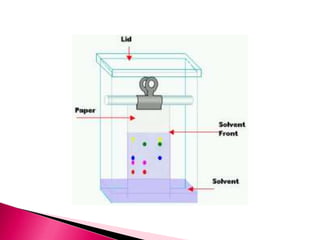
   Place each strip in each beaker
-   Cover the beakers
-   Let the strips absorb the solutions about 2
    cm from the top of the strips
-   Remove strips and let them dry
   Observe the colors separated in low
    concentrations of isopropanol and high
    concentrations of propanol.
   Record data.
Distilled water   5% alcohol
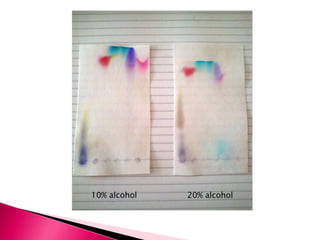
10% alcohol   20% alcohol
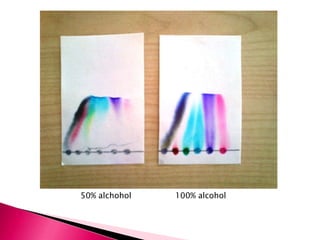
50% alchohol   100% alcohol
   1st – black
   2nd – red
   3rd – green
   4th – blue
   5th – purple
   6th - pink
   According to the conducted experiment, the
    results are as follows:

 Distilled water : Colors does not rise up to
  stationary phase, dissolve
 Alcoholic solution: Colors rise up to stationary
  phase and spread its colors
1. Black = purple and yellow color
2. Red = bright red and white
3. Green = blue and yellow
4. Blue = bright blue
5. Purple = bright purple and pink
6. Pink = Bright pink and white
   When a colored sample is placed on a filter
    paper, the colors separate from the sample
    by placing one of the paper in a low-leveled
    solvent.
   The solvent diffuses up to the filter paper,
    dissolving the various molecules in the
    sample according to polarities of the
    molecules and the solvent.
   If the sample contains more than one color, it
    means that it have more than one kind of
    molecule.
   Because of the different chemical structures
    of each kind of molecules, the chances are
    very high that each molecule will have at least
    a slightly different polarity, giving each
    molecule a different solubility in the solvent.
   The unequeal solubilities cause the various
    color molecules to leave solution at different
    places as the solvent continues to move up
    the paper.
   Hence, the more soluble is a molecule, the
    higher it will migrate up the paper.
   Chromatography has many uses. It is
    commonly used in laboratories to isolate new
    compounds, analyze subtle differences
    between different environmental samples,
    and even in the sequencing of DNA.
   To perform chromatography, one need two
    things; a matrix and a color indicator. A
    matrix is simply the materials to which a
    sample is applied, the material is often
    porous, action as filter paper that affects the
    rate of flow of a sample. Special beads with
    different pore sizes are commonly used to
    separate proteins in biochemistry labs.
   The matrix may interact with a sample, and
    depending on the chemical properties of
    both, and is commonly used to analyze
    mixtures of sugars.
   The color indicator may be the compound
    itself. Some organic compounds are bright
    yellow or orange, which makes them easy on
    identifying on a chromatogram. Others need
    to react with another chemicals to become
    colored.
   Dyes specific for particular chemical
    substances properties can be used to identify
    samples. For examples, rhodamine dye can
    be applied to visualize fats and oils.
Paper chromatography experiment

Paper chromatography experiment

  • 1.
    Clarinda clare linus DiplomaIn Medical Sciences – January 2011
  • 2.
    At the end of this laboratory activity, the students should be able to:  Be introduced to the principles and terminology of chromatography and demonstrate separation of the dyes in colored pens with paper chromatography.
  • 3.
    Paper chromatography is an analytical chemistry technique for separating and identifying color mixtures.  In paper chromatography, substances are distributed between stationary phase and a mobile phase. Stationary phase is usually a piece of filter paper and mobile phase is the colors that travels up the stationary phase.  Components of the samples will separate readily according to how strongly they absorb on the stationary phase vs. how readily they dissolve in the mobile phase.
  • 4.
    6 beakers of jars  6 covers of lids  Distilled water  Isopropanol  Graduated cylinder  6 strips of filter paper  Different colors of water color pens  Pencil  Ruler  Scissors  tape
  • 5.
     Prepare 15ml of isopropanol solutions in labeled beakers 0%, 5%, 10%, 20%, 50% and 100%  Cut 6 strips of filter paper - Draw a line 1cm above the bottom edge of the strip with the pencil - Label each strip with its corresponding solution - Place a spot from each pen on your starting line
  • 6.
    Place each strip in each beaker - Cover the beakers - Let the strips absorb the solutions about 2 cm from the top of the strips - Remove strips and let them dry  Observe the colors separated in low concentrations of isopropanol and high concentrations of propanol.  Record data.
  • 8.
    Distilled water 5% alcohol
  • 9.
    10% alcohol 20% alcohol
  • 10.
    50% alchohol 100% alcohol
  • 11.
    1st – black  2nd – red  3rd – green  4th – blue  5th – purple  6th - pink
  • 12.
    According to the conducted experiment, the results are as follows:  Distilled water : Colors does not rise up to stationary phase, dissolve  Alcoholic solution: Colors rise up to stationary phase and spread its colors 1. Black = purple and yellow color 2. Red = bright red and white 3. Green = blue and yellow 4. Blue = bright blue 5. Purple = bright purple and pink 6. Pink = Bright pink and white
  • 13.
    When a colored sample is placed on a filter paper, the colors separate from the sample by placing one of the paper in a low-leveled solvent.  The solvent diffuses up to the filter paper, dissolving the various molecules in the sample according to polarities of the molecules and the solvent.  If the sample contains more than one color, it means that it have more than one kind of molecule.
  • 14.
    Because of the different chemical structures of each kind of molecules, the chances are very high that each molecule will have at least a slightly different polarity, giving each molecule a different solubility in the solvent.  The unequeal solubilities cause the various color molecules to leave solution at different places as the solvent continues to move up the paper.
  • 15.
    Hence, the more soluble is a molecule, the higher it will migrate up the paper.
  • 16.
    Chromatography has many uses. It is commonly used in laboratories to isolate new compounds, analyze subtle differences between different environmental samples, and even in the sequencing of DNA.
  • 17.
    To perform chromatography, one need two things; a matrix and a color indicator. A matrix is simply the materials to which a sample is applied, the material is often porous, action as filter paper that affects the rate of flow of a sample. Special beads with different pore sizes are commonly used to separate proteins in biochemistry labs.
  • 18.
    The matrix may interact with a sample, and depending on the chemical properties of both, and is commonly used to analyze mixtures of sugars.
  • 19.
    The color indicator may be the compound itself. Some organic compounds are bright yellow or orange, which makes them easy on identifying on a chromatogram. Others need to react with another chemicals to become colored.  Dyes specific for particular chemical substances properties can be used to identify samples. For examples, rhodamine dye can be applied to visualize fats and oils.