PRECIPITATION
REACTIONS
10 Chemistry
Salt Families
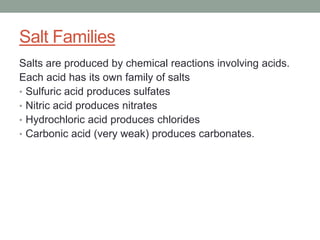
Salts are produced by chemical reactions involving acids.
Each acid has its own family of salts
• Sulfuric acid produces sulfates
• Nitric acid produces nitrates
• Hydrochloric acid produces chlorides
• Carbonic acid (very weak) produces carbonates.
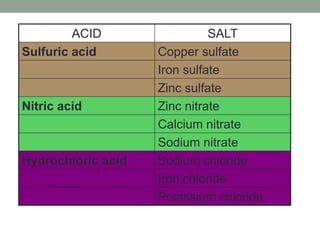
ACID                 SALT
Sulfuric acid       Copper sulfate
                    Iron sulfate
                    Zinc sulfate
Nitric acid         Zinc nitrate
                    Calcium nitrate
                    Sodium nitrate
Hydrochloric acid   Sodium chloride
                    Iron chloride
                    Potassium chloride
Solubility Rules
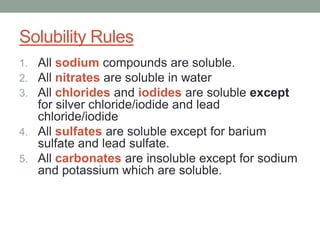
1. All sodium compounds are soluble.
2. All nitrates are soluble in water
3. All chlorides and iodides are soluble except
   for silver chloride/iodide and lead
   chloride/iodide
4. All sulfates are soluble except for barium
   sulfate and lead sulfate.
5. All carbonates are insoluble except for sodium
   and potassium which are soluble.
Precipitation is
the reverse of
the dissolving
process….an
example
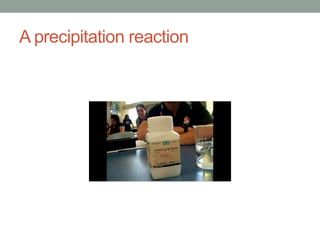
A precipitation reaction
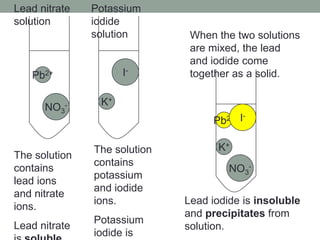
Lead nitrate    Potassium
solution        iodide
                solution        When the two solutions
                                are mixed, the lead
                                and iodide come
   Pb2+               I-        together as a solid.

            -    K+
      NO3
                                           -
                                    Pb2+ I

                The solution          K+
The solution
                contains
contains                                NO3-
                potassium
lead ions
                and iodide
and nitrate
                ions.          Lead iodide is insoluble
ions.
                               and precipitates from
                Potassium
Lead nitrate                   solution.
                iodide is
Writing word equations for precipitation
    reactions


    Lead nitrate + potassium iodide-->lead iodide + potassium nitrate


   Swap the names around and if one of the products is
   insoluble a precipitate will form.
   The subscript (aq) means aqueous solution, the subscript
   (s) means a solid precipitate.

Lead nitrate(aq) + potassium iodide(aq)-->lead iodide(s) + potassium nitrate(aq)
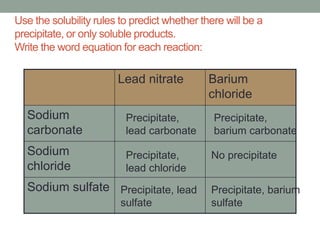
Use the solubility rules to predict whether there will be a
precipitate, or only soluble products.
Write the word equation for each reaction:

                        Lead nitrate          Barium
                                              chloride
   Sodium                 Precipitate,         Precipitate,
   carbonate              lead carbonate       barium carbonate
   Sodium                 Precipitate,        No precipitate
   chloride               lead chloride
   Sodium sulfate Precipitate, lead           Precipitate, barium
                         sulfate              sulfate
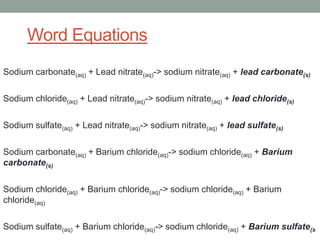
Word Equations
Sodium carbonate(aq) + Lead nitrate(aq)-> sodium nitrate(aq) + lead carbonate(s)

Sodium chloride(aq) + Lead nitrate(aq)-> sodium nitrate(aq) + lead chloride(s)

Sodium sulfate(aq) + Lead nitrate(aq)-> sodium nitrate(aq) + lead sulfate(s)

Sodium carbonate(aq) + Barium chloride(aq)-> sodium chloride(aq) + Barium
carbonate(s)

Sodium chloride(aq) + Barium chloride(aq)-> sodium chloride(aq) + Barium
chloride(aq)

Sodium sulfate(aq) + Barium chloride(aq)-> sodium chloride(aq) + Barium sulfate(s
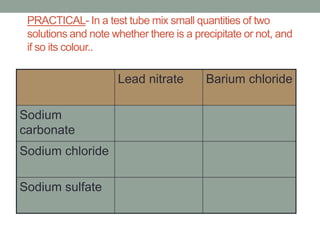
PRACTICAL- In a test tube mix small quantities of two
 solutions and note whether there is a precipitate or not, and
 if so its colour..

                     Lead nitrate         Barium chloride

Sodium
carbonate
Sodium chloride

Sodium sulfate
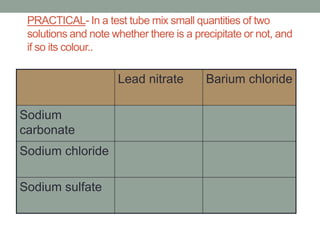
PRACTICAL- In a test tube mix small quantities of two
 solutions and note whether there is a precipitate or not, and
 if so its colour..

                     Lead nitrate         Barium chloride

Sodium
carbonate
Sodium chloride

Sodium sulfate
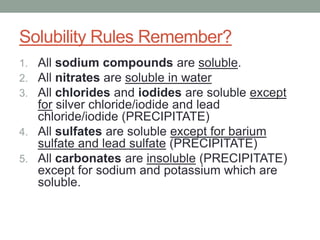
Solubility Rules Remember?
1. All sodium compounds are soluble.
2. All nitrates are soluble in water
3. All chlorides and iodides are soluble except
   for silver chloride/iodide and lead
   chloride/iodide (PRECIPITATE)
4. All sulfates are soluble except for barium
   sulfate and lead sulfate (PRECIPITATE)
5. All carbonates are insoluble (PRECIPITATE)
   except for sodium and potassium which are
   soluble.
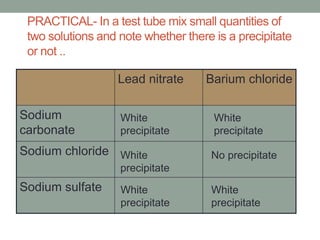
PRACTICAL- In a test tube mix small quantities of
 two solutions and note whether there is a precipitate
 or not ..

                   Lead nitrate     Barium chloride

Sodium             White              White
carbonate          precipitate        precipitate
Sodium chloride White                No precipitate
                   precipitate
Sodium sulfate     White             White
                   precipitate       precipitate
TEST REVISION
STUDY!!!
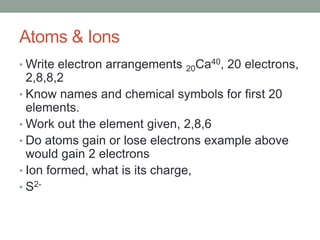
Atoms & Ions
• Write electron arrangements   20 Ca40, 20 electrons,
  2,8,8,2
• Know names and chemical symbols for first 20
  elements.
• Work out the element given, 2,8,6
• Do atoms gain or lose electrons example above
  would gain 2 electrons
• Ion formed, what is its charge,
• S2-
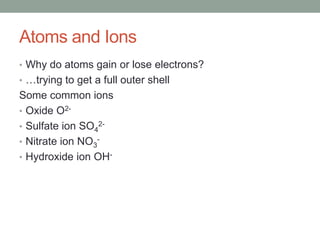
Atoms and Ions
• Why do atoms gain or lose electrons?
• …trying to get a full outer shell
Some common ions
• Oxide O2-
• Sulfate ion SO42-
• Nitrate ion NO3-
• Hydroxide ion OH-
Combustion
• Fuel and air. You need some heat to make combustion
  happen. Heat to melt and form vapour, vapour that burns.
• Why does the candle keep burning?
• How do you put fires out?
• Complete and incomplete combustion. Word equations for
  methane burning
Solubility and Precipitates
You will be given the solubility rules.
• What is meant by a precipitation reaction?
• Identify the insoluble material using the rules
• Why does the precipitate form? …something insoluble is
  formed, it has to come out of solution.
• Write a word equation.

Precipitates

  • 1.
  • 2.
    Salt Families Salts areproduced by chemical reactions involving acids. Each acid has its own family of salts • Sulfuric acid produces sulfates • Nitric acid produces nitrates • Hydrochloric acid produces chlorides • Carbonic acid (very weak) produces carbonates.
  • 3.
    ACID SALT Sulfuric acid Copper sulfate Iron sulfate Zinc sulfate Nitric acid Zinc nitrate Calcium nitrate Sodium nitrate Hydrochloric acid Sodium chloride Iron chloride Potassium chloride
  • 4.
    Solubility Rules 1. Allsodium compounds are soluble. 2. All nitrates are soluble in water 3. All chlorides and iodides are soluble except for silver chloride/iodide and lead chloride/iodide 4. All sulfates are soluble except for barium sulfate and lead sulfate. 5. All carbonates are insoluble except for sodium and potassium which are soluble.
  • 5.
    Precipitation is the reverseof the dissolving process….an example
  • 6.
  • 7.
    Lead nitrate Potassium solution iodide solution When the two solutions are mixed, the lead and iodide come Pb2+ I- together as a solid. - K+ NO3 - Pb2+ I The solution K+ The solution contains contains NO3- potassium lead ions and iodide and nitrate ions. Lead iodide is insoluble ions. and precipitates from Potassium Lead nitrate solution. iodide is
  • 8.
    Writing word equationsfor precipitation reactions Lead nitrate + potassium iodide-->lead iodide + potassium nitrate Swap the names around and if one of the products is insoluble a precipitate will form. The subscript (aq) means aqueous solution, the subscript (s) means a solid precipitate. Lead nitrate(aq) + potassium iodide(aq)-->lead iodide(s) + potassium nitrate(aq)
  • 9.
    Use the solubilityrules to predict whether there will be a precipitate, or only soluble products. Write the word equation for each reaction: Lead nitrate Barium chloride Sodium Precipitate, Precipitate, carbonate lead carbonate barium carbonate Sodium Precipitate, No precipitate chloride lead chloride Sodium sulfate Precipitate, lead Precipitate, barium sulfate sulfate
  • 10.
    Word Equations Sodium carbonate(aq)+ Lead nitrate(aq)-> sodium nitrate(aq) + lead carbonate(s) Sodium chloride(aq) + Lead nitrate(aq)-> sodium nitrate(aq) + lead chloride(s) Sodium sulfate(aq) + Lead nitrate(aq)-> sodium nitrate(aq) + lead sulfate(s) Sodium carbonate(aq) + Barium chloride(aq)-> sodium chloride(aq) + Barium carbonate(s) Sodium chloride(aq) + Barium chloride(aq)-> sodium chloride(aq) + Barium chloride(aq) Sodium sulfate(aq) + Barium chloride(aq)-> sodium chloride(aq) + Barium sulfate(s
  • 11.
    PRACTICAL- In atest tube mix small quantities of two solutions and note whether there is a precipitate or not, and if so its colour.. Lead nitrate Barium chloride Sodium carbonate Sodium chloride Sodium sulfate
  • 12.
    PRACTICAL- In atest tube mix small quantities of two solutions and note whether there is a precipitate or not, and if so its colour.. Lead nitrate Barium chloride Sodium carbonate Sodium chloride Sodium sulfate
  • 13.
    Solubility Rules Remember? 1.All sodium compounds are soluble. 2. All nitrates are soluble in water 3. All chlorides and iodides are soluble except for silver chloride/iodide and lead chloride/iodide (PRECIPITATE) 4. All sulfates are soluble except for barium sulfate and lead sulfate (PRECIPITATE) 5. All carbonates are insoluble (PRECIPITATE) except for sodium and potassium which are soluble.
  • 14.
    PRACTICAL- In atest tube mix small quantities of two solutions and note whether there is a precipitate or not .. Lead nitrate Barium chloride Sodium White White carbonate precipitate precipitate Sodium chloride White No precipitate precipitate Sodium sulfate White White precipitate precipitate
  • 15.
  • 16.
    Atoms & Ions •Write electron arrangements 20 Ca40, 20 electrons, 2,8,8,2 • Know names and chemical symbols for first 20 elements. • Work out the element given, 2,8,6 • Do atoms gain or lose electrons example above would gain 2 electrons • Ion formed, what is its charge, • S2-
  • 17.
    Atoms and Ions •Why do atoms gain or lose electrons? • …trying to get a full outer shell Some common ions • Oxide O2- • Sulfate ion SO42- • Nitrate ion NO3- • Hydroxide ion OH-
  • 18.
    Combustion • Fuel andair. You need some heat to make combustion happen. Heat to melt and form vapour, vapour that burns. • Why does the candle keep burning? • How do you put fires out? • Complete and incomplete combustion. Word equations for methane burning
  • 19.
    Solubility and Precipitates Youwill be given the solubility rules. • What is meant by a precipitation reaction? • Identify the insoluble material using the rules • Why does the precipitate form? …something insoluble is formed, it has to come out of solution. • Write a word equation.