When table salt (Sodium Chloride) is
dissolved in water to form an aqueous
solution the ions no longer bond together,
they separate into an array of positive and
negative ions.
The dissolving of Sodium Chloride into
water can be represented by the equation:
NaCl (s) → Na+ (aq) + Cl-(aq)
The solubility of compounds are based on a number of
rules . At this stage it is important to be aware and
exposed to these:
 All compounds containing NA+, NH4
+, K+ or NO-
3 will
dissolve in water (SOLUBLE)
 Compounds containing Cl-, Br- and I- ions are SOLUBLE
except if they have (Ag+, Pb2+ or Hg2+ ions)
 Compounds containing SO4
-2 are SOLUBLE except (Ba+2,
Pb+2 and Ca2+)
 Compounds containing CO3
-2 and PO4
-3 are INSOLUBLE
except with Na+, NH4
+ or K+
 Compounds containing OH- are INSOLUBLE unless with
Na+, NH4
+ or K+
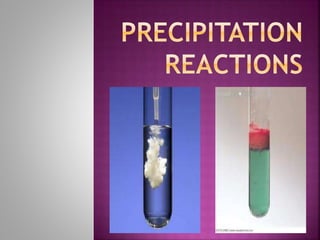
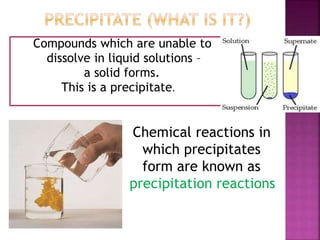
Compounds which are unable to
dissolve in liquid solutions –
a solid forms.
This is a precipitate.
Chemical reactions in
which precipitates
form are known as
precipitation reactions
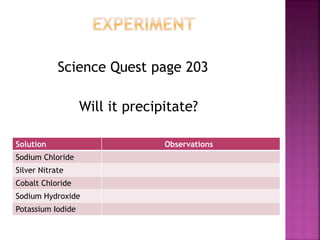
Science Quest page 203
Will it precipitate?
Solution Observations
Sodium Chloride
Silver Nitrate
Cobalt Chloride
Sodium Hydroxide
Potassium Iodide

Precipitation reactions

  • 2.
    When table salt(Sodium Chloride) is dissolved in water to form an aqueous solution the ions no longer bond together, they separate into an array of positive and negative ions. The dissolving of Sodium Chloride into water can be represented by the equation: NaCl (s) → Na+ (aq) + Cl-(aq)
  • 3.
    The solubility ofcompounds are based on a number of rules . At this stage it is important to be aware and exposed to these:  All compounds containing NA+, NH4 +, K+ or NO- 3 will dissolve in water (SOLUBLE)  Compounds containing Cl-, Br- and I- ions are SOLUBLE except if they have (Ag+, Pb2+ or Hg2+ ions)  Compounds containing SO4 -2 are SOLUBLE except (Ba+2, Pb+2 and Ca2+)  Compounds containing CO3 -2 and PO4 -3 are INSOLUBLE except with Na+, NH4 + or K+  Compounds containing OH- are INSOLUBLE unless with Na+, NH4 + or K+
  • 4.
    Compounds which areunable to dissolve in liquid solutions – a solid forms. This is a precipitate. Chemical reactions in which precipitates form are known as precipitation reactions
  • 5.
    Science Quest page203 Will it precipitate? Solution Observations Sodium Chloride Silver Nitrate Cobalt Chloride Sodium Hydroxide Potassium Iodide