Rabia Aziz
BS Chemistry (Jinnah University for Women)
Karachi, Sindh, Pakistan
7/16/2019 Rabia Aziz 1
Kashmiri
• Introduction
 Process
 Reaction and Mechanism
 Synthesis
 Applications
• Notes
• Conclusion
7/16/2019 Rabia Aziz 2
• It is named after Adolph Wilhelm
Hermann Kolbe and Rudolf Schmitt.
(1859)
• This is also called carboxylation
chemical reaction.
7/16/2019 Rabia Aziz 3
Phenol
Salicylic Acid /
Ortho-Hydroxy Benzoic Acid /
2-Hydroxy Benzoic Acid /
7/16/2019 Rabia Aziz 4
A reaction for adding a
carboxyl group onto
the benzene ring of a
phenol.
Reaction
7/16/2019 Rabia Aziz 5
7/16/2019 Rabia Aziz 6
Examples
7/16/2019 Rabia Aziz 7
Synthesis
7/16/2019 Rabia Aziz 8
Application
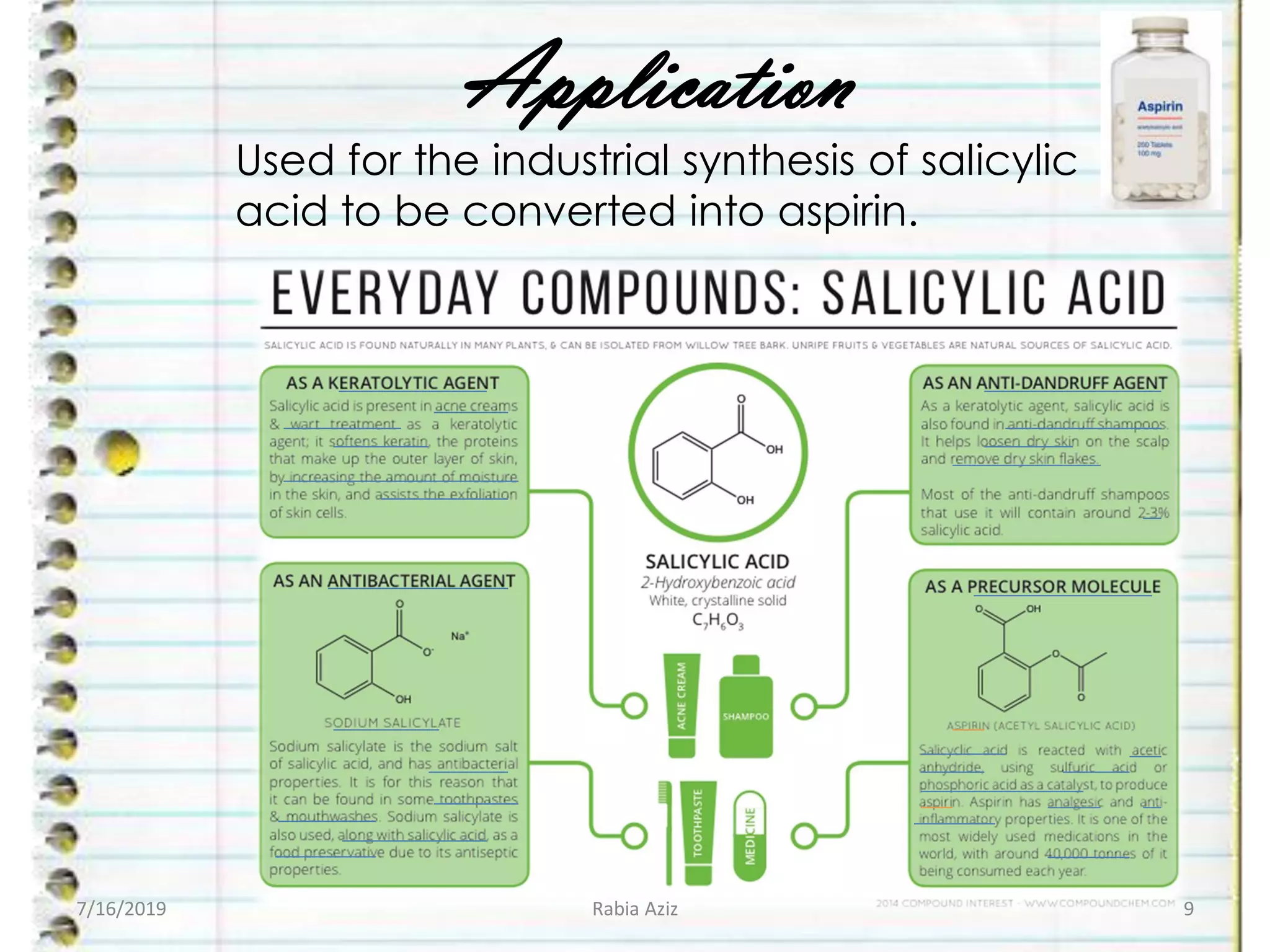
Used for the industrial synthesis of salicylic
acid to be converted into aspirin.
7/16/2019 Rabia Aziz 9
7/16/2019 Rabia Aziz 10
NOTES
7/16/2019 Rabia Aziz 11
1. The reaction is electrophilic Substitution Reaction.
2. The reaction is Carboxylation Reaction. Carboxylation of phenol.
3. Formation of Aromatic Carboxylic Acid.
4. Synthesis of Salicylic acid.
5. The reaction is Strong base and Strong acid catalyzed.
6. The reaction is metal catalyzed. Small size metal ion leads to ortho product while large
size metal ion leads to ortho and para products.
7. In this reaction C-C bond is formed.
8. In Reaction, generation of electrophile step is not present.
9. OH group is ortho and para directing group.
10. Carbon dioxide is weak electrophile.
11. While OH group is electron donating group (increases the electron density on ring) and
generation of phenoxide by deprotonation increases the nucleophilicity of phenol which
enhances the rate of reaction.
12. Phenol is weakly acidic. It reacts with NaOH and give phenoxide.
13. Phenol is highly reactive toward electrophilic aromatic substitution.
14. The Preparation steps are : phenoxide preparation, carboxylation, Dilution, decolorizing,
filtration, precipitation, separation, dry .
• Purpose of NaOH
It Catalyzed the reaction and increase the rate of reaction by
increasing the nucleophilicity of phenol. It abstract proton of
phenol and form Sodium Phenoxide then Sodium Salicylate
which is Alkalimetal-Carbon Dioxide
• Without NaOH
Reaction can be performed without NaOH but the rate of
reaction is slow
7/16/2019 Rabia Aziz 12
• Substitution on Ortho Position
OH group is electron donating group and it is ortho
and para director group
Na can form Alkalimetal-Carbon dioxide complex when
Carbon dioxide substitute on ortho position of phenol
because Sodium atom has small nuclei size
7/16/2019 Rabia Aziz 13
CONCLUSION
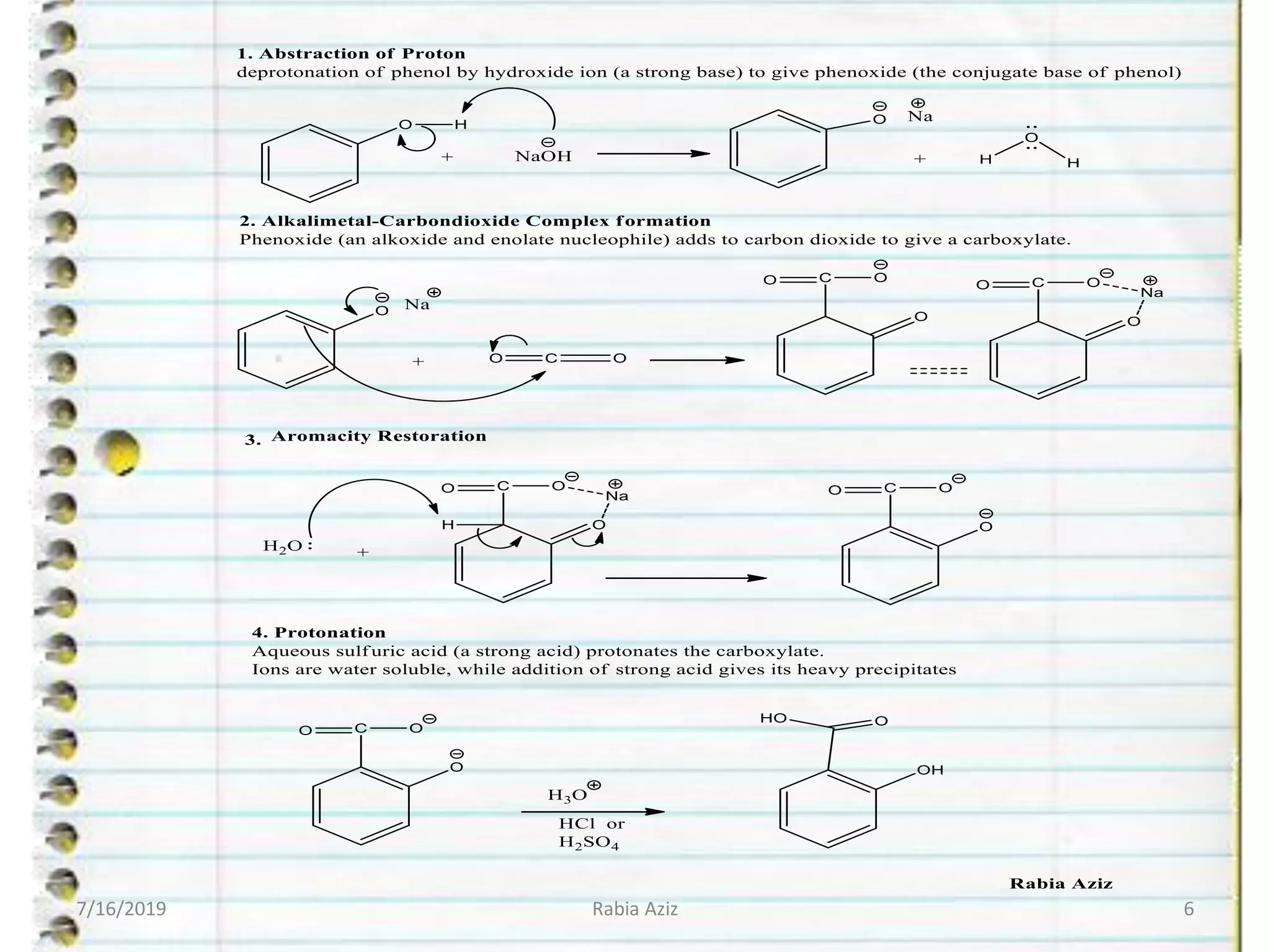
• The Kolbe-Schmitt reaction is used to convert a phenol to a
hydroxy benzoic acid using carbon dioxide gas, a base, and acid
work-up.
• The mechanism begins with deprotonation of the phenol by
the base to form a phenoxide. The phenoxide rearranges to
form a carbonyl group while the aromatic ring attacks the CO2
molecule. The attack can happen from either the ortho or para
position, which explains the two possible products, and results
in the loss of aromaticity of the ring. Another deprotonation by
the base regenerates aromaticity and produces the phenoxide
again. Protonation of the phenoxide and the carboxy-late
anions yield the final ortho- and/or para-hydroxy benzoic acids.
• Salicylic acid is a precursor of aspirin. It also possesses several
pharmacological properties. It is used in various industries.
7/16/2019 Rabia Aziz 14

Kolbe schmitt reaction

  • 1.
    Rabia Aziz BS Chemistry(Jinnah University for Women) Karachi, Sindh, Pakistan 7/16/2019 Rabia Aziz 1 Kashmiri
  • 2.
    • Introduction  Process Reaction and Mechanism  Synthesis  Applications • Notes • Conclusion 7/16/2019 Rabia Aziz 2
  • 3.
    • It isnamed after Adolph Wilhelm Hermann Kolbe and Rudolf Schmitt. (1859) • This is also called carboxylation chemical reaction. 7/16/2019 Rabia Aziz 3
  • 4.
    Phenol Salicylic Acid / Ortho-HydroxyBenzoic Acid / 2-Hydroxy Benzoic Acid / 7/16/2019 Rabia Aziz 4
  • 5.
    A reaction foradding a carboxyl group onto the benzene ring of a phenol. Reaction 7/16/2019 Rabia Aziz 5
  • 6.
  • 7.
  • 8.
  • 9.
    Application Used for theindustrial synthesis of salicylic acid to be converted into aspirin. 7/16/2019 Rabia Aziz 9
  • 10.
  • 11.
    NOTES 7/16/2019 Rabia Aziz11 1. The reaction is electrophilic Substitution Reaction. 2. The reaction is Carboxylation Reaction. Carboxylation of phenol. 3. Formation of Aromatic Carboxylic Acid. 4. Synthesis of Salicylic acid. 5. The reaction is Strong base and Strong acid catalyzed. 6. The reaction is metal catalyzed. Small size metal ion leads to ortho product while large size metal ion leads to ortho and para products. 7. In this reaction C-C bond is formed. 8. In Reaction, generation of electrophile step is not present. 9. OH group is ortho and para directing group. 10. Carbon dioxide is weak electrophile. 11. While OH group is electron donating group (increases the electron density on ring) and generation of phenoxide by deprotonation increases the nucleophilicity of phenol which enhances the rate of reaction. 12. Phenol is weakly acidic. It reacts with NaOH and give phenoxide. 13. Phenol is highly reactive toward electrophilic aromatic substitution. 14. The Preparation steps are : phenoxide preparation, carboxylation, Dilution, decolorizing, filtration, precipitation, separation, dry .
  • 12.
    • Purpose ofNaOH It Catalyzed the reaction and increase the rate of reaction by increasing the nucleophilicity of phenol. It abstract proton of phenol and form Sodium Phenoxide then Sodium Salicylate which is Alkalimetal-Carbon Dioxide • Without NaOH Reaction can be performed without NaOH but the rate of reaction is slow 7/16/2019 Rabia Aziz 12
  • 13.
    • Substitution onOrtho Position OH group is electron donating group and it is ortho and para director group Na can form Alkalimetal-Carbon dioxide complex when Carbon dioxide substitute on ortho position of phenol because Sodium atom has small nuclei size 7/16/2019 Rabia Aziz 13
  • 14.
    CONCLUSION • The Kolbe-Schmittreaction is used to convert a phenol to a hydroxy benzoic acid using carbon dioxide gas, a base, and acid work-up. • The mechanism begins with deprotonation of the phenol by the base to form a phenoxide. The phenoxide rearranges to form a carbonyl group while the aromatic ring attacks the CO2 molecule. The attack can happen from either the ortho or para position, which explains the two possible products, and results in the loss of aromaticity of the ring. Another deprotonation by the base regenerates aromaticity and produces the phenoxide again. Protonation of the phenoxide and the carboxy-late anions yield the final ortho- and/or para-hydroxy benzoic acids. • Salicylic acid is a precursor of aspirin. It also possesses several pharmacological properties. It is used in various industries. 7/16/2019 Rabia Aziz 14