Elvis Plaza
     EDPE 3018
September 2012
   Introduce the Communicative Language
    Approach in Language Teaching
   CLT General Objectives and Purpose
   Teaching Techniques
   Teaching Example
   Introduce the Communicative Language
    Teaching approach, and how was this
    approach developed in teaching languages.
    Present the CLT objectives in language
    teaching and teaching techniques examples.
   CLT origins, can be found in changes in the
    British Language teaching tradition in the
    1960s.
   Back then, the Situational Language teaching
    approach was the norm.
   SLT consisted in internalizing the structures
    of a language.
   Mostly, learning grammar rules without
    vocabulary development.
   The SLT did not fill the need to develop
    language competence in Language teaching.
   A group of experts saw the need to focus in
    communicative proficiency rather than
    mastery of structures. (Richards, J.C. &
    Rodgers, T.S. p.64)
   Sandra J. Savignon, Christopher Candlin, D.A.
    Wilkins and Henry Widdowson along with
    others promoted the CLT approach.
   Along with the changes in Europe it helped to
    reform the language teaching.
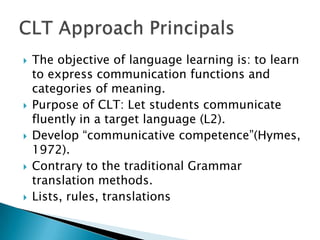
   The objective of language learning is: to learn
    to express communication functions and
    categories of meaning.
   Purpose of CLT: Let students communicate
    fluently in a target language (L2).
   Develop “communicative competence”(Hymes,
    1972).
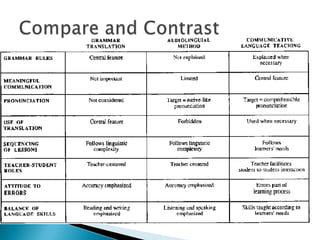
   Contrary to the traditional Grammar
    translation methods.
   Lists, rules, translations
   Use Language as:
    ◦ means of communication
    ◦ object of learning
    ◦ means of expressing values
   Focus on communication rather than
    structure
   Language learning within the school
    curriculum
   Focus on meaningful tasks
   Collaboration
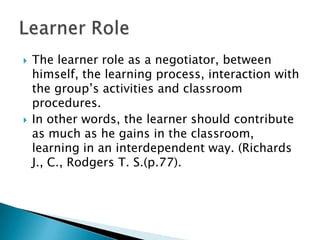
   The learner role as a negotiator, between
    himself, the learning process, interaction with
    the group’s activities and classroom
    procedures.
   In other words, the learner should contribute
    as much as he gains in the classroom,
    learning in an interdependent way. (Richards
    J., C., Rodgers T. S.(p.77).
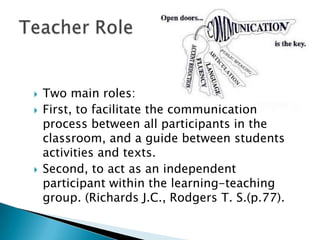
   Two main roles:
   First, to facilitate the communication
    process between all participants in the
    classroom, and a guide between students
    activities and texts.
   Second, to act as an independent
    participant within the learning-teaching
    group. (Richards J.C., Rodgers T. S.(p.77).
   Materials are seen as a way of influencing the
    quality of classroom interaction and language
    use.
   They have promote communicative language
    use.
   Some Instructional Materials are:
   Visual cues
   Taped cues
   Pictures
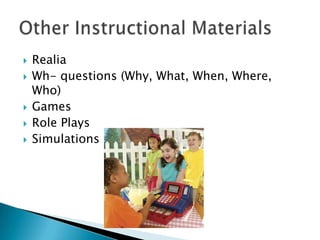
   Realia
   Wh- questions (Why, What, When, Where,
    Who)
   Games
   Role Plays
   Simulations
   Exercise types and activities compatible with
    the CLT, are unlimited.
   If they help to engage in communication they
    are welcome.
   Information sharing, negotiation of meaning
    and interaction.
   Communicating behind a screen to give
    instructions on how to draw a picture or
    shape
   Follow directions
   Conversation and discussion sessions
   Dialogues and role plays
   Simulations
   Improvisations
   Debates
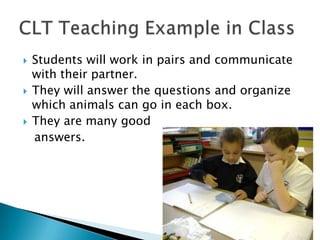
   Students will work in pairs and communicate
    with their partner.
   They will answer the questions and organize
    which animals can go in each box.
   They are many good
    answers.
   During research, I realized that my elementary
    teachers rarely used this teaching approach.
   I rarely got any oral practice in my English
    class.
   Therefore, to my future students I plan to use
    this approach so that they can lose the fear of
    speaking a second language.
   I will help them overcome their fears and
    boost their confidence by the different
    techniques available.
   This approach can help future teachers
    develop their students’ oral communication
    skills.
   Students will lose the fear of communicating
    in a second language, in this case English as
    a Second Language. (ESL)
   It can help promote confidence and security
    in the classroom environment, in everyday
    use, and when travelling abroad.
   Richards, J. C. Rodgers, T. S. (1992). Approaches and Methods in
          Language Teaching. New York: Cambridge University Press.
   Littlewood, W. (1981). Communicative Language Teaching an I
          ntroduction. London: Cambridge University Press.
   Nunan, D. (1999). Second Language Teaching & Learning. New York:
          Heinle & Heinle Publishers.
   Sun, G. & Cheng, L. (Spring 2002). From Context to Curriculum: A Case
          Study of Communicative Language Teaching in China. [Electronic
          version]. TESL Canada Journal. VOL. 19, NO.2. Retrieved August 29,
          2012, from the Eric database.
    Criado, R. & Sánchez A. (2009). English Language Teaching in Spain: Do
         Textbooks Comply with the Official Methodological Regulations? A
         Sample Analysis. [Electronic version]. University of Murcia
         Publications. IJES, vol. 9 (1).
   Orwig, C. J. (1999, March 21). Communicative Language Teaching.
         Retrieved:
         August 28, 2012, from SIL International, 1999. Web site:
   http://www.sil.org/lingualinks/LANGUAGELEARNING/WaysToApproachLa
    nguageLearning/CommunicativeLanguageTeaching.htm

Communicative language teaching

  • 1.
    Elvis Plaza EDPE 3018 September 2012
  • 2.
    Introduce the Communicative Language Approach in Language Teaching  CLT General Objectives and Purpose  Teaching Techniques  Teaching Example
  • 3.
    Introduce the Communicative Language Teaching approach, and how was this approach developed in teaching languages. Present the CLT objectives in language teaching and teaching techniques examples.
  • 4.
    CLT origins, can be found in changes in the British Language teaching tradition in the 1960s.  Back then, the Situational Language teaching approach was the norm.  SLT consisted in internalizing the structures of a language.  Mostly, learning grammar rules without vocabulary development.
  • 5.
    The SLT did not fill the need to develop language competence in Language teaching.  A group of experts saw the need to focus in communicative proficiency rather than mastery of structures. (Richards, J.C. & Rodgers, T.S. p.64)  Sandra J. Savignon, Christopher Candlin, D.A. Wilkins and Henry Widdowson along with others promoted the CLT approach.  Along with the changes in Europe it helped to reform the language teaching.
  • 6.
    The objective of language learning is: to learn to express communication functions and categories of meaning.  Purpose of CLT: Let students communicate fluently in a target language (L2).  Develop “communicative competence”(Hymes, 1972).  Contrary to the traditional Grammar translation methods.  Lists, rules, translations
  • 7.
    Use Language as: ◦ means of communication ◦ object of learning ◦ means of expressing values  Focus on communication rather than structure  Language learning within the school curriculum  Focus on meaningful tasks  Collaboration
  • 9.
    The learner role as a negotiator, between himself, the learning process, interaction with the group’s activities and classroom procedures.  In other words, the learner should contribute as much as he gains in the classroom, learning in an interdependent way. (Richards J., C., Rodgers T. S.(p.77).
  • 10.
    Two main roles:  First, to facilitate the communication process between all participants in the classroom, and a guide between students activities and texts.  Second, to act as an independent participant within the learning-teaching group. (Richards J.C., Rodgers T. S.(p.77).
  • 11.
    Materials are seen as a way of influencing the quality of classroom interaction and language use.  They have promote communicative language use.  Some Instructional Materials are:  Visual cues  Taped cues  Pictures
  • 12.
    Realia  Wh- questions (Why, What, When, Where, Who)  Games  Role Plays  Simulations
  • 13.
    Exercise types and activities compatible with the CLT, are unlimited.  If they help to engage in communication they are welcome.  Information sharing, negotiation of meaning and interaction.
  • 14.
    Communicating behind a screen to give instructions on how to draw a picture or shape  Follow directions  Conversation and discussion sessions  Dialogues and role plays  Simulations  Improvisations  Debates
  • 15.
    Students will work in pairs and communicate with their partner.  They will answer the questions and organize which animals can go in each box.  They are many good answers.
  • 16.
    During research, I realized that my elementary teachers rarely used this teaching approach.  I rarely got any oral practice in my English class.  Therefore, to my future students I plan to use this approach so that they can lose the fear of speaking a second language.  I will help them overcome their fears and boost their confidence by the different techniques available.
  • 17.
    This approach can help future teachers develop their students’ oral communication skills.  Students will lose the fear of communicating in a second language, in this case English as a Second Language. (ESL)  It can help promote confidence and security in the classroom environment, in everyday use, and when travelling abroad.
  • 18.
    Richards, J. C. Rodgers, T. S. (1992). Approaches and Methods in Language Teaching. New York: Cambridge University Press.  Littlewood, W. (1981). Communicative Language Teaching an I ntroduction. London: Cambridge University Press.  Nunan, D. (1999). Second Language Teaching & Learning. New York: Heinle & Heinle Publishers.  Sun, G. & Cheng, L. (Spring 2002). From Context to Curriculum: A Case Study of Communicative Language Teaching in China. [Electronic version]. TESL Canada Journal. VOL. 19, NO.2. Retrieved August 29, 2012, from the Eric database.  Criado, R. & Sánchez A. (2009). English Language Teaching in Spain: Do Textbooks Comply with the Official Methodological Regulations? A Sample Analysis. [Electronic version]. University of Murcia Publications. IJES, vol. 9 (1).  Orwig, C. J. (1999, March 21). Communicative Language Teaching. Retrieved: August 28, 2012, from SIL International, 1999. Web site:  http://www.sil.org/lingualinks/LANGUAGELEARNING/WaysToApproachLa nguageLearning/CommunicativeLanguageTeaching.htm