Presented by: Hassnae SALEK
CRMEF Oujda
English department
2018
Michael Lewis
Outline
• Background
• Fundamentals of the Lexical approach
• Features of the Lexical approach
• In search of a theory
• Teacher/ Learner roles
• Methodological Implications of the Lexical Approach
• Lexical approach activities
• Limitations of the Lexical Approach
• Teaching lexically
Background
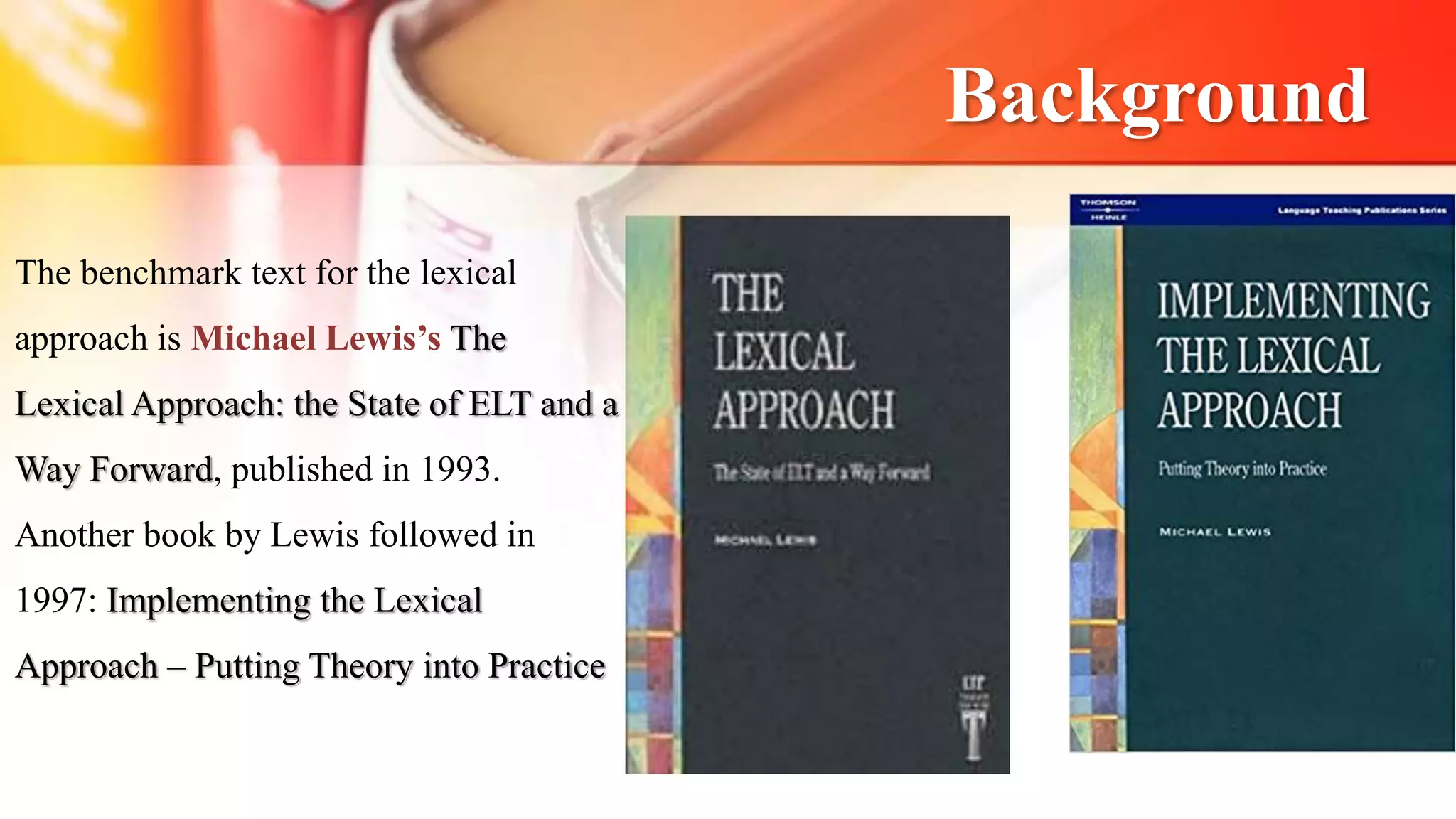
The benchmark text for the lexical
approach is Michael Lewis’s The
Lexical Approach: the State of ELT and a
Way Forward, published in 1993.
Another book by Lewis followed in
1997: Implementing the Lexical
Approach – Putting Theory into Practice
Grammar/Vocabulary dichotomy is false.
Language is basically its lexicon.
(Lexical Approach)
Fundamentals of the Lexical approach
Grammar Vs Lexis
• The fundamental principle of the
lexical approach is that language
consists of “grammaticalized lexis, not
lexicalized grammar.”
(Lewis, 1993)
Fundamentals of the Lexical approach
"The more one considers the matter, the more reasonable it seems
to suppose that lexis is where we need to start from, the syntax
to be put to the service of words and not the other way round.“
(Lewis, 2002)
Fundamentals of the Lexical approach
Features of the lexical approach
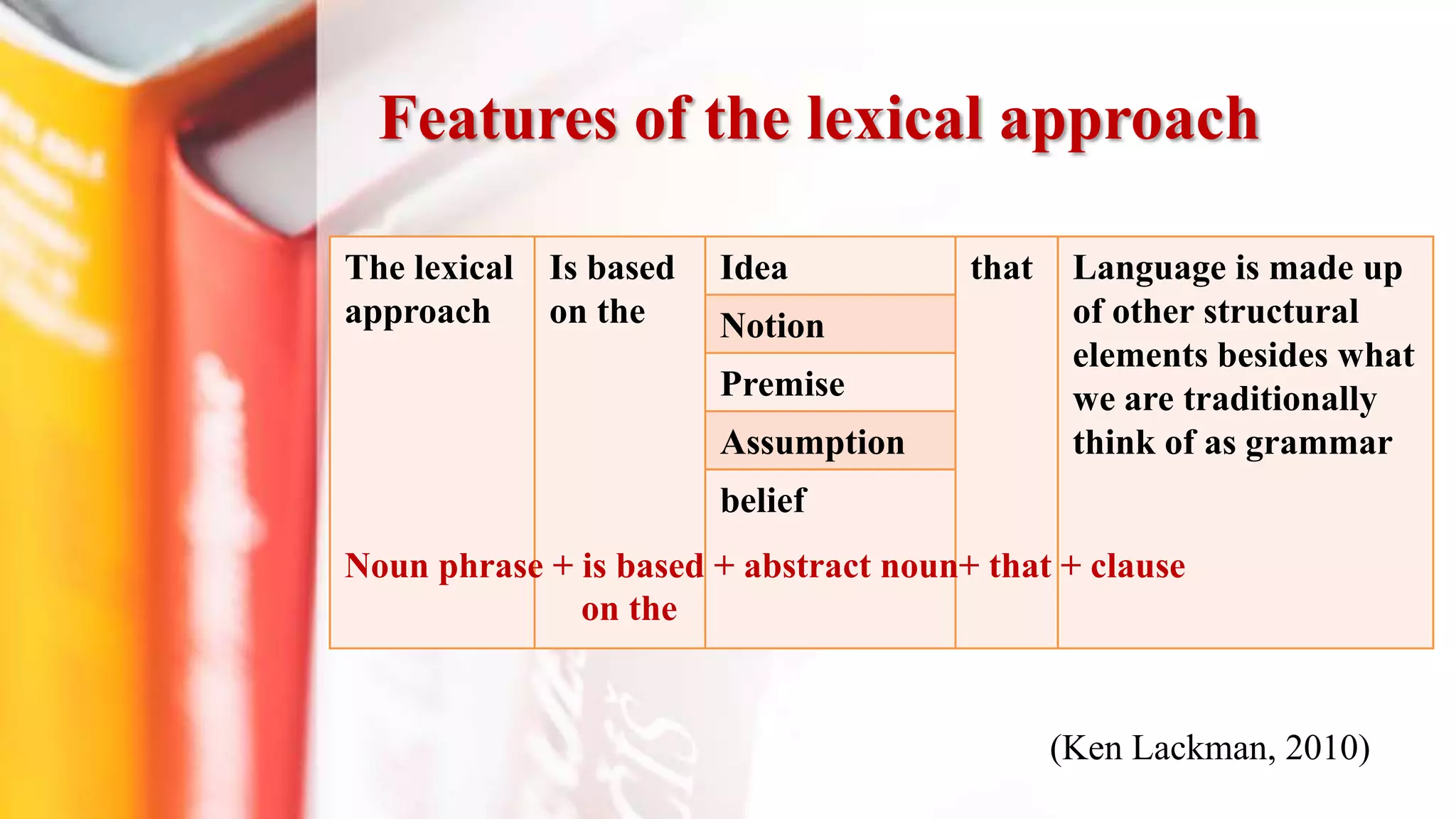
The lexical
approach
Is based
on the
Idea that Language is made up
of other structural
elements besides what
we are traditionally
think of as grammar
Notion
Premise
Assumption
belief
(Ken Lackman, 2010)
Noun phrase + is based + abstract noun+ that + clause
on the
Features of the lexical approach
‘Language consists not of traditional grammar
and vocabulary but often of multi-word
prefabricated chunks’ (ILA, p.3)
What is a Chunk?
• Any pair or group of words commonly found together or
near one another, e.g., idioms, collocations, fixed
expressions, phrasal verbs etc.
• It is a lexico-grammatical unit which exists somewhere
between the traditional poles of lexicon and syntax.
Types of Chunks
• Collocations: words which go together to give a certain meaning, usually, but not always, two
words.
(e.g., a broken home = a family in which one parent is absent, usually due to divorce or desertion)
• Fixed expressions: expressions which cannot be changed. Most fixed expressions are
idiomatic or are those used in polite speech
(e.g., kick the bucket = To die)
• Semi-fixed expressions: are phrases or idioms that retain the same basic word order
throughout.
(e.g., spill the beans = reveal the secrets )
In search of a theory
• Theory of the Nature of language:
“language consists of “grammaticalized lexis, not
lexicalized grammar.”
(Lewis, 1993)
• No theory of learning
• No clear implications on syllabus specifications
• “The lexical approach ....is specifically not a lexical
syllabus”
• “A central requirement of the Lexical Approach is that
language material should be text and discourse, rather than
sentence-based”
(e.g., Ask learners to underline chunks they can find in a text)
Lewis, 1997
Methodological Implications of the Lexical Approach in the learning /teaching
operation
• Emphasis is on successful communication not grammatical
mastery.
• Teach whole phrases not individual sounds.
• Grammar is acquired by a process of observation, hypothesis and
experiment.
• Grammar exploration instead of grammar explanation.
• Intensive and extensive listening and reading in the target
language.
• Guessing the meaning of vocabulary items from context.
• Working with dictionaries and other references tools.
Teacher/ Learner roles
Teacher
• His talk is the major source of learner’s
input.
• His role is to provide scaffolding to help
learners.
• The teacher’s role is to help the students
develop their “noticing” skill, or in
other words, to turn input (language
exposure) into intake (language
acquisition).
Learner
• Discoverer and Data analyst
• Notice and record lexical chunks
• “Adult language knowledge consists of a continuum of linguistic
constructions of different levels of complexity and abstraction.
Constructions can comprise concrete and particular items (as in words
and idioms), more abstract classes of items (as in word classes and
abstract constructions), or complex combinations of concrete and
abstract pieces of language (as mixed constructions). Consequently, no
rigid separation is postulated to exist between lexis and grammar”.
(Nick C. Ellis, 2011)
Limitations of the Lexical Approach
• Seth Lindstromberg “My good-bye to the Lexical
Approach”
• Coming from the perspective of Cognitive Linguistics,
Lindstromberg argues against a strong version of the
LA, whose proponents downplay the importance of
meaning at the word level.
Limitations of the Lexical Approach
• Which chunks should teachers and materials writers
be concerned about?
‘The most frequent ones ( e.g., I mean, of course..)’
• Where should we expect chunks to be learned?
‘outside the class; over a considerable period of time’
Limitations of the Lexical Approach
• Lexical approach lacks full characterization of an
APPROACH.
Conclusion
• The lexical approach is a method of teaching foreign
languages described by Michael Lewis in the early 1990s.
• Vocabulary is prized over grammar.
• Vocabulary should be taught within a context (sentences, texts)
• New sentences structures.
• Lexical items allow the production of natural successful language.
• “Lewis offers us a journey without maps.”
References
• Lackman, K. (2010). Lexical Approach Activities: A revolutionary way of teaching.
• Lewis, Michael (1993), The Lexical Approach: the State of ELT and a Way Forward. Hove:
Language Teaching Publications.
• Lindstromberg, S. (2003). My good-bye to the Lexical Approach. Humanising Language
Teaching 5(2)
• Lewis, Michael (2002). The Lexical Approach: The state of ELT and a way forward. Croatia:
Thomson Corporation.
• Lewis, Michael, (1997). Implementing the Lexical Approach – Putting Theory into Practice
• Nick C. Ellis, (2011). "The Emergence of Language As a Complex Adaptive System." The
Routledge Handbook of Applied Linguistics, ed. by James Simpson. Routledge.
• Thornbury, S. (1998). Lexical Approach: A journey without maps? Modern English Teacher
7:7-13

Lexical approach

  • 1.
    Presented by: HassnaeSALEK CRMEF Oujda English department 2018 Michael Lewis
  • 2.
    Outline • Background • Fundamentalsof the Lexical approach • Features of the Lexical approach • In search of a theory • Teacher/ Learner roles • Methodological Implications of the Lexical Approach • Lexical approach activities • Limitations of the Lexical Approach • Teaching lexically
  • 3.
    Background The benchmark textfor the lexical approach is Michael Lewis’s The Lexical Approach: the State of ELT and a Way Forward, published in 1993. Another book by Lewis followed in 1997: Implementing the Lexical Approach – Putting Theory into Practice
  • 4.
    Grammar/Vocabulary dichotomy isfalse. Language is basically its lexicon. (Lexical Approach) Fundamentals of the Lexical approach
  • 5.
    Grammar Vs Lexis •The fundamental principle of the lexical approach is that language consists of “grammaticalized lexis, not lexicalized grammar.” (Lewis, 1993) Fundamentals of the Lexical approach
  • 6.
    "The more oneconsiders the matter, the more reasonable it seems to suppose that lexis is where we need to start from, the syntax to be put to the service of words and not the other way round.“ (Lewis, 2002) Fundamentals of the Lexical approach
  • 7.
    Features of thelexical approach The lexical approach Is based on the Idea that Language is made up of other structural elements besides what we are traditionally think of as grammar Notion Premise Assumption belief (Ken Lackman, 2010) Noun phrase + is based + abstract noun+ that + clause on the
  • 8.
    Features of thelexical approach ‘Language consists not of traditional grammar and vocabulary but often of multi-word prefabricated chunks’ (ILA, p.3)
  • 9.
    What is aChunk? • Any pair or group of words commonly found together or near one another, e.g., idioms, collocations, fixed expressions, phrasal verbs etc. • It is a lexico-grammatical unit which exists somewhere between the traditional poles of lexicon and syntax.
  • 10.
    Types of Chunks •Collocations: words which go together to give a certain meaning, usually, but not always, two words. (e.g., a broken home = a family in which one parent is absent, usually due to divorce or desertion) • Fixed expressions: expressions which cannot be changed. Most fixed expressions are idiomatic or are those used in polite speech (e.g., kick the bucket = To die) • Semi-fixed expressions: are phrases or idioms that retain the same basic word order throughout. (e.g., spill the beans = reveal the secrets )
  • 11.
    In search ofa theory • Theory of the Nature of language: “language consists of “grammaticalized lexis, not lexicalized grammar.” (Lewis, 1993) • No theory of learning • No clear implications on syllabus specifications
  • 12.
    • “The lexicalapproach ....is specifically not a lexical syllabus” • “A central requirement of the Lexical Approach is that language material should be text and discourse, rather than sentence-based” (e.g., Ask learners to underline chunks they can find in a text) Lewis, 1997
  • 13.
    Methodological Implications ofthe Lexical Approach in the learning /teaching operation • Emphasis is on successful communication not grammatical mastery. • Teach whole phrases not individual sounds. • Grammar is acquired by a process of observation, hypothesis and experiment. • Grammar exploration instead of grammar explanation. • Intensive and extensive listening and reading in the target language. • Guessing the meaning of vocabulary items from context. • Working with dictionaries and other references tools.
  • 14.
    Teacher/ Learner roles Teacher •His talk is the major source of learner’s input. • His role is to provide scaffolding to help learners. • The teacher’s role is to help the students develop their “noticing” skill, or in other words, to turn input (language exposure) into intake (language acquisition). Learner • Discoverer and Data analyst • Notice and record lexical chunks
  • 15.
    • “Adult languageknowledge consists of a continuum of linguistic constructions of different levels of complexity and abstraction. Constructions can comprise concrete and particular items (as in words and idioms), more abstract classes of items (as in word classes and abstract constructions), or complex combinations of concrete and abstract pieces of language (as mixed constructions). Consequently, no rigid separation is postulated to exist between lexis and grammar”. (Nick C. Ellis, 2011) Limitations of the Lexical Approach
  • 16.
    Limitations of theLexical Approach • Seth Lindstromberg “My good-bye to the Lexical Approach” • Coming from the perspective of Cognitive Linguistics, Lindstromberg argues against a strong version of the LA, whose proponents downplay the importance of meaning at the word level.
  • 17.
    Limitations of theLexical Approach • Which chunks should teachers and materials writers be concerned about? ‘The most frequent ones ( e.g., I mean, of course..)’ • Where should we expect chunks to be learned? ‘outside the class; over a considerable period of time’
  • 18.
    Limitations of theLexical Approach • Lexical approach lacks full characterization of an APPROACH.
  • 19.
    Conclusion • The lexicalapproach is a method of teaching foreign languages described by Michael Lewis in the early 1990s. • Vocabulary is prized over grammar. • Vocabulary should be taught within a context (sentences, texts) • New sentences structures. • Lexical items allow the production of natural successful language.
  • 20.
    • “Lewis offersus a journey without maps.”
  • 21.
    References • Lackman, K.(2010). Lexical Approach Activities: A revolutionary way of teaching. • Lewis, Michael (1993), The Lexical Approach: the State of ELT and a Way Forward. Hove: Language Teaching Publications. • Lindstromberg, S. (2003). My good-bye to the Lexical Approach. Humanising Language Teaching 5(2) • Lewis, Michael (2002). The Lexical Approach: The state of ELT and a way forward. Croatia: Thomson Corporation. • Lewis, Michael, (1997). Implementing the Lexical Approach – Putting Theory into Practice • Nick C. Ellis, (2011). "The Emergence of Language As a Complex Adaptive System." The Routledge Handbook of Applied Linguistics, ed. by James Simpson. Routledge. • Thornbury, S. (1998). Lexical Approach: A journey without maps? Modern English Teacher 7:7-13

Editor's Notes

  • #5 The grammar/vocabulary dichotomy becomes obviously false. In fact, language has long been analyzed as consisting of grammatical structures and a set of usually single vocabulary items. Grammar has been given priority over vocabulary. The latter has been seen as secondary in importance, merely serving to illustrate the meaning and scope of the grammar. In the lexical Approach this dichotomy is irrealistic and considered to be based on false assumptions about language. Language is basically its lexicon. 
  • #6 In other words, lexis is central in creating meaning whereas grammar plays a secondary role in managing meaning. When this principle is accepted, the logical implication for teachers is that we should spend more time helping learners develop their stock of phrases, and less time on grammatical structures.
  • #7 Again this quote highlights Lewis’s idea that refers to the importance of lexis over grammar.
  • #8 Using the Lexical Approach requires the investigation of spoken and written language in order to notice structures which are often ignored because they do not fall into the categories determined by the traditional understanding of grammar; like the SVO, here as you can see there is a NP followed by verb to be and a predicate etc. Outlining the form of these structures (see example above), helps students acquire and use the structures and trains them to recognize other ones. They become aware of the structural nature of the language beyond the traditional grammar structures.
  • #11 Fixed expressions: The words in the phrase or the idiom cannot be separated and if they are separated, no meaning can be derived.  Semi-fixed expressions: the word spill separately means ‘reveal’ and the beans means ‘secrets’ giving the overall sense reveal the secrets. This is a decomposable semi-fixed expression.
  • #12 Following Richards and Rodgers, an approach refers to theories about the nature of language and language learning that serve as the source of practices and principles in language teaching’ It is clear that Lewis does have a consistent theory about the nature of language. ‘ language consists of ....)
  • #13 We know what sort of syllabus Lewis does not favour: neither a grammatical one nor a lexical one. He provided examples of the kinds of activities like “ ask learners..........
  • #14 An inductive consciousness raising methodology that was suggested by Lewis to replace the ppp paradigm. Intensive to focus on one material, to read very carefully to know the details, and extensive is to vary the sources
  • #16 While the lexical approach can be a quick way for students to pick up phrases it doesn't foster much creativity. It can have the negative side effect of limiting people's responses to safely fixed phrases. Because they don't have to build responses they don't need to learn the intricacies ( compelxities) of language. 
  • #17 After that I had read this article, I came out with the idea that since LA put much emphasis on learning L2 via learning Chunks, actually chunks are not that easy for learners even to recognize, let alone notice and learn. Suppose we accept the opinion that L2 learners need to acquire masses of chunks. Then we ought to consider at least the following questions:
  • #18 A common answer is ‘The most frequent ones’. However, the number of highly frequent chunks (such as I mean and of course) is relatively small. The great mass of chunks are not common at all. And they are mostly used by native speakers. -Typical learners are only likely to pick up large numbers of chunks outside of class if they get a large amount of comprehensible L2 input over a considerable period of time.  So it can’t be very successful in a classroom, but outside via getting in touch with that language speakers..
  • #19 No theory of learning , and no clear way of instruction relying on this approach