Content-Based Instruction (CBI)
and
Content and Language Integrated Learning (CLIL)
Introduction
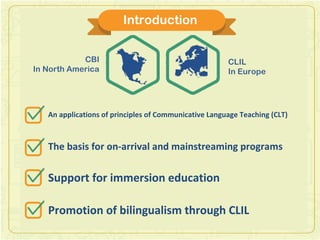
CBI
In North America
CLIL
In Europe
An applications of principles of Communicative Language Teaching (CLT)
The basis for on-arrival and mainstreaming programs
Support for immersion education
Promotion of bilingualism through CLIL
Approach
People learn a second language more succesfully when
they use the language as a means of understanding
content, rather than as an end itself.
Content-Based Instruction better reflects
learners’ needs for learning a second language.
Content provides the basis for activating both the
cognitive and the interactional processes that are the
starting point for second language learning.
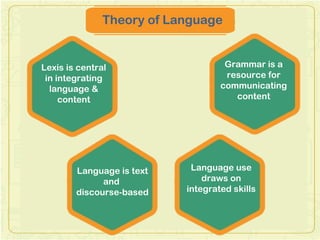
Theory of Language
Lexis is central
in integrating
language &
content
Grammar is a
resource for
communicating
content
Language is text
and
discourse-based
Language use
draws on
integrated skills
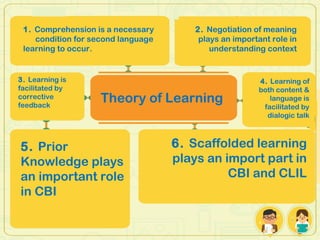
Theory of Learning
1. Comprehension is a necessary
condition for second language
learning to occur.
2. Negotiation of meaning
plays an important role in
understanding context
3. Learning is
facilitated by
corrective
feedback
4. Learning of
both content &
language is
facilitated by
dialogic talk
5. Prior
Knowledge plays
an important role
in CBI
6. Scaffolded learning
plays an import part in
CBI and CLIL
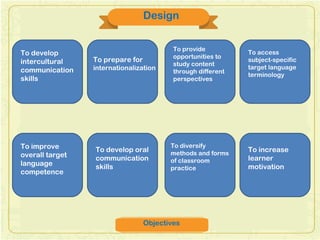
Design
Objectives
To develop
intercultural
communication
skills
To prepare for
internationalization
To provide
opportunities to
study content
through different
perspectives
To access
subject-specific
target language
terminology
To improve
overall target
language
competence
To develop oral
communication
skills
To diversify
methods and forms
of classroom
practice
To increase
learner
motivation
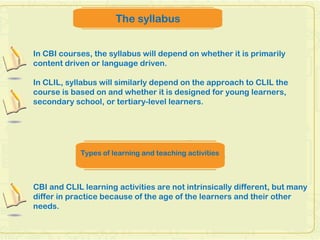
The syllabus
In CBI courses, the syllabus will depend on whether it is primarily
content driven or language driven.
In CLIL, syllabus will similarly depend on the approach to CLIL the
course is based on and whether it is designed for young learners,
secondary school, or tertiary-level learners.
Types of learning and teaching activities
CBI and CLIL learning activities are not intrinsically different, but many
differ in practice because of the age of the learners and their other
needs.
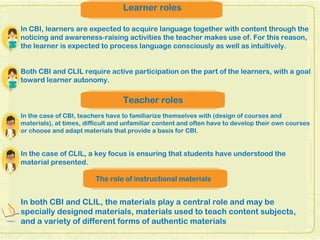
Learner roles
In CBI, learners are expected to acquire language together with content through the
noticing and awareness-raising activities the teacher makes use of. For this reason,
the learner is expected to process language consciously as well as intuitively.
Both CBI and CLIL require active participation on the part of the learners, with a goal
toward learner autonomy.
Teacher roles
In the case of CBI, teachers have to familiarize themselves with (design of courses and
materials), at times, difficult and unfamiliar content and often have to develop their own courses
or choose and adapt materials that provide a basis for CBI.
In the case of CLIL, a key focus is ensuring that students have understood the
material presented.
The role of instructional materials
In both CBI and CLIL, the materials play a central role and may be
specially designed materials, materials used to teach content subjects,
and a variety of different forms of authentic materials
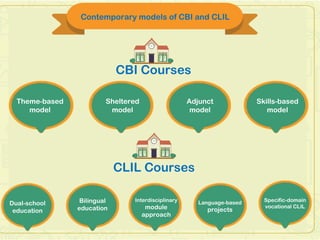
Contemporary models of CBI and CLIL
CBI Courses
CLIL Courses
Theme-based
model
Sheltered
model
Adjunct
model
Skills-based
model
Dual-school
education
Bilingual
education
Interdisciplinary
module
approach
Language-based
projects
Specific-domain
vocational CLIL
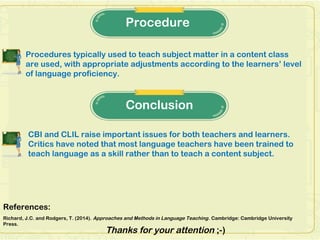
Procedure
Conclusion
Procedures typically used to teach subject matter in a content class
are used, with appropriate adjustments according to the learners’ level
of language proficiency.
CBI and CLIL raise important issues for both teachers and learners.
Critics have noted that most language teachers have been trained to
teach language as a skill rather than to teach a content subject.
Richard, J.C. and Rodgers, T. (2014). Approaches and Methods in Language Teaching. Cambridge: Cambridge University
Press.
References:
Thanks for your attention ;-)

CBI and CLIL

  • 1.
    Content-Based Instruction (CBI) and Contentand Language Integrated Learning (CLIL)
  • 2.
    Introduction CBI In North America CLIL InEurope An applications of principles of Communicative Language Teaching (CLT) The basis for on-arrival and mainstreaming programs Support for immersion education Promotion of bilingualism through CLIL
  • 3.
    Approach People learn asecond language more succesfully when they use the language as a means of understanding content, rather than as an end itself. Content-Based Instruction better reflects learners’ needs for learning a second language. Content provides the basis for activating both the cognitive and the interactional processes that are the starting point for second language learning.
  • 4.
    Theory of Language Lexisis central in integrating language & content Grammar is a resource for communicating content Language is text and discourse-based Language use draws on integrated skills
  • 5.
    Theory of Learning 1.Comprehension is a necessary condition for second language learning to occur. 2. Negotiation of meaning plays an important role in understanding context 3. Learning is facilitated by corrective feedback 4. Learning of both content & language is facilitated by dialogic talk 5. Prior Knowledge plays an important role in CBI 6. Scaffolded learning plays an import part in CBI and CLIL
  • 6.
    Design Objectives To develop intercultural communication skills To preparefor internationalization To provide opportunities to study content through different perspectives To access subject-specific target language terminology To improve overall target language competence To develop oral communication skills To diversify methods and forms of classroom practice To increase learner motivation
  • 7.
    The syllabus In CBIcourses, the syllabus will depend on whether it is primarily content driven or language driven. In CLIL, syllabus will similarly depend on the approach to CLIL the course is based on and whether it is designed for young learners, secondary school, or tertiary-level learners. Types of learning and teaching activities CBI and CLIL learning activities are not intrinsically different, but many differ in practice because of the age of the learners and their other needs.
  • 8.
    Learner roles In CBI,learners are expected to acquire language together with content through the noticing and awareness-raising activities the teacher makes use of. For this reason, the learner is expected to process language consciously as well as intuitively. Both CBI and CLIL require active participation on the part of the learners, with a goal toward learner autonomy. Teacher roles In the case of CBI, teachers have to familiarize themselves with (design of courses and materials), at times, difficult and unfamiliar content and often have to develop their own courses or choose and adapt materials that provide a basis for CBI. In the case of CLIL, a key focus is ensuring that students have understood the material presented. The role of instructional materials In both CBI and CLIL, the materials play a central role and may be specially designed materials, materials used to teach content subjects, and a variety of different forms of authentic materials
  • 9.
    Contemporary models ofCBI and CLIL CBI Courses CLIL Courses Theme-based model Sheltered model Adjunct model Skills-based model Dual-school education Bilingual education Interdisciplinary module approach Language-based projects Specific-domain vocational CLIL
  • 10.
    Procedure Conclusion Procedures typically usedto teach subject matter in a content class are used, with appropriate adjustments according to the learners’ level of language proficiency. CBI and CLIL raise important issues for both teachers and learners. Critics have noted that most language teachers have been trained to teach language as a skill rather than to teach a content subject. Richard, J.C. and Rodgers, T. (2014). Approaches and Methods in Language Teaching. Cambridge: Cambridge University Press. References: Thanks for your attention ;-)