CENTRAL UNIVERSITY OF ECUADOR
PLURILINGUE
DIDACTICS
MSc. KARLA HIDALGO
COMMUNICATIVE APPROACH
Group:
Caiza Raquel
Rodríguez Tania
Torres Fernanda
COMMUNICATIVE APPROACH
ORIGINS
Communication is the aim of the
language learning.
It started in 60’s and 70’s as a reaction
against the grammar translation method.
New syllabuses took into account needs
of different pupils in terms of usefulness
for practical purposes.
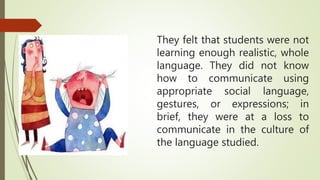
They felt that students were not
learning enough realistic, whole
language. They did not know
how to communicate using
appropriate social language,
gestures, or expressions; in
brief, they were at a loss to
communicate in the culture of
the language studied.
INVENTORS
 Country of Origin: Great Britain
 This method is based partly in the theories of Brititish functional linguists such as: Firth,
Halliday, and the American sociolinguistics Hymes, Gumperz and Lavob.
Theory of Language Communicative
 The goal of language teaching is to develop what Hymes (1972) referred to as
communicative competence. Hymes coined this term in order to contrast a
communicative view of language
 Hymes’ theory of communicative competence was a definition of what a speaker
needs to know in order to be communicative competence in a speech community.
DEFINITION
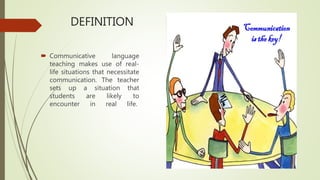
 Communicative language
teaching makes use of real-
life situations that necessitate
communication. The teacher
sets up a situation that
students are likely to
encounter in real life.
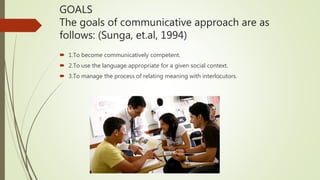
GOALS
The goals of communicative approach are as
follows: (Sunga, et.al, 1994)
 1.To become communicatively competent.
 2.To use the language appropriate for a given social context.
 3.To manage the process of relating meaning with interlocutors.
FEATURES
 Focuses on language as a medium of
communication social purpose.
 Interaction in the target language in a
communicative way for meaningful activities
 Errors are considered as a natural part of
learning language .
 Learners should be able to go to foreign
country survive in a variety of everyday
situations.
 Classroom should provide opportunities for
rehearsal of real-life situations and provide
opportunity for real communication .
FEATURES
 Emphasis on: pair work and group-work.
 Primacy of oral work .
 Grammar can still be taught, but less
systematically.
 Use of everyday language.
 Communicative approach seeks to use
authentic resources real texts: newspaper,
magazines , manuals, recipes, videos, etc.
 Important not to be restricted to textbook
Role of the teacher:
 The teacher facilitates the
communication in the
classroom, and he also acts
like an adviser and a guide.
Role of the student:
 they are communicators.
 They are actively engage
in trying to make
themselves understood
and in understanding
others.
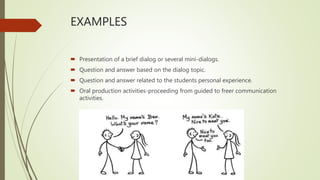
EXAMPLES
EXAMPLES
 Presentation of a brief dialog or several mini-dialogs.
 Question and answer based on the dialog topic.
 Question and answer related to the students personal experience.
 Oral production activities-proceeding from guided to freer communication
activities.
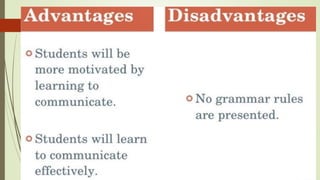
ADVANTAGES
 The interaction between students and teachers.
Teacher-student relationship is an interactive,
harmonious relationship, rather than the
traditional education
 Communicative language teaching encourage
students to participate in, sometimes
accompanied by scenes or simulated scenarios,
so that students more close to life, the students
become the main character, naturally they were
interested inthe English language, to learn
English as a pleasure.
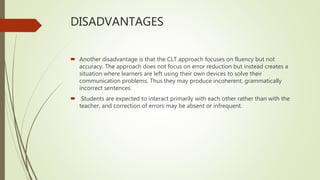
DISADVANTAGES
 Another disadvantage is that the CLT approach focuses on fluency but not
accuracy. The approach does not focus on error reduction but instead creates a
situation where learners are left using their own devices to solve their
communication problems. Thus they may produce incoherent, grammatically
incorrect sentences.
 Students are expected to interact primarily with each other rather than with the
teacher, and correction of errors may be absent or infrequent.
REFERENCES
 ´ http://es.slideshare.net/JoyAvelino/communicative-language-teaching-12942898
 ´ http://es.slideshare.net/sarika0991/communicative-approach-presentation
 ´ http://es.slideshare.net/vacoka/communicative-approach-presentation-
750714?related=1

http://es.slideshare.net/mortdida/communicative-language-teaching-method1
 http://www.monografias.com/trabajos18/the-communicative-approach/the-
communicative-approach.shtml

Communicative approach by Raquel Caiza

  • 1.
    CENTRAL UNIVERSITY OFECUADOR PLURILINGUE DIDACTICS MSc. KARLA HIDALGO COMMUNICATIVE APPROACH Group: Caiza Raquel Rodríguez Tania Torres Fernanda
  • 2.
    COMMUNICATIVE APPROACH ORIGINS Communication isthe aim of the language learning. It started in 60’s and 70’s as a reaction against the grammar translation method. New syllabuses took into account needs of different pupils in terms of usefulness for practical purposes.
  • 3.
    They felt thatstudents were not learning enough realistic, whole language. They did not know how to communicate using appropriate social language, gestures, or expressions; in brief, they were at a loss to communicate in the culture of the language studied.
  • 4.
    INVENTORS  Country ofOrigin: Great Britain  This method is based partly in the theories of Brititish functional linguists such as: Firth, Halliday, and the American sociolinguistics Hymes, Gumperz and Lavob.
  • 5.
    Theory of LanguageCommunicative  The goal of language teaching is to develop what Hymes (1972) referred to as communicative competence. Hymes coined this term in order to contrast a communicative view of language  Hymes’ theory of communicative competence was a definition of what a speaker needs to know in order to be communicative competence in a speech community.
  • 6.
    DEFINITION  Communicative language teachingmakes use of real- life situations that necessitate communication. The teacher sets up a situation that students are likely to encounter in real life.
  • 7.
    GOALS The goals ofcommunicative approach are as follows: (Sunga, et.al, 1994)  1.To become communicatively competent.  2.To use the language appropriate for a given social context.  3.To manage the process of relating meaning with interlocutors.
  • 8.
    FEATURES  Focuses onlanguage as a medium of communication social purpose.  Interaction in the target language in a communicative way for meaningful activities  Errors are considered as a natural part of learning language .  Learners should be able to go to foreign country survive in a variety of everyday situations.  Classroom should provide opportunities for rehearsal of real-life situations and provide opportunity for real communication .
  • 9.
    FEATURES  Emphasis on:pair work and group-work.  Primacy of oral work .  Grammar can still be taught, but less systematically.  Use of everyday language.  Communicative approach seeks to use authentic resources real texts: newspaper, magazines , manuals, recipes, videos, etc.  Important not to be restricted to textbook
  • 10.
    Role of theteacher:  The teacher facilitates the communication in the classroom, and he also acts like an adviser and a guide.
  • 11.
    Role of thestudent:  they are communicators.  They are actively engage in trying to make themselves understood and in understanding others.
  • 12.
  • 14.
    EXAMPLES  Presentation ofa brief dialog or several mini-dialogs.  Question and answer based on the dialog topic.  Question and answer related to the students personal experience.  Oral production activities-proceeding from guided to freer communication activities.
  • 16.
    ADVANTAGES  The interactionbetween students and teachers. Teacher-student relationship is an interactive, harmonious relationship, rather than the traditional education  Communicative language teaching encourage students to participate in, sometimes accompanied by scenes or simulated scenarios, so that students more close to life, the students become the main character, naturally they were interested inthe English language, to learn English as a pleasure.
  • 17.
    DISADVANTAGES  Another disadvantageis that the CLT approach focuses on fluency but not accuracy. The approach does not focus on error reduction but instead creates a situation where learners are left using their own devices to solve their communication problems. Thus they may produce incoherent, grammatically incorrect sentences.  Students are expected to interact primarily with each other rather than with the teacher, and correction of errors may be absent or infrequent.
  • 18.
    REFERENCES  ´ http://es.slideshare.net/JoyAvelino/communicative-language-teaching-12942898 ´ http://es.slideshare.net/sarika0991/communicative-approach-presentation  ´ http://es.slideshare.net/vacoka/communicative-approach-presentation- 750714?related=1  http://es.slideshare.net/mortdida/communicative-language-teaching-method1  http://www.monografias.com/trabajos18/the-communicative-approach/the- communicative-approach.shtml