COMMUNICATIVE
  LANGUAGE
  TEACHING

      Ma.Isabel Huaccho S.
      Albert Pérez Farro
      Enrique A. Rojas Rojas
FEATURES

   Based on the idea that learning language
   successfully comes through having to
   communicate real meaning. When learners
   are involved in real communication, their
   natural strategies for language acquisition
   will be used, and this will allow them to learn
   to use the language.
The communicative approach could be said to be
the product of educators and linguists who had
grown dissatisfied with the audio-lingual and
grammar-translation methods of foreign language
instruction.


             Emphasis on learning to communicate
             through interaction in the target
             language.
             Focus, not only on the language but
             also on the learning process itself.
TEACHER’S ROLE

•A teacher's main role is a facilitator and
monitor .
•Lessons are usually theme or topic based.

•Lessons are built round situations/functions
practical and authentic in the real world e.g.
asking for information, complaining,
apologizing, job interviews, telephoning.

•Emphasis is on communication and
meaning rather than accuracy.
•Communicative competence is the desired
goal.

•Authentic listening and reading texts are used
more often.

•Feedback and correction is usually given by
the teacher after tasks have been completed,
rather than at the point of error, thus
interrupting the flow.
• Learners are often more motivated with this
  approach as they have an interest in what is
  being communicated, as the lesson is topic or
  theme based.

• Learners practice the target language a number
  of times, slowly building on accuracy.


                LEARNER’S ROLE

                 •Learners interact with each other in pairs
                 or groups, to encourage a flow of language
                 and maximize the percentage of talking
                 time, rather than just teacher to student
                 and vice versa
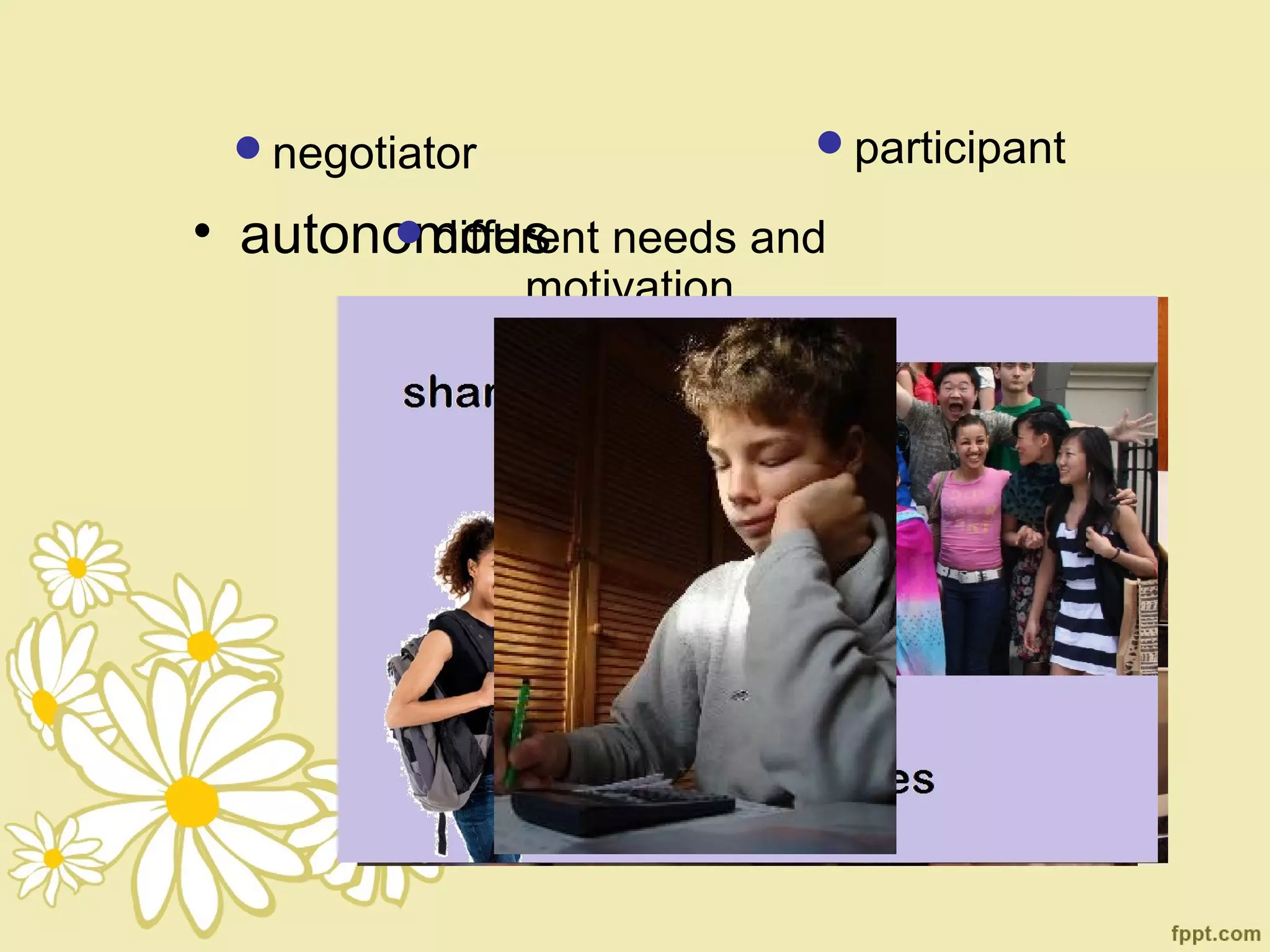
negotiator                participant

• autonomous needs and
       different
               motivation
WHAT ARE SOME EXAMPLES
   OF COMMUNICATIVE
   OF COMMUNICATIVE
      EXERCISES?
      EXERCISES?
Learning by
                                         teaching
Role Play

                         Surveys


                                          Games
            Interviews


                             Pair Work
MATERIALS IN CLT
TASK-BASED MATERIALS
• A variety of games, role plays, simulations, and task-
  based communication activities.

• Exercise handbooks, cue cards, activity cards, pair-
  communication practice materials, and student-
  interaction practice booklets.

• Pair-communication materials and others in which the
  partners assume different role relationships (e.g., an
  interviewer and an interviewee).
• Still others provide drills and practice material in inter-
  actional formats.
• Realia consists of actual objects or items which
  illustrate and teach vocabulary or serve as an aid to
  facilitate language acquisition and production.

• It concretizes vocabulary and language and places it
  in a frame of reference.

• It also allows language learners to see, hear, and in
  some cases touch the objects.


                              REALIA
AUTHENTIC MATERIALS
Defined as:
“Any texts written by native English speakers for native
English speakers.”

               ADVANTAGES:

               1.Bring learners into direct contact with a
               reality level of specialized English.

               2. Authentic materials drawn from periodicals
               are always up-to-date and constantly being
               updated
3. Authentic materials from a particular source
   tend to work in consistent areas of
   language, so, students will become experts
   in reading that sort of English language
   publication.

4. Authentic materials provide us with a source
   of up-to-date materials that can be directly
   relevant to English learners needs.
THE ROLE OF GRAMMAR
  • In the beginning the tendency was against
    the inclusion of grammar in.

  • Currently some proponents of CLT say that
    grammar should be learned while
    communicating but others prefer to reserve
    time for more explicit study.
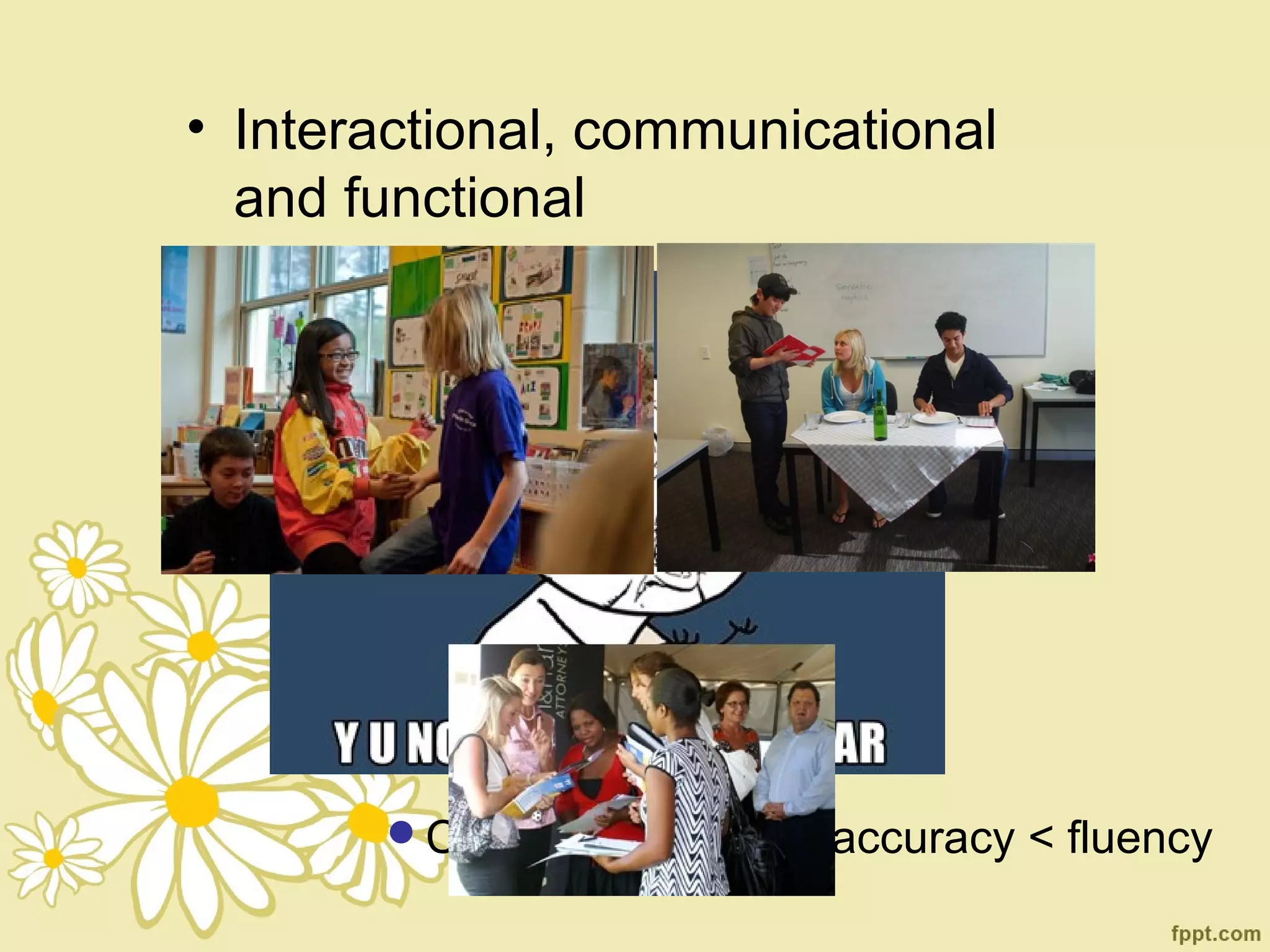
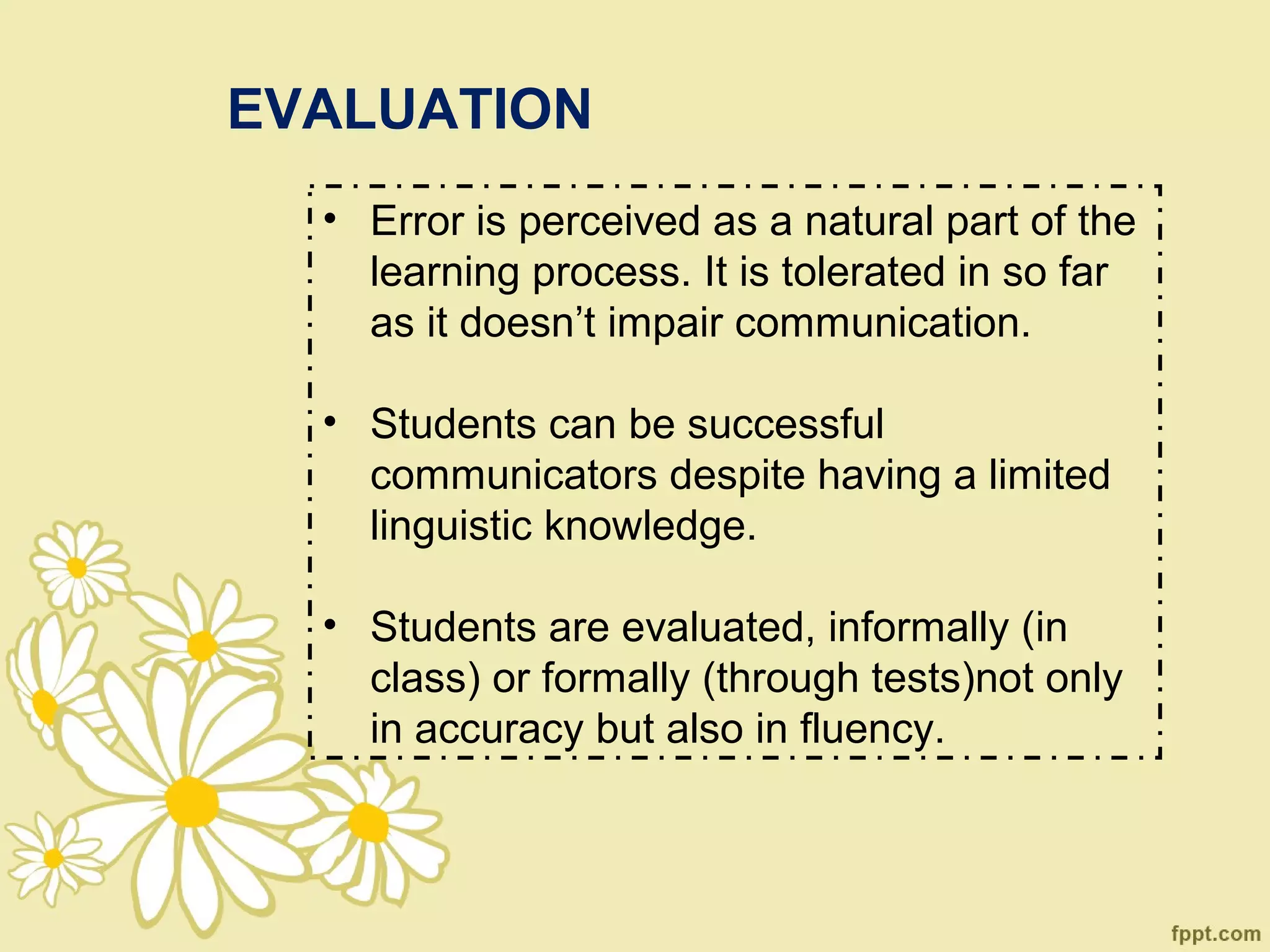
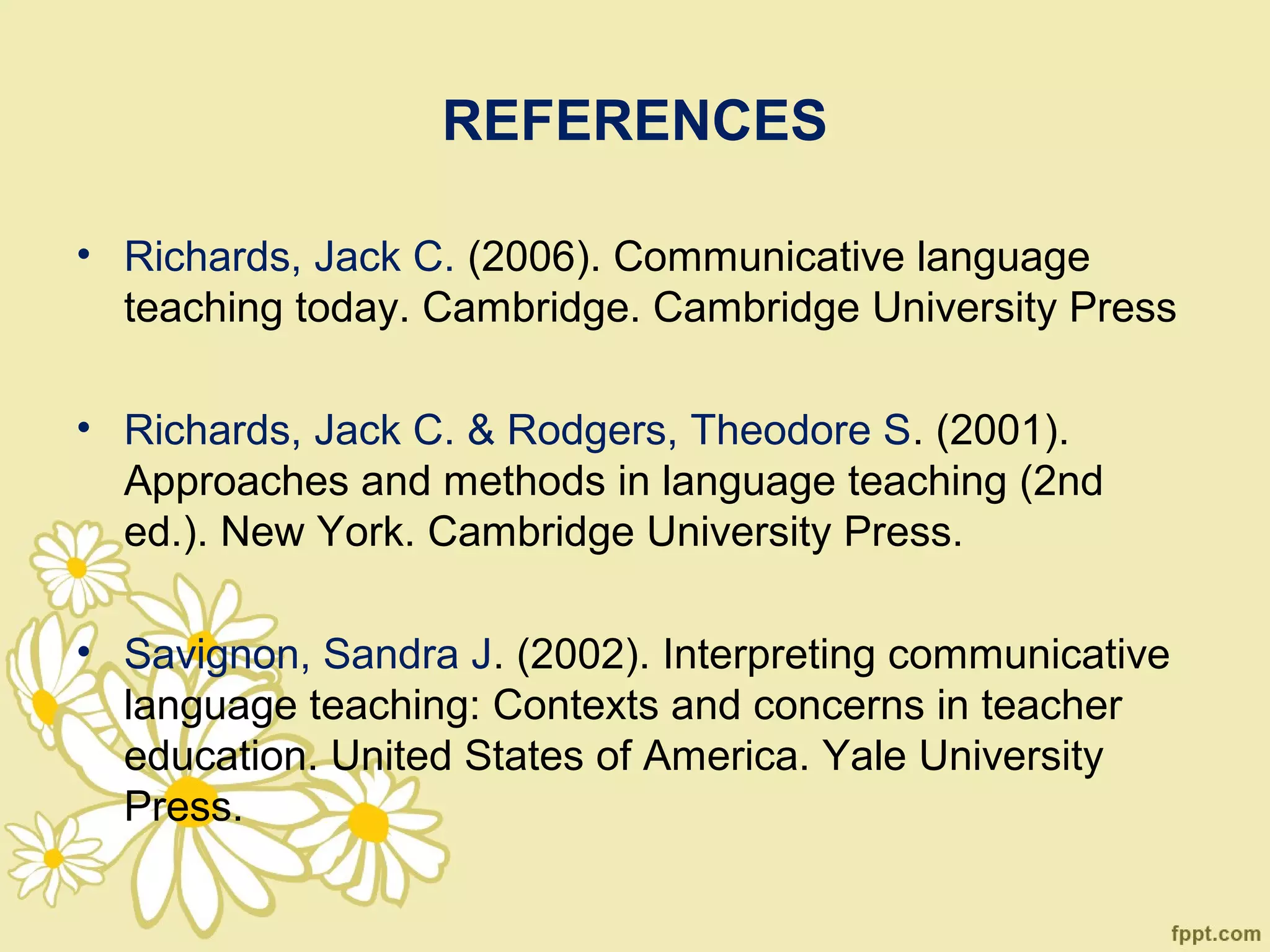
• Interactional, communicational
  and functional


       Content not form / accuracy < fluency
EVALUATION
  • Error is perceived as a natural part of the
    learning process. It is tolerated in so far
    as it doesn’t impair communication.

  • Students can be successful
    communicators despite having a limited
    linguistic knowledge.

  • Students are evaluated, informally (in
    class) or formally (through tests)not only
    in accuracy but also in fluency.
REFERENCES

• Richards, Jack C. (2006). Communicative language
  teaching today. Cambridge. Cambridge University Press

• Richards, Jack C. & Rodgers, Theodore S. (2001).
  Approaches and methods in language teaching (2nd
  ed.). New York. Cambridge University Press.

• Savignon, Sandra J. (2002). Interpreting communicative
  language teaching: Contexts and concerns in teacher
  education. United States of America. Yale University
  Press.

Communicative language teaching

  • 1.
    COMMUNICATIVE LANGUAGE TEACHING Ma.Isabel Huaccho S. Albert Pérez Farro Enrique A. Rojas Rojas
  • 2.
    FEATURES Based on the idea that learning language successfully comes through having to communicate real meaning. When learners are involved in real communication, their natural strategies for language acquisition will be used, and this will allow them to learn to use the language.
  • 3.
    The communicative approachcould be said to be the product of educators and linguists who had grown dissatisfied with the audio-lingual and grammar-translation methods of foreign language instruction. Emphasis on learning to communicate through interaction in the target language. Focus, not only on the language but also on the learning process itself.
  • 4.
    TEACHER’S ROLE •A teacher'smain role is a facilitator and monitor . •Lessons are usually theme or topic based. •Lessons are built round situations/functions practical and authentic in the real world e.g. asking for information, complaining, apologizing, job interviews, telephoning. •Emphasis is on communication and meaning rather than accuracy.
  • 5.
    •Communicative competence isthe desired goal. •Authentic listening and reading texts are used more often. •Feedback and correction is usually given by the teacher after tasks have been completed, rather than at the point of error, thus interrupting the flow.
  • 6.
    • Learners areoften more motivated with this approach as they have an interest in what is being communicated, as the lesson is topic or theme based. • Learners practice the target language a number of times, slowly building on accuracy. LEARNER’S ROLE •Learners interact with each other in pairs or groups, to encourage a flow of language and maximize the percentage of talking time, rather than just teacher to student and vice versa
  • 7.
    negotiator participant • autonomous needs and different motivation
  • 8.
    WHAT ARE SOMEEXAMPLES WHAT ARE SOME EXAMPLES OF COMMUNICATIVE OF COMMUNICATIVE EXERCISES? EXERCISES?
  • 9.
    Learning by teaching Role Play Surveys Games Interviews Pair Work
  • 10.
  • 11.
    TASK-BASED MATERIALS • Avariety of games, role plays, simulations, and task- based communication activities. • Exercise handbooks, cue cards, activity cards, pair- communication practice materials, and student- interaction practice booklets. • Pair-communication materials and others in which the partners assume different role relationships (e.g., an interviewer and an interviewee). • Still others provide drills and practice material in inter- actional formats.
  • 12.
    • Realia consistsof actual objects or items which illustrate and teach vocabulary or serve as an aid to facilitate language acquisition and production. • It concretizes vocabulary and language and places it in a frame of reference. • It also allows language learners to see, hear, and in some cases touch the objects. REALIA
  • 13.
    AUTHENTIC MATERIALS Defined as: “Anytexts written by native English speakers for native English speakers.” ADVANTAGES: 1.Bring learners into direct contact with a reality level of specialized English. 2. Authentic materials drawn from periodicals are always up-to-date and constantly being updated
  • 14.
    3. Authentic materialsfrom a particular source tend to work in consistent areas of language, so, students will become experts in reading that sort of English language publication. 4. Authentic materials provide us with a source of up-to-date materials that can be directly relevant to English learners needs.
  • 15.
    THE ROLE OFGRAMMAR • In the beginning the tendency was against the inclusion of grammar in. • Currently some proponents of CLT say that grammar should be learned while communicating but others prefer to reserve time for more explicit study.
  • 16.
    • Interactional, communicational and functional Content not form / accuracy < fluency
  • 17.
    EVALUATION •Error is perceived as a natural part of the learning process. It is tolerated in so far as it doesn’t impair communication. • Students can be successful communicators despite having a limited linguistic knowledge. • Students are evaluated, informally (in class) or formally (through tests)not only in accuracy but also in fluency.
  • 18.
    REFERENCES • Richards, JackC. (2006). Communicative language teaching today. Cambridge. Cambridge University Press • Richards, Jack C. & Rodgers, Theodore S. (2001). Approaches and methods in language teaching (2nd ed.). New York. Cambridge University Press. • Savignon, Sandra J. (2002). Interpreting communicative language teaching: Contexts and concerns in teacher education. United States of America. Yale University Press.