Competency-Based
Language Teaching#teamtambay
COMPETENCY-BASED EDUCATION (CBE)
-emergedin the United States in the 1970s.
-focuses on the outcomes oroutputs of learning in the development
of language programs.
COMPETENCY-BASEDLANGUAGE TEACHING
(CBLT)
-anapplication of the principle of Competency-Based Education
(CBE) to language teaching.
BACKGR
OUND
( CBE ) by SCHENCK ( 1978 )
( CBLT ) by AUERBACH ( 1986 )
PROPON
ENTS
THEORY OF LANGUAGE AND LEARNING
• CBLT most often beenused as a framework for language learning
in situations where learners havespecific goal and are in
particularly roles and where the language skills they can be fairly
accurately predicted ordetermined.
•It shares the behaviorist views of learning the
notion that language from can be inferred from language function;
that is, certain life encounters
call for certain kinds of language
approach
THEORY OF LANGUAGE AND LEARNING
•Central to both language and learning theory is the viewthat
language can be functionally analyzed into appropriate parts and
subparts can be taught
(and tested) incrementally.
•CBLT is also built around the notion of communicative
competence and seeks to develop functional communication skills
in learners.
approach
LEARNING ACTIVITIES:
•TaskPerformance
•Safety
•General Word-Related
•Work Schedules, Time Sheets, Paychecks
•Social Language
•Job Application
•Job Interview
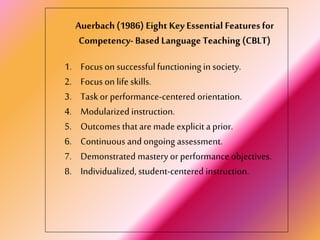
Auerbach (1986) Eight Key Essential Features for
Competency- Based Language Teaching (CBLT)
1. Focus on successfulfunctioning in society.
2. Focus on life skills.
3. Taskor performance-centered orientation.
4. Modularized instruction.
5. Outcomes that are made explicita prior.
6. Continuous andongoing assessment.
7. Demonstrated mastery or performance objectives.
8. Individualized, student-centered instruction.
ADVANTAGES OF A COMPETENCIES APPROACH
FROM THE LEARNER’S POINT OF VIEW
1. The competencies are specificand practical.
2. The learners can judge whether the competencies
seem relevant and useful.
3. The competencies that willbe taught and tested are
specificand public.
4. Competencies can be mastered one at atime.
Teacher’s role#teamtambay
1. The teacher has provide positive and constructive feedback in order
to help the students to improve their skills. She/he needs to be
aware of the learners’ needs so that everybody feels welcome in
class.
2. The teacher has to give clear orders and explanations to make sure
that every student understands the task they aregoing to deal with.
3. The teacher does not push the students because the instructions
are not time-based; instead the student’s progress is most
important.
4. The teacher has to select learning activities and to design a syllabus
according to the competency the students are going to acquire.
Learner’s role#teamtambay
1. Learner has to decide whether the competencies are useful and
relevant for him/her.
2. Students areexpectedto perform the skills learned.
3. For every learner, it is vital that every competency is mastered one
at a time because this makes sure that the learners know what they
havealready learned and what the next steps will look like.
4. The students have to stay in the actual program until they improve.
After they mastered their skills, they move into a more proficient
group of students.
Conclusion#teamtambay
CBLT is seen asprescriptivismfor it prepares
students to fitinto the status quo and
maintainclassrelationships.In addition,
teachingtypicallyfocuseson behavior and
performance rather than onthe
development of thinkingskills.
Evaluation#teamtambay
Instructions: On a ¼ sheet of paper
answer the following questions.
1. CBLTis an application of theprinciples of what
movement?
2. Wheredid CBLT emerge?
3-4. Whowere theproponents of CBLT?
5. Citeone learningactivity for CBLT?
6-10. In 2-3 sentences, how important CBLT is for
language students in preparation for the real world
tasks?

Competency-based language teaching

  • 1.
  • 2.
    COMPETENCY-BASED EDUCATION (CBE) -emergedinthe United States in the 1970s. -focuses on the outcomes oroutputs of learning in the development of language programs. COMPETENCY-BASEDLANGUAGE TEACHING (CBLT) -anapplication of the principle of Competency-Based Education (CBE) to language teaching. BACKGR OUND
  • 3.
    ( CBE )by SCHENCK ( 1978 ) ( CBLT ) by AUERBACH ( 1986 ) PROPON ENTS
  • 4.
    THEORY OF LANGUAGEAND LEARNING • CBLT most often beenused as a framework for language learning in situations where learners havespecific goal and are in particularly roles and where the language skills they can be fairly accurately predicted ordetermined. •It shares the behaviorist views of learning the notion that language from can be inferred from language function; that is, certain life encounters call for certain kinds of language approach
  • 5.
    THEORY OF LANGUAGEAND LEARNING •Central to both language and learning theory is the viewthat language can be functionally analyzed into appropriate parts and subparts can be taught (and tested) incrementally. •CBLT is also built around the notion of communicative competence and seeks to develop functional communication skills in learners. approach
  • 6.
    LEARNING ACTIVITIES: •TaskPerformance •Safety •General Word-Related •WorkSchedules, Time Sheets, Paychecks •Social Language •Job Application •Job Interview
  • 7.
    Auerbach (1986) EightKey Essential Features for Competency- Based Language Teaching (CBLT) 1. Focus on successfulfunctioning in society. 2. Focus on life skills. 3. Taskor performance-centered orientation. 4. Modularized instruction. 5. Outcomes that are made explicita prior. 6. Continuous andongoing assessment. 7. Demonstrated mastery or performance objectives. 8. Individualized, student-centered instruction.
  • 8.
    ADVANTAGES OF ACOMPETENCIES APPROACH FROM THE LEARNER’S POINT OF VIEW 1. The competencies are specificand practical. 2. The learners can judge whether the competencies seem relevant and useful. 3. The competencies that willbe taught and tested are specificand public. 4. Competencies can be mastered one at atime.
  • 9.
  • 10.
    1. The teacherhas provide positive and constructive feedback in order to help the students to improve their skills. She/he needs to be aware of the learners’ needs so that everybody feels welcome in class. 2. The teacher has to give clear orders and explanations to make sure that every student understands the task they aregoing to deal with. 3. The teacher does not push the students because the instructions are not time-based; instead the student’s progress is most important. 4. The teacher has to select learning activities and to design a syllabus according to the competency the students are going to acquire.
  • 11.
  • 12.
    1. Learner hasto decide whether the competencies are useful and relevant for him/her. 2. Students areexpectedto perform the skills learned. 3. For every learner, it is vital that every competency is mastered one at a time because this makes sure that the learners know what they havealready learned and what the next steps will look like. 4. The students have to stay in the actual program until they improve. After they mastered their skills, they move into a more proficient group of students.
  • 13.
  • 14.
    CBLT is seenasprescriptivismfor it prepares students to fitinto the status quo and maintainclassrelationships.In addition, teachingtypicallyfocuseson behavior and performance rather than onthe development of thinkingskills.
  • 15.
  • 16.
    Instructions: On a¼ sheet of paper answer the following questions. 1. CBLTis an application of theprinciples of what movement? 2. Wheredid CBLT emerge? 3-4. Whowere theproponents of CBLT? 5. Citeone learningactivity for CBLT? 6-10. In 2-3 sentences, how important CBLT is for language students in preparation for the real world tasks?