SECOND LANGUAGE 
ACQUISITION 
By Natasha Velásquez Manrique
WHAT IS SLA? 
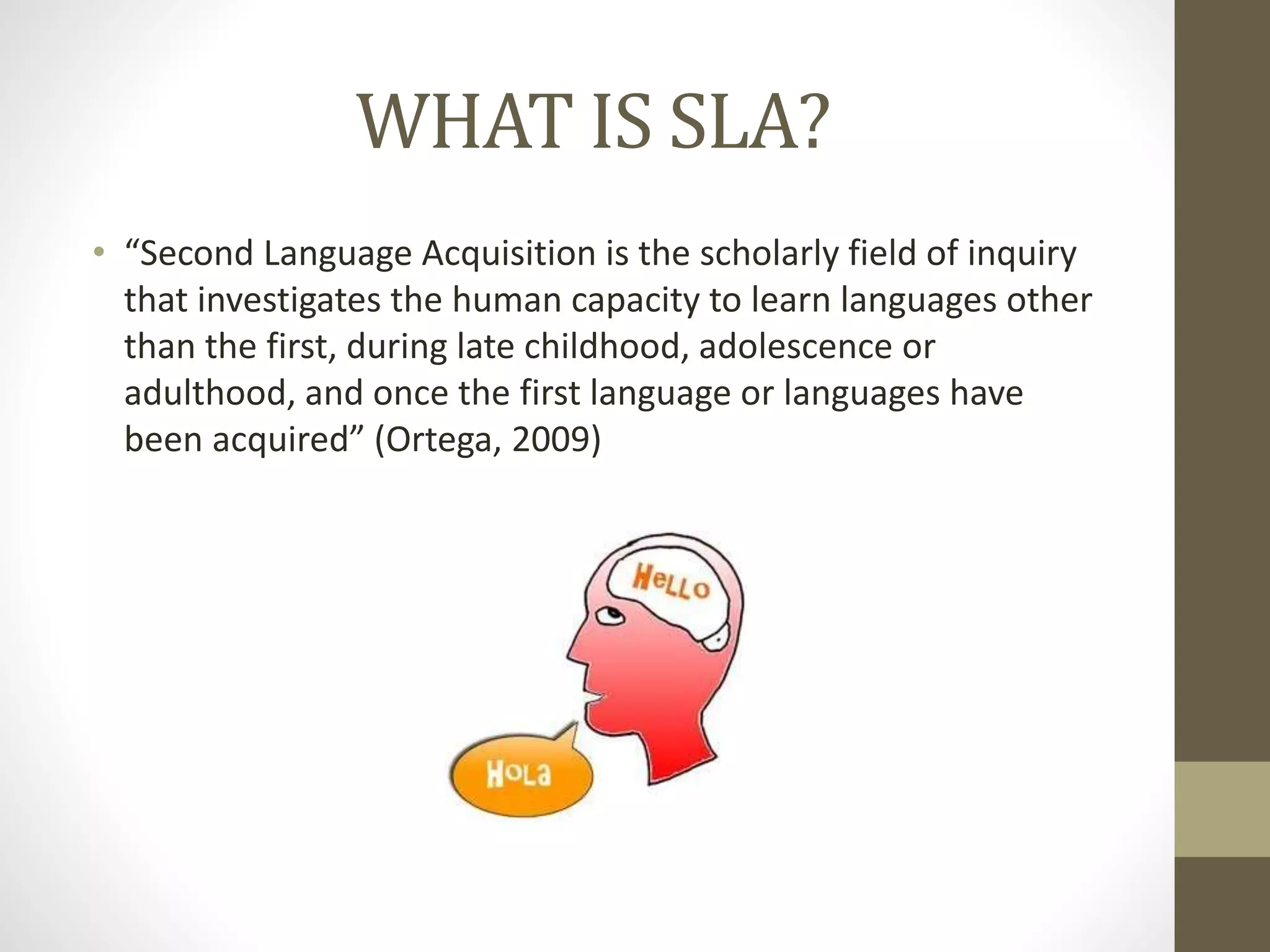
• “Second Language Acquisition is the scholarly field of inquiry 
that investigates the human capacity to learn languages other 
than the first, during late childhood, adolescence or 
adulthood, and once the first language or languages have 
been acquired” (Ortega, 2009)
BRIEF HISTORY 
• SLA began in the late 1960s. 
• During the 1980s and 1990s, SLA expanded considerably in 
scope and methodology. 
• At the end of the twentieth century, it had finally reached its 
coming of age as an autonomous discipline. 
• It continues growing.
SLA APPROACHES 
According to Saville-Troike (2006, pp. 24): 
• Linguistic 
• Psychological 
• Social
LINGUISTIC 
• There have been two foci for the study of SLA from a linguistic 
perspective since 1960: internal and external. 
• Internal focus: 
• Have been based on the work of Noam Chomsky. 
• It refers to the linguistic competence. 
• External focus: 
• It emphasized the use of language (performance).
PSYCHOLOGICAL 
• There have been 3 foci in the study of SLA from a 
psychological perspective: 
• Languages in the brain: 
• There is a critical period for language acquisition which has a 
neurological basis. 
• Learning processes: 
• It has been heavily influenced by computer-based Information 
Processing (IP) models of learning. 
• L2 is a complex skill. It tries to answer the question of how. 
• Processability and Conectionism. 
• Learner differences: 
• It has been concerned with the question of why some learners 
are more successful than others.
SOCIAL 
• Some of the frameworks can be considered linguistic or 
cognitive. 
• They all emphasize the importance of social context for 
language acquisition and use. 
• There are 2 foci for the study of SLA from this perspective: 
• Microsocial focus: 
• Language acquisition and use in immediate social context of 
production, interpretation, and interaction. 
• Macrosocial focus: 
Language acquisition and use to broader ecological contexts, 
including cultural, political, and educational setting.
THE LINGUISTICS OF THE SECOND 
LANGUAGE ACQUSIITION 
• Early approaches to SLA: 
Internal focus: 
• Contrastive analysis 
• Error analysis 
• Interlangage 
• Morpheme Order Studies 
• Monitor Model 
• Universal Grammar
External focus: 
• Systemic Linguistics 
• Funtional Typology 
• Function-to-Form 
• Mapping 
• Information Organization
CONTRASTIVE ANALYSIS 
• According to Saville-Troike (2006, pp. 34): 
• This is an approach to the study of SLA which involves 
predicting and explaining learner problems based on a 
comparison of L1 and L2 to determine similarities and 
differences. 
• It was influenced by Struturalism and Behaviorism. 
• The concept of transfer: This means the transfer of elements 
acquired in L1 to the target L2.
POSITIVE AND NEGATIVE 
TRANSFER 
• The transfer is called positive when the same structure is 
appropriate in both languages. Example: 
• Spanish plural –s morpheme on nouns to English. 
• The transfer is called negative when the L1 structure is used 
inappropriately in the L2, as in the additional transfer of 
Spanish –s to a modifier in number agreement with the noun. 
For example: 
• Lenguas modernas to languages moderns.
• The easiest L2 structure are those which exist in L1 with the 
same form, meaning and distribution and are thus available 
for positive transfer; any structure in L2 which has a form not 
occurring in L1 needs to be learned, but this is not likely to be 
very difficult if it has the same meaning and distribution as an 
“equivalent” in L1.
How can your hypothesis help 
students to learn? 
• This hypothesis can help students to learn based on the fact 
that many people ignore that there are many structures in 
other languages that are similar to our native language. If we 
use these similarities we can learn a language faster and also 
improve it easily.
How can your hypothesis help 
teachers? 
• The process of CA involves describing L1 and L2 at each level, 
analyzing roughly comparable segments of the languages for 
elements which are likely to cause problems for learners. 
• This information provides a rationale for constructing 
language lessons that focus on structures which are predicted 
to most need attention and practice, and for sequencing the 
L2 structures in order of difficulty.
Sources 
• Ortega, Lourdes. (2009). Understanding Second Language 
Acquisition. New York: Routledge 
• Saville-Troike, Muriel. (2006). Introducing Second Language 
Acquisition. United States of America: Cambridge University 
Press.

Second language acquisition

  • 1.
    SECOND LANGUAGE ACQUISITION By Natasha Velásquez Manrique
  • 2.
    WHAT IS SLA? • “Second Language Acquisition is the scholarly field of inquiry that investigates the human capacity to learn languages other than the first, during late childhood, adolescence or adulthood, and once the first language or languages have been acquired” (Ortega, 2009)
  • 3.
    BRIEF HISTORY •SLA began in the late 1960s. • During the 1980s and 1990s, SLA expanded considerably in scope and methodology. • At the end of the twentieth century, it had finally reached its coming of age as an autonomous discipline. • It continues growing.
  • 4.
    SLA APPROACHES Accordingto Saville-Troike (2006, pp. 24): • Linguistic • Psychological • Social
  • 5.
    LINGUISTIC • Therehave been two foci for the study of SLA from a linguistic perspective since 1960: internal and external. • Internal focus: • Have been based on the work of Noam Chomsky. • It refers to the linguistic competence. • External focus: • It emphasized the use of language (performance).
  • 6.
    PSYCHOLOGICAL • Therehave been 3 foci in the study of SLA from a psychological perspective: • Languages in the brain: • There is a critical period for language acquisition which has a neurological basis. • Learning processes: • It has been heavily influenced by computer-based Information Processing (IP) models of learning. • L2 is a complex skill. It tries to answer the question of how. • Processability and Conectionism. • Learner differences: • It has been concerned with the question of why some learners are more successful than others.
  • 7.
    SOCIAL • Someof the frameworks can be considered linguistic or cognitive. • They all emphasize the importance of social context for language acquisition and use. • There are 2 foci for the study of SLA from this perspective: • Microsocial focus: • Language acquisition and use in immediate social context of production, interpretation, and interaction. • Macrosocial focus: Language acquisition and use to broader ecological contexts, including cultural, political, and educational setting.
  • 8.
    THE LINGUISTICS OFTHE SECOND LANGUAGE ACQUSIITION • Early approaches to SLA: Internal focus: • Contrastive analysis • Error analysis • Interlangage • Morpheme Order Studies • Monitor Model • Universal Grammar
  • 9.
    External focus: •Systemic Linguistics • Funtional Typology • Function-to-Form • Mapping • Information Organization
  • 10.
    CONTRASTIVE ANALYSIS •According to Saville-Troike (2006, pp. 34): • This is an approach to the study of SLA which involves predicting and explaining learner problems based on a comparison of L1 and L2 to determine similarities and differences. • It was influenced by Struturalism and Behaviorism. • The concept of transfer: This means the transfer of elements acquired in L1 to the target L2.
  • 11.
    POSITIVE AND NEGATIVE TRANSFER • The transfer is called positive when the same structure is appropriate in both languages. Example: • Spanish plural –s morpheme on nouns to English. • The transfer is called negative when the L1 structure is used inappropriately in the L2, as in the additional transfer of Spanish –s to a modifier in number agreement with the noun. For example: • Lenguas modernas to languages moderns.
  • 12.
    • The easiestL2 structure are those which exist in L1 with the same form, meaning and distribution and are thus available for positive transfer; any structure in L2 which has a form not occurring in L1 needs to be learned, but this is not likely to be very difficult if it has the same meaning and distribution as an “equivalent” in L1.
  • 13.
    How can yourhypothesis help students to learn? • This hypothesis can help students to learn based on the fact that many people ignore that there are many structures in other languages that are similar to our native language. If we use these similarities we can learn a language faster and also improve it easily.
  • 14.
    How can yourhypothesis help teachers? • The process of CA involves describing L1 and L2 at each level, analyzing roughly comparable segments of the languages for elements which are likely to cause problems for learners. • This information provides a rationale for constructing language lessons that focus on structures which are predicted to most need attention and practice, and for sequencing the L2 structures in order of difficulty.
  • 15.
    Sources • Ortega,Lourdes. (2009). Understanding Second Language Acquisition. New York: Routledge • Saville-Troike, Muriel. (2006). Introducing Second Language Acquisition. United States of America: Cambridge University Press.