ASSIGNMENT ON: Communication Skills
PREPARED BY: Civil-A
SEMESTER: 1st
GIVEN BY: Pratibha Mam
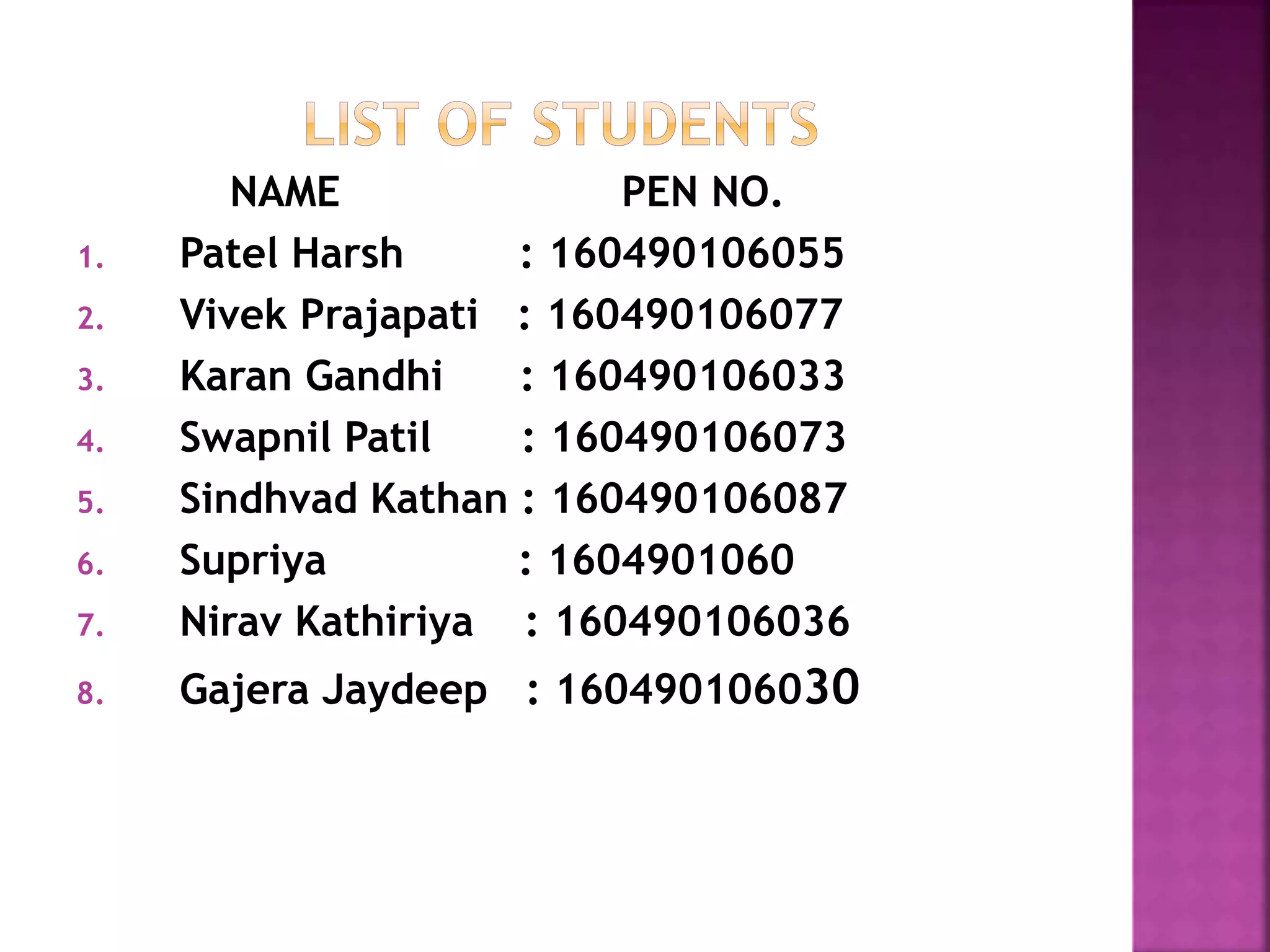
NAME PEN NO.
1. Patel Harsh : 160490106055
2. Vivek Prajapati : 160490106077
3. Karan Gandhi : 160490106033
4. Swapnil Patil : 160490106073
5. Sindhvad Kathan : 160490106087
6. Supriya : 1604901060
7. Nirav Kathiriya : 160490106036
8. Gajera Jaydeep : 160490106030
 The importance of Communication through
English at the present time:
 Before trying to understand the importance and
relevance of English or English Communication
skills we must understand the historical
background of the language and how it has
evolved to the present status. English as a
language never enjoyed this position from the
beginning. World history in and after 14th
century has a major role to play in making this
language powerful and useful. In today’s date it
is not only a major language all over the world
but also the official language in many parts of
the world. Many people depend on this language
for their mere survival and sustenance.
 History of English Language:
 Many may be surprised to know that English as
language was never used for official purposes
even in England up to 11th and 12th century. In
England people used to use rich languages like
Latin, French and Spanish. The dominance of
each and every language over the history has
been dictated by the might the countries
enjoyed. As England was ruled by the France and
other nations for a long period of time they never
had the opportunity to develop their own
language. Till late 13th century the script of
English language was not completely developed.
The first writing in English which can be claimed
as a piece of literature dates back to late 13th
century.
 The term communication has been defined at
various levels. Communication is a dynamic
interactive process that involves the effective
transmission of facts, ideas, thoughts, feelings,
and values. It is not passive and does not just
happen; we actively and consciously engage in
communication in order to develop the
information and understanding required for
effective group functioning. It is dynamic
because it involves a variety of forces and
activities interacting over a period of time.
 Communication is an interactive process. The two
communication agents involved in the
communication process are the sender(s) and the
receiver(s). Bothe the communication agents
exert a reciprocal influence on each other
through inter-stimulation and response. The
process of communication consists of five steps
that is ideation, encoding, transmission, decoding
and feedback. These steps take place only
between the sender and receiver.
 Ideation: This is the initiation in the different
stages of communication. Ideation refers to the
formation of the idea and we tend select the
message to be communicated. We also finalize
the language for communication and the length
and breadth of it. It consists of the ‘What’ of
communication and is concerned with the
content of the specific message to be presented.
Ideation depends on the sender’s knowledge,
experiences, and abilities, as well as the purpose
of communication and the context of the
communication situation. However, ideation
depends on various factors. Messages are
generally of two types as far as content is
concerned, i.e. logical and emotional. Logical
messages contains facts, figures and analysis
whereas emotional messages consists of feelings.
We finalize on the topic to communication in this
step.
 Encoding: It is the process of converting the idea
into a particular language. The information to be
sent is transformed into a logical and coded
message. It depends on the type of relationship
the sender and receiver enjoy. For example, if it
is a formal situation then the sender has to keep
various things in mind e.g. Selection of language,
level of competency of the receiver to
understand the language, selecting a medium of
communication (speaking, writing or non-verbal
means) and the form of communication (face to
face, telephonic, one-to-one, one-to-many, group
communication etc.)
 Transmission: It refers to the transfer of message
from sender to the receiver through a proper
channel. It helps in confirming the process of
encoding and the keeps the channel free from
interference. It decides the right time, place and
method for communication. Through transmission
only the intended message reaches the receiver
without distortion and the listener is able to
decode it in order to understand and comprehend
the message.
 Decoding: In order to understand the message the
receiver has to decode the message in form and
content. It is the process of converting the
message into thoughts by translating the received
stimuli into an interpreted meaning in order to
understand the message communicated. One must
understand that the message is transferred not
the meaning. It depends on the receiver to realize
the meaning and understand it. The process also
involves 19 interpretation and analysis of a
message. In case of oral communication in
involves listening and understanding. As quick
response is required in oral communication the
decoding must take place rapidly, whereas, in
case of written communication it involves reading
and understanding, hence, the time taken can
depend on the ability of receiver. Effective
decoding is very much essential for successful
communication to continue.
 Feedback: It is most important step in the
process of communication. Without feedback the
process of communication won’t be complete. It
makes the process of communication two-way.
This is the last stage in the process of
communication but, one must keep in mind that,
the communication doesn’t end here. It just
completes one loop in the communication cycle.
The process of communication continues in a
cyclical order. It is considered the
reaction/response to the message. The feedback
is given by the receiver, but when the receiver is
giving the feedback he/she becomes the sender
and the sender becomes the receiver. That’s why
it is also known as the reverse flow of
communication. Feedback denotes whether the
receiver has understood the message or not. The
effectiveness of the process of communication
depends on feedback.
 When an alarm clock goes off,it is
communication through sound,urging one to get
out of bed.When one feels loyal towards a
particular brand of toothpaste,watching news on
TV,Saying goodbye to one’s family,and giving
directions are all different types of GENERAL
communication.
 Messages that are non-technical of informal in
nature are categorized as general–purpose
communication, whereas messages pertaining or
technical,industrial, business matters belong to
the category of TECHNICAL or business
communication.
 General Communication
• Contains a general message
• Informal in style and approach
• No set pattern of communication
• Mostly oral
• Not always for a specific audience
• Does not involve the use of technical
vocabulary or graphics etc
 Technical Communication
• Contains a technical message
• Mostly formal
• Follows a set pattern
• Both oral and written
• Always for a specific audience
• Frequently involves jargon , graphics etc
 There are various factors that influence the
process of communication. Without having a
proper understanding of the factors one
cannot involve in the process of
communication effectively. They control and
regulate the process of communication. The
factors are sender & receiver, code, channel,
topic, message, context, feedback, noise,
barriers and filters.
 Sender & receiver: They are the two participants
essential for the process of communication to
take place. The flow of information takes place
between these two sides. Sender initiates the
process of communication & ends on receiver.
 Code: It is a system of symbols used for the
purpose of communication. Language is the most
prominent code used by human beings. Each
language uses various symbols in the form of
letters which are represented by different script
in different languages for written communication
and different sounds for oral communication. For
the communication to be complete both sender
and receiver must be well versed with code they
use. In case of non-verbal communication we use
gestures/body language as code. “Code” is also a
set of rules which we follow while using a
particular language. Each language has different
rules e.g. Grammar, sounds (phonetics) and syntax
(sentence structure).
 Channel: It refers to the medium through which
the information passes. There are basically two
types of channels. a) Auditory channel: The
message in the transmission is converted into
sounds and the sound wave passes through air to
reach the receiver. b) Visual channel: In case of
written communication we read symbols with the
help of vision. This type of channel is also used
while sending or receiving non-verbal messages.
As most of the communication involves a mixture
of verbal and non-verbal messages hence, both
the channels are active in any process of
communication.
 Topic: The topic is the idea converted into a
message. The topic should suit both the sender
and receiver. They must enjoy some rapport with
each other to undertake the process of
communication and must have some
understanding on the topic to be communicated.
The topic can range from an event, action,
object, person, experience, feeling, emotion,
subject, theory, analysis, law, regulations, etc.
The topic should be of mutual interest for the
communication to be sincere and continuous. The
participants in the process of communication
finalize on the degree of involvement in a
particular topic after initial exchange of ideas.
There are some topics which are participant
dependent e.g. entertainment, sports, behavior,
attitude etc. some topics of Science, technology,
policies, economic theories, administrative
functions etc. Hence, in topic dependent topics
passive form of communication is used.
 Message: The message depends of five
factors.They are precision, confusion, exclusion,
emotion and style. a) Precision: The accuracy and
strictness of the message need to be maintained
in order to send it in proper content as it was
devised in ideation should be free of mistakes
and misconceptions. Mistakes may lead to
misunderstanding of the message as a result the
process may get disturbed or diluted.c)Exclusion:
Omission of unnecessary details is highly essential
for the message to be clear and specific.We
should also try to segregate the information in
such a manner that no extra information is
provided. d) Emotion:The message should reflect
proper sentiment and excitement.But one must
keep in mind that it should not be an overflow of
emotion which may distort the process.e) It is
individual specific.The encoders understanding,
social position, context,cultural background and
knowledge affects the style of a message.
 Context: It is the setting in which the
communication takes place. The context is
dependent on factors like time of
communication, place, sender/receiver, channel,
code and topic etc. For complete communication
to take place both the participants should be
sensitive towards the context or else the
message may be wrongly comprehended and the
result can be disastrous. In case of written
communication the context is less visible.
 Any interference in the message sent and the
message received leads to the production of
‘noise’.Noise doesn’t refer to the concept of
sound but a break or disturbance in the
communication process.It is an unplanned
interference in the communication setup.This
affects the transmission of the message.It can be
of two types channel noise and semantic
noise.Channel noise refers to the interference in
the mechanics of the medium used,faulty
connection,technical fault etc.Semantic noise is
generated internally,resulting from internal
problems/errors in the message itself.Sometimes
semantic noise occurs because of
misunderstanding of a given
word/sentence/phrase by any of the
participants.Other e.g:Grammatical error, faulty
pronunciation,ambiguous sentence etc.
 Whether we are trying to persuade, command,
motivate, and entertain or to train we are
communicating with an audience. The sole
purpose of our communication revolves round
the audience. Our communication should always
strive to be audience oriented, for the process of
communication to successful and complete. We
must understand that without the receiver’s
attention and interest the process will fail. The
sender must give due importance to the receiver.
Before beginning the process of communication
the sender must clear the objective of the
communication in his mind. Then only, he will be
able to make it clear to the audience (receiver).
 The sender must keep the following things in
mind to keep the communication audience
specific.
 i) Always respect the receiver’s point of view.
 ii) Sender must know receiver’s interests, tastes,
preferences, background, education, culture etc.
in advance.
 iii) Never underestimate the receiver. There must
be a sense of respect for the receiver (vice-
versa).
 iv) Communication should be a collaborative
activity between sender and receiver.
 v) Effective planning is required. The planning
involves 3 things. a) Language skills and
intelligence, b) Knowledge and understanding of
the topic/subject and c) relationship/rapport
enjoyed by both the sender and receiver with
each other.
 A statement of purpose not only describes what
we want to accomplish, but also helps us know at
the end of the communication whether it has
been achieved. The purpose can be classified into
two broad categories. I.e. General or specific.
General purposes can be to entertain, to inform,
to attract, to regulate, to instruct etc... Specific
purposes involve to influence, to motivate, to
enquire, to persuade etc... The listeners of
communication plays an important role in the
communication process because they influence
the medium of communication. When
communication is targeted towards audience
with a purpose it yields
 We must understand that some purposes are
sender related and some purposes are receiver
related:
 To inform: Any sentence that is informative in
nature. e.g. i) this road leads to the main hall of
the compound. ii) I’m a student of IST year B.Tech
from CET.
 To entertain: Cracking a joke or delivering a
dialogue which amuses the audience or listeners.
 To attract: In this purpose the listeners or
audience or receivers are attracted to listen or
give attention to the speaker. The listeners might
not have a direct interest or role in what the
sender is telling but the communication is such
designed that they get attracted. Advertisement
hoardings, Ads in TV channels.
 To regulate: This purpose generally serves rules
and regulations, sometimes maintaining discipline
in a particular environment. No smoking here.
 To motivate: This purpose gives attention to
particular individual or group to get some work
done or to do better in life, like sermonizing etc.
 To persuade: Here the sender is trying to extract
some work or job by continuously involving in
conversation with the receiver. This purpose
require a lot of skills. This may also take some
time to get fulfilled.
 To enquire: When we try to extract information
from someone on a specific issue or with a
specific motif we use this purpose. What is your
name? Where do you read? etc...
 Human beings are social beings. Though we claim
that we cannot exist without communication but
in reality we use communication for achieving
our own selfish motifs. Hence, we may conclude
that all communication taking place in this world
revolves around some purpose or the other.
Communication  Skills

Communication Skills

  • 1.
    ASSIGNMENT ON: CommunicationSkills PREPARED BY: Civil-A SEMESTER: 1st GIVEN BY: Pratibha Mam
  • 2.
    NAME PEN NO. 1.Patel Harsh : 160490106055 2. Vivek Prajapati : 160490106077 3. Karan Gandhi : 160490106033 4. Swapnil Patil : 160490106073 5. Sindhvad Kathan : 160490106087 6. Supriya : 1604901060 7. Nirav Kathiriya : 160490106036 8. Gajera Jaydeep : 160490106030
  • 3.
     The importanceof Communication through English at the present time:  Before trying to understand the importance and relevance of English or English Communication skills we must understand the historical background of the language and how it has evolved to the present status. English as a language never enjoyed this position from the beginning. World history in and after 14th century has a major role to play in making this language powerful and useful. In today’s date it is not only a major language all over the world but also the official language in many parts of the world. Many people depend on this language for their mere survival and sustenance.
  • 4.
     History ofEnglish Language:  Many may be surprised to know that English as language was never used for official purposes even in England up to 11th and 12th century. In England people used to use rich languages like Latin, French and Spanish. The dominance of each and every language over the history has been dictated by the might the countries enjoyed. As England was ruled by the France and other nations for a long period of time they never had the opportunity to develop their own language. Till late 13th century the script of English language was not completely developed. The first writing in English which can be claimed as a piece of literature dates back to late 13th century.
  • 5.
     The termcommunication has been defined at various levels. Communication is a dynamic interactive process that involves the effective transmission of facts, ideas, thoughts, feelings, and values. It is not passive and does not just happen; we actively and consciously engage in communication in order to develop the information and understanding required for effective group functioning. It is dynamic because it involves a variety of forces and activities interacting over a period of time.
  • 6.
     Communication isan interactive process. The two communication agents involved in the communication process are the sender(s) and the receiver(s). Bothe the communication agents exert a reciprocal influence on each other through inter-stimulation and response. The process of communication consists of five steps that is ideation, encoding, transmission, decoding and feedback. These steps take place only between the sender and receiver.
  • 7.
     Ideation: Thisis the initiation in the different stages of communication. Ideation refers to the formation of the idea and we tend select the message to be communicated. We also finalize the language for communication and the length and breadth of it. It consists of the ‘What’ of communication and is concerned with the content of the specific message to be presented. Ideation depends on the sender’s knowledge, experiences, and abilities, as well as the purpose of communication and the context of the communication situation. However, ideation depends on various factors. Messages are generally of two types as far as content is concerned, i.e. logical and emotional. Logical messages contains facts, figures and analysis whereas emotional messages consists of feelings. We finalize on the topic to communication in this step.
  • 8.
     Encoding: Itis the process of converting the idea into a particular language. The information to be sent is transformed into a logical and coded message. It depends on the type of relationship the sender and receiver enjoy. For example, if it is a formal situation then the sender has to keep various things in mind e.g. Selection of language, level of competency of the receiver to understand the language, selecting a medium of communication (speaking, writing or non-verbal means) and the form of communication (face to face, telephonic, one-to-one, one-to-many, group communication etc.)
  • 9.
     Transmission: Itrefers to the transfer of message from sender to the receiver through a proper channel. It helps in confirming the process of encoding and the keeps the channel free from interference. It decides the right time, place and method for communication. Through transmission only the intended message reaches the receiver without distortion and the listener is able to decode it in order to understand and comprehend the message.
  • 10.
     Decoding: Inorder to understand the message the receiver has to decode the message in form and content. It is the process of converting the message into thoughts by translating the received stimuli into an interpreted meaning in order to understand the message communicated. One must understand that the message is transferred not the meaning. It depends on the receiver to realize the meaning and understand it. The process also involves 19 interpretation and analysis of a message. In case of oral communication in involves listening and understanding. As quick response is required in oral communication the decoding must take place rapidly, whereas, in case of written communication it involves reading and understanding, hence, the time taken can depend on the ability of receiver. Effective decoding is very much essential for successful communication to continue.
  • 11.
     Feedback: Itis most important step in the process of communication. Without feedback the process of communication won’t be complete. It makes the process of communication two-way. This is the last stage in the process of communication but, one must keep in mind that, the communication doesn’t end here. It just completes one loop in the communication cycle. The process of communication continues in a cyclical order. It is considered the reaction/response to the message. The feedback is given by the receiver, but when the receiver is giving the feedback he/she becomes the sender and the sender becomes the receiver. That’s why it is also known as the reverse flow of communication. Feedback denotes whether the receiver has understood the message or not. The effectiveness of the process of communication depends on feedback.
  • 12.
     When analarm clock goes off,it is communication through sound,urging one to get out of bed.When one feels loyal towards a particular brand of toothpaste,watching news on TV,Saying goodbye to one’s family,and giving directions are all different types of GENERAL communication.  Messages that are non-technical of informal in nature are categorized as general–purpose communication, whereas messages pertaining or technical,industrial, business matters belong to the category of TECHNICAL or business communication.
  • 13.
     General Communication •Contains a general message • Informal in style and approach • No set pattern of communication • Mostly oral • Not always for a specific audience • Does not involve the use of technical vocabulary or graphics etc
  • 14.
     Technical Communication •Contains a technical message • Mostly formal • Follows a set pattern • Both oral and written • Always for a specific audience • Frequently involves jargon , graphics etc
  • 15.
     There arevarious factors that influence the process of communication. Without having a proper understanding of the factors one cannot involve in the process of communication effectively. They control and regulate the process of communication. The factors are sender & receiver, code, channel, topic, message, context, feedback, noise, barriers and filters.
  • 16.
     Sender &receiver: They are the two participants essential for the process of communication to take place. The flow of information takes place between these two sides. Sender initiates the process of communication & ends on receiver.  Code: It is a system of symbols used for the purpose of communication. Language is the most prominent code used by human beings. Each language uses various symbols in the form of letters which are represented by different script in different languages for written communication and different sounds for oral communication. For the communication to be complete both sender and receiver must be well versed with code they use. In case of non-verbal communication we use gestures/body language as code. “Code” is also a set of rules which we follow while using a particular language. Each language has different rules e.g. Grammar, sounds (phonetics) and syntax (sentence structure).
  • 17.
     Channel: Itrefers to the medium through which the information passes. There are basically two types of channels. a) Auditory channel: The message in the transmission is converted into sounds and the sound wave passes through air to reach the receiver. b) Visual channel: In case of written communication we read symbols with the help of vision. This type of channel is also used while sending or receiving non-verbal messages. As most of the communication involves a mixture of verbal and non-verbal messages hence, both the channels are active in any process of communication.
  • 18.
     Topic: Thetopic is the idea converted into a message. The topic should suit both the sender and receiver. They must enjoy some rapport with each other to undertake the process of communication and must have some understanding on the topic to be communicated. The topic can range from an event, action, object, person, experience, feeling, emotion, subject, theory, analysis, law, regulations, etc. The topic should be of mutual interest for the communication to be sincere and continuous. The participants in the process of communication finalize on the degree of involvement in a particular topic after initial exchange of ideas. There are some topics which are participant dependent e.g. entertainment, sports, behavior, attitude etc. some topics of Science, technology, policies, economic theories, administrative functions etc. Hence, in topic dependent topics passive form of communication is used.
  • 19.
     Message: Themessage depends of five factors.They are precision, confusion, exclusion, emotion and style. a) Precision: The accuracy and strictness of the message need to be maintained in order to send it in proper content as it was devised in ideation should be free of mistakes and misconceptions. Mistakes may lead to misunderstanding of the message as a result the process may get disturbed or diluted.c)Exclusion: Omission of unnecessary details is highly essential for the message to be clear and specific.We should also try to segregate the information in such a manner that no extra information is provided. d) Emotion:The message should reflect proper sentiment and excitement.But one must keep in mind that it should not be an overflow of emotion which may distort the process.e) It is individual specific.The encoders understanding, social position, context,cultural background and knowledge affects the style of a message.
  • 20.
     Context: Itis the setting in which the communication takes place. The context is dependent on factors like time of communication, place, sender/receiver, channel, code and topic etc. For complete communication to take place both the participants should be sensitive towards the context or else the message may be wrongly comprehended and the result can be disastrous. In case of written communication the context is less visible.
  • 21.
     Any interferencein the message sent and the message received leads to the production of ‘noise’.Noise doesn’t refer to the concept of sound but a break or disturbance in the communication process.It is an unplanned interference in the communication setup.This affects the transmission of the message.It can be of two types channel noise and semantic noise.Channel noise refers to the interference in the mechanics of the medium used,faulty connection,technical fault etc.Semantic noise is generated internally,resulting from internal problems/errors in the message itself.Sometimes semantic noise occurs because of misunderstanding of a given word/sentence/phrase by any of the participants.Other e.g:Grammatical error, faulty pronunciation,ambiguous sentence etc.
  • 22.
     Whether weare trying to persuade, command, motivate, and entertain or to train we are communicating with an audience. The sole purpose of our communication revolves round the audience. Our communication should always strive to be audience oriented, for the process of communication to successful and complete. We must understand that without the receiver’s attention and interest the process will fail. The sender must give due importance to the receiver. Before beginning the process of communication the sender must clear the objective of the communication in his mind. Then only, he will be able to make it clear to the audience (receiver).
  • 23.
     The sendermust keep the following things in mind to keep the communication audience specific.  i) Always respect the receiver’s point of view.  ii) Sender must know receiver’s interests, tastes, preferences, background, education, culture etc. in advance.  iii) Never underestimate the receiver. There must be a sense of respect for the receiver (vice- versa).  iv) Communication should be a collaborative activity between sender and receiver.  v) Effective planning is required. The planning involves 3 things. a) Language skills and intelligence, b) Knowledge and understanding of the topic/subject and c) relationship/rapport enjoyed by both the sender and receiver with each other.
  • 24.
     A statementof purpose not only describes what we want to accomplish, but also helps us know at the end of the communication whether it has been achieved. The purpose can be classified into two broad categories. I.e. General or specific. General purposes can be to entertain, to inform, to attract, to regulate, to instruct etc... Specific purposes involve to influence, to motivate, to enquire, to persuade etc... The listeners of communication plays an important role in the communication process because they influence the medium of communication. When communication is targeted towards audience with a purpose it yields
  • 25.
     We mustunderstand that some purposes are sender related and some purposes are receiver related:  To inform: Any sentence that is informative in nature. e.g. i) this road leads to the main hall of the compound. ii) I’m a student of IST year B.Tech from CET.  To entertain: Cracking a joke or delivering a dialogue which amuses the audience or listeners.  To attract: In this purpose the listeners or audience or receivers are attracted to listen or give attention to the speaker. The listeners might not have a direct interest or role in what the sender is telling but the communication is such designed that they get attracted. Advertisement hoardings, Ads in TV channels.  To regulate: This purpose generally serves rules and regulations, sometimes maintaining discipline in a particular environment. No smoking here.
  • 26.
     To motivate:This purpose gives attention to particular individual or group to get some work done or to do better in life, like sermonizing etc.  To persuade: Here the sender is trying to extract some work or job by continuously involving in conversation with the receiver. This purpose require a lot of skills. This may also take some time to get fulfilled.  To enquire: When we try to extract information from someone on a specific issue or with a specific motif we use this purpose. What is your name? Where do you read? etc...  Human beings are social beings. Though we claim that we cannot exist without communication but in reality we use communication for achieving our own selfish motifs. Hence, we may conclude that all communication taking place in this world revolves around some purpose or the other.