Unit I:
Communication Skill
Presented by:-
Prof. Gunjan P. Malode
UNIT – I 07 Hours
 Communication Skills: Introduction, Definition, The Importance of
Communication, The Communication Process – Source, Message,
Encoding, Channel, Decoding, Receiver, Feedback, Context
 Barriers to communication: Physiological Barriers, Physical
Barriers, Cultural Barriers, Language Barriers, Gender Barriers,
Interpersonal Barriers, Psychological Barriers, Emotional barriers
 Perspectives in Communication: Introduction, Visual Perception,
Language, Other factors affecting our perspective - Past Experiences,
Prejudices, Feelings, Environment
UNIT - II 07Hours
 Elements of Communication: Introduction, Face to Face Communication -
Tone of Voice, Body Language (Non-verbal communication), Verbal
Communication, Physical Communication
 Communication Styles: Introduction, The Communication Styles Matrix with
example for each -Direct Communication Style, Spirited Communication Style,
Systematic Communication Style, Considerate Communication Style.
UNIT – III 07 Hours
 Basic Listening Skills: Introduction, Self-Awareness, Active Listening,
Becoming an Active Listener, Listening in Difficult Situations
 Effective Written Communication: Introduction, When and When Not to
Use Written Communication - Complexity of the Topic, Amount of Discussion’
Required, Shades of Meaning, Formal Communication
 Writing Effectively: Subject Lines, Put the Main Point First, Know Your
Audience, Organization of the Message.
UNIT – IV 05
Hours
 Interview Skills: Purpose of an interview, Do’s and Dont’s of an interview
 Giving Presentations: Dealing with Fears, Planning your Presentation,
Structuring Your Presentation, Delivering Your Presentation, Techniques of
Delivery
UNIT – V 04 Hours
 Group Discussion: Introduction, Communication skills in group
discussion, Do’s and Dont’s of group discussion
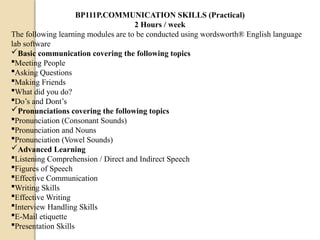
BP111P.COMMUNICATION SKILLS (Practical)
2 Hours / week
The following learning modules are to be conducted using wordsworth® English language
lab software
Basic communication covering the following topics
Meeting People
Asking Questions
Making Friends
What did you do?
Do’s and Dont’s
Pronunciations covering the following topics
Pronunciation (Consonant Sounds)
Pronunciation and Nouns
Pronunciation (Vowel Sounds)
Advanced Learning
Listening Comprehension / Direct and Indirect Speech
Figures of Speech
Effective Communication
Writing Skills
Effective Writing
Interview Handling Skills
E-Mail etiquette
Presentation Skills
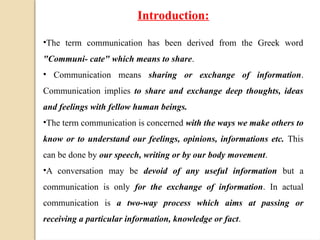
Introduction:
•The term communication has been derived from the Greek word
"Communi- cate" which means to share.
• Communication means sharing or exchange of information.
Communication implies to share and exchange deep thoughts, ideas
and feelings with fellow human beings.
•The term communication is concerned with the ways we make others to
know or to understand our feelings, opinions, informations etc. This
can be done by our speech, writing or by our body movement.
•A conversation may be devoid of any useful information but a
communication is only for the exchange of information. In actual
communication is a two-way process which aims at passing or
receiving a particular information, knowledge or fact.
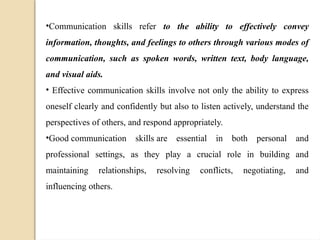
•Communication skills refer to the ability to effectively convey
information, thoughts, and feelings to others through various modes of
communication, such as spoken words, written text, body language,
and visual aids.
• Effective communication skills involve not only the ability to express
oneself clearly and confidently but also to listen actively, understand the
perspectives of others, and respond appropriately.
•Good communication skills are essential in both personal and
professional settings, as they play a crucial role in building and
maintaining relationships, resolving conflicts, negotiating, and
influencing others.
•Communication skills include verbal communication, which involves
using language to convey a message, and nonverbal communication,
which includes body language, facial expressions, and tone of voice.
•Effective communicators are able to use both verbal and
nonverbal communication to convey their message accurately and
clearly.
•In summary, communication skills are an essential set of skills that
enable individuals to effectively interact with others, express
themselves, and understand the perspectives of others.
DEFINITIONS OF COMMUNICATION
Communication can be defined in a number of ways-
Communication is defined as the exchange of information, ideas and
knowledge between a sender and a receiver through an accepted code
of symbols.
Communication is a social interaction through symbols and
messages.
Communication is the transfer of information and understanding from
one person to another person.
Communication is the act of conveying intended meanings from one
entity or group to another through the use of mutually understood signs
and rules.
On the basis of above definitions the following are the main points of
communication-
1. Communication is the transmission of signals from one person to
another.
2. It involves use of symbols which are directed towards some goal.
3. Communication involves the perception of commonly understood
symbolic stimuli of language.
4. Communication may bring about a change in a person or in an
organization if used for a specific purpose.
IMPORTANCE OF COMMUNICATION
Communication is an important life skill that enables us to better
understand and connect with the people around us.
 The purpose of communication is to get your message across to others.
 This is a two way process and involves both the sender of the message and
the receiver.
It allows us to build respect & trust and to resolve differences, helps in
solving problems and helps to create new ideas.
Lack of communication leads to conflict and frustration in both professional
and personal life.
We all are using communication skills even before we start walking. For ex-
ample, a baby communicates by crying.
Good communication skills help in listening, non-verbal
communication, stress management and emotional awareness.
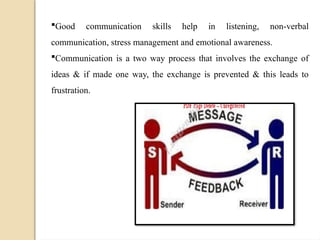
Communication is a two way process that involves the exchange of
ideas & if made one way, the exchange is prevented & this leads to
frustration.
Characteristics of Communication
1. It involves at least two persons
2. Message is must
3. Communication may be written , Oral or Gestures
4. Communication is a two way process
5. Its primary purpose is to motivate a response
6. Communication may be formal or informal
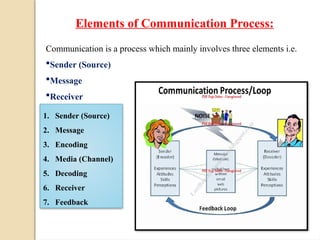
Elements of Communication Process:
Communication is a process which mainly involves three elements i.e.
Sender (Source)
Message
Receiver
1. Sender (Source)
2. Message
3. Encoding
4. Media (Channel)
5. Decoding
6. Receiver
7. Feedback
Elements of Communication Cycle
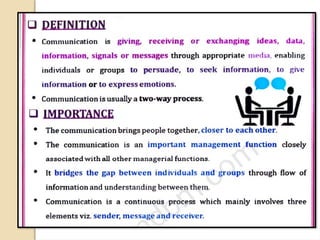
Communications is a continuous process which mainly involves
three elements viz. sender (Source), message, and receiver. The elements
involved in the communication process are explained below in detail.
1. Sender (Source): The sender or the communicator generates the
message and conveys it to the receiver. He is the source and the one
who starts the communication.
2. Message: It is the idea, information, view, fact, feeling, etc. that is
generated by the sender and is then intended to be communicated
further.
3. Encoding: The message generated by the sender is encoded
symbolically such as in the form of words, pictures, gestures, etc.
before it is being conveyed.
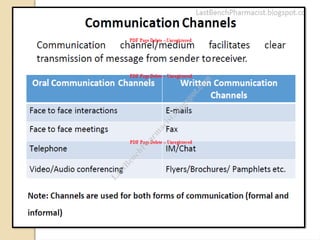
4. Media (Channel): It is the manner in which the encoded message is
transmitted. The message may be transmitted orally or in writing. The medium
of communication includes telephone, internet, post, fax, E-mail, etc. The
choice of medium is decided by the sender.
5. Decoding: It is the process of converting the symbols encoded by the
sender. After decoding the message is received by the receiver.
6. Receiver: He is the person who is last in the chain and for whom the
message was sent by the sender. Once the receiver receives the message and
understands it in proper perspective and acts according to the message, only
then the purpose of communication is successful.
7. Feedback: The response or reaction to the sender's message is called
feedback. Once the receiver confirms to the sender that he has received the
message and understood it, the process of communication is complete.
Feedback allows the sender to evaluate the effectiveness of his message.
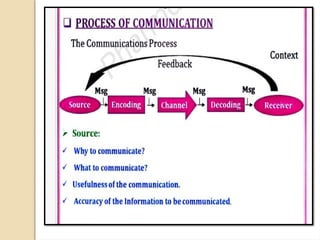
•The process of communication involves multiple stages. In general, there
are seven stages having its own importance as discussed below.
•The Communication Process (How does the communication process
work? )
•In order to successfully communicate, it's important to understand how
the process works.
•Here are the seven steps in the communication process,
1. The sender develops an idea to be sent.
2. The sender encodes the message.
3. The sender selects the channel of communication that will be used.
4. The message travels over the channel of communication
5. The message is received by the receiver
6. The receiver decodes the message.
7. The receiver provides feedback, if applicable
1. The sender develops an idea to be sent
•Communication is the process of passing information and
understanding from one person to another.
•The person who wants to send the message is known as the sender.
•He/she has three functions to perform i.e. planning, encoding and
finally transmitting the message.
•The beginning of the communication process involves the sender
creating an idea that they plan to send to another person or group of
people.
•Essentially, they're planning the overall subject matter or information
they want to transmit.
Planning:
The mind of a person works very fast during the planning stage, Ideas
keep coming to him/her one after the other. These ideas are not
organized and there is generally no consistency in the thoughts, Hence,
the speaker has to first assimilate, put together all his ideas and gather
all the information he/she wants to convey. Thereafter, the sender needs
to determine the purpose of his communication and plan the message
accordingly. While planning the message, the sender should keep in
mind the grasping power of the receiver. In other words, he/she has to
plan the form and content of the message.
2. The sender encodes the message:
Once the sender develops an idea, they translate it into a form that can
be transmitted to someone else. This means they transform the thoughts
of the information they want to send into a certain format. For
example, if you are writing a letter, you'll translate your idea into words.
The message can also be nonverbal, oral or symbolic.
Encoding: It is the process of turning thoughts into communication.
The encoder uses a specific 'medium' like a phone call, email, text
message, face-to-face meeting, or other communication toolto send the
message.
Transmitting the sender must select the proper mode and medium of
communication to transmit the message which determines the outcome
of the transmission. Once the sender decides the mode and medium of
communication, he transmits his message.
3. The sender selects the channel of communication that will be used:
Next, the sender decides how the message will be sent. This involves
selecting the most suitable medium for the message they're relaying.
Some communication mediums include speaking, writing, electronic
transmission or nonverbal communication. If you're communicating
at work, make sure to select the proper and most professional channel
of communication.
4. The message travels over the channel of communication:
After the medium is chosen, the message then begins the process of
transmission. The exact process of this will depend on the selected
medium. In order for the message to be properly sent, the sender should
have selected the appropriate medium.
5. The message is received by the receiver:
Next, the message is received by the recipient. This step in the
communication process is done by hearing the message, seeing it,
feeling it or another form of reception.
Receiver: The receiver has to first receive the message sent by the
sender. When a message is transmitted it has to be received with an open
mind. The receiver has to ensure that the message is not affected by the
additional noise or the different barriers present in the environment. The
noise and the barriers present can result in either loss on
misinterpretation of the data.
Receive the message..........Decode the message.....Send a feedback
6. The receiver decodes the message
Decoding:
It is a process of understanding of a message received and decoding is
the prerequisite step. Once the message is decoded then it is properly
understood by the receiver. For example, if a Marathi speaking person
conveys a message in Marathi to a Bengali who does not understand
Marathi, message cannot be decoded. In such a case, the purpose of
communication will be lost and it will not be effective. Communication to
be effective must be decoded by the receiver. The receiver then decodes
the sender's message. In other words, they interpret it and convert it into a
thought. After they've done this, they analyze the message and attempt to
understand it. The communication process is performed effectively when
the sender and receiver have the same meaning for the transmitted
message.
7. The receiver provides feedback, if applicable:
Feedback: Once the message is decoded and understood, then next step is sending
feedback. The receiver must send feedback or else the process of communication will not
be complete. In fact, feedback enables the sender to know whether the message sent by him
has been successfully received and decoded by the receiver or not. No communication can
be called effective unless the feedback is sent by the receiver.
Importance of Feedback in Communication:
•Feedback is the final component and one of the important factors in the process of
communication. It is defined as the response given by the receiver to the sender. The
sender needs response of the receiver in order to decide effectiveness of communication.
•Feedback can be negative or positive. Positive feedback indicates that the sender can
continue his communication in the same manner as before. Negative feedback on the
other hand, indicates a need for a change in the manner of communication. The
feedback tells the sender many things such as whether the message is received successfully
or not, whether the receiver liked it or not, whether the choice of channel/medium was
appropriate etc.
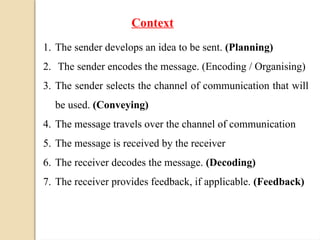
Context
1. The sender develops an idea to be sent. (Planning)
2. The sender encodes the message. (Encoding / Organising)
3. The sender selects the channel of communication that will
be used. (Conveying)
4. The message travels over the channel of communication
5. The message is received by the receiver
6. The receiver decodes the message. (Decoding)
7. The receiver provides feedback, if applicable. (Feedback)
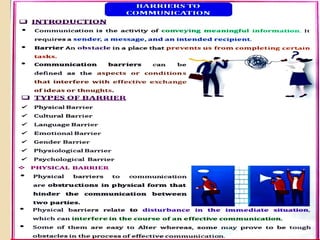
BARRIERS OF COMMUNICATION
The word barrier means an obstacle, a hindrance
or simply a problem that comes in a way of
transmission of message and blocks the process,
either completely or partially.
Communication Barrier can be defined as the
aspect or the conditions that interfere with effective
exchange of any thought or idea.
The word barrier refers a problem, hindrance or
fence that obstructs the smooth transmission to
movement. In communication, barriers implies that
there are blocks in the communication process which
could be complete or partial.
1. Physiological Barriers
2. Physical Barriers
3. Cultural Barriers
4. Language Barriers
5. Gender Barriers
6. Interpersonal Barriers
7. Psycological Barriers
8. Emotional Barriers
9. Organizational Barriers
10. Mechanical Barriers
11. Semantic Barriers
12. Status Barriers
13. Dramatizing Barriers
Unit 1 Syllabus, Introduction, CP, Barriers.pptx