Dattatreya Reddy Peram
Assistant Professor
 Communication is the process of passing information from
one person to another. It is the process in which a person,
through the use of sign or symbols verbally and or non-
verbally, consciously or unconsciously, conveys meaning in
order to affect change.
 The Communication Process is a system that involves an
interrelated, interdependent group of elements working
together as a whole to achieve a desired outcome or goal
 To inform
 To educate
 To train
 To motivate
 To integrate
 To relate
 To promote
 To entertain
 To facilitate decision-making
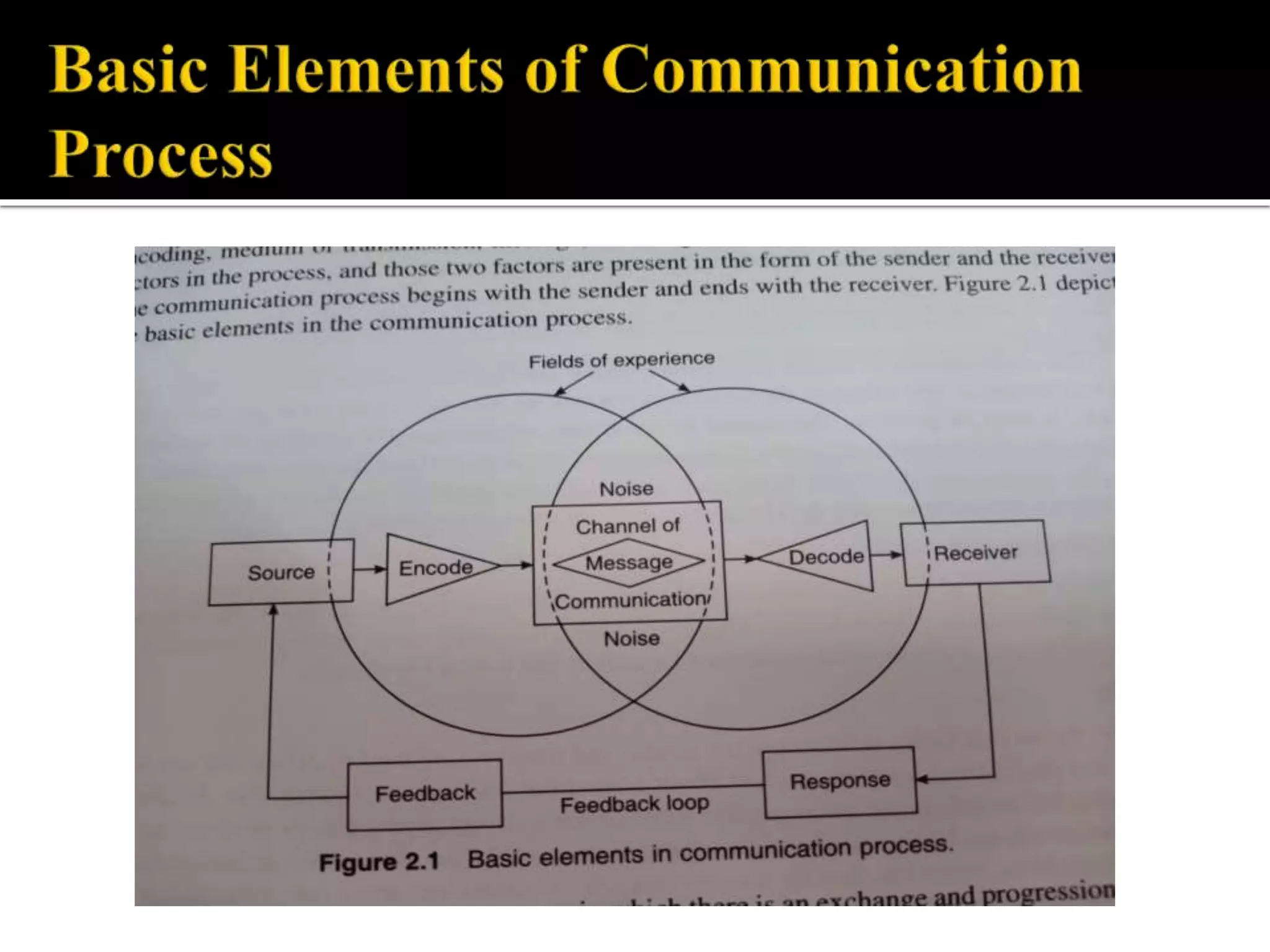
 Sender/Encoder/Speaker
 Message
 Medium/Channels
 Receiver/Decoder/Listener
 Feedback
 A Communication Process follows the following steps:
1. There is a Sender
2. The Sender has an Idea
3. The Sender encodes the idea into a message
4. The message travels through the Channel
5. Noise in the transmission process
6. The receiver gets the message
7. The receiver decodes the message
8. The receiver gives the feedback
 For the Process of Communication to be effective, there should be a well-
defined goal in the mind of the sender.
Harmony between the goals of the two communicators makes for good and
easy progression of ideas and concepts.
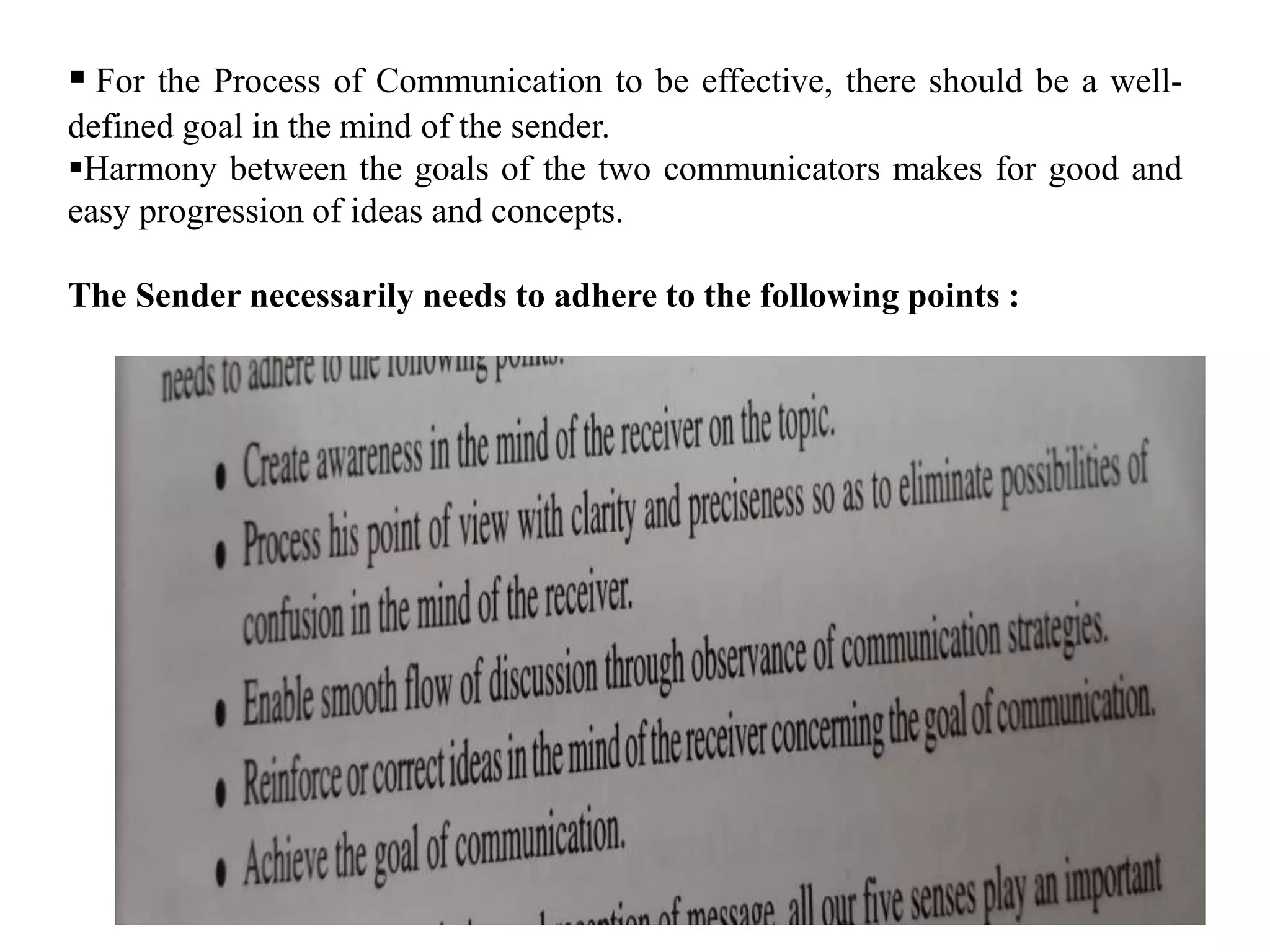
The Sender necessarily needs to adhere to the following points :
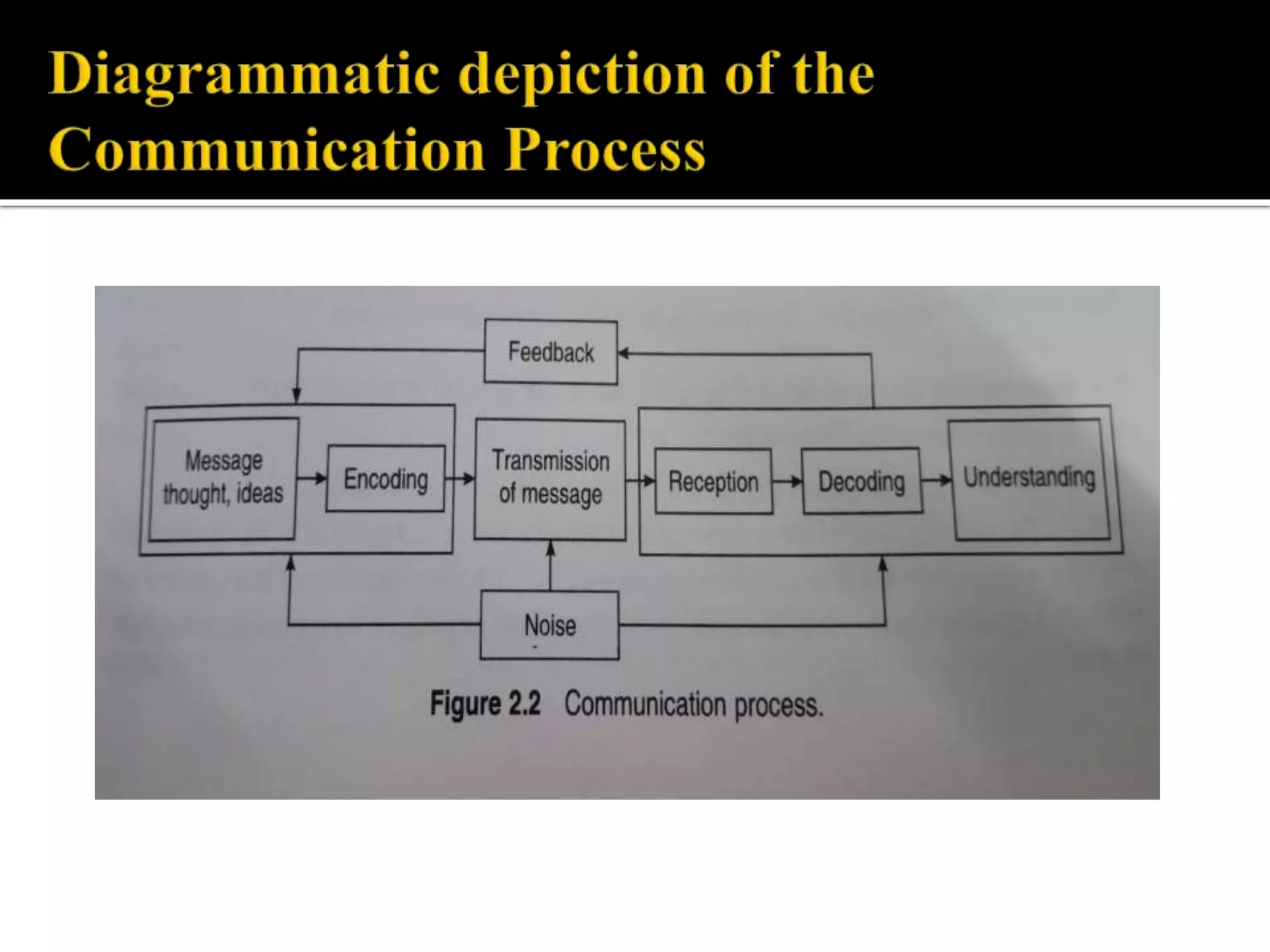
Process flow like this …
1. The Sender, according to his ideas, behaviour pattern and
intention, selects a message, encodes it, and transmit to the
receiver through a medium – be it oral, verbal and non-verbal.
2. As soon as the message reaches the receiver, he decodes it and
gives an internal response to the perceived message
3. It is noteworthy that the response is not in relation to the actual
content but rather to the perceived content of the original
message. This Completes the first phase of the communication
process.
4. In the Second Phase, the receiver formulates his message,
encodes it and transmits it to the original sender-now-turned-
receiver. This Stage is referred to as providing feedback and is
most crucial.
Unless and until there is feedback- be it in the Verbal or the
non-verbal form, we cannot say that effective
communication has taken Place.
If the feedback is in tune with the original intent of the sender,
communication proceeds without a hitch

Process of communication

  • 1.
  • 2.
     Communication isthe process of passing information from one person to another. It is the process in which a person, through the use of sign or symbols verbally and or non- verbally, consciously or unconsciously, conveys meaning in order to affect change.  The Communication Process is a system that involves an interrelated, interdependent group of elements working together as a whole to achieve a desired outcome or goal
  • 3.
     To inform To educate  To train  To motivate  To integrate  To relate  To promote  To entertain  To facilitate decision-making
  • 5.
     Sender/Encoder/Speaker  Message Medium/Channels  Receiver/Decoder/Listener  Feedback
  • 6.
     A CommunicationProcess follows the following steps: 1. There is a Sender 2. The Sender has an Idea 3. The Sender encodes the idea into a message 4. The message travels through the Channel 5. Noise in the transmission process 6. The receiver gets the message 7. The receiver decodes the message 8. The receiver gives the feedback
  • 8.
     For theProcess of Communication to be effective, there should be a well- defined goal in the mind of the sender. Harmony between the goals of the two communicators makes for good and easy progression of ideas and concepts. The Sender necessarily needs to adhere to the following points :
  • 9.
    Process flow likethis … 1. The Sender, according to his ideas, behaviour pattern and intention, selects a message, encodes it, and transmit to the receiver through a medium – be it oral, verbal and non-verbal. 2. As soon as the message reaches the receiver, he decodes it and gives an internal response to the perceived message 3. It is noteworthy that the response is not in relation to the actual content but rather to the perceived content of the original message. This Completes the first phase of the communication process. 4. In the Second Phase, the receiver formulates his message, encodes it and transmits it to the original sender-now-turned- receiver. This Stage is referred to as providing feedback and is most crucial. Unless and until there is feedback- be it in the Verbal or the non-verbal form, we cannot say that effective communication has taken Place.
  • 10.
    If the feedbackis in tune with the original intent of the sender, communication proceeds without a hitch