1
Government Degree College, Nainpur (Mandla)
PPT
on
Communicative English
Prepared by-
Dr. Kulbhushan Rajak
Asst. Professor, English
Govt. Degree College, Nainpur
Communicative English
For B.A. B.Sc. & B.Com.
1. Language and Skills of Communication
2. Application of Linguistic Ability
3. LetterWriting
4. Technical Writing/ Précis Writing
5. Report Writing
2
Language and Skills of Communication
 LinguisticTechniques
 Modern Usage: Functional Grammar
 Comprehension Skills
 AppliedTechniques
 Introduction to Phonetics
 Clarification of Sounds
 PhoneticTranscription
 Mechanism of Sound Production
3
 Oral presentation
 Presentation factors
 Introduction to communication
 Process of communication
 Importance of communication
 Verbal & non-verbal communication
 Objectives / types of communication
 Barriers to communication
4
Application of Linguistic Ability
 Definitions of EngineeringTerms
 Listening skills
 Barriers to listening
 Listening & Hearing
 Topics of general interest
 Paragraph writing
 Essays
5
LetterWriting
 Business correspondence
 Characteristics of business letters
 Kinds of business letters
 Pattern of business letters
 Quotation- calling & sending
 Enquiry letters
 Placing an order
6
 Complaint letter
 Adjustment letter
 Job application letter
 Resume writing
 Tenders
7
Technical Writing/ Précis Writing
 Precise writing
 Noting & drafting
 Difference between note taking & note
making
 Technical description
 Slogan writing
 Advertising
8
Report Writing
 Introduction to technical reports
 Characteristics of technical reports
 Types of reports
 Telephonic conversation & skills
9
Reference Books
 Communication Skills: Dr. Jaya Garg, Balaji Learning
Books, Bhopal .
 Communication Skills: Dr. Neeta Sharma, Satya
Prakashan, New Delhi.
 Communication Skills: Dr. Gajanan Malviya, S. Chand
Publication, New Delhi.
ReferenceWebsites
 http://forum.jntuworld.com
 http://www.imdiastudychannel.com
 http://www.mimdtools.com
 http://www.techbits.co.in
10
Language
Language is a system of arbitrary vocal symbols by means
of which social human group cooperates. - Bloch &Trager .
Language may be defined as the expression of thought by
means of speech sounds. –Henry Sweet.
11
The way we communicate with others
and with ourselves, ultimately
determines the quality of our lives.
Language the ‘species-specific’ and
‘species-uniform possession of man’ is
the most remarkable tool and also
precious that man invented which
makes our civilization possible. It is a
gift which distinguishes us from
animals.
12
Characteristics of Language
 Language is a means of communication.
 Language is verbal-vocal.
 Language is symbolic.
 Language is systematic.
 Language is a social phenomenon.
 Language is arbitrary.
 Language is unique.
13
PurposeofLanguage
 Language is a means of communication.
 Language is a means of expression.
 Language is a system based on symbol.
 Language is a system based mainly on sounds.
 Language is must for social interaction.
14
Linguistic Techniques
 Linguistics is the scientific study of
language. It is learning about a language
rather than learning a language.The word
language here does not stand for any
particular language but in general.
 Linguistics is the study of the ways in which
a language is organised to fulfil human
needs as a system of communication. It is
to study about a language rather than
learning a language.
15
Communication
Communication is the name given to number
of ways by which different creature convey
and receive information. The talks among
human beings, the singing and chirping of
birds, every written word, picture and body
movement noticed etc. are communication
part of communication process.
16
 The term ‘communication’ is derived from
the Latin word “Communicare” which
means common, consequently it implies
that the communication is common
understanding through communion of
mind and hearts.
 Communication is complete when the
receiver receives the message and
understands in the same sense and spirit
that the sender intends to convey.
Communication means transfer of
message or exchange of ideas, facts,
opinions or feelings by two or more
persons.
17
Definitions of Communication
 Communication is the process of exchanging
or sharing and understanding from one
person to another. – Keith Davis.
 Communication is an exchange of facts,
ideas, opinions or emotions by two or more
persons. –William Newman & Charles
Summer.
18
Characteristics of Communication
 Communication is a two way process.
 Communication is an on-going process.
 Communication is unavoidable.
 Communication is universal.
 Communication is a social need.
19
Importance & Functions of Communication
 Getting and supplying of information.
 Suggestion.
 Giving advice.
 Orders.
 To encourage or to motivate.
 Education.
 Counselling.
 Discipline.
20
Process of Communication
21
There is inter-relationship between several inter-
dependent components.
Components of Communication Process
Sender- person who transmit the message
Input- ideas generated in the mind of sender
Encoding- converting ideas in to language symbol
Message- systematically arranged language
symbol
Medium- oral, written, visual etc.
Channel- regular pattern of interaction among
people.
22
Decoding- Process of converting message into
language symbols by receiver.
Output- Understanding generated in the mind of
receiver.
Receiver- the person who receives the message.
Feedback- response given by the receiver after
receiving the message.
Brain Drain- leakage of information at every step
of communication process due to barriers.
Semantic Gap- gap between sent & received
message due to improper communication.
23
When a person wants to say something he
gets ideas in his mind (Input). With the help
of language symbols he transforms the ideas
(encoding) into a systematically arranged
language codes (message).This framed
message reaches the other person (receiver)
with the help of a suitable medium. Medium
may be oral, visual or audio-visual. It further
can be classified into channels.The received
message again converted (decoding) by the
receiver and understood by him (output).The
receiver may or may not send a response to
the sender (feedback).
24
Types of Communication
 Media ( Mode of Expression)
Oral
Written
Visual
Audio-Visual
Computer Based
Face to face
25
 ElementsTransferred
1. Verbal- Written & Oral
2. Non-verbal
Kinesics
Oculesics
Haptics
Proxemics
Appearance &Accessories
Voice &Tone
Chronemics
Sign Language
Para Language
Silence
26
Oral Communication
Oral communication implies the conveying
of the message through spoken words. It
includes face to face communication,
converstaion on telephone and speech
etc.The important feature of oral
communication is that the real meaning
is conveyed by manner or tone of the
voice or the facial expressions.
27
Written Communication
It implies transmission of
message in black and
white. Everything that is
transmitted in written form
comes in the area of written
communication.
Letters, memos, notices, reports etc.
28
Verbal Communication
Verbal communication consists of
words arranged in grammatical
manner.The term verbal implies
use of words which makes
language.Verbal communication
means communication through
spoken and written words.
Oral & Written
29
Non-Verbal Communication
It includes facial expression,
eye-contact, body posture
and gesture. It may also
include the way we wear
our clothes or the silence
we keep.
30
Non-verbal communication can be defined in several ways
 It is a communication using any other
means other than words.
 It is the communication that uses non-
linguistic means of communication.
 It refers to the transfer of by body
language, space, time and para-
language.
31
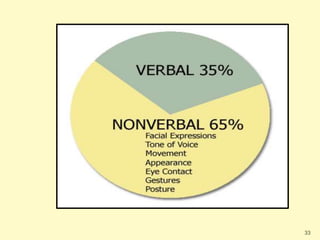
“Action speaks louder than words”
Research has shown that
between 70% to 90%
entire communication
spectrum is
non-verbal.
32
33
34
35
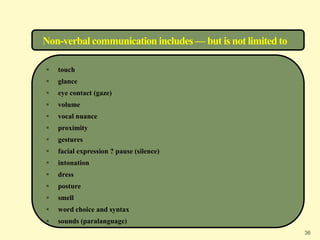
Non-verbal communication includes — but is not limited to
 touch
 glance
 eye contact (gaze)
 volume
 vocal nuance
 proximity
 gestures
 facial expression ? pause (silence)
 intonation
 dress
 posture
 smell
 word choice and syntax
 sounds (paralanguage)
36
Channels of Communication
In an organization, information
flows forward, backwards and
sideways.This information flow is
referred to as communication.
Communication channels refer to
the way this information flows
within the organization and with
other organizations.
37
Channels refer to regular pattern of
interaction among people and a
systematic flow of information.
Kinds of channels-
Formal
Informal
38
Formal Channels of Communication
39
Grapevine (Informal Channels)
Informal communication network
Grapevine, ignores formal
channels of communication. It is
spontaneous, off the record and
beyond organisational hierarchy.
It has no set rules and regulations
& no particular direction.
40
41
42
43
Advantages of Grapevine
1. Speed
Grapevine is highly rapid and can be used to send
messages very quickly.
2.Valuable Feedback
The grapevine provides a valuable feedback to the
management, if it is used intelligently.
3. Check on Emotions
Grapevine is an indicator of the employee's interest in
their work because the grapevine serves as an emotional
outlet for workers.
4. Morale Booster
Grapevine can act as a morale booster because it can be
used effectively by the management for transmitting
good and positive ideas. 44
Disadvantages of Grapevine
Spreads Rumours
Distorts Messages
Affects Productivity
Lacks Control
45
Barriers to Communication
Barriers to communication
are those obstacles which
occurs in the process of
communication and
interfere the transmitting of
the message.
46
47
Language & Semantic Barriers
Language that describes what we
would want to express and
communicate to others, may at
times, serve as a barrier to them. In
today’s global scenario, the greatest
compliment we can pay to another
person is by speaking and effectively
communicating to them in their local
language.
48
Physical Barriers
Physical Barriers consist of any
sound that prevents a person from
being heard. Physical noise
interferes with a speaker's ability to
send messages and with an
audience's ability to receive them.
Noise,Time & Distance
49
Socio-psychological Barriers
 Difference in perception
 Difference in attitude
 Emotions
 Closed Minds
 Premature evaluation
 Distrust
 Resistance to change
 Cultural differences
50
Organisational Barriers
 Lack of communication policy
 Authoritarian attitude of
management
 Poorly Defined Authority and
Responsibility
 Too Many Levels in Organization
Structure
 Insufficient CommunicationTraining
51
Paragraph Writing
A paragraph (from the Greek
paragraphos, "to write beside" or
"written beside") is a group of
sentences with one topic.
A paragraph is a group of closely
related sentences that deals with a
single thought.
52
A good paragraph should have
three major structural parts
1.Topic Sentence
2. Supporting Sentences
3. Concluding Sentence
53
A good paragraph should also possess
two additional elements
 Unity
All of the supporting sentences develop
or discuss the main idea stated in the
topic sentence of the paragraph.
 Coherence
The paragraph is easy to read and
understand because supporting
sentences are organized in logical order
and the use of appropriate transition
signals.
54
Topics for writing paragraphs
 E-governance
 Economic planning in India
 Reservation
 Aim of Education
 ModernTechnology and Humanity
 Positive Attitude
 Knowledge is Power
 Economic Recession
55
Defining Technical Terms
 Name of the object.
 Set or class to which it belongs.
 Its specific features.
 Its specification.
 Use simple words that themselves don’t
need to define.
 Avoid using abstract words.
56
 Atom
An atom is the smallest particle of a
substance that takes part in a chemical
reaction.
 Momentum
Momentum is the quality of motion
possessed by a body and is calculated by
the product of the mass of the body and
its velocity.
57
Listening
Listening is the first of the four language
skills, which are:
 Listening
 Speaking
 Reading
 Writing
In our own language, listening is usually
the first language skill that we learn.
58
Listening is the absorption of the
meanings of words and sentences by
the brain. Listening leads to the
understanding of facts and ideas. It
requires concentration.
Listening is the ability to accurately
receive and interpret messages in the
communication process.
Listening is key to all effective
communication.
59
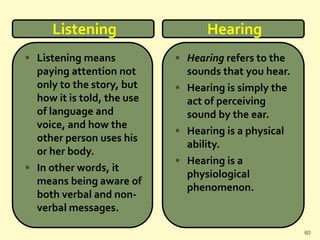
Listening Hearing
 Listening means
paying attention not
only to the story, but
how it is told, the use
of language and
voice, and how the
other person uses his
or her body.
 In other words, it
means being aware of
both verbal and non-
verbal messages.
 Hearing refers to the
sounds that you hear.
 Hearing is simply the
act of perceiving
sound by the ear.
 Hearing is a physical
ability.
 Hearing is a
physiological
phenomenon.
60
Listening process
 Attending
 Précising
 Interpreting
 Assessing
 Responding
61
Types of Listening
 Discriminative listening
 Comprehension listening
 Critical listening
 Evaluative listening
 Biased listening
62
Types of Listener
 Non-Listener
Don’t hear others at all. In fact, you do not even make an effort
to hear what the other person is saying.
 Marginal Listener
Hearing the sounds and words but not really listening.The
message is toyed with but not really heard.
 Evaluative Listener
Listener is actively trying to hear what the speaker is saying but
isn't making an effort to understand the speaker's intent.
 Active Listener
The active listener continually tries to get a deeper
understanding of the other person.
63
Active Listening Techniques
 StopTalking
 PrepareYourself to Listen
 Put the Speaker at Ease
 Remove Distractions
 Empathise
 Be Patient
 Avoid Personal Prejudice
 Listen to theTone
 Listen for Ideas – Not Just Words
 Wait and Watch for Non-Verbal Communication
64
LetterWriting
Business letters are the
life-breath of business.
Despite the availability of
telephone, conventional
mail is still very popular.
65
Importance of business letters
 Drafting at convenience
 Reaches far and wide
 A record for purpose of law
 A record for reference
 Solidifies a business bond
 Helps to expand business
 Saves money in communication
 Convenient for giving unpleasant news
66
Purpose of a business letters
 Answering & Enquiring
 Placing an order
 Demanding or refusing credit
 Selling goods & services
 Accepting or refusing a request
 Making or responding to complaints
67
Whatever be the purpose every letter is an
ambassador of good will. In writing a
letter one must perform two functions:
1. An attempt to achieve the specific
purpose of the organisation.
2. Friendly relationship with other
organisation dealing with different
levels of human intellect.
68
Excellent and different attitude would
demand a number of qualities from the
professional. Writing a successful letter
requires-
 A clear perception of human nature.
 A deep understanding of the psychology
of man.
 An ability to anticipate the reaction of
receiver.
69
Functions of a business letter
 Permanent record
 Business letters build friendly relationship
between companies and concerned parties.
 It can be treated as a legal document.
 It is a formal method of communication.
 It is a positive instrument of professional to
exchange ideas, opinions and information.
70
Steps for writing a letter are-
Planning
Writing
Revising
Editing
71
Effective letters are the result of
good thinking and careful planning.
There must be-
Accuracy
Brevity
Clarity
Courteous
Reader oriented
You attitude
Study of reader’s mind
Avoid use of jargons
72
Elements of business letter
 Heading
 Date
 Reference number
 Inside address
 Attention line
 Salutation
 Subject
 Body of the letter
 Complementary close
 Signature
 Enclosure
 Cc/B c (copy notation)
73
Format layout of business letter
 Indented form
 Block Form ( Modified Block)
 Full Block Form ( Complete Block)
 Semi Block
 Hanging Indented Form
 Simplified Form
74
Indented form
75
Block form
76
Full block form
77
Semi block form
78
Job application letter
 A job application letter is written when
someone needs a job. It is like a sales letter
because a job application letter highlights
the qualities of a candidate for a job. A job
application letter asks for an opportunity.
 A job application letter consist of two parts-
 1. Cover letter
 2. Resume
79
Cover letter
 A cover letter is a document sent with
your resume to provide additional
information on your skills and
experience.
 Employers use cover letters as a way
to screen applicants for available jobs
and to determine which candidates
they would like to interview.
80
 A cover letter provides detailed
information on why you are qualified
for the job.
 Effective cover letters explain the
reasons for your interest in the
specific organization and identify your
most relevant skills or experiences.
81
82
Resume
A resume is a written compilation of your
education, work experience, credentials,
and accomplishments that is used to
apply for jobs. It is one of the most
important pieces of any job application.
83
A CV is an in-depth document that can be
laid out over two or more pages and it
contains a high level of detail about your
achievements, a great deal more than just
a career biography.
The CV covers your education as well as
any
other accomplishments like publications,
awards, honours etc.
84
Notice Inviting Tenders
 Sealed bid or offer document
submitted in response to a request for
tenders and containing detailed
information on requirements and
terms associated with a potential
contract.
 Tenders are offers to supply goods or
to perform a job for an agreed price.
85
Tender Quotation Letter
1. Tenders are widely
advertised in news
papers, magazines,
websites etc.
2. Tenders are notices
inviting sellers
publically.
3. Tenderer buys a
form, fills it and
submits it.Then
tenders are opened.
1. Quotations are sent
to few selected
sellers.
2. Quotations are
limited to private
correspondence.
3. It is a complete
private affair, no
such type of activity
takes place here.
86
Tender Quotation Letter
4. Tenders are invited
for job, buying and
selling of goods and
services.
5. Tenders are invited
for a large period of
time.
6. Examples- for
constructions of
roads, buildings or
bulk supply of
goods.
4. Quotations are
invited for buying
and selling of goods
and services only.
5. Time duration for
execution is small.
6. Examples- buying
and selling of
clothes, electronic
gadgets, computers
etc.
87
TechnicalWriting/PrécisWriting
Precise Writing
Precise is an English Adjective meaning
clearly expressed, brief and to the point.
Precise writing means using as few words
as possible without sacrificing clarity.
E.g. His trousers are red in colour.
Precise- His trousers are red.
88
Précis Writing
Précis is a French Noun meaning a
concise summary. It is a clear statement
of a longer passage in a connected and
readable shape. It must be accurate,
brief and clear (ABC).
It is like a restatement in shorten form.
Completeness, clarity and conciseness
are the qualities of a good précis.
89
Do’s of Précis Writing
 Use your own language as far as possible.
 There should be logical sequence in sentences.
 Don’t use figures of speech.
 Give maximum information in required limit.
 It should be like an independent text with
proper beginning and proper end.
 Use indirect speech and third person.
 It is very important to have good vocabulary.
90
Don'ts of Précis Writing
 Don’t copy from the original text.
 Don’t divide précis into paragraphs
unless the original passage is very long.
 Don’t change facts and information.
 The given information should be
reproduced only.
 Don’t make any comment or suggestion.
 Don’t give any conclusion or
recommendation.
91
Steps to make a Précis
 Read the original piece of writing carefully.
 Specify its main points and arguments.
 Write a précis describing all important
arguments of the original in logical
progression.
 Re-read it and try to understand the central
idea.This is a key!
 Reduce your précis to one-quarter
(approximately) of its original length
without omitting its essential points.
92
Note Taking & Note Making
 Note taking is a passive process where a
person tries to gather and store
information after listening a lecture or
having read a book.
 Note-making is more active and focused
activity where you assimilate all
information and make sense of it for
yourself. Noting means preparing a note
or taking a decision on a case.
93
Note Making [Noting]
Noting is done to focus the
important points of a particular
communication. It includes
explanation also.The note also
provides a very useful guide to the
officers who may act to handle
the similar case in future.
94
A note contains facts and figures,
rules, laws, procedures etc.
A good note should properly
define and analyze the problem.
It also talks about alternative
solutions and suggest suitable
option.
95
Guidelines for Note Making
 It should be complete, clear, concise,
coherent, correct (ideas & language),
courteous, visually attractive.
 Notes and orders should be recorded on
note sheets in the note section of the file.
 Note should be typed on both sides of the
note sheet.
 2 to 3 inches spaces should be left in the top
and bottom.
96
A note is written by the Section
Officer on file describing the case
which is under consideration.
In other words, a note is a
statement of facts describing the
issue under consideration,
suggesting course of action to
reach a decision.
97
 A note is written to assist the competent
authority to decide a matter easily.
 It helps the seniors to study the whole
picture of a case as portrayed by the junior
officers. The decision of the matter is the
end point of a note.
 A well written note leads to correct
decision and a badly composed note may
lead to confusion, wastage of time and
ultimately to a bad or wrong decision.
98
Advantages of Noting
 It presents the various aspects of a matter in a
clear perspective and bring out pros and cons
of the point under consideration.
 It put down the views of the writer in black and
white and records the precise reason for
adopting a particular course of action
considered to be the best out of all possible
courses.
 A note is a record of discussion leading to a
particular decision. It can be used as precedent
for future references.
99
 Recorded notes help in understanding reasons
for a particular decision, and in finding out, at
what level the decision was taken.
 Responsibility for a particular decision can be
fixed on the bases of recorded note.
 Note indicates what steps were taken and
what authorities were consulted before taking
final decision.
 Note enables people who come afterwards to
pick up the tasks where others left.
 A note is a historical record and source of
information for the coming officials.
100
Qualities of Good Noting
Paragraphs of a note should be
numbered continuously from the
beginning onwards.
It should be temperate, objective and
free from personal remarks.
It should embody all the relevant
material about a case concisely, but
should not repeat facts, arguments,
words and phrases.
101
The expression should be clear,
precise and simple.
It should be properly documented
and referenced.
All previous papers, precedents,
rules and regulations orders, etc.
which are relied upon in a note,
should, as far as possible, be put
up with it, and referenced.
102
Drafting
When noting is done and line of action
is finally worked out the next step is
drafting.
Drafting means framing of an official
letter to be issued to the concerned.
Its objective is to convey the decision
or order in written form to all the
concerned person.
103
Guidelines of Drafting
 A draft should be written, preferably
typed in double space on both sides of
the paper. A sufficiently wide margin
should be left for corrections and
additions.
 All drafts should bear the relevant file
number and the subject.The reference
number of the addressee’s letter, if
available.
104
 When two or more letters, notifications
etc., are to issue under the same file
number, on the same date, to the same
addressee, a serial number
should always be given in addition to the
file number to avoid confusion.
 A draft should show clearly the enclosures
which are to accompany the fair copy.
 The appropriate priority marking i.e.
“Residence” “Immediate” or “Priority”
should be indicated on the draft.
105
Slogan Writing
 A forceful, catchy, mind grabbing
utterance that will persuade people to
buy something or behave in a certain
way.
 A slogan is a memorable phrase, motto
or jingles that expresses a particular
concept.
 A concept that sticks in the mind of
audience like glue to paper.
106
The slogan should reach the client for
publicity and must hold longer with
the audience.
It should be-
Short and simple
Can be understood quickly
Memorable
Unique
Create an emotional response
107
Advertisement
“Advertisement is a sales message
directed at a mass audience that seeks
through persuasion to goods, services
or ideas on behalf of the paying
sponsor”.
-John D. Burke
108

PPT English.ppt

  • 1.
    1 Government Degree College,Nainpur (Mandla) PPT on Communicative English Prepared by- Dr. Kulbhushan Rajak Asst. Professor, English Govt. Degree College, Nainpur
  • 2.
    Communicative English For B.A.B.Sc. & B.Com. 1. Language and Skills of Communication 2. Application of Linguistic Ability 3. LetterWriting 4. Technical Writing/ Précis Writing 5. Report Writing 2
  • 3.
    Language and Skillsof Communication  LinguisticTechniques  Modern Usage: Functional Grammar  Comprehension Skills  AppliedTechniques  Introduction to Phonetics  Clarification of Sounds  PhoneticTranscription  Mechanism of Sound Production 3
  • 4.
     Oral presentation Presentation factors  Introduction to communication  Process of communication  Importance of communication  Verbal & non-verbal communication  Objectives / types of communication  Barriers to communication 4
  • 5.
    Application of LinguisticAbility  Definitions of EngineeringTerms  Listening skills  Barriers to listening  Listening & Hearing  Topics of general interest  Paragraph writing  Essays 5
  • 6.
    LetterWriting  Business correspondence Characteristics of business letters  Kinds of business letters  Pattern of business letters  Quotation- calling & sending  Enquiry letters  Placing an order 6
  • 7.
     Complaint letter Adjustment letter  Job application letter  Resume writing  Tenders 7
  • 8.
    Technical Writing/ PrécisWriting  Precise writing  Noting & drafting  Difference between note taking & note making  Technical description  Slogan writing  Advertising 8
  • 9.
    Report Writing  Introductionto technical reports  Characteristics of technical reports  Types of reports  Telephonic conversation & skills 9
  • 10.
    Reference Books  CommunicationSkills: Dr. Jaya Garg, Balaji Learning Books, Bhopal .  Communication Skills: Dr. Neeta Sharma, Satya Prakashan, New Delhi.  Communication Skills: Dr. Gajanan Malviya, S. Chand Publication, New Delhi. ReferenceWebsites  http://forum.jntuworld.com  http://www.imdiastudychannel.com  http://www.mimdtools.com  http://www.techbits.co.in 10
  • 11.
    Language Language is asystem of arbitrary vocal symbols by means of which social human group cooperates. - Bloch &Trager . Language may be defined as the expression of thought by means of speech sounds. –Henry Sweet. 11
  • 12.
    The way wecommunicate with others and with ourselves, ultimately determines the quality of our lives. Language the ‘species-specific’ and ‘species-uniform possession of man’ is the most remarkable tool and also precious that man invented which makes our civilization possible. It is a gift which distinguishes us from animals. 12
  • 13.
    Characteristics of Language Language is a means of communication.  Language is verbal-vocal.  Language is symbolic.  Language is systematic.  Language is a social phenomenon.  Language is arbitrary.  Language is unique. 13
  • 14.
    PurposeofLanguage  Language isa means of communication.  Language is a means of expression.  Language is a system based on symbol.  Language is a system based mainly on sounds.  Language is must for social interaction. 14
  • 15.
    Linguistic Techniques  Linguisticsis the scientific study of language. It is learning about a language rather than learning a language.The word language here does not stand for any particular language but in general.  Linguistics is the study of the ways in which a language is organised to fulfil human needs as a system of communication. It is to study about a language rather than learning a language. 15
  • 16.
    Communication Communication is thename given to number of ways by which different creature convey and receive information. The talks among human beings, the singing and chirping of birds, every written word, picture and body movement noticed etc. are communication part of communication process. 16
  • 17.
     The term‘communication’ is derived from the Latin word “Communicare” which means common, consequently it implies that the communication is common understanding through communion of mind and hearts.  Communication is complete when the receiver receives the message and understands in the same sense and spirit that the sender intends to convey. Communication means transfer of message or exchange of ideas, facts, opinions or feelings by two or more persons. 17
  • 18.
    Definitions of Communication Communication is the process of exchanging or sharing and understanding from one person to another. – Keith Davis.  Communication is an exchange of facts, ideas, opinions or emotions by two or more persons. –William Newman & Charles Summer. 18
  • 19.
    Characteristics of Communication Communication is a two way process.  Communication is an on-going process.  Communication is unavoidable.  Communication is universal.  Communication is a social need. 19
  • 20.
    Importance & Functionsof Communication  Getting and supplying of information.  Suggestion.  Giving advice.  Orders.  To encourage or to motivate.  Education.  Counselling.  Discipline. 20
  • 21.
  • 22.
    There is inter-relationshipbetween several inter- dependent components. Components of Communication Process Sender- person who transmit the message Input- ideas generated in the mind of sender Encoding- converting ideas in to language symbol Message- systematically arranged language symbol Medium- oral, written, visual etc. Channel- regular pattern of interaction among people. 22
  • 23.
    Decoding- Process ofconverting message into language symbols by receiver. Output- Understanding generated in the mind of receiver. Receiver- the person who receives the message. Feedback- response given by the receiver after receiving the message. Brain Drain- leakage of information at every step of communication process due to barriers. Semantic Gap- gap between sent & received message due to improper communication. 23
  • 24.
    When a personwants to say something he gets ideas in his mind (Input). With the help of language symbols he transforms the ideas (encoding) into a systematically arranged language codes (message).This framed message reaches the other person (receiver) with the help of a suitable medium. Medium may be oral, visual or audio-visual. It further can be classified into channels.The received message again converted (decoding) by the receiver and understood by him (output).The receiver may or may not send a response to the sender (feedback). 24
  • 25.
    Types of Communication Media ( Mode of Expression) Oral Written Visual Audio-Visual Computer Based Face to face 25
  • 26.
     ElementsTransferred 1. Verbal-Written & Oral 2. Non-verbal Kinesics Oculesics Haptics Proxemics Appearance &Accessories Voice &Tone Chronemics Sign Language Para Language Silence 26
  • 27.
    Oral Communication Oral communicationimplies the conveying of the message through spoken words. It includes face to face communication, converstaion on telephone and speech etc.The important feature of oral communication is that the real meaning is conveyed by manner or tone of the voice or the facial expressions. 27
  • 28.
    Written Communication It impliestransmission of message in black and white. Everything that is transmitted in written form comes in the area of written communication. Letters, memos, notices, reports etc. 28
  • 29.
    Verbal Communication Verbal communicationconsists of words arranged in grammatical manner.The term verbal implies use of words which makes language.Verbal communication means communication through spoken and written words. Oral & Written 29
  • 30.
    Non-Verbal Communication It includesfacial expression, eye-contact, body posture and gesture. It may also include the way we wear our clothes or the silence we keep. 30
  • 31.
    Non-verbal communication canbe defined in several ways  It is a communication using any other means other than words.  It is the communication that uses non- linguistic means of communication.  It refers to the transfer of by body language, space, time and para- language. 31
  • 32.
    “Action speaks louderthan words” Research has shown that between 70% to 90% entire communication spectrum is non-verbal. 32
  • 33.
  • 34.
  • 35.
  • 36.
    Non-verbal communication includes— but is not limited to  touch  glance  eye contact (gaze)  volume  vocal nuance  proximity  gestures  facial expression ? pause (silence)  intonation  dress  posture  smell  word choice and syntax  sounds (paralanguage) 36
  • 37.
    Channels of Communication Inan organization, information flows forward, backwards and sideways.This information flow is referred to as communication. Communication channels refer to the way this information flows within the organization and with other organizations. 37
  • 38.
    Channels refer toregular pattern of interaction among people and a systematic flow of information. Kinds of channels- Formal Informal 38
  • 39.
    Formal Channels ofCommunication 39
  • 40.
    Grapevine (Informal Channels) Informalcommunication network Grapevine, ignores formal channels of communication. It is spontaneous, off the record and beyond organisational hierarchy. It has no set rules and regulations & no particular direction. 40
  • 41.
  • 42.
  • 43.
  • 44.
    Advantages of Grapevine 1.Speed Grapevine is highly rapid and can be used to send messages very quickly. 2.Valuable Feedback The grapevine provides a valuable feedback to the management, if it is used intelligently. 3. Check on Emotions Grapevine is an indicator of the employee's interest in their work because the grapevine serves as an emotional outlet for workers. 4. Morale Booster Grapevine can act as a morale booster because it can be used effectively by the management for transmitting good and positive ideas. 44
  • 45.
    Disadvantages of Grapevine SpreadsRumours Distorts Messages Affects Productivity Lacks Control 45
  • 46.
    Barriers to Communication Barriersto communication are those obstacles which occurs in the process of communication and interfere the transmitting of the message. 46
  • 47.
  • 48.
    Language & SemanticBarriers Language that describes what we would want to express and communicate to others, may at times, serve as a barrier to them. In today’s global scenario, the greatest compliment we can pay to another person is by speaking and effectively communicating to them in their local language. 48
  • 49.
    Physical Barriers Physical Barriersconsist of any sound that prevents a person from being heard. Physical noise interferes with a speaker's ability to send messages and with an audience's ability to receive them. Noise,Time & Distance 49
  • 50.
    Socio-psychological Barriers  Differencein perception  Difference in attitude  Emotions  Closed Minds  Premature evaluation  Distrust  Resistance to change  Cultural differences 50
  • 51.
    Organisational Barriers  Lackof communication policy  Authoritarian attitude of management  Poorly Defined Authority and Responsibility  Too Many Levels in Organization Structure  Insufficient CommunicationTraining 51
  • 52.
    Paragraph Writing A paragraph(from the Greek paragraphos, "to write beside" or "written beside") is a group of sentences with one topic. A paragraph is a group of closely related sentences that deals with a single thought. 52
  • 53.
    A good paragraphshould have three major structural parts 1.Topic Sentence 2. Supporting Sentences 3. Concluding Sentence 53
  • 54.
    A good paragraphshould also possess two additional elements  Unity All of the supporting sentences develop or discuss the main idea stated in the topic sentence of the paragraph.  Coherence The paragraph is easy to read and understand because supporting sentences are organized in logical order and the use of appropriate transition signals. 54
  • 55.
    Topics for writingparagraphs  E-governance  Economic planning in India  Reservation  Aim of Education  ModernTechnology and Humanity  Positive Attitude  Knowledge is Power  Economic Recession 55
  • 56.
    Defining Technical Terms Name of the object.  Set or class to which it belongs.  Its specific features.  Its specification.  Use simple words that themselves don’t need to define.  Avoid using abstract words. 56
  • 57.
     Atom An atomis the smallest particle of a substance that takes part in a chemical reaction.  Momentum Momentum is the quality of motion possessed by a body and is calculated by the product of the mass of the body and its velocity. 57
  • 58.
    Listening Listening is thefirst of the four language skills, which are:  Listening  Speaking  Reading  Writing In our own language, listening is usually the first language skill that we learn. 58
  • 59.
    Listening is theabsorption of the meanings of words and sentences by the brain. Listening leads to the understanding of facts and ideas. It requires concentration. Listening is the ability to accurately receive and interpret messages in the communication process. Listening is key to all effective communication. 59
  • 60.
    Listening Hearing  Listeningmeans paying attention not only to the story, but how it is told, the use of language and voice, and how the other person uses his or her body.  In other words, it means being aware of both verbal and non- verbal messages.  Hearing refers to the sounds that you hear.  Hearing is simply the act of perceiving sound by the ear.  Hearing is a physical ability.  Hearing is a physiological phenomenon. 60
  • 61.
    Listening process  Attending Précising  Interpreting  Assessing  Responding 61
  • 62.
    Types of Listening Discriminative listening  Comprehension listening  Critical listening  Evaluative listening  Biased listening 62
  • 63.
    Types of Listener Non-Listener Don’t hear others at all. In fact, you do not even make an effort to hear what the other person is saying.  Marginal Listener Hearing the sounds and words but not really listening.The message is toyed with but not really heard.  Evaluative Listener Listener is actively trying to hear what the speaker is saying but isn't making an effort to understand the speaker's intent.  Active Listener The active listener continually tries to get a deeper understanding of the other person. 63
  • 64.
    Active Listening Techniques StopTalking  PrepareYourself to Listen  Put the Speaker at Ease  Remove Distractions  Empathise  Be Patient  Avoid Personal Prejudice  Listen to theTone  Listen for Ideas – Not Just Words  Wait and Watch for Non-Verbal Communication 64
  • 65.
    LetterWriting Business letters arethe life-breath of business. Despite the availability of telephone, conventional mail is still very popular. 65
  • 66.
    Importance of businessletters  Drafting at convenience  Reaches far and wide  A record for purpose of law  A record for reference  Solidifies a business bond  Helps to expand business  Saves money in communication  Convenient for giving unpleasant news 66
  • 67.
    Purpose of abusiness letters  Answering & Enquiring  Placing an order  Demanding or refusing credit  Selling goods & services  Accepting or refusing a request  Making or responding to complaints 67
  • 68.
    Whatever be thepurpose every letter is an ambassador of good will. In writing a letter one must perform two functions: 1. An attempt to achieve the specific purpose of the organisation. 2. Friendly relationship with other organisation dealing with different levels of human intellect. 68
  • 69.
    Excellent and differentattitude would demand a number of qualities from the professional. Writing a successful letter requires-  A clear perception of human nature.  A deep understanding of the psychology of man.  An ability to anticipate the reaction of receiver. 69
  • 70.
    Functions of abusiness letter  Permanent record  Business letters build friendly relationship between companies and concerned parties.  It can be treated as a legal document.  It is a formal method of communication.  It is a positive instrument of professional to exchange ideas, opinions and information. 70
  • 71.
    Steps for writinga letter are- Planning Writing Revising Editing 71
  • 72.
    Effective letters arethe result of good thinking and careful planning. There must be- Accuracy Brevity Clarity Courteous Reader oriented You attitude Study of reader’s mind Avoid use of jargons 72
  • 73.
    Elements of businessletter  Heading  Date  Reference number  Inside address  Attention line  Salutation  Subject  Body of the letter  Complementary close  Signature  Enclosure  Cc/B c (copy notation) 73
  • 74.
    Format layout ofbusiness letter  Indented form  Block Form ( Modified Block)  Full Block Form ( Complete Block)  Semi Block  Hanging Indented Form  Simplified Form 74
  • 75.
  • 76.
  • 77.
  • 78.
  • 79.
    Job application letter A job application letter is written when someone needs a job. It is like a sales letter because a job application letter highlights the qualities of a candidate for a job. A job application letter asks for an opportunity.  A job application letter consist of two parts-  1. Cover letter  2. Resume 79
  • 80.
    Cover letter  Acover letter is a document sent with your resume to provide additional information on your skills and experience.  Employers use cover letters as a way to screen applicants for available jobs and to determine which candidates they would like to interview. 80
  • 81.
     A coverletter provides detailed information on why you are qualified for the job.  Effective cover letters explain the reasons for your interest in the specific organization and identify your most relevant skills or experiences. 81
  • 82.
  • 83.
    Resume A resume isa written compilation of your education, work experience, credentials, and accomplishments that is used to apply for jobs. It is one of the most important pieces of any job application. 83
  • 84.
    A CV isan in-depth document that can be laid out over two or more pages and it contains a high level of detail about your achievements, a great deal more than just a career biography. The CV covers your education as well as any other accomplishments like publications, awards, honours etc. 84
  • 85.
    Notice Inviting Tenders Sealed bid or offer document submitted in response to a request for tenders and containing detailed information on requirements and terms associated with a potential contract.  Tenders are offers to supply goods or to perform a job for an agreed price. 85
  • 86.
    Tender Quotation Letter 1.Tenders are widely advertised in news papers, magazines, websites etc. 2. Tenders are notices inviting sellers publically. 3. Tenderer buys a form, fills it and submits it.Then tenders are opened. 1. Quotations are sent to few selected sellers. 2. Quotations are limited to private correspondence. 3. It is a complete private affair, no such type of activity takes place here. 86
  • 87.
    Tender Quotation Letter 4.Tenders are invited for job, buying and selling of goods and services. 5. Tenders are invited for a large period of time. 6. Examples- for constructions of roads, buildings or bulk supply of goods. 4. Quotations are invited for buying and selling of goods and services only. 5. Time duration for execution is small. 6. Examples- buying and selling of clothes, electronic gadgets, computers etc. 87
  • 88.
    TechnicalWriting/PrécisWriting Precise Writing Precise isan English Adjective meaning clearly expressed, brief and to the point. Precise writing means using as few words as possible without sacrificing clarity. E.g. His trousers are red in colour. Precise- His trousers are red. 88
  • 89.
    Précis Writing Précis isa French Noun meaning a concise summary. It is a clear statement of a longer passage in a connected and readable shape. It must be accurate, brief and clear (ABC). It is like a restatement in shorten form. Completeness, clarity and conciseness are the qualities of a good précis. 89
  • 90.
    Do’s of PrécisWriting  Use your own language as far as possible.  There should be logical sequence in sentences.  Don’t use figures of speech.  Give maximum information in required limit.  It should be like an independent text with proper beginning and proper end.  Use indirect speech and third person.  It is very important to have good vocabulary. 90
  • 91.
    Don'ts of PrécisWriting  Don’t copy from the original text.  Don’t divide précis into paragraphs unless the original passage is very long.  Don’t change facts and information.  The given information should be reproduced only.  Don’t make any comment or suggestion.  Don’t give any conclusion or recommendation. 91
  • 92.
    Steps to makea Précis  Read the original piece of writing carefully.  Specify its main points and arguments.  Write a précis describing all important arguments of the original in logical progression.  Re-read it and try to understand the central idea.This is a key!  Reduce your précis to one-quarter (approximately) of its original length without omitting its essential points. 92
  • 93.
    Note Taking &Note Making  Note taking is a passive process where a person tries to gather and store information after listening a lecture or having read a book.  Note-making is more active and focused activity where you assimilate all information and make sense of it for yourself. Noting means preparing a note or taking a decision on a case. 93
  • 94.
    Note Making [Noting] Notingis done to focus the important points of a particular communication. It includes explanation also.The note also provides a very useful guide to the officers who may act to handle the similar case in future. 94
  • 95.
    A note containsfacts and figures, rules, laws, procedures etc. A good note should properly define and analyze the problem. It also talks about alternative solutions and suggest suitable option. 95
  • 96.
    Guidelines for NoteMaking  It should be complete, clear, concise, coherent, correct (ideas & language), courteous, visually attractive.  Notes and orders should be recorded on note sheets in the note section of the file.  Note should be typed on both sides of the note sheet.  2 to 3 inches spaces should be left in the top and bottom. 96
  • 97.
    A note iswritten by the Section Officer on file describing the case which is under consideration. In other words, a note is a statement of facts describing the issue under consideration, suggesting course of action to reach a decision. 97
  • 98.
     A noteis written to assist the competent authority to decide a matter easily.  It helps the seniors to study the whole picture of a case as portrayed by the junior officers. The decision of the matter is the end point of a note.  A well written note leads to correct decision and a badly composed note may lead to confusion, wastage of time and ultimately to a bad or wrong decision. 98
  • 99.
    Advantages of Noting It presents the various aspects of a matter in a clear perspective and bring out pros and cons of the point under consideration.  It put down the views of the writer in black and white and records the precise reason for adopting a particular course of action considered to be the best out of all possible courses.  A note is a record of discussion leading to a particular decision. It can be used as precedent for future references. 99
  • 100.
     Recorded noteshelp in understanding reasons for a particular decision, and in finding out, at what level the decision was taken.  Responsibility for a particular decision can be fixed on the bases of recorded note.  Note indicates what steps were taken and what authorities were consulted before taking final decision.  Note enables people who come afterwards to pick up the tasks where others left.  A note is a historical record and source of information for the coming officials. 100
  • 101.
    Qualities of GoodNoting Paragraphs of a note should be numbered continuously from the beginning onwards. It should be temperate, objective and free from personal remarks. It should embody all the relevant material about a case concisely, but should not repeat facts, arguments, words and phrases. 101
  • 102.
    The expression shouldbe clear, precise and simple. It should be properly documented and referenced. All previous papers, precedents, rules and regulations orders, etc. which are relied upon in a note, should, as far as possible, be put up with it, and referenced. 102
  • 103.
    Drafting When noting isdone and line of action is finally worked out the next step is drafting. Drafting means framing of an official letter to be issued to the concerned. Its objective is to convey the decision or order in written form to all the concerned person. 103
  • 104.
    Guidelines of Drafting A draft should be written, preferably typed in double space on both sides of the paper. A sufficiently wide margin should be left for corrections and additions.  All drafts should bear the relevant file number and the subject.The reference number of the addressee’s letter, if available. 104
  • 105.
     When twoor more letters, notifications etc., are to issue under the same file number, on the same date, to the same addressee, a serial number should always be given in addition to the file number to avoid confusion.  A draft should show clearly the enclosures which are to accompany the fair copy.  The appropriate priority marking i.e. “Residence” “Immediate” or “Priority” should be indicated on the draft. 105
  • 106.
    Slogan Writing  Aforceful, catchy, mind grabbing utterance that will persuade people to buy something or behave in a certain way.  A slogan is a memorable phrase, motto or jingles that expresses a particular concept.  A concept that sticks in the mind of audience like glue to paper. 106
  • 107.
    The slogan shouldreach the client for publicity and must hold longer with the audience. It should be- Short and simple Can be understood quickly Memorable Unique Create an emotional response 107
  • 108.
    Advertisement “Advertisement is asales message directed at a mass audience that seeks through persuasion to goods, services or ideas on behalf of the paying sponsor”. -John D. Burke 108