1
Defining Communication
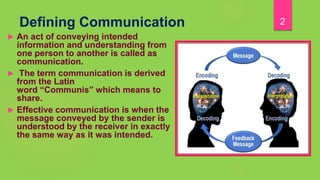
 An act of conveying intended
information and understanding from
one person to another is called as
communication.
 The term communication is derived
from the Latin
word “Communis” which means to
share.
 Effective communication is when the
message conveyed by the sender is
understood by the receiver in exactly
the same way as it was intended.
2
Communication Process
 Definition: The Communicati
on is a two-way process
wherein the message in the
form of ideas, thoughts,
feelings, opinions is
transmitted between two or
more persons with the intent of
creating a shared
understanding.
3
Sender
 Encoding: The sender begins with the encoding
process wherein he uses certain words or non-
verbal methods such as symbols, signs, body
gestures, etc. to translate the information into a
message.
 The sender’s knowledge, skills, perception,
background, competencies, etc. has a great
impact on the success of the message.
4
Communication Process
 The communication is a dynamic process that begins with the
conceptualizing of ideas by the sender who then transmits the
message through a channel to the receiver, who in turn gives the
feedback in the form of some message or signal within the given time
frame.
 There are Seven major elements of communication process:
5
Encoding
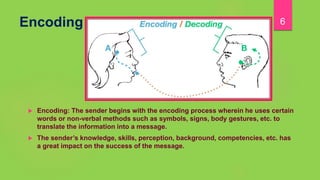
 Encoding: The sender begins with the encoding process wherein he uses certain
words or non-verbal methods such as symbols, signs, body gestures, etc. to
translate the information into a message.
 The sender’s knowledge, skills, perception, background, competencies, etc. has
a great impact on the success of the message.
6
Message
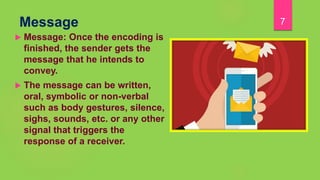
 Message: Once the encoding is
finished, the sender gets the
message that he intends to
convey.
 The message can be written,
oral, symbolic or non-verbal
such as body gestures, silence,
sighs, sounds, etc. or any other
signal that triggers the
response of a receiver.
7
Communication Channel
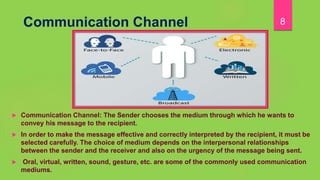
 Communication Channel: The Sender chooses the medium through which he wants to
convey his message to the recipient.
 In order to make the message effective and correctly interpreted by the recipient, it must be
selected carefully. The choice of medium depends on the interpersonal relationships
between the sender and the receiver and also on the urgency of the message being sent.
 Oral, virtual, written, sound, gesture, etc. are some of the commonly used communication
mediums.
8
Receiver
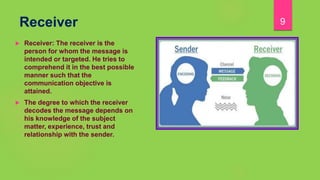
 Receiver: The receiver is the
person for whom the message is
intended or targeted. He tries to
comprehend it in the best possible
manner such that the
communication objective is
attained.
 The degree to which the receiver
decodes the message depends on
his knowledge of the subject
matter, experience, trust and
relationship with the sender.
9
Decoding
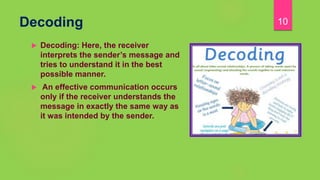
 Decoding: Here, the receiver
interprets the sender’s message and
tries to understand it in the best
possible manner.
 An effective communication occurs
only if the receiver understands the
message in exactly the same way as
it was intended by the sender.
10
Feedback
 Feedback: The Feedback is the final
step of the process that ensures the
receiver has received the message
and interpreted it correctly as it was
intended by the sender.
 It increases the effectiveness of the
communication as it permits the
sender to know the efficacy of his
message. The response of the
receiver can be verbal or non-verbal.
11
Environment
 The environment is the space where you send
and receive messages. If you glance around
your room, your environment can include the
tables, chairs, lighting, and the computer you
are using. The room itself is an example of the
environment.
 The environment can also include factors like
formal dress, that may indicate whether a
discussion is open and caring or more
professional and formal.
 People may be more likely to have an intimate
conversation when they are physically close
to each other, and less likely when they can
only see each other from across the room. In
that case, they may text each other, itself an
intimate form of communication.
12
Context
 A presentation or discussion does not take place
as an isolated event. Context is the circumstances
that form the setting for an event, statement, or
idea, and in terms of which it can be fully
understood and assessed. For example, when you
came to class, you came from somewhere. So did
the person seated next to you, as did the
instructor.
 The degree to which the environment is formal or
informal depends on the contextual expectations
for communication held by the participants.
 The person sitting next to you may be used to
informal communication with instructors, but this
particular instructor may be used to verbal and
nonverbal displays of respect in the academic
environment.
13
Inference
 Interference, also called noise, can come from
any source and has the ability to block or
change the intended meaning of the message.
For example, if you drove a car to work or
school, chances are you were surrounded by
noise. Car horns, billboards, or perhaps the
radio in your car interrupted your thoughts or
your conversation with a passenger.
 Psychological noise is what happens when your
thoughts occupy your attention while you are
hearing, or reading, a message.Suppose you are
studying for your first test and you are nervous
about the grade you will receive. As thoughts of
doubt creep into your mind, they interfere with
your reading of classroom notes and the study
guide.
14
Cont......
 Interference can come from other sources, too. Perhaps you are
hungry, and your attention to your current situation interferes with
your ability to listen. Maybe the classroom is hot and stuffy.
 If you were a member of an audience listening to a guest speaker,
this could impact your ability to listen and participate.
 Noise interferes with normal encoding and decoding of the message
carried by the channel between source and receiver.
 Noise interferes with the communication process. For example, your
cell phone ringtone may be a welcome noise to you, but it may
interrupt the communication process in class and bother your
classmates.
15
Conclusion
 The communication
process involves
understanding, sharing,
and meaning, and it
consists of eight essential
elements: source,
message, channel,
receiver, feedback,
environment, context, and
interference.
16
THANK YOU17
Upcoming...

Communication process

  • 1.
  • 2.
    Defining Communication  Anact of conveying intended information and understanding from one person to another is called as communication.  The term communication is derived from the Latin word “Communis” which means to share.  Effective communication is when the message conveyed by the sender is understood by the receiver in exactly the same way as it was intended. 2
  • 3.
    Communication Process  Definition:The Communicati on is a two-way process wherein the message in the form of ideas, thoughts, feelings, opinions is transmitted between two or more persons with the intent of creating a shared understanding. 3
  • 4.
    Sender  Encoding: Thesender begins with the encoding process wherein he uses certain words or non- verbal methods such as symbols, signs, body gestures, etc. to translate the information into a message.  The sender’s knowledge, skills, perception, background, competencies, etc. has a great impact on the success of the message. 4
  • 5.
    Communication Process  Thecommunication is a dynamic process that begins with the conceptualizing of ideas by the sender who then transmits the message through a channel to the receiver, who in turn gives the feedback in the form of some message or signal within the given time frame.  There are Seven major elements of communication process: 5
  • 6.
    Encoding  Encoding: Thesender begins with the encoding process wherein he uses certain words or non-verbal methods such as symbols, signs, body gestures, etc. to translate the information into a message.  The sender’s knowledge, skills, perception, background, competencies, etc. has a great impact on the success of the message. 6
  • 7.
    Message  Message: Oncethe encoding is finished, the sender gets the message that he intends to convey.  The message can be written, oral, symbolic or non-verbal such as body gestures, silence, sighs, sounds, etc. or any other signal that triggers the response of a receiver. 7
  • 8.
    Communication Channel  CommunicationChannel: The Sender chooses the medium through which he wants to convey his message to the recipient.  In order to make the message effective and correctly interpreted by the recipient, it must be selected carefully. The choice of medium depends on the interpersonal relationships between the sender and the receiver and also on the urgency of the message being sent.  Oral, virtual, written, sound, gesture, etc. are some of the commonly used communication mediums. 8
  • 9.
    Receiver  Receiver: Thereceiver is the person for whom the message is intended or targeted. He tries to comprehend it in the best possible manner such that the communication objective is attained.  The degree to which the receiver decodes the message depends on his knowledge of the subject matter, experience, trust and relationship with the sender. 9
  • 10.
    Decoding  Decoding: Here,the receiver interprets the sender’s message and tries to understand it in the best possible manner.  An effective communication occurs only if the receiver understands the message in exactly the same way as it was intended by the sender. 10
  • 11.
    Feedback  Feedback: TheFeedback is the final step of the process that ensures the receiver has received the message and interpreted it correctly as it was intended by the sender.  It increases the effectiveness of the communication as it permits the sender to know the efficacy of his message. The response of the receiver can be verbal or non-verbal. 11
  • 12.
    Environment  The environmentis the space where you send and receive messages. If you glance around your room, your environment can include the tables, chairs, lighting, and the computer you are using. The room itself is an example of the environment.  The environment can also include factors like formal dress, that may indicate whether a discussion is open and caring or more professional and formal.  People may be more likely to have an intimate conversation when they are physically close to each other, and less likely when they can only see each other from across the room. In that case, they may text each other, itself an intimate form of communication. 12
  • 13.
    Context  A presentationor discussion does not take place as an isolated event. Context is the circumstances that form the setting for an event, statement, or idea, and in terms of which it can be fully understood and assessed. For example, when you came to class, you came from somewhere. So did the person seated next to you, as did the instructor.  The degree to which the environment is formal or informal depends on the contextual expectations for communication held by the participants.  The person sitting next to you may be used to informal communication with instructors, but this particular instructor may be used to verbal and nonverbal displays of respect in the academic environment. 13
  • 14.
    Inference  Interference, alsocalled noise, can come from any source and has the ability to block or change the intended meaning of the message. For example, if you drove a car to work or school, chances are you were surrounded by noise. Car horns, billboards, or perhaps the radio in your car interrupted your thoughts or your conversation with a passenger.  Psychological noise is what happens when your thoughts occupy your attention while you are hearing, or reading, a message.Suppose you are studying for your first test and you are nervous about the grade you will receive. As thoughts of doubt creep into your mind, they interfere with your reading of classroom notes and the study guide. 14
  • 15.
    Cont......  Interference cancome from other sources, too. Perhaps you are hungry, and your attention to your current situation interferes with your ability to listen. Maybe the classroom is hot and stuffy.  If you were a member of an audience listening to a guest speaker, this could impact your ability to listen and participate.  Noise interferes with normal encoding and decoding of the message carried by the channel between source and receiver.  Noise interferes with the communication process. For example, your cell phone ringtone may be a welcome noise to you, but it may interrupt the communication process in class and bother your classmates. 15
  • 16.
    Conclusion  The communication processinvolves understanding, sharing, and meaning, and it consists of eight essential elements: source, message, channel, receiver, feedback, environment, context, and interference. 16
  • 17.