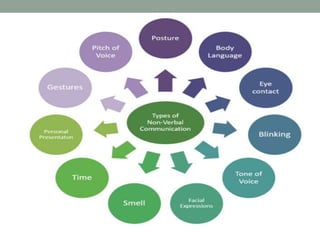
Communication styles vary between individuals and depend on both the sender and receiver. Effective communication requires consideration of barriers like authority, language, personality, and gender. True communication is only achieved when barriers are identified and removed through an anti-oppressive approach. Verbal communication includes both written and oral exchanges, while non-verbal communication conveys messages through gestures and body language to supplement verbal interactions. The communication process involves a sender encoding a message, choosing a channel to send it through, a receiver decoding the message, and feedback to assess understanding. Noise can also interfere with successful transmission and interpretation of the message.