Process of Communication
Dr. SHAFAYAT ALI
Assistant Professor/HOD
Department of Mass Comm.
Govt. College of Science,
Wahdat Road, Lahore
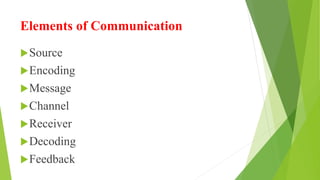
Elements of Communication
Source
Encoding
Message
Channel
Receiver
Decoding
Feedback
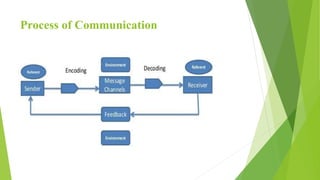
Process of Communication
Sender
 Sender is a person who sends a message. He is a chief
initiator of any communication. Infact communication
may not take place if there is no sender.
 Sender may be individual or group, or an organization.
 Individual to Individual
 Individual to collective
 A sender makes use of symbols (words or graphic or
visual aids) to convey the message and produce the
required response.
Encoding
 Encoding is the process where the information you
would like to communicate gets transferred into a
form to be sent.
 To give physical shape to one’s idea.
 It requires use of certain symbols such as words,
actions or pictures
 Conversion of subject matter into these symbols is
the process of encoding
Message/Idea
 This is the subject matter of the communication. This
may be an opinion, attitude, feelings, views, orders, or
suggestions.
 The coded idea of sender
 Message is a key idea that the sender wants to
communicate.
 The message is the content of communication & may
contain verbal, nonverbal or symbolic language.
Channel
 A channel is a medium through which a message is sent or
received between two or more people.
 Channels are the way you convey your message. These
channels include verbal such as telephone, and face-to-face
conversations as well as non-verbal such as e-mail and text
messaging.
 Several channels can be used to send or receive the
message, i.e seeing, hearing, touching, smelling, & tasting. •
While selecting channels of communication, several factors
must be considered.
Receiver
 A receiver is an individual or a group of individuals
intended to receive, decode & interpret the message sent
by the sender/source of message.
 A receiver also known as decoder. • He is expected to have
the ability & skills to receive, decode & interpret the
message.
 Receiver is a person for whom the message is intended or
aimed. The degree to which the decoder understands the
message is dependent upon various factors such as
knowledge of recipient, their responsiveness to the
message, and the reliance of encoder on decoder.

Decoding
 Decoding is on the receiving end of communication.
This stage is just as important as encoding.
 The person who receives the message or symbol from
the communicator tries to convert the same in such a
way so that he may extract its meaning to his complete
understanding.
Feedback
Feedback is a return message sent by the receiver to the
sender. It is most essential element of the communication
process as it shows that the receiver has understood the
primary message sent by the sender & the communication
process is now consider complete.
Feedback permits the sender to analyze the efficacy of the
message. It helps the sender in confirming the correct
interpretation of message by the decoder. Feedback may be
verbal (through words) or non-verbal (in form of smiles,
sighs, etc.).
Confounding elements
These elements are not a direct part of the flow of the
communication process but influence the communication
process significantly in directed.
Noise….Anything that interferes with the delivery of
message.
Environment….where the communication process take
place.
Interpersonal variables such as perception, beliefs,
values, sociocultural background, educational &
developmental levels, emotion, gender, physical & mental
health, etc.
Thank You !

Process of communication

  • 1.
    Process of Communication Dr.SHAFAYAT ALI Assistant Professor/HOD Department of Mass Comm. Govt. College of Science, Wahdat Road, Lahore
  • 2.
  • 3.
  • 4.
    Sender  Sender isa person who sends a message. He is a chief initiator of any communication. Infact communication may not take place if there is no sender.  Sender may be individual or group, or an organization.  Individual to Individual  Individual to collective  A sender makes use of symbols (words or graphic or visual aids) to convey the message and produce the required response.
  • 5.
    Encoding  Encoding isthe process where the information you would like to communicate gets transferred into a form to be sent.  To give physical shape to one’s idea.  It requires use of certain symbols such as words, actions or pictures  Conversion of subject matter into these symbols is the process of encoding
  • 6.
    Message/Idea  This isthe subject matter of the communication. This may be an opinion, attitude, feelings, views, orders, or suggestions.  The coded idea of sender  Message is a key idea that the sender wants to communicate.  The message is the content of communication & may contain verbal, nonverbal or symbolic language.
  • 7.
    Channel  A channelis a medium through which a message is sent or received between two or more people.  Channels are the way you convey your message. These channels include verbal such as telephone, and face-to-face conversations as well as non-verbal such as e-mail and text messaging.  Several channels can be used to send or receive the message, i.e seeing, hearing, touching, smelling, & tasting. • While selecting channels of communication, several factors must be considered.
  • 8.
    Receiver  A receiveris an individual or a group of individuals intended to receive, decode & interpret the message sent by the sender/source of message.  A receiver also known as decoder. • He is expected to have the ability & skills to receive, decode & interpret the message.  Receiver is a person for whom the message is intended or aimed. The degree to which the decoder understands the message is dependent upon various factors such as knowledge of recipient, their responsiveness to the message, and the reliance of encoder on decoder. 
  • 9.
    Decoding  Decoding ison the receiving end of communication. This stage is just as important as encoding.  The person who receives the message or symbol from the communicator tries to convert the same in such a way so that he may extract its meaning to his complete understanding.
  • 10.
    Feedback Feedback is areturn message sent by the receiver to the sender. It is most essential element of the communication process as it shows that the receiver has understood the primary message sent by the sender & the communication process is now consider complete. Feedback permits the sender to analyze the efficacy of the message. It helps the sender in confirming the correct interpretation of message by the decoder. Feedback may be verbal (through words) or non-verbal (in form of smiles, sighs, etc.).
  • 11.
    Confounding elements These elementsare not a direct part of the flow of the communication process but influence the communication process significantly in directed. Noise….Anything that interferes with the delivery of message. Environment….where the communication process take place. Interpersonal variables such as perception, beliefs, values, sociocultural background, educational & developmental levels, emotion, gender, physical & mental health, etc.
  • 12.