Learning Competencies:
1. Defines communication
2. Explains the nature and process of
communication
3. Differentiates the various models of
communication
4. Distinguishes the unique feature(s) of one
communication process from the other.
5. Explains why there is a breakdown of
communication.
6. Use various strategies in order to avoid
communication breakdown.
7. Demonstrates sensitivity to the socio-
cultural dimension of communication
situation with focus on
– Culture
– Gender
– Age
– Social status
– religion
Content Standard
The learner…..
Understands the nature and
elements of oral
communication in context
Performance Standard
The learner…..
Designs and performs effective
controlled and uncontrolled oral
communication activities based
on context
Why do we
communicate?
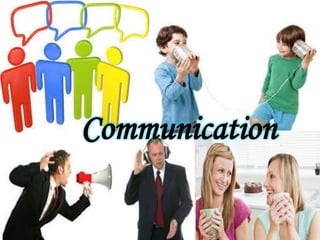
Communication
• Communication is best
thought of as the transfer of
information from one person
to another
Nature of Communication
• the existence of these four things
does not automatically guarantee
a successful communication. A
communication has only
succeeded when the information
given by the sender has been
received and understood by the
recipient.
Four things are required for
communication to take place. These are:
• A sender - the person giving out the
information;
• A message - the information being
communicated;
• A medium - the format in which the
information is being conveyed;
• A recipient - the person receiving the
information.
Means of Communication
• Physical communications;
• Visual communications;
• Aural communications;
• Written communications.
Physical Communications
• This category of
communication
includes such things as
a nudge, or a tap on the
shoulder. The limitation
of this type of
communication is that it
relies upon the
recipient being in close
proximity to the sender.
Another example would
be a mobile 'phone on
vibrate mode.
Visual communications
• can be thought of as all
forms of communication
that rely on the visual
perception of the recipient
(with the exception of
written communications,
which are described
separately below).
Examples of visual
communications are traffic
lights, semaphore, smoke
signals, and so on.
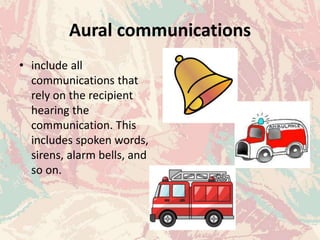
Aural communications
• include all
communications that
rely on the recipient
hearing the
communication. This
includes spoken words,
sirens, alarm bells, and
so on.
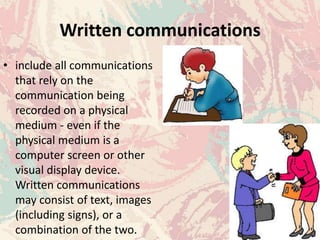
Written communications
• include all communications
that rely on the
communication being
recorded on a physical
medium - even if the
physical medium is a
computer screen or other
visual display device.
Written communications
may consist of text, images
(including signs), or a
combination of the two.

1 communication

  • 1.
    Learning Competencies: 1. Definescommunication 2. Explains the nature and process of communication 3. Differentiates the various models of communication 4. Distinguishes the unique feature(s) of one communication process from the other. 5. Explains why there is a breakdown of communication.
  • 2.
    6. Use variousstrategies in order to avoid communication breakdown. 7. Demonstrates sensitivity to the socio- cultural dimension of communication situation with focus on – Culture – Gender – Age – Social status – religion
  • 3.
    Content Standard The learner….. Understandsthe nature and elements of oral communication in context
  • 4.
    Performance Standard The learner….. Designsand performs effective controlled and uncontrolled oral communication activities based on context
  • 5.
  • 6.
  • 7.
    • Communication isbest thought of as the transfer of information from one person to another
  • 8.
    Nature of Communication •the existence of these four things does not automatically guarantee a successful communication. A communication has only succeeded when the information given by the sender has been received and understood by the recipient.
  • 9.
    Four things arerequired for communication to take place. These are: • A sender - the person giving out the information; • A message - the information being communicated; • A medium - the format in which the information is being conveyed; • A recipient - the person receiving the information.
  • 10.
    Means of Communication •Physical communications; • Visual communications; • Aural communications; • Written communications.
  • 11.
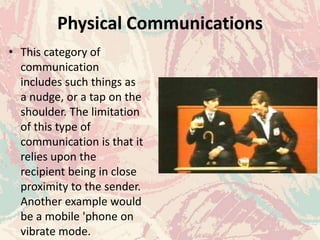
    Physical Communications • Thiscategory of communication includes such things as a nudge, or a tap on the shoulder. The limitation of this type of communication is that it relies upon the recipient being in close proximity to the sender. Another example would be a mobile 'phone on vibrate mode.
  • 12.
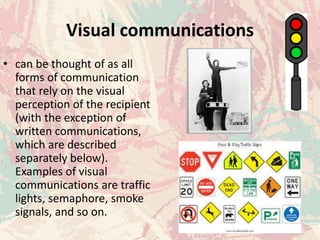
    Visual communications • canbe thought of as all forms of communication that rely on the visual perception of the recipient (with the exception of written communications, which are described separately below). Examples of visual communications are traffic lights, semaphore, smoke signals, and so on.
  • 13.
    Aural communications • includeall communications that rely on the recipient hearing the communication. This includes spoken words, sirens, alarm bells, and so on.
  • 14.
    Written communications • includeall communications that rely on the communication being recorded on a physical medium - even if the physical medium is a computer screen or other visual display device. Written communications may consist of text, images (including signs), or a combination of the two.