SNPIT & RC
PROJECT ON : EARTHQUAKE TIPS
SUBJECT : DESIGN OF REINFORCED CONCRETE STRUCTURES
CODE : 2170607
GUIDED BY : VISHAL PATEL
PREPARED BY PEN
 Sindhvad Kathan Pankajbhai 160490106087
Sengar Pratik Udaysingh 160490106082
Shukla Malhar Ashishbhai 160490106086
Patel Brijesh Jayantilal 170493106038
Patel Bhavika Nareshbhai 170493106029
WHAT ARE THE SSEISMIC EFFECTS ON
STRUCTURES?
 It includes,
1. Inertia forces in structures
2. Effects of deformations in structures
3. Horizontal and vertical shaking
4. Flow of inertia forces to foundations
1.INERTIA FORCES IN STRUCTURES
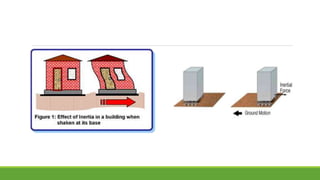
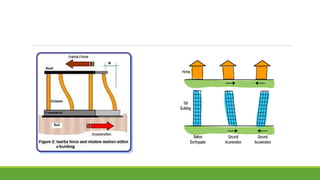
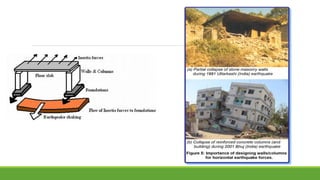
 The generation of inertia forces in a structure is one of the seismic influences that
detrimentally affect the structure.
 When an earthquake causes ground shaking, the base of the building would move but the roof
would be at rest. However, since the walls and columns are attached to it, the roof is dragged
with the base of the building.
 The tendency of the roof structure to remain at its original position is called inertia. The inertia
forces can cause shearing of the structure which can concentrate stresses on the weak walls or
joints in the structure resulting in failure or perhaps total collapse.
 Finally, more mass means higher inertia force that is why lighter buildings sustain the
earthquake shaking better.
2.EFFECTS OF DEFORMATIONS IN
STRUCTURES
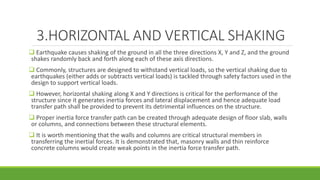
 When a building experiences earthquake and ground shaking occurs, the base of the building
moves with the ground shaking.
 However, the roof movement would be different from that of the base of the structure.
 This difference in the movement creates internal forces in columns which tend to return the
column to its original position. These internal forces are termed stiffness forces.
 The stiffness forces would be higher as the size of columns gets higher.
 The stiffness force in a column is the column stiffness times the relative displacement between
its ends.
3.HORIZONTAL AND VERTICAL SHAKING
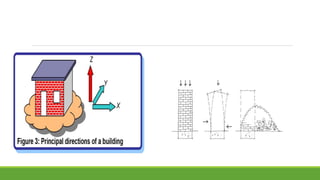
 Earthquake causes shaking of the ground in all the three directions X, Y and Z, and the ground
shakes randomly back and forth along each of these axis directions.
 Commonly, structures are designed to withstand vertical loads, so the vertical shaking due to
earthquakes (either adds or subtracts vertical loads) is tackled through safety factors used in the
design to support vertical loads.
 However, horizontal shaking along X and Y directions is critical for the performance of the
structure since it generates inertia forces and lateral displacement and hence adequate load
transfer path shall be provided to prevent its detrimental influences on the structure.
 Proper inertia force transfer path can be created through adequate design of floor slab, walls
or columns, and connections between these structural elements.
 It is worth mentioning that the walls and columns are critical structural members in
transferring the inertial forces. It is demonstrated that, masonry walls and thin reinforce
concrete columns would create weak points in the inertia force transfer path.
4.FLOW OF INERTIA FORCES TO
FOUNDATIONS
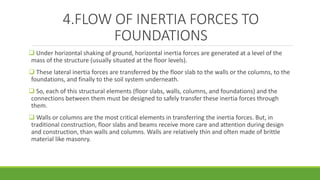
 Under horizontal shaking of ground, horizontal inertia forces are generated at a level of the
mass of the structure (usually situated at the floor levels).
 These lateral inertia forces are transferred by the floor slab to the walls or the columns, to the
foundations, and finally to the soil system underneath.
 So, each of this structural elements (floor slabs, walls, columns, and foundations) and the
connections between them must be designed to safely transfer these inertia forces through
them.
 Walls or columns are the most critical elements in transferring the inertia forces. But, in
traditional construction, floor slabs and beams receive more care and attention during design
and construction, than walls and columns. Walls are relatively thin and often made of brittle
material like masonry.
HOW ARCHITECTURAL FEATURES AFFECT
BUILDINGS DURING EARTHQUAKES?
 It includes ,
1. Size of the buildings
2. Horizontal layout of buildings
3. Vertical layout of buildings
4. Adjacency of buildings
IMPORTANCE OF ARCHITECTURAL
FEATURES
 The behaviour of the building during earthquakes depends critically on its overall shape, size
and geometry, in addition to how the earthquake forces are carried to the ground.
 Hence, at planning stage itself, architects and structural engineers must work together to
ensure that the unfavourable features are avoided and a good building configuration is chosen.
 Regarding the importance of building configuration, Henry Degenkolb said that “If we have a
poor configuration to start with, all the engineer can do is to provide a band-aid – improve a
basically poor solution as best as he can. Conversely, if we start-off with a good configuration
and reasonable framing system, even a poor engineer cannot harm its ultimate performance too
much.”
1.SIZE OF BUILDINGS
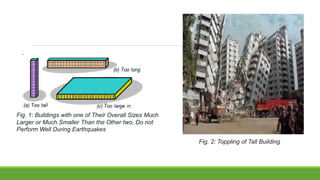
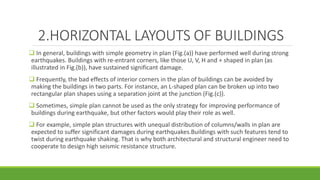
 In tall buildings with large height-to-base size ratio (as shown in fig.(a)), the horizontal
movement of the floors during ground shaking is large which detrimentally affect the stability of
a structure, and it increases overturn tendency.
 With regard to short but very long buildings (as in Fig.(b)), the damaging effects during
earthquake shaking are many.
 Additionally, in buildings with large plan area like warehouses (Fig.(c)), the horizontal seismic
forces can be excessive to be carried by columns and walls. So, the aforementioned sizes of
buildings are highly likely to show poor performance during earthquakes.
Fig. 1: Buildings with one of Their Overall Sizes Much
Larger or Much Smaller Than the Other two, Do not
Perform Well During Earthquakes
Fig. 2: Toppling of Tall Building
2.HORIZONTAL LAYOUTS OF BUILDINGS
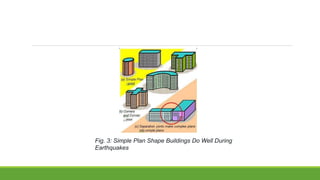
 In general, buildings with simple geometry in plan (Fig.(a)) have performed well during strong
earthquakes. Buildings with re-entrant corners, like those U, V, H and + shaped in plan (as
illustrated in Fig.(b)), have sustained significant damage.
 Frequently, the bad effects of interior corners in the plan of buildings can be avoided by
making the buildings in two parts. For instance, an L-shaped plan can be broken up into two
rectangular plan shapes using a separation joint at the junction (Fig.(c)).
 Sometimes, simple plan cannot be used as the only strategy for improving performance of
buildings during earthquake, but other factors would play their role as well.
 For example, simple plan structures with unequal distribution of columns/walls in plan are
expected to suffer significant damages during earthquakes.Buildings with such features tend to
twist during earthquake shaking. That is why both architectural and structural engineer need to
cooperate to design high seismic resistance structure.
Fig. 3: Simple Plan Shape Buildings Do Well During
Earthquakes
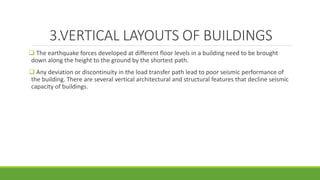
3.VERTICAL LAYOUTS OF BUILDINGS
 The earthquake forces developed at different floor levels in a building need to be brought
down along the height to the ground by the shortest path.
 Any deviation or discontinuity in the load transfer path lead to poor seismic performance of
the building. There are several vertical architectural and structural features that decline seismic
capacity of buildings.
(I) VERTICAL SETBACKS
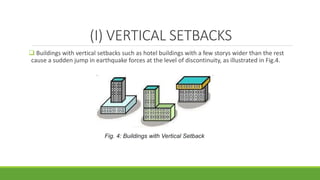
 Buildings with vertical setbacks such as hotel buildings with a few storys wider than the rest
cause a sudden jump in earthquake forces at the level of discontinuity, as illustrated in Fig.4.
Fig. 4: Buildings with Vertical Setback
(II)WEAK OR FLEXIBLE STOREY
 Buildings that have fewer columns or walls in a particular story or with unusually tall story as
shown in Fig.5, tend to damage or collapse which is initiated in that story.
Fig. 4: Buildings with Soft Storey
(III)UNEQUAL COLUMN HEIGHTS ALONG
SLOPES
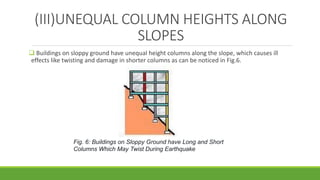
 Buildings on sloppy ground have unequal height columns along the slope, which causes ill
effects like twisting and damage in shorter columns as can be noticed in Fig.6.
Fig. 6: Buildings on Sloppy Ground have Long and Short
Columns Which May Twist During Earthquake
(IV)HANGING OR FLOATING COLUMNS
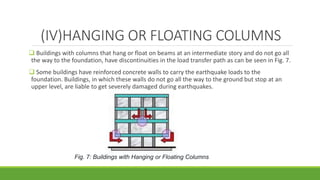
 Buildings with columns that hang or float on beams at an intermediate story and do not go all
the way to the foundation, have discontinuities in the load transfer path as can be seen in Fig. 7.
 Some buildings have reinforced concrete walls to carry the earthquake loads to the
foundation. Buildings, in which these walls do not go all the way to the ground but stop at an
upper level, are liable to get severely damaged during earthquakes.
Fig. 7: Buildings with Hanging or Floating Columns
4.ADJACENCY OF BUILDINGS
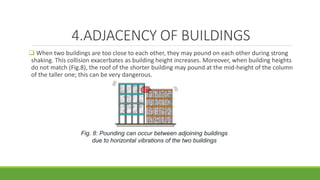
 When two buildings are too close to each other, they may pound on each other during strong
shaking. This collision exacerbates as building height increases. Moreover, when building heights
do not match (Fig.8), the roof of the shorter building may pound at the mid-height of the column
of the taller one; this can be very dangerous.
Fig. 8: Pounding can occur between adjoining buildings
due to horizontal vibrations of the two buildings
BUILDING DESIGN AND CODES
 Architectural features are detrimental to earthquake response of buildings should be avoided,
if not should be minimized.
 When irregular features are included in buildings, a considerably high level of engineering
effort is required in the structures design and yet the building may not be as good as one with
simple architectural features.
 Decision made at the planning stage on building configuration are more important, or are
known to have made greater difference, than accurate determination of code specified design
forces.
Thank You

Earthquake tips

  • 1.
    SNPIT & RC PROJECTON : EARTHQUAKE TIPS SUBJECT : DESIGN OF REINFORCED CONCRETE STRUCTURES CODE : 2170607 GUIDED BY : VISHAL PATEL
  • 2.
    PREPARED BY PEN Sindhvad Kathan Pankajbhai 160490106087 Sengar Pratik Udaysingh 160490106082 Shukla Malhar Ashishbhai 160490106086 Patel Brijesh Jayantilal 170493106038 Patel Bhavika Nareshbhai 170493106029
  • 3.
    WHAT ARE THESSEISMIC EFFECTS ON STRUCTURES?  It includes, 1. Inertia forces in structures 2. Effects of deformations in structures 3. Horizontal and vertical shaking 4. Flow of inertia forces to foundations
  • 4.
    1.INERTIA FORCES INSTRUCTURES  The generation of inertia forces in a structure is one of the seismic influences that detrimentally affect the structure.  When an earthquake causes ground shaking, the base of the building would move but the roof would be at rest. However, since the walls and columns are attached to it, the roof is dragged with the base of the building.  The tendency of the roof structure to remain at its original position is called inertia. The inertia forces can cause shearing of the structure which can concentrate stresses on the weak walls or joints in the structure resulting in failure or perhaps total collapse.  Finally, more mass means higher inertia force that is why lighter buildings sustain the earthquake shaking better.
  • 6.
    2.EFFECTS OF DEFORMATIONSIN STRUCTURES  When a building experiences earthquake and ground shaking occurs, the base of the building moves with the ground shaking.  However, the roof movement would be different from that of the base of the structure.  This difference in the movement creates internal forces in columns which tend to return the column to its original position. These internal forces are termed stiffness forces.  The stiffness forces would be higher as the size of columns gets higher.  The stiffness force in a column is the column stiffness times the relative displacement between its ends.
  • 8.
    3.HORIZONTAL AND VERTICALSHAKING  Earthquake causes shaking of the ground in all the three directions X, Y and Z, and the ground shakes randomly back and forth along each of these axis directions.  Commonly, structures are designed to withstand vertical loads, so the vertical shaking due to earthquakes (either adds or subtracts vertical loads) is tackled through safety factors used in the design to support vertical loads.  However, horizontal shaking along X and Y directions is critical for the performance of the structure since it generates inertia forces and lateral displacement and hence adequate load transfer path shall be provided to prevent its detrimental influences on the structure.  Proper inertia force transfer path can be created through adequate design of floor slab, walls or columns, and connections between these structural elements.  It is worth mentioning that the walls and columns are critical structural members in transferring the inertial forces. It is demonstrated that, masonry walls and thin reinforce concrete columns would create weak points in the inertia force transfer path.
  • 10.
    4.FLOW OF INERTIAFORCES TO FOUNDATIONS  Under horizontal shaking of ground, horizontal inertia forces are generated at a level of the mass of the structure (usually situated at the floor levels).  These lateral inertia forces are transferred by the floor slab to the walls or the columns, to the foundations, and finally to the soil system underneath.  So, each of this structural elements (floor slabs, walls, columns, and foundations) and the connections between them must be designed to safely transfer these inertia forces through them.  Walls or columns are the most critical elements in transferring the inertia forces. But, in traditional construction, floor slabs and beams receive more care and attention during design and construction, than walls and columns. Walls are relatively thin and often made of brittle material like masonry.
  • 12.
    HOW ARCHITECTURAL FEATURESAFFECT BUILDINGS DURING EARTHQUAKES?  It includes , 1. Size of the buildings 2. Horizontal layout of buildings 3. Vertical layout of buildings 4. Adjacency of buildings
  • 13.
    IMPORTANCE OF ARCHITECTURAL FEATURES The behaviour of the building during earthquakes depends critically on its overall shape, size and geometry, in addition to how the earthquake forces are carried to the ground.  Hence, at planning stage itself, architects and structural engineers must work together to ensure that the unfavourable features are avoided and a good building configuration is chosen.  Regarding the importance of building configuration, Henry Degenkolb said that “If we have a poor configuration to start with, all the engineer can do is to provide a band-aid – improve a basically poor solution as best as he can. Conversely, if we start-off with a good configuration and reasonable framing system, even a poor engineer cannot harm its ultimate performance too much.”
  • 14.
    1.SIZE OF BUILDINGS In tall buildings with large height-to-base size ratio (as shown in fig.(a)), the horizontal movement of the floors during ground shaking is large which detrimentally affect the stability of a structure, and it increases overturn tendency.  With regard to short but very long buildings (as in Fig.(b)), the damaging effects during earthquake shaking are many.  Additionally, in buildings with large plan area like warehouses (Fig.(c)), the horizontal seismic forces can be excessive to be carried by columns and walls. So, the aforementioned sizes of buildings are highly likely to show poor performance during earthquakes.
  • 15.
    Fig. 1: Buildingswith one of Their Overall Sizes Much Larger or Much Smaller Than the Other two, Do not Perform Well During Earthquakes Fig. 2: Toppling of Tall Building
  • 16.
    2.HORIZONTAL LAYOUTS OFBUILDINGS  In general, buildings with simple geometry in plan (Fig.(a)) have performed well during strong earthquakes. Buildings with re-entrant corners, like those U, V, H and + shaped in plan (as illustrated in Fig.(b)), have sustained significant damage.  Frequently, the bad effects of interior corners in the plan of buildings can be avoided by making the buildings in two parts. For instance, an L-shaped plan can be broken up into two rectangular plan shapes using a separation joint at the junction (Fig.(c)).  Sometimes, simple plan cannot be used as the only strategy for improving performance of buildings during earthquake, but other factors would play their role as well.  For example, simple plan structures with unequal distribution of columns/walls in plan are expected to suffer significant damages during earthquakes.Buildings with such features tend to twist during earthquake shaking. That is why both architectural and structural engineer need to cooperate to design high seismic resistance structure.
  • 17.
    Fig. 3: SimplePlan Shape Buildings Do Well During Earthquakes
  • 18.
    3.VERTICAL LAYOUTS OFBUILDINGS  The earthquake forces developed at different floor levels in a building need to be brought down along the height to the ground by the shortest path.  Any deviation or discontinuity in the load transfer path lead to poor seismic performance of the building. There are several vertical architectural and structural features that decline seismic capacity of buildings.
  • 19.
    (I) VERTICAL SETBACKS Buildings with vertical setbacks such as hotel buildings with a few storys wider than the rest cause a sudden jump in earthquake forces at the level of discontinuity, as illustrated in Fig.4. Fig. 4: Buildings with Vertical Setback
  • 20.
    (II)WEAK OR FLEXIBLESTOREY  Buildings that have fewer columns or walls in a particular story or with unusually tall story as shown in Fig.5, tend to damage or collapse which is initiated in that story. Fig. 4: Buildings with Soft Storey
  • 21.
    (III)UNEQUAL COLUMN HEIGHTSALONG SLOPES  Buildings on sloppy ground have unequal height columns along the slope, which causes ill effects like twisting and damage in shorter columns as can be noticed in Fig.6. Fig. 6: Buildings on Sloppy Ground have Long and Short Columns Which May Twist During Earthquake
  • 22.
    (IV)HANGING OR FLOATINGCOLUMNS  Buildings with columns that hang or float on beams at an intermediate story and do not go all the way to the foundation, have discontinuities in the load transfer path as can be seen in Fig. 7.  Some buildings have reinforced concrete walls to carry the earthquake loads to the foundation. Buildings, in which these walls do not go all the way to the ground but stop at an upper level, are liable to get severely damaged during earthquakes. Fig. 7: Buildings with Hanging or Floating Columns
  • 23.
    4.ADJACENCY OF BUILDINGS When two buildings are too close to each other, they may pound on each other during strong shaking. This collision exacerbates as building height increases. Moreover, when building heights do not match (Fig.8), the roof of the shorter building may pound at the mid-height of the column of the taller one; this can be very dangerous. Fig. 8: Pounding can occur between adjoining buildings due to horizontal vibrations of the two buildings
  • 24.
    BUILDING DESIGN ANDCODES  Architectural features are detrimental to earthquake response of buildings should be avoided, if not should be minimized.  When irregular features are included in buildings, a considerably high level of engineering effort is required in the structures design and yet the building may not be as good as one with simple architectural features.  Decision made at the planning stage on building configuration are more important, or are known to have made greater difference, than accurate determination of code specified design forces.
  • 25.