1 
Introduction to Communication 
OBJECTIVES 
By the end of this unit you should be able to: 
 Define the term communication 
 Explain the key stages in the communication cycle 
 Distinguish between the different levels of communication 
 Describe the different methods of communication 
 Identify and explain the various models of communication 
 Give examples of barriers to communication 
STAGES IN THE COMMUNICATION CYCLE 
(The Communication Process) 
Introduction 
The communication process involves a sender, a receiver and the message to be sent. Effective 
communication occurs when the receiver understands/interprets the message in the way the sender 
intended. However, External things might occur during this transfer, which could distort the message 
and prevent the receiver from receiving the original message that was meant by the sender. In addi-tion 
to these externalities, both the sender and the receiver do something interesting. The senders 
do not just give a universal message that is understandable by everybody. They encode it. They add 
certain things and state things in a certain way. 
On the other side, the receiver of the message has to decode, to a certain extent, what the sender 
meant to say. As well as the words, this includes the tones and certain gestures and indications that 
are not expressed verbally. This often results in distortion of the message. Our experience is part of 
this encoding-decoding process. It can affect the intention of the message sent, based on past 
experiences involving similar cases. The meaning the sender intends does not necessarily match the 
impact on the receiver. 
Stages 
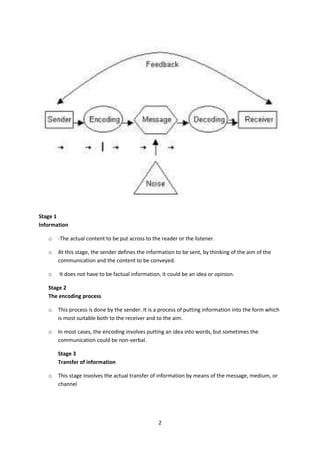
Communication specialists have developed a model to explain how the communication process 
works, known as the communication cycle.
2 
Stage 1 
Information 
o -The actual content to be put across to the reader or the listener. 
o At this stage, the sender defines the information to be sent, by thinking of the aim of the 
communication and the content to be conveyed. 
o It does not have to be factual information, it could be an idea or opinion. 
Stage 2 
The encoding process 
o This process is done by the sender. It is a process of putting information into the form which 
is most suitable both to the receiver and to the aim. 
o In most cases, the encoding involves putting an idea into words, but sometimes the 
communication could be non-verbal. 
Stage 3 
Transfer of information 
o This stage involves the actual transfer of information by means of the message, medium, or 
channel
3 
Stage 4 
Taking in of message 
o At this point the receiver takes in the message by, for example, reading a letter, listening to 
a speech or looking at an educational television programme. 
Stage 5 
Decoding 
o This is the process by which the recipient/receiver interprets the message he/she has been 
given in order to obtain his/her own idea of the information it conveys. 
o This may not be the same as the information which the sender intended to convey. 
o This may be a result of distortion, if the sender encodes the idea wrongly, ambiguously, or in 
terms which the receiver understands according to his/her own experience rather than that 
of the sender’s. 
Stage 6 
Feedback 
o Feedback is the name given to the information the sender derives from the receiver’s first 
reaction to the message. 
o The sender should watch for feedback to see whether or not the message has been 
understood. 
o Feedback could take the form of either verbal or non-verbal responses, e.g. nodding or 
smiling to show agreement, or adopting a posture which reflects active listening. 
o It refers to the indirect reactions of the recipient, rather than to any message sent in return. 
Motivation 
o Although it is not shown in the diagram, motivation is a crucial element in communication. It 
is the urge or desire to achieve a purpose, alter a given situation, or satisfy need. 
o If Motivation is not present, the communication cycle is adversely affected. 
Conclusion 
o These are the principle elements in the cycle of communication. They are completed when 
the process is reversed and the receiver/recipient communicates in response to the sender’s 
original message. 
o Although the cycle can be effectively accomplished by effective communicators, any system 
which involves the exchange of information has to overcome many barriers.
4 
Methods of Communication 
Verbal communication – When a message is put across through speech. The message can be 
sent to an individual, a team or a group. 
Non-verbal communication - is divided into six types: Body language, physical 
characteristics and appearance, voice, space, environment, time 
Silence can be a type of non-verbal communication. 
Written communication provides a record for the future. Written communication can be 
studied, reflected on, and absorbed at the receiver’s own pace. 
Visual communication is the visual display of information, like, topography, photography, 
signs, symbols and designs. Television and video clips are the electronic form of visual 
communication 
Levels of Communication 
The levels of communication are the following: 
1. Intrapersonal Communication 
2. Interpersonal Communication 
3. Group Communication 
4. Public Communication 
1) INTRAPERSONAL COMMUNICATION 
Intrapersonal communication is language use or thought internal to the communicator. 
o It is the active internal involvement of the individual in symbolic processing of messages. The 
individual becomes his or her own sender and receiver, providing feedback to him or herself 
in an ongoing internal process. 
o Although successful communication is generally defined as being between two or more 
individuals, issues concerning the useful nature of communicating with oneself have made 
some argue that this definition is too narrow. 
Intrapersonal communication can encompass: 
o Day-dreaming 
o Nocturnal dreaming 
o Speaking aloud (talking to oneself), reading aloud, repeating what one hears. This is 
considered normal, and the extent to which it occurs varies from person to person. The time 
when there should be concern is when talking to oneself occurs outside of socially 
acceptable situations.
5 
o Writing one's thoughts or observations 
o Making gestures while thinking 
o Sense-making e.g. interpreting maps, texts, signs, and symbols 
o Interpreting non-verbal communication e.g. gestures, eye contact 
o Communication between body parts; e.g. "My stomach is telling me it's time for lunch." 
2.) INTERPERSONAL COMMUNICATION 
Interpersonal communication is defined by communication scholars in numerous ways, 
though most definitions involve participants who are interdependent on one another, or 
who have a shared history. 
Communication channels are the medium chosen to convey the message from sender to 
receiver. Communication channels can be categorized into two main categories: Direct and 
Indirect channels of communication. 
Direct channels are those that are obvious and can be easily recognized by the receiver. 
They are also under direct control of the sender. In this category are the verbal and non-verbal 
channels of communication. 
Indirect channels are those channels that are usually recognized subconsciously by the 
receiver, and not under direct control of the sender. This includes kinesics or body language, 
that reflects the inner emotions and motivations rather than the actual delivered message. 
GROUP COMMUNICATION 
Group communication refers to the nature of communication that occurs in groups that are 
between 3 and 12 individuals. 
Small group communication generally takes place in a context that mixes interpersonal 
communication interactions with social clustering. 
4.) PUBLIC COMMUNICATION 
Public communication is at the heart of our economy, society, and politics. 
Studios use it to promote their films. Politicians use it to get elected. Businesses use it to 
burnish their image. Advocates use it to promote social causes. 
It is a field built on ideas and images, persuasion and information, strategy and tactics. 
No policy or product can succeed without a smart message targeted to the right audience in 
creative and innovative ways.
Four Principles of Interpersonal Communication 
These principles underlie the workings in real life of interpersonal communication. They are basic to 
communication. We cannot ignore them. 
1. Interpersonal communication is inescapable 
o We cannot not communicate. The very attempt not to communicate communicates 
6 
something. 
o Through not only words, but through tone of voice and through gesture, posture, facial 
expression, etc., we constantly communicate to those around us. Through these channels, 
we constantly receive communication from others. 
o Remember a basic principle of communication in general: people are not mind readers. 
Another way to put this is: people judge you by your behavior, not your intent. 
2. Interpersonal communication is irreversible 
o You cannot really take back something once it has been said. The effect must inevitably 
remain. 
o . A Russian proverb says, "Once a word goes out of your mouth, you can never swallow it 
again." 
3. Interpersonal communication is complicated 
o No form of communication is simple. 
o Because of the number of variables involved, even simple requests are extremely complex. 
4. Interpersonal communication is contextual 
In other words, communication does not happen in isolation. There is: 
Psychological context, which is who you are and what you bring to the interaction. Your 
needs, desires, values, personality, etc., all form the psychological context. ("You" here 
refers to both participants in the interaction.) 
Relational context, which concerns your reactions to the other person - the "mix." 
Situational context deals with the psycho-social "where" you are communicating. An 
interaction that takes place in a classroom will be very different from one that takes place in 
a bar. 
Environmental context deals with the physical "where" you are communicating. Furniture, 
location, noise level, temperature, season, time of day, all are examples of factors in the 
environmental context. 
Cultural context includes all the learned behaviors and rules that affect the interaction.
e.g. If you come from a culture (foreign or within your own country) where it is considered 
rude to make long, direct eye contact, you will out of politeness avoid eye contact. If the 
other person comes from a culture where long, direct eye contact signals trustworthiness, 
then we have in the cultural context a basis for misunderstanding. 
7

Introduction to communication

  • 1.
    1 Introduction toCommunication OBJECTIVES By the end of this unit you should be able to:  Define the term communication  Explain the key stages in the communication cycle  Distinguish between the different levels of communication  Describe the different methods of communication  Identify and explain the various models of communication  Give examples of barriers to communication STAGES IN THE COMMUNICATION CYCLE (The Communication Process) Introduction The communication process involves a sender, a receiver and the message to be sent. Effective communication occurs when the receiver understands/interprets the message in the way the sender intended. However, External things might occur during this transfer, which could distort the message and prevent the receiver from receiving the original message that was meant by the sender. In addi-tion to these externalities, both the sender and the receiver do something interesting. The senders do not just give a universal message that is understandable by everybody. They encode it. They add certain things and state things in a certain way. On the other side, the receiver of the message has to decode, to a certain extent, what the sender meant to say. As well as the words, this includes the tones and certain gestures and indications that are not expressed verbally. This often results in distortion of the message. Our experience is part of this encoding-decoding process. It can affect the intention of the message sent, based on past experiences involving similar cases. The meaning the sender intends does not necessarily match the impact on the receiver. Stages Communication specialists have developed a model to explain how the communication process works, known as the communication cycle.
  • 2.
    2 Stage 1 Information o -The actual content to be put across to the reader or the listener. o At this stage, the sender defines the information to be sent, by thinking of the aim of the communication and the content to be conveyed. o It does not have to be factual information, it could be an idea or opinion. Stage 2 The encoding process o This process is done by the sender. It is a process of putting information into the form which is most suitable both to the receiver and to the aim. o In most cases, the encoding involves putting an idea into words, but sometimes the communication could be non-verbal. Stage 3 Transfer of information o This stage involves the actual transfer of information by means of the message, medium, or channel
  • 3.
    3 Stage 4 Taking in of message o At this point the receiver takes in the message by, for example, reading a letter, listening to a speech or looking at an educational television programme. Stage 5 Decoding o This is the process by which the recipient/receiver interprets the message he/she has been given in order to obtain his/her own idea of the information it conveys. o This may not be the same as the information which the sender intended to convey. o This may be a result of distortion, if the sender encodes the idea wrongly, ambiguously, or in terms which the receiver understands according to his/her own experience rather than that of the sender’s. Stage 6 Feedback o Feedback is the name given to the information the sender derives from the receiver’s first reaction to the message. o The sender should watch for feedback to see whether or not the message has been understood. o Feedback could take the form of either verbal or non-verbal responses, e.g. nodding or smiling to show agreement, or adopting a posture which reflects active listening. o It refers to the indirect reactions of the recipient, rather than to any message sent in return. Motivation o Although it is not shown in the diagram, motivation is a crucial element in communication. It is the urge or desire to achieve a purpose, alter a given situation, or satisfy need. o If Motivation is not present, the communication cycle is adversely affected. Conclusion o These are the principle elements in the cycle of communication. They are completed when the process is reversed and the receiver/recipient communicates in response to the sender’s original message. o Although the cycle can be effectively accomplished by effective communicators, any system which involves the exchange of information has to overcome many barriers.
  • 4.
    4 Methods ofCommunication Verbal communication – When a message is put across through speech. The message can be sent to an individual, a team or a group. Non-verbal communication - is divided into six types: Body language, physical characteristics and appearance, voice, space, environment, time Silence can be a type of non-verbal communication. Written communication provides a record for the future. Written communication can be studied, reflected on, and absorbed at the receiver’s own pace. Visual communication is the visual display of information, like, topography, photography, signs, symbols and designs. Television and video clips are the electronic form of visual communication Levels of Communication The levels of communication are the following: 1. Intrapersonal Communication 2. Interpersonal Communication 3. Group Communication 4. Public Communication 1) INTRAPERSONAL COMMUNICATION Intrapersonal communication is language use or thought internal to the communicator. o It is the active internal involvement of the individual in symbolic processing of messages. The individual becomes his or her own sender and receiver, providing feedback to him or herself in an ongoing internal process. o Although successful communication is generally defined as being between two or more individuals, issues concerning the useful nature of communicating with oneself have made some argue that this definition is too narrow. Intrapersonal communication can encompass: o Day-dreaming o Nocturnal dreaming o Speaking aloud (talking to oneself), reading aloud, repeating what one hears. This is considered normal, and the extent to which it occurs varies from person to person. The time when there should be concern is when talking to oneself occurs outside of socially acceptable situations.
  • 5.
    5 o Writingone's thoughts or observations o Making gestures while thinking o Sense-making e.g. interpreting maps, texts, signs, and symbols o Interpreting non-verbal communication e.g. gestures, eye contact o Communication between body parts; e.g. "My stomach is telling me it's time for lunch." 2.) INTERPERSONAL COMMUNICATION Interpersonal communication is defined by communication scholars in numerous ways, though most definitions involve participants who are interdependent on one another, or who have a shared history. Communication channels are the medium chosen to convey the message from sender to receiver. Communication channels can be categorized into two main categories: Direct and Indirect channels of communication. Direct channels are those that are obvious and can be easily recognized by the receiver. They are also under direct control of the sender. In this category are the verbal and non-verbal channels of communication. Indirect channels are those channels that are usually recognized subconsciously by the receiver, and not under direct control of the sender. This includes kinesics or body language, that reflects the inner emotions and motivations rather than the actual delivered message. GROUP COMMUNICATION Group communication refers to the nature of communication that occurs in groups that are between 3 and 12 individuals. Small group communication generally takes place in a context that mixes interpersonal communication interactions with social clustering. 4.) PUBLIC COMMUNICATION Public communication is at the heart of our economy, society, and politics. Studios use it to promote their films. Politicians use it to get elected. Businesses use it to burnish their image. Advocates use it to promote social causes. It is a field built on ideas and images, persuasion and information, strategy and tactics. No policy or product can succeed without a smart message targeted to the right audience in creative and innovative ways.
  • 6.
    Four Principles ofInterpersonal Communication These principles underlie the workings in real life of interpersonal communication. They are basic to communication. We cannot ignore them. 1. Interpersonal communication is inescapable o We cannot not communicate. The very attempt not to communicate communicates 6 something. o Through not only words, but through tone of voice and through gesture, posture, facial expression, etc., we constantly communicate to those around us. Through these channels, we constantly receive communication from others. o Remember a basic principle of communication in general: people are not mind readers. Another way to put this is: people judge you by your behavior, not your intent. 2. Interpersonal communication is irreversible o You cannot really take back something once it has been said. The effect must inevitably remain. o . A Russian proverb says, "Once a word goes out of your mouth, you can never swallow it again." 3. Interpersonal communication is complicated o No form of communication is simple. o Because of the number of variables involved, even simple requests are extremely complex. 4. Interpersonal communication is contextual In other words, communication does not happen in isolation. There is: Psychological context, which is who you are and what you bring to the interaction. Your needs, desires, values, personality, etc., all form the psychological context. ("You" here refers to both participants in the interaction.) Relational context, which concerns your reactions to the other person - the "mix." Situational context deals with the psycho-social "where" you are communicating. An interaction that takes place in a classroom will be very different from one that takes place in a bar. Environmental context deals with the physical "where" you are communicating. Furniture, location, noise level, temperature, season, time of day, all are examples of factors in the environmental context. Cultural context includes all the learned behaviors and rules that affect the interaction.
  • 7.
    e.g. If youcome from a culture (foreign or within your own country) where it is considered rude to make long, direct eye contact, you will out of politeness avoid eye contact. If the other person comes from a culture where long, direct eye contact signals trustworthiness, then we have in the cultural context a basis for misunderstanding. 7