 MOHAMMAD YOUSIF
 ABDUL NOOR
 DEPARTMENT OF MEDIA AND MASS COMMUNICATION UNIVERSITY OF LAHORE
 SUBJECT INTRODUCTION TO COMMUNICATION STUDIES
 ASSIGNMENT OF COMMUNICATION PROCESS
 DATE OF SUBMISSION 28-10-2015
INTRODUCTION
Communication (from Latin communicare,
meaning "to share" is the purposeful activity
of information exchange between two or
more participants in order to convey or
receive the intended meanings through a
shared system of signs and semiotic rule. The
different categories of communication are:
• Spoken or Verbal Communication: face-
to-face, telephone, radio or television
and other media.
• Non-Verbal Communication: body
language, gestures, how we dress or act -
even our scent.
• Written Communication: letters, e-mails,
books, magazines, the Internet or via
other media.
• Visualizations: graphs and charts, maps,
logos and other visualizations can
communicate messages.
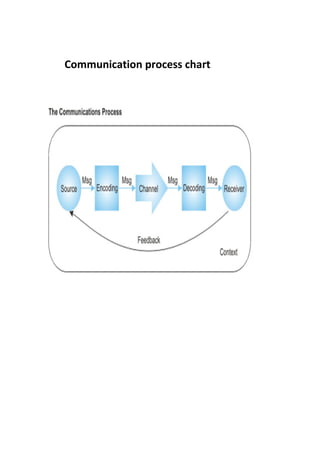
Communication process chart
ELEMENTS OF COMMUNICATION PROCESS
SENDER:> The sender is a person who
encodes and sends the message to the
expected receiver through an appropriate
channel.
A sender is the source of the message that is
generated to be delivered to the receiver
after appropriate stimulus from the referent.
Message:> The message is the content of
communication or may contain
verbal,nonverbal or symbolic language.
CHANNEL:> A channel is a medium through
which a message is sent or received between
two or more people.
Several channels can be used to send or
receive the message.
Example:> seeing, hearing, touching,
smelling and tasting.
While selecting channels of communication,
several factors must be considered:
availability of channels, purpose, suitability,
types of receivers, types of message,
preference of sender and receivers,
communication skills of the sender, cost etc.
CLASSIFICATIONS OF CHANNELS OF
COMMUNICATION:>
VISUAL CHANNEL:> facial expression, body
language, posture, gestures, pictures, and
written words,electronic mails, mass media,
etc.
AUDITORY CHANNEL:> spoken words,
sounds, telephone or mobile
communications, deleivering audio
content(radio, voicemail), etc.
TACTILE CHANNEL:> touch sensations,
therapeutic touch, etc.
COMBINED CHANNEL:> Audiovisual media,
consoling a person with touch and spoken
words.
DECODING:> Decoding is the process of
converting code into plain text or any format
that is useful for subsequent processes.
Decoding is the reverse of encoding. It
converts encoded data communication
transmissions and files to their original
states.
RECEIVER:> The receiver is the destination of
the message. The receiver's task is to
interpret the sender's message, both verbal
and nonverbal, with as little distortion as
possible. The process of interpreting the
message is known as decoding. Because
words and nonverbal signals have different
meanings to different people, countless
problems can occur at this point in the
communication process:
- The sender inadequately encodes the
original message with words not present in
the receiver's vocabulary; ambiguous,
nonspecific ideas;
FEEDBACK:> The observation of the
receiver’s response is called feedback. In
other words, the part of the receiver’s
response communicated back to the sender
is called feedback. Actually it is the amount
of response of the receiver that reaches to
the sender. It enables the sender to evaluate
the effectiveness of the message.
Feedback can be conveyed both verbally and
nonverbally.
CONCLUSION:> In my conclusion,
communication is not just words it is a
mixture of tone and body language. You can
effectively utilize your voice tone and body
language to convey your message across. It is
often advised to establish eye to eye contact
wherever possible rather than other forms of
indirect communication. Not only for this
some time you send wrong message just only
one word also will make you lose money or
harm people in business. So that, in the
business ways communication is very
important sometimes not only business ways
when u talk with people also will spoil your
morality.In my conclusion, communication is
not just words it is a mixture of tone and
body language. You can effectively utilize
your voice tone and body language to convey
your message across. It is often advised to
establish eye to eye contact wherever
possible rather than other forms of indirect
communication. Not only for this some time
you send wrong message just only one word
also will make you lose money or harm
people in business. So that, in the business
ways communication is very important
sometimes not only business ways when u
talk with people also will spoil your morality.
BARRIERS IN COMMUNICATION PROCESS
The use of jargon. Over-complicated, unfamiliar and/or
technical terms.
Emotional barriers and taboos. Some people may find it
difficult to express their emotions and some topics may be
completely 'off-limits' or taboo.
Lack of attention, interest, distractions, or irrelevance to the
receiver.
Differences in perception and viewpoint.
Physical disabilities such as hearing problems or speech
difficulties.
Physical barriers to non-verbal communication. Not
being able to see the non-verbal cues, gestures, posture and
general body language can make communication less
effective.
Language differences and the difficulty in understanding
unfamiliar accents.
Expectations and prejudices which may lead to false
assumptions or stereotyping. People often hear what they
expect to hear rather than what is actually said and jump to
incorrect conclusions.
Cultural differences. The norms of social interaction vary
greatly in different cultures, as do the way in which emotions
are expressed. For example, the concept of personal space
varies between cultures and between different social settings.
COMMUNICATION PROCESS IN PRACTICAL
Lecture delivering of a teacher in class
example:
In this teacher is source the (SENDER) of
message and the (message) is that lecture
like the subject of cinema, in this the
medium is that (CLASS) in which the lecture
is being delivered, in this the (BARRIERS) can
be the class environment like lights and the
temperature of class and language barrier
like most students can not understand
English, message is (encoded) by teacher in
the form of lecture now the (receiver)
students receives the message by their
teacher and the give (FEEDBACK) in the form
of answers asked by teacher during lecture.

Communication process with practical example

  • 2.
     MOHAMMAD YOUSIF ABDUL NOOR  DEPARTMENT OF MEDIA AND MASS COMMUNICATION UNIVERSITY OF LAHORE  SUBJECT INTRODUCTION TO COMMUNICATION STUDIES  ASSIGNMENT OF COMMUNICATION PROCESS  DATE OF SUBMISSION 28-10-2015
  • 3.
    INTRODUCTION Communication (from Latincommunicare, meaning "to share" is the purposeful activity of information exchange between two or more participants in order to convey or receive the intended meanings through a shared system of signs and semiotic rule. The different categories of communication are: • Spoken or Verbal Communication: face- to-face, telephone, radio or television and other media. • Non-Verbal Communication: body language, gestures, how we dress or act - even our scent. • Written Communication: letters, e-mails, books, magazines, the Internet or via other media. • Visualizations: graphs and charts, maps, logos and other visualizations can communicate messages.
  • 4.
  • 5.
    ELEMENTS OF COMMUNICATIONPROCESS SENDER:> The sender is a person who encodes and sends the message to the expected receiver through an appropriate channel. A sender is the source of the message that is generated to be delivered to the receiver after appropriate stimulus from the referent. Message:> The message is the content of communication or may contain verbal,nonverbal or symbolic language. CHANNEL:> A channel is a medium through which a message is sent or received between
  • 6.
    two or morepeople. Several channels can be used to send or receive the message. Example:> seeing, hearing, touching, smelling and tasting. While selecting channels of communication, several factors must be considered: availability of channels, purpose, suitability, types of receivers, types of message, preference of sender and receivers, communication skills of the sender, cost etc. CLASSIFICATIONS OF CHANNELS OF COMMUNICATION:> VISUAL CHANNEL:> facial expression, body language, posture, gestures, pictures, and written words,electronic mails, mass media, etc. AUDITORY CHANNEL:> spoken words, sounds, telephone or mobile
  • 7.
    communications, deleivering audio content(radio,voicemail), etc. TACTILE CHANNEL:> touch sensations, therapeutic touch, etc. COMBINED CHANNEL:> Audiovisual media, consoling a person with touch and spoken words. DECODING:> Decoding is the process of converting code into plain text or any format that is useful for subsequent processes. Decoding is the reverse of encoding. It converts encoded data communication
  • 8.
    transmissions and filesto their original states. RECEIVER:> The receiver is the destination of the message. The receiver's task is to interpret the sender's message, both verbal and nonverbal, with as little distortion as possible. The process of interpreting the message is known as decoding. Because words and nonverbal signals have different meanings to different people, countless problems can occur at this point in the communication process: - The sender inadequately encodes the original message with words not present in the receiver's vocabulary; ambiguous, nonspecific ideas; FEEDBACK:> The observation of the receiver’s response is called feedback. In other words, the part of the receiver’s
  • 9.
    response communicated backto the sender is called feedback. Actually it is the amount of response of the receiver that reaches to the sender. It enables the sender to evaluate the effectiveness of the message. Feedback can be conveyed both verbally and nonverbally. CONCLUSION:> In my conclusion, communication is not just words it is a mixture of tone and body language. You can effectively utilize your voice tone and body language to convey your message across. It is often advised to establish eye to eye contact wherever possible rather than other forms of indirect communication. Not only for this some time you send wrong message just only one word also will make you lose money or harm people in business. So that, in the business ways communication is very important sometimes not only business ways
  • 10.
    when u talkwith people also will spoil your morality.In my conclusion, communication is not just words it is a mixture of tone and body language. You can effectively utilize your voice tone and body language to convey your message across. It is often advised to establish eye to eye contact wherever possible rather than other forms of indirect communication. Not only for this some time you send wrong message just only one word also will make you lose money or harm people in business. So that, in the business ways communication is very important sometimes not only business ways when u talk with people also will spoil your morality. BARRIERS IN COMMUNICATION PROCESS
  • 11.
    The use ofjargon. Over-complicated, unfamiliar and/or technical terms. Emotional barriers and taboos. Some people may find it difficult to express their emotions and some topics may be completely 'off-limits' or taboo. Lack of attention, interest, distractions, or irrelevance to the receiver. Differences in perception and viewpoint. Physical disabilities such as hearing problems or speech difficulties. Physical barriers to non-verbal communication. Not being able to see the non-verbal cues, gestures, posture and general body language can make communication less effective. Language differences and the difficulty in understanding unfamiliar accents. Expectations and prejudices which may lead to false assumptions or stereotyping. People often hear what they expect to hear rather than what is actually said and jump to
  • 12.
    incorrect conclusions. Cultural differences.The norms of social interaction vary greatly in different cultures, as do the way in which emotions are expressed. For example, the concept of personal space varies between cultures and between different social settings. COMMUNICATION PROCESS IN PRACTICAL Lecture delivering of a teacher in class example: In this teacher is source the (SENDER) of message and the (message) is that lecture
  • 13.
    like the subjectof cinema, in this the medium is that (CLASS) in which the lecture is being delivered, in this the (BARRIERS) can be the class environment like lights and the temperature of class and language barrier like most students can not understand English, message is (encoded) by teacher in the form of lecture now the (receiver) students receives the message by their teacher and the give (FEEDBACK) in the form of answers asked by teacher during lecture.