Communication
Copyright © 2005 by South-Western, a division of Thomson Learning. All rights reserved.
2
The word ‘communication’ is derived from the Latin word ‘communis’
which means common.
“Communication in its simplest form is conveying of information from
one person to another.”-Hudson
“Communication refers to transference and understanding of meaning.”-
Stephen P. Robbings
Also communication can be considered as the transfer of information from a
sender to a receiver with the information being understood by the receiver.
Thus communication not only involves sending of a message by one person.
It also involves listening, interpreting are responding by the receiver.
Definition of CommunicationDefinition of Communication
Copyright © 2005 by South-Western, a division of Thomson Learning. All rights reserved.
3
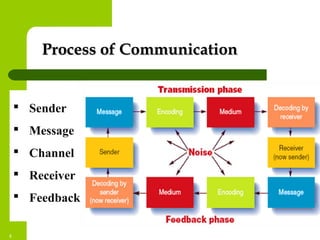
 Sender
 Message
 Channel
 Receiver
 Feedback
Process of CommunicationProcess of Communication
Copyright © 2005 by South-Western, a division of Thomson Learning. All rights reserved.
4
Importance of CommunicationImportance of Communication
• It helps in achieving coordination.
• It helps in smooth working of the organization.
• It increases managerial efficiency.
• It helps in faster decision making.
• It helps in maintaining Industrial peace.
• It helps in the recruitment process.
• It helps employees to perform effectively and efficiently.
• It helps in teaching employees about personal safety.
• It helps in projecting the image of the enterprise.
• It helps managers in performing their function.
Copyright © 2005 by South-Western, a division of Thomson Learning. All rights reserved.
5
Types of CommunicationTypes of Communication
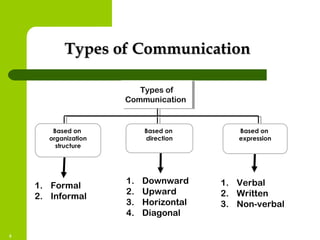
Types of
Communication
Types of
Communication
Based on
organization
structure
Based on
direction
Based on
expression
1. Formal
2. Informal
1. Downward
2. Upward
3. Horizontal
4. Diagonal
1. Verbal
2. Written
3. Non-verbal
Copyright © 2005 by South-Western, a division of Thomson Learning. All rights reserved.
6
Channel
Feedback Loop
Based on organization structureBased on organization structure
1. Formal communication :
This type of communication channel is established formally by the
management and this is used for the transmission of official messages
within or outside the organisation.
2. Informal communication :
If a communication takes place on the basis of informal or social
relations among the individuals in organisations, it is known as informal
communication. Here the communication takes place between different
individuals across different sections and it is also known as grapevine.
Copyright © 2005 by South-Western, a division of Thomson Learning. All rights reserved.
7
Based on directionBased on direction
1. Downward communication :
It denotes the flow of information from higher level to lower level.
Orders, policies and instructions are the example.
2. Upward communication :
If a communication flows from lower level to higher level it is called as
upward communication. Examples are reports, suggestions, proposals,
reactions of workers etc.
Copyright © 2005 by South-Western, a division of Thomson Learning. All rights reserved.
8
Based on directionBased on direction
3. Horizontal communication :
When communication takes place among the subordinates who are
working at the same level, it is called as horizontal communication. It
facilitates coordination among people working at the same level and
is informal in nature.
4. Diagonal communication :
It refers to the communication which cuts across all direction in an
organisation. For example sales manager interacts with production
personnel in charge of product planning.
Copyright © 2005 by South-Western, a division of Thomson Learning. All rights reserved.
9
Based on expressionBased on expression
1. Verbal communication :
It refers to the form of communication in which message is transmitted
verbally. Communication is done by word of mouth and a piece of writing.
In verbal communication remember the acronym “KISS”KISS” (keep it short and
simple).
It includes face-to-face conversations, speech, telephonic conversation, video,
radio, television, voice over internet.
Limitations of verbal communication:
In face-to-face discussion, user is unable to deeply think about what he is
delivering, so this can be counted as a fault.
Copyright © 2005 by South-Western, a division of Thomson Learning. All rights reserved.
10
2. Written communication :
In written communication, written signs or symbols are used to communicate.
Written Communication is most common form of communication being used
in business.
It includes statement, circulars, letters, report and manual.
Messages can be edited and revised. It provide record and backup.
A written message enables receiver to fully understand it and send appropriate
feedback.
Limitations of verbal communication:
Written communication doesn’t bring instant feedback. It is time consuming,
lack of personal touch and no secrecy.
Based on expressionBased on expression
Copyright © 2005 by South-Western, a division of Thomson Learning. All rights reserved.
11
Based on expressionBased on expression
3. Non-verbal communication :
Nonverbal communication is the sending or receiving of wordless messages.
Such as gesture, body language, posture, tone of voice or facial expressions,
is called nonverbal communication.
Nonverbal communication is all about the body language of speaker.
Nonverbal communication have the following three elements –
Appearance :
Speaker – clothing, hairstyle, neatness, use of cosmetics
Surrounding – room size, lighting, decorations, furnishings.
Body Language :
Facial expressions, gestures, postures.
Sounds :
Voice Tone, Volume, Speech rate.
Copyright © 2005 by South-Western, a division of Thomson Learning. All rights reserved.
12
Source: Adapted from Richard L. Daft and Richard M. Steers, Organizations: A Micro/Macro Approach, 538. Copyright © 1986 by Scott, and Company. Used by
permission.
Guidelines forGuidelines for
Effective CommunicationEffective Communication
Effective communication is the responsibility of all the individuals in the organisation
and all should work towards a common objective. The following guidelines will help in
improving the communication.
 Simple language to be used in the communication process.
 There should not be any ambiguity in communication.
 Proper medium of communication has to be used.
 Select the important facts and figures to support your message.
 Identify the key points in your message and arrange them in order.
 Choose a style (facial expression, body stance and articulation) to express your
message.
 Take feedback while delivering the message and adjust the message, if necessary.
 For a communication to be effective, right climate should exist in the organisation.
 Training to be given to communication for making communication effective.
 Remedial action has to be taken in line with the message.
Copyright © 2005 by South-Western, a division of Thomson Learning. All rights reserved.
13
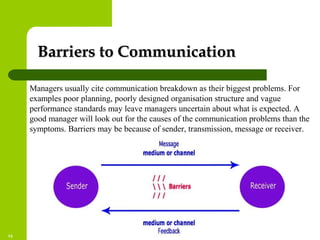
Barriers to CommunicationBarriers to Communication
Managers usually cite communication breakdown as their biggest problems. For
examples poor planning, poorly designed organisation structure and vague
performance standards may leave managers uncertain about what is expected. A
good manager will look out for the causes of the communication problems than the
symptoms. Barriers may be because of sender, transmission, message or receiver.
Copyright © 2005 by South-Western, a division of Thomson Learning. All rights reserved.
14
The communicationThe communication
barriers are discussed belowbarriers are discussed below
Semantic Barriers :
There is always a possibility of misunderstanding the feelings of the sender
of the message or getting a wrong meaning of it. The words, signs, and
figures used in the communication are explained by the receiver in the light
of his experience which creates doubtful situations. This happens because
the information is not sent in simple language.
•Badly Expressed Message
• Faulty Translation
•Unclarified Assumptions
•Body Language and Gesture Decoding
•Symbols or Words with Different Meanings
Copyright © 2005 by South-Western, a division of Thomson Learning. All rights reserved.
15
The importance of communication depends on the mental condition of both
the parties. A mentally disturbed party can be a barrier in communication.
Following are the emotional barriers in the way of communication:
•Lack of Attention
•Premature Evaluation
•Loss by Transmission and Poor Retention
•Confused thinking
•Fear and anxiety
•Suspicious, jealous, and anger
•Communication overload
Psychological or EmotionalPsychological or Emotional
BarriersBarriers
Copyright © 2005 by South-Western, a division of Thomson Learning. All rights reserved.
16
Organisational BarriersOrganisational Barriers
Organisational structure greatly affects the capability of the employees as far
as the communication is concerned. Some major organisational hindrances in
the way of communication are the following:
• Organisational Policies
•Rules and Regulations
•Status an positions
•Complexity in Organisational Structure
•Organisational Facilities
Copyright © 2005 by South-Western, a division of Thomson Learning. All rights reserved.
17
Personal BarriersPersonal Barriers
The above-mentioned organisational barriers are important in themselves but
there are some barriers which are directly connected with the sender and the
receiver. They are called personal barriers. From the point of view of
convenience, they have been divided into two parts:
•Fear of Challenge of Authority
•Lack of Confidence in Subordinates
•Unwillingness to Communicate
•Lack of Proper Incentive
•Poor hearing
Copyright © 2005 by South-Western, a division of Thomson Learning. All rights reserved.
18
Managers use evaluation & communication to help individuals
Feedback and Learning
 Feedback
− Enables managers to determine whether they have been successful
in communicating with others
− Giving & receiving feedback is typically difficult –both for
managers & employees
 Successful managers focus their feedback
− To help develop the capacities of subordinates
− To teach the organization how to better reach its goals
Copyright © 2005 by South-Western, a division of Thomson Learning. All rights reserved.
19
…in the new global and diverse
workplace requires
excellent communication skills!
Success for YOU…Success for YOU…
20

Communication

  • 1.
  • 2.
    Copyright © 2005by South-Western, a division of Thomson Learning. All rights reserved. 2 The word ‘communication’ is derived from the Latin word ‘communis’ which means common. “Communication in its simplest form is conveying of information from one person to another.”-Hudson “Communication refers to transference and understanding of meaning.”- Stephen P. Robbings Also communication can be considered as the transfer of information from a sender to a receiver with the information being understood by the receiver. Thus communication not only involves sending of a message by one person. It also involves listening, interpreting are responding by the receiver. Definition of CommunicationDefinition of Communication
  • 3.
    Copyright © 2005by South-Western, a division of Thomson Learning. All rights reserved. 3  Sender  Message  Channel  Receiver  Feedback Process of CommunicationProcess of Communication
  • 4.
    Copyright © 2005by South-Western, a division of Thomson Learning. All rights reserved. 4 Importance of CommunicationImportance of Communication • It helps in achieving coordination. • It helps in smooth working of the organization. • It increases managerial efficiency. • It helps in faster decision making. • It helps in maintaining Industrial peace. • It helps in the recruitment process. • It helps employees to perform effectively and efficiently. • It helps in teaching employees about personal safety. • It helps in projecting the image of the enterprise. • It helps managers in performing their function.
  • 5.
    Copyright © 2005by South-Western, a division of Thomson Learning. All rights reserved. 5 Types of CommunicationTypes of Communication Types of Communication Types of Communication Based on organization structure Based on direction Based on expression 1. Formal 2. Informal 1. Downward 2. Upward 3. Horizontal 4. Diagonal 1. Verbal 2. Written 3. Non-verbal
  • 6.
    Copyright © 2005by South-Western, a division of Thomson Learning. All rights reserved. 6 Channel Feedback Loop Based on organization structureBased on organization structure 1. Formal communication : This type of communication channel is established formally by the management and this is used for the transmission of official messages within or outside the organisation. 2. Informal communication : If a communication takes place on the basis of informal or social relations among the individuals in organisations, it is known as informal communication. Here the communication takes place between different individuals across different sections and it is also known as grapevine.
  • 7.
    Copyright © 2005by South-Western, a division of Thomson Learning. All rights reserved. 7 Based on directionBased on direction 1. Downward communication : It denotes the flow of information from higher level to lower level. Orders, policies and instructions are the example. 2. Upward communication : If a communication flows from lower level to higher level it is called as upward communication. Examples are reports, suggestions, proposals, reactions of workers etc.
  • 8.
    Copyright © 2005by South-Western, a division of Thomson Learning. All rights reserved. 8 Based on directionBased on direction 3. Horizontal communication : When communication takes place among the subordinates who are working at the same level, it is called as horizontal communication. It facilitates coordination among people working at the same level and is informal in nature. 4. Diagonal communication : It refers to the communication which cuts across all direction in an organisation. For example sales manager interacts with production personnel in charge of product planning.
  • 9.
    Copyright © 2005by South-Western, a division of Thomson Learning. All rights reserved. 9 Based on expressionBased on expression 1. Verbal communication : It refers to the form of communication in which message is transmitted verbally. Communication is done by word of mouth and a piece of writing. In verbal communication remember the acronym “KISS”KISS” (keep it short and simple). It includes face-to-face conversations, speech, telephonic conversation, video, radio, television, voice over internet. Limitations of verbal communication: In face-to-face discussion, user is unable to deeply think about what he is delivering, so this can be counted as a fault.
  • 10.
    Copyright © 2005by South-Western, a division of Thomson Learning. All rights reserved. 10 2. Written communication : In written communication, written signs or symbols are used to communicate. Written Communication is most common form of communication being used in business. It includes statement, circulars, letters, report and manual. Messages can be edited and revised. It provide record and backup. A written message enables receiver to fully understand it and send appropriate feedback. Limitations of verbal communication: Written communication doesn’t bring instant feedback. It is time consuming, lack of personal touch and no secrecy. Based on expressionBased on expression
  • 11.
    Copyright © 2005by South-Western, a division of Thomson Learning. All rights reserved. 11 Based on expressionBased on expression 3. Non-verbal communication : Nonverbal communication is the sending or receiving of wordless messages. Such as gesture, body language, posture, tone of voice or facial expressions, is called nonverbal communication. Nonverbal communication is all about the body language of speaker. Nonverbal communication have the following three elements – Appearance : Speaker – clothing, hairstyle, neatness, use of cosmetics Surrounding – room size, lighting, decorations, furnishings. Body Language : Facial expressions, gestures, postures. Sounds : Voice Tone, Volume, Speech rate.
  • 12.
    Copyright © 2005by South-Western, a division of Thomson Learning. All rights reserved. 12 Source: Adapted from Richard L. Daft and Richard M. Steers, Organizations: A Micro/Macro Approach, 538. Copyright © 1986 by Scott, and Company. Used by permission. Guidelines forGuidelines for Effective CommunicationEffective Communication Effective communication is the responsibility of all the individuals in the organisation and all should work towards a common objective. The following guidelines will help in improving the communication.  Simple language to be used in the communication process.  There should not be any ambiguity in communication.  Proper medium of communication has to be used.  Select the important facts and figures to support your message.  Identify the key points in your message and arrange them in order.  Choose a style (facial expression, body stance and articulation) to express your message.  Take feedback while delivering the message and adjust the message, if necessary.  For a communication to be effective, right climate should exist in the organisation.  Training to be given to communication for making communication effective.  Remedial action has to be taken in line with the message.
  • 13.
    Copyright © 2005by South-Western, a division of Thomson Learning. All rights reserved. 13 Barriers to CommunicationBarriers to Communication Managers usually cite communication breakdown as their biggest problems. For examples poor planning, poorly designed organisation structure and vague performance standards may leave managers uncertain about what is expected. A good manager will look out for the causes of the communication problems than the symptoms. Barriers may be because of sender, transmission, message or receiver.
  • 14.
    Copyright © 2005by South-Western, a division of Thomson Learning. All rights reserved. 14 The communicationThe communication barriers are discussed belowbarriers are discussed below Semantic Barriers : There is always a possibility of misunderstanding the feelings of the sender of the message or getting a wrong meaning of it. The words, signs, and figures used in the communication are explained by the receiver in the light of his experience which creates doubtful situations. This happens because the information is not sent in simple language. •Badly Expressed Message • Faulty Translation •Unclarified Assumptions •Body Language and Gesture Decoding •Symbols or Words with Different Meanings
  • 15.
    Copyright © 2005by South-Western, a division of Thomson Learning. All rights reserved. 15 The importance of communication depends on the mental condition of both the parties. A mentally disturbed party can be a barrier in communication. Following are the emotional barriers in the way of communication: •Lack of Attention •Premature Evaluation •Loss by Transmission and Poor Retention •Confused thinking •Fear and anxiety •Suspicious, jealous, and anger •Communication overload Psychological or EmotionalPsychological or Emotional BarriersBarriers
  • 16.
    Copyright © 2005by South-Western, a division of Thomson Learning. All rights reserved. 16 Organisational BarriersOrganisational Barriers Organisational structure greatly affects the capability of the employees as far as the communication is concerned. Some major organisational hindrances in the way of communication are the following: • Organisational Policies •Rules and Regulations •Status an positions •Complexity in Organisational Structure •Organisational Facilities
  • 17.
    Copyright © 2005by South-Western, a division of Thomson Learning. All rights reserved. 17 Personal BarriersPersonal Barriers The above-mentioned organisational barriers are important in themselves but there are some barriers which are directly connected with the sender and the receiver. They are called personal barriers. From the point of view of convenience, they have been divided into two parts: •Fear of Challenge of Authority •Lack of Confidence in Subordinates •Unwillingness to Communicate •Lack of Proper Incentive •Poor hearing
  • 18.
    Copyright © 2005by South-Western, a division of Thomson Learning. All rights reserved. 18 Managers use evaluation & communication to help individuals Feedback and Learning  Feedback − Enables managers to determine whether they have been successful in communicating with others − Giving & receiving feedback is typically difficult –both for managers & employees  Successful managers focus their feedback − To help develop the capacities of subordinates − To teach the organization how to better reach its goals
  • 19.
    Copyright © 2005by South-Western, a division of Thomson Learning. All rights reserved. 19 …in the new global and diverse workplace requires excellent communication skills! Success for YOU…Success for YOU…
  • 20.