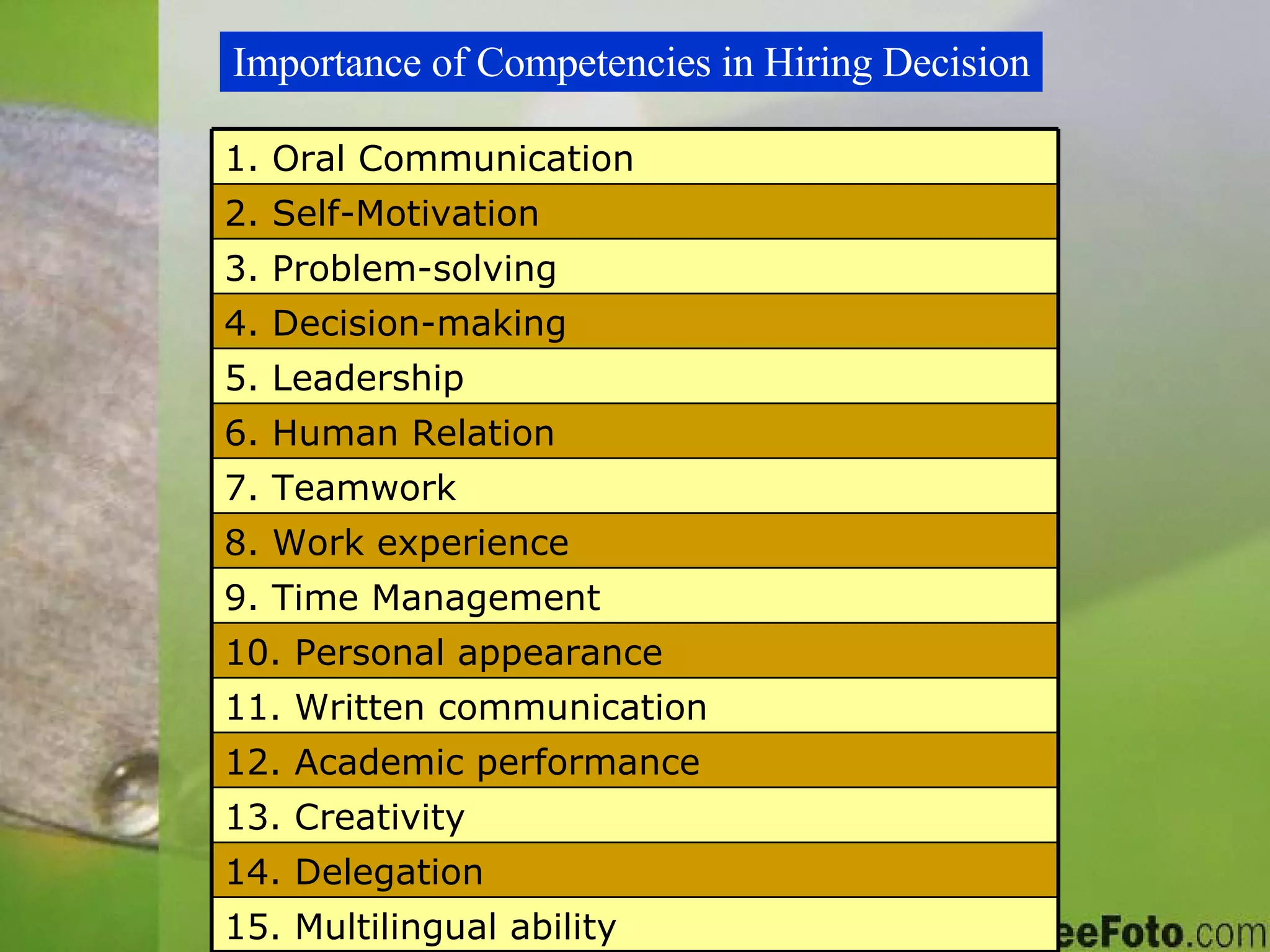
Importance of Competencies in Hiring Decision 15. Multilingual ability 14. Delegation 13. Creativity 12. Academic performance 11. Written communication 10. Personal appearance 9. Time Management 8. Work experience 7. Teamwork 6. Human Relation 5. Leadership 4. Decision-making 3. Problem-solving 2. Self-Motivation 1. Oral Communication
Question 1: Read once and consider very carefully what follows. Then, without lengthy consideration, note down the answer to the question that follows below. Imagine that you are the captain of a ship which is sailing due north in mid-Atlantic at a speed of 12 knots. After steaming at this speed and in this direction for 30 minutes, the captain gives the order to the engine room to alter course through 180 ° and then maintain the same speed on the new course for one hour. After another hour, the captain orders the engine room to change course through  180° back on the ship’s original course of due north, “to avoid a storm”.
NOW WRITE THE ANSWER TO THE QUESTION, WHAT’S THE AGE OF THE SHIP’S CAPTAIN?
TOPIC 1  INTRODUCTION TO COMMUNICATION FOR MANAGERS WHAT IS COMMUNICATION ? Latin : Communicare – to create similarity. English : Communicate – talk or interact. COMMUNICATION : Interactions within individual or group in order to create Similarity.
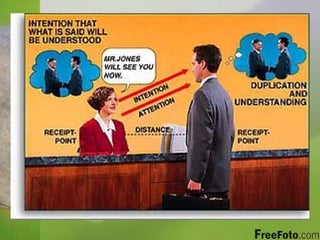
DEFINITION OF COMMUNICATION Communication takes place when there is information at one place or person, and we want to get it to another place or another person.  Miller (1951) Communication is a process involving the sorting, selecting and sending of symbols in such a way as to help a listener perceived and re-create in his own mind the meaning contained in the mind of the communicator.  ( Ross,1983) All (of) those processes by which people influence one another…communication involves one person trying to create meaning in another.
 
DEFINITION OF COMMUNICATION Communication involve the creation of meaning in  the listener. -  Senders attempts to create a meaning in the    mind of the listener similar to the meaning in his    own mind. Communication involves the transfer of information. -  Information is transferd through the use of      symbols, which can be verbal or non verbal or both . Communication involves thousands of potential stimuli. -  A stimulus becomes a message when the individual    assigns it a meaning.
WHAT IS the PURPOSE of COMMUNICATION? To get your listener to  HEAR  what you tell them or  SEE  what you show them. To get your listeners to  UNDERSTAND   what they have heard or seen; To get your listeners to  AGREE  with what they have heard or seen: To get your listeners to take  ACTION  which accords exactly with your overall objectives, and which they find acceptable To receive  FEEDBACK  from your listeners
NATURE OF COMMUNICATION Potential Communication context or conditions: Someone needs information. -  all kind of info. are needed to survive in orgn . -  Information transfer is one of the important reason    for communication in organizations Someone needs social reinforcement. -  Social and psychological needs that must be      fulfilled, this include the  needs for recognition,    esteem and growth. - Fulfill the need of others and own needs.
NATURE OF COMMUNICATION 3. Someone has directed someone else to communicate. -  People are ordered or directed to engage in      communication, such as giving speech, conduct an    interview, write a letter or reports, negotiating and    etc. Someone communicates to achieve a goal. -  Psychological and physiological condition of the    individual. - Style of interaction will bring impacts to      understanding , reactions and actions. - degrees of reciprocity.
SITUATIONAL VARIABLES Five important situational variables that influence the potential success of a communication exchange. Climate or attitudinal environment in which communication takes place. The perceived communication purpose of the sender and receiver The communication skills demonstrated by the sender and the receiver/s Whether the message has been intentionally or unintentionally transmitted Whether the message is verbal or non verbal.
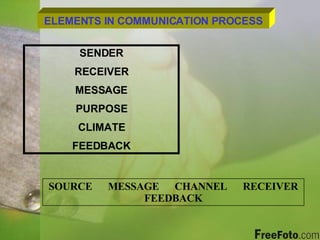
ELEMENTS IN COMMUNICATION PROCESS SENDER RECEIVER MESSAGE PURPOSE CLIMATE FEEDBACK SOURCE  MESSAGE  CHANNEL  RECEIVER FEEDBACK
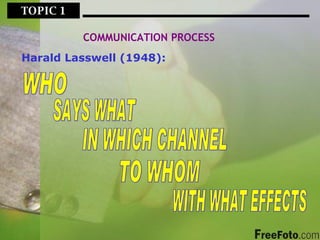
TOPIC 1  COMMUNICATION PROCESS Harald Lasswell (1948): WHO SAYS WHAT IN WHICH CHANNEL TO WHOM WITH WHAT EFFECTS
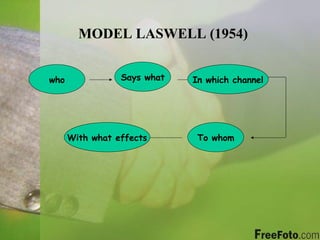
MODEL LASWELL (1954) who Says what In which channel To whom With what effects
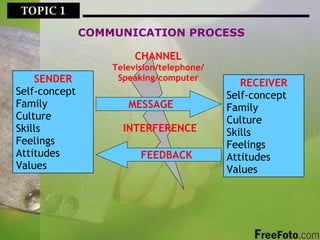
SENDER Self-concept Family Culture Skills Feelings Attitudes Values RECEIVER Self-concept Family Culture Skills Feelings Attitudes Values MESSAGE FEEDBACK INTERFERENCE CHANNEL Television/telephone/ Speaking/computer TOPIC 1  COMMUNICATION PROCESS
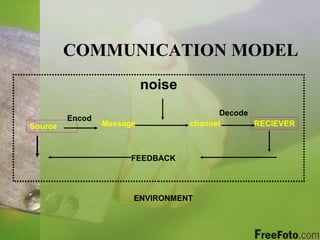
COMMUNICATION MODEL noise Message Source channel RECIEVER FEEDBACK Encod Decode ENVIRONMENT
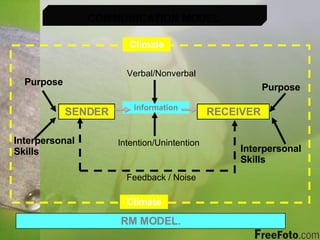
Climate COMMUNICATION MODEL SENDER RECEIVER Purpose Interpersonal Skills Climate Purpose Interpersonal Skills information Verbal/Nonverbal Intention/Unintention Feedback / Noise RM MODEL.
PROBLEMS IN COMMUNICATION PROBLEMS OF THE HIERARCHY - Gives some people power and authority over      other people, prevents some people from gaining    power. Case:  Hafidz is a highly ambitious graduate who had been hired into the  art department of a large advertising firm. His department manager  is John Tan, an old time learn-by- experience type, who believe that  young people must remain in grade and pay their dues to the  organizational elders. Because of John’s attitude, Hafidz could feel  that he must make his supervisor look bad in front of the  management. To do this Hafidz may resort to spreading gossip  about John, lying to him, reporting only good things to John  about the job he is doing, and following only certain John’s orders.  Assuming that he is devious enough, Hafidz may succeed in  making  himself look good while making John look bad.
PROBLEMS IN COMMUNICATION i. Filtering - Occurs when people intentionally or        unintentionally leave out some of the details of a    message, such as reluctant to tell our        supervisor or negatively leave out negatives      associated with our job performance. ii. Distortion. - When messages must travel up or down five to      six different hierarchical levels – unavoidable. ` - Distort information intentionally to serve their      own purpose…placing his or her own goals      ahead of those of the organization.
PROBLEMS IN COMMUNICATION iii. Refusal to communicate - Members’ decides that someone else should not      have certain information, due to conscientious or    conflicts between constraints of hierarchy and      the human desires. 2. PROBLEMS WITH THE WRITTEN WORD - Maintaining historical document with written - Written word has become the primary means of      communication. - Causing problem if not understood or the only      channel of conveying messages.
PROBLEMS IN COMMUNICATION 3. PROBLEMS WITH MANAGEMENT FAILURES - Managers who makes decisions or develop      policy, but does not adequately communicate      information about, or explain the reasons for,      these decisions. - 2 reasons why managers’ fail  a) They do not think that communication is      important, or  (b) they do not know how to communicate. SHARING OF INFORMATION, MAINTAINING A RECIPROCAL RELATIONSHIP BETWEEN THE EMPLOYEE AND THE ORGANIZATION AND UNDERSTANDING ROLE DEPENDS ON EFFECTIVE COMMUNICATION.
GUIDELINES  IN EFFECTIVE COMMUNICATION COMMUNICATION NEEDS RECEIVER CENTERED. - Sensitive to the needs, expectations and        orientations of sender and listener. - Determine the level of treatment, style and      approach EFFECTIVE COMMUNICATION CONSISTS OF MAKING THE MOST APPROPRIATE CHOICE FROM A RANGE OF POTENTIAL COURSES OF ACTION. - Consider the receiver, the purpose of the        exchange, the topic and your own unique skills    and abilities.
GUIDELINES  IN EFFECTIVE COMMUNICATION 3.  THE ILLUSION OF COMMUNICATION SOMETIMES HINDERS REAL COMMUNICATION. - The assumptions that communication has taken      place when it is not. -  Only receiver determine whether or not        communication has been achieved. – check by      using dialogue and feedback. 4.  COMMUNICATION PROBLEMS ARE GOING TO ARISE BECAUSE PEOPLE ARE IMPERFECT COMMUNICATORS. - Do your best to communicate; try to prevent major      problems; but expect them to surface. - Lowered expectations and adjustment.
GUIDELINES  IN EFFECTIVE COMMUNICATION 5.  EFFECTIVE COMMUNICATION IS LEARNED THROUGH TRAINING AND EXPERIENCE. - Unrealistic to expect a new manager or employee    to communicate effectively during the first days      on the job. - can be improve by learning the appropriate      techniques, practising and reviewed by        experienced communicators. - Organization must encourage good        communication; and the employee must be      motivated and improve good communication      skills.
BARRIERS TO COMMUNICATION Communication is hindered by barriers.. A  Barrier is anything that inteferes with the process of sending or receiving a message. These barriers can be as simple as using words that are not easily understood by the reciever. They can be more complex issues like not listening to a person because you do not like them. Barriers change the message.
List of barriers that can alter a message. Accent Anger Body language Courtesy Diverting Facial expression Self-talk
List of barriers that can alter a message. Flashing lights Room temperature Negotiation methods One way communication Personal appearance Poor expression pronunciation
List of barriers that can alter a message. silence .  smiling attitudes Unclear questions emotions Hearing difficulties prejudices
RESPONSE ASSIGNMENT What are the essential elements in the communication process? Identify them and describe the role of each. From your own work experience, describe the importance of communication in the workplace. What are the some of advantages and disadvantages of relying solely on oral communication to send your ideas?  What are the some of advantages and disadvantages of relying solely on written communication to send your ideas?
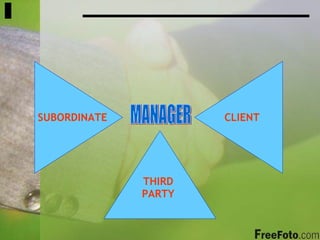
MANAGER SUBORDINATE CLIENT THIRD PARTY
MANAGEMENT Who are managers:  A manager is responsible for the work performance of one or more people in an organizations. It can be the supervisor, team leader, division head, chief executive, school principal, prime minister, vice chancellor…etc.
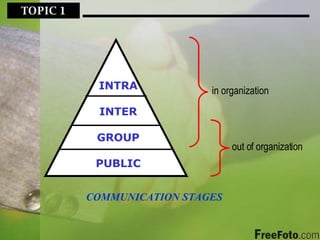
TOPIC 1  INTRA INTER GROUP PUBLIC COMMUNICATION STAGES in organization out of organization
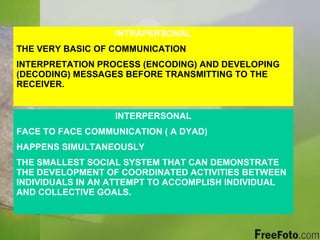
INTRAPERSONAL THE VERY BASIC OF COMMUNICATION INTERPRETATION PROCESS (ENCODING) AND DEVELOPING  (DECODING) MESSAGES BEFORE TRANSMITTING TO THE RECEIVER. INTERPERSONAL FACE TO FACE COMMUNICATION ( A DYAD) HAPPENS SIMULTANEOUSLY THE SMALLEST SOCIAL SYSTEM THAT CAN DEMONSTRATE THE DEVELOPMENT OF COORDINATED ACTIVITIES BETWEEN INDIVIDUALS IN AN ATTEMPT TO ACCOMPLISH INDIVIDUAL AND COLLECTIVE GOALS.
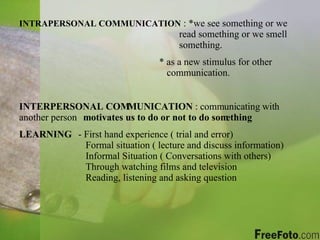
INTRAPERSONAL COMMUNICATION  : *we see something or we  read something or we smell  something.      * as a new stimulus for other      communication. INTERPERSONAL COMMUNICATION  : communicating with another person motivates us to do or not to do something LEARNING   - First hand experience ( trial and error)  Formal situation ( lecture and discuss information)    Informal Situation ( Conversations with others)  Through watching films and television  Reading, listening and asking question
SMALL GROUPS Three or more interacting in attempt to adapt to their environment and achieve commonly recognised goals. Occur in work group, staff and mnanagement education classes, decision making commitees Perform important function in organizations by providing information, support and problem solving expertise that individually cannot provide independently. INTERGROUP/ INTERORGANIZATIONAL . Encompasses the lower levels of communication. The means by which organizations members (from all divisions of the organizations) coordinate their activities to accomplish the goals of the organizations. To cope with the complexity of MGC, orgn. Must develop formal channel of communication among various parts and members.
FILTERING PRINCIPLES ( McCroskey,1992). We cannot know everything:     Selection are stimulate by   that are close to us, that we are involved in, that have utility for us and for which we are reinforced. We cannot attend to everything to which we are exposed .   3.   We selectively perceive because some messages are ambigous .  lack redundancy, do not provide us a schema, do not relate to our prevoius experiences, does not fit into our expectancies and biases.
We tend to remember only a few of those items that we perceive.   Items were not highlighted, not organizes, no realistic application dan susunan yang mengelirukan. We selectively recall only a few of those items that we remember .   Knowledge acquistion require re-training and re-thinking When we  communicate our knowledge  we are really communicating,  through the process of understanding  not only our perceptions of the topics, but also understanding and  trying to predicts other’s perceptions  of the same topic. The most basic differences between organizations  –  CHANGE.
INTERPERSONAL ATTRACTIVENESS: a. PHYSICAL Making decisions about who will work with us,    eg. physical appearance b.   SOCIAL The extent to which one would like to be “friends”  with  another. c.   TASK ATTRACTION. The degrees to which one person perceives it to be  desirable to establish a work relationship with  another person. We may wish to work with this person on the job, but  not socialize with them outside  the task situation .
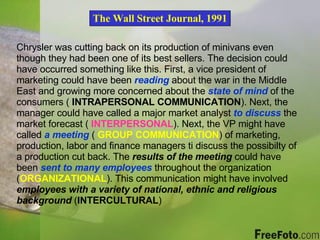
Chrysler was cutting back on its production of minivans even though they had been one of its best sellers. The decision could have occurred something like this. First, a vice president of marketing could have been  reading  about the war in the Middle East and growing more concerned about the  state of mind  of the consumers (  INTRAPERSONAL COMMUNICATION ). Next, the manager could have called a major market analyst  to discuss  the market forecast (  INTERPERSONAL ). Next, the VP might have called  a meeting  (  GROUP COMMUNICATION ) of marketing, production, labor and finance managers ti discuss the possibilty of a production cut back. The  results of the meeting  could have been  sent to many employees  throughout the organization  ( ORGANIZATIONAL ). This communication might have involved  employees with a variety of national, ethnic and religious background  ( INTERCULTURAL ) The Wall Street Journal, 1991
TOPIC 1  WHY COMMUNICATION IMPORTANCE TO MANAGERS ? To delegate task/job. To inform. To persuade. To increased satisfaction. To increased productivity. To get feedback.
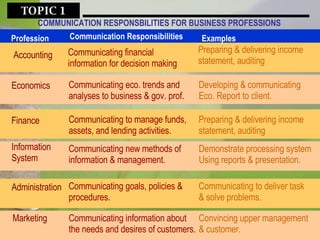
Accounting Economics Finance Information System Administration Marketing TOPIC 1  COMMUNICATION RESPONSBILITIES FOR BUSINESS PROFESSIONS Profession Examples Communication Responsibilities Communicating financial information for decision making Preparing & delivering income statement, auditing Communicating eco. trends and analyses to business & gov. prof. Developing & communicating Eco. Report to client. Communicating to manage funds, assets, and lending activities. Preparing & delivering income statement, auditing Communicating new methods of information & management. Demonstrate processing system Using reports & presentation. Communicating goals, policies & procedures. Communicating to deliver task & solve problems. Communicating information about the needs and desires of customers. Convincing upper management & customer.
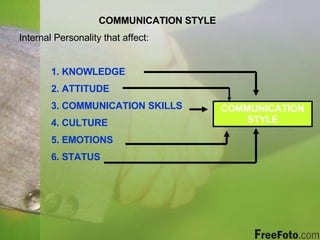
COMMUNICATION STYLE Internal Personality that affect:  1. KNOWLEDGE 2. ATTITUDE 3. COMMUNICATION SKILLS 4. CULTURE 5. EMOTIONS 6. STATUS COMMUNICATION STYLE
COMMUNICATION STYLE Virginia Satri(1972),  1. THE BLAMING OR AGGRESSIVE STYLE 2.  THE NONASSERTIVE STYLE 3. THE COMPUTING OR INTELLECTUAL STYLE 4. THE DISTRACTING OR MANIPULATIVE STYLE 5. THE LEVELING OR ASSERTIVE STYLE.
THE BLAMING OR AGGRESSIVE STYLE a.  Acts  in a  demanding  fashion and  superiors  with others b.  Finds fault  and  are critical  of others. c.  Gets what he or she wants  without experiencing  negative reactions from others. d.  Fails  to establish  close relationship , feeling a need  to  constantly guard against other people’s attacks  and  possible  retaliation . e.  Rely on written  rather than interpersonal channels,  inconsiderate of others’ time and may generally  communicate in a negative environment.
THE PLACATING OR NONASSERTIVE STYLE Try to  please and ingratiate  themselves with others They  apologize constantly ,  seldom disagree , and talk as though they could do almost nothing for and by themselves. Often  ignore their own rights ,  needs  and  feelings  or are  unable to express  them in a direct manner. Avoiding conflicts ,  fear hurting others  feelings and  worry that saying no  or standing up for their own rights will cause others to dislike them. Others often exploit them, teach others not to respect them.
3. THE COMPUTING OR INTELLECTUAL STYLE Tends to  use calculations  when dealing with communication situations Believes  emotions are best kept hidden  because feelings distract from the work at hand. Requires  logic and rationality . Appearance of being calm, cool and collected .
4 .  THE DISTRACTING OR MANIPULATIVE STYLE Do not deal directly with situations requiring communication. Avoid threatening situations  and develop strategies to manipulate themselves out of unpleasant encounters. If the cannot avoid the encounters, their communication style may include  manipulating other people’s feelings . Often use  anger, hurt and guilt   as manipulative devices  to get others to do what they want. i.e  “  How could you let the company down after the  way it has taken care of you”
5 .  THE LEVELING OR ASSERTIVE STYLE. Able to  stand up for their rights  and  express their feelings, thoughts, or needs in a direct, honest  and clear manner Actions match words,  follow through on what they say  they will do. Respects others with  room for compromise or negotiation . “ This is what I think” or “This is how I see the situation.” Does not become aggressive or defensive if other employees do not happen to see things the same way. The goal is  accurate communication , solving conflicts. Increases the manager’s  self respect  and results in greater  self-confidence.
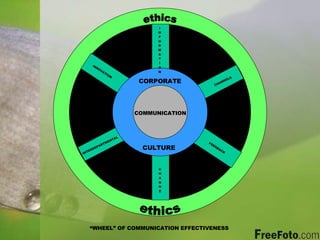
CORPORATE CULTURE COMMUNICATION I N F O R M A T I O N C H A N G E FEEDBACK INNOVATION INTERDEPARTMENTAL CHANNELS “ WHEEL” OF COMMUNICATION EFFECTIVENESS ethics ethics
COMMUNICATION ‘ AS A PROCESS THROUGH WHICH PEOPLE, ACTING TOGETHER, CREATE, SUSTAIN, AND MANAGE MEANINGS THROUGH THE USE OF VERBAL AND NONVERBAL SIGNS  AND SYMBOLS WITHIN A PARTICULAR CONTEXT.’

Lect1 Intro

  • 1.
    Importance of Competenciesin Hiring Decision 15. Multilingual ability 14. Delegation 13. Creativity 12. Academic performance 11. Written communication 10. Personal appearance 9. Time Management 8. Work experience 7. Teamwork 6. Human Relation 5. Leadership 4. Decision-making 3. Problem-solving 2. Self-Motivation 1. Oral Communication
  • 2.
    Question 1: Readonce and consider very carefully what follows. Then, without lengthy consideration, note down the answer to the question that follows below. Imagine that you are the captain of a ship which is sailing due north in mid-Atlantic at a speed of 12 knots. After steaming at this speed and in this direction for 30 minutes, the captain gives the order to the engine room to alter course through 180 ° and then maintain the same speed on the new course for one hour. After another hour, the captain orders the engine room to change course through 180° back on the ship’s original course of due north, “to avoid a storm”.
  • 3.
    NOW WRITE THEANSWER TO THE QUESTION, WHAT’S THE AGE OF THE SHIP’S CAPTAIN?
  • 4.
    TOPIC 1 INTRODUCTION TO COMMUNICATION FOR MANAGERS WHAT IS COMMUNICATION ? Latin : Communicare – to create similarity. English : Communicate – talk or interact. COMMUNICATION : Interactions within individual or group in order to create Similarity.
  • 5.
    DEFINITION OF COMMUNICATIONCommunication takes place when there is information at one place or person, and we want to get it to another place or another person. Miller (1951) Communication is a process involving the sorting, selecting and sending of symbols in such a way as to help a listener perceived and re-create in his own mind the meaning contained in the mind of the communicator. ( Ross,1983) All (of) those processes by which people influence one another…communication involves one person trying to create meaning in another.
  • 6.
  • 7.
    DEFINITION OF COMMUNICATIONCommunication involve the creation of meaning in the listener. - Senders attempts to create a meaning in the mind of the listener similar to the meaning in his own mind. Communication involves the transfer of information. - Information is transferd through the use of symbols, which can be verbal or non verbal or both . Communication involves thousands of potential stimuli. - A stimulus becomes a message when the individual assigns it a meaning.
  • 8.
    WHAT IS thePURPOSE of COMMUNICATION? To get your listener to HEAR what you tell them or SEE what you show them. To get your listeners to UNDERSTAND what they have heard or seen; To get your listeners to AGREE with what they have heard or seen: To get your listeners to take ACTION which accords exactly with your overall objectives, and which they find acceptable To receive FEEDBACK from your listeners
  • 9.
    NATURE OF COMMUNICATIONPotential Communication context or conditions: Someone needs information. - all kind of info. are needed to survive in orgn . - Information transfer is one of the important reason for communication in organizations Someone needs social reinforcement. - Social and psychological needs that must be fulfilled, this include the needs for recognition, esteem and growth. - Fulfill the need of others and own needs.
  • 10.
    NATURE OF COMMUNICATION3. Someone has directed someone else to communicate. - People are ordered or directed to engage in communication, such as giving speech, conduct an interview, write a letter or reports, negotiating and etc. Someone communicates to achieve a goal. - Psychological and physiological condition of the individual. - Style of interaction will bring impacts to understanding , reactions and actions. - degrees of reciprocity.
  • 11.
    SITUATIONAL VARIABLES Fiveimportant situational variables that influence the potential success of a communication exchange. Climate or attitudinal environment in which communication takes place. The perceived communication purpose of the sender and receiver The communication skills demonstrated by the sender and the receiver/s Whether the message has been intentionally or unintentionally transmitted Whether the message is verbal or non verbal.
  • 12.
    ELEMENTS IN COMMUNICATIONPROCESS SENDER RECEIVER MESSAGE PURPOSE CLIMATE FEEDBACK SOURCE MESSAGE CHANNEL RECEIVER FEEDBACK
  • 13.
    TOPIC 1 COMMUNICATION PROCESS Harald Lasswell (1948): WHO SAYS WHAT IN WHICH CHANNEL TO WHOM WITH WHAT EFFECTS
  • 14.
    MODEL LASWELL (1954)who Says what In which channel To whom With what effects
  • 15.
    SENDER Self-concept FamilyCulture Skills Feelings Attitudes Values RECEIVER Self-concept Family Culture Skills Feelings Attitudes Values MESSAGE FEEDBACK INTERFERENCE CHANNEL Television/telephone/ Speaking/computer TOPIC 1 COMMUNICATION PROCESS
  • 16.
    COMMUNICATION MODEL noiseMessage Source channel RECIEVER FEEDBACK Encod Decode ENVIRONMENT
  • 17.
    Climate COMMUNICATION MODELSENDER RECEIVER Purpose Interpersonal Skills Climate Purpose Interpersonal Skills information Verbal/Nonverbal Intention/Unintention Feedback / Noise RM MODEL.
  • 18.
    PROBLEMS IN COMMUNICATIONPROBLEMS OF THE HIERARCHY - Gives some people power and authority over other people, prevents some people from gaining power. Case: Hafidz is a highly ambitious graduate who had been hired into the art department of a large advertising firm. His department manager is John Tan, an old time learn-by- experience type, who believe that young people must remain in grade and pay their dues to the organizational elders. Because of John’s attitude, Hafidz could feel that he must make his supervisor look bad in front of the management. To do this Hafidz may resort to spreading gossip about John, lying to him, reporting only good things to John about the job he is doing, and following only certain John’s orders. Assuming that he is devious enough, Hafidz may succeed in making himself look good while making John look bad.
  • 19.
    PROBLEMS IN COMMUNICATIONi. Filtering - Occurs when people intentionally or unintentionally leave out some of the details of a message, such as reluctant to tell our supervisor or negatively leave out negatives associated with our job performance. ii. Distortion. - When messages must travel up or down five to six different hierarchical levels – unavoidable. ` - Distort information intentionally to serve their own purpose…placing his or her own goals ahead of those of the organization.
  • 20.
    PROBLEMS IN COMMUNICATIONiii. Refusal to communicate - Members’ decides that someone else should not have certain information, due to conscientious or conflicts between constraints of hierarchy and the human desires. 2. PROBLEMS WITH THE WRITTEN WORD - Maintaining historical document with written - Written word has become the primary means of communication. - Causing problem if not understood or the only channel of conveying messages.
  • 21.
    PROBLEMS IN COMMUNICATION3. PROBLEMS WITH MANAGEMENT FAILURES - Managers who makes decisions or develop policy, but does not adequately communicate information about, or explain the reasons for, these decisions. - 2 reasons why managers’ fail a) They do not think that communication is important, or (b) they do not know how to communicate. SHARING OF INFORMATION, MAINTAINING A RECIPROCAL RELATIONSHIP BETWEEN THE EMPLOYEE AND THE ORGANIZATION AND UNDERSTANDING ROLE DEPENDS ON EFFECTIVE COMMUNICATION.
  • 22.
    GUIDELINES INEFFECTIVE COMMUNICATION COMMUNICATION NEEDS RECEIVER CENTERED. - Sensitive to the needs, expectations and orientations of sender and listener. - Determine the level of treatment, style and approach EFFECTIVE COMMUNICATION CONSISTS OF MAKING THE MOST APPROPRIATE CHOICE FROM A RANGE OF POTENTIAL COURSES OF ACTION. - Consider the receiver, the purpose of the exchange, the topic and your own unique skills and abilities.
  • 23.
    GUIDELINES INEFFECTIVE COMMUNICATION 3. THE ILLUSION OF COMMUNICATION SOMETIMES HINDERS REAL COMMUNICATION. - The assumptions that communication has taken place when it is not. - Only receiver determine whether or not communication has been achieved. – check by using dialogue and feedback. 4. COMMUNICATION PROBLEMS ARE GOING TO ARISE BECAUSE PEOPLE ARE IMPERFECT COMMUNICATORS. - Do your best to communicate; try to prevent major problems; but expect them to surface. - Lowered expectations and adjustment.
  • 24.
    GUIDELINES INEFFECTIVE COMMUNICATION 5. EFFECTIVE COMMUNICATION IS LEARNED THROUGH TRAINING AND EXPERIENCE. - Unrealistic to expect a new manager or employee to communicate effectively during the first days on the job. - can be improve by learning the appropriate techniques, practising and reviewed by experienced communicators. - Organization must encourage good communication; and the employee must be motivated and improve good communication skills.
  • 25.
    BARRIERS TO COMMUNICATIONCommunication is hindered by barriers.. A Barrier is anything that inteferes with the process of sending or receiving a message. These barriers can be as simple as using words that are not easily understood by the reciever. They can be more complex issues like not listening to a person because you do not like them. Barriers change the message.
  • 26.
    List of barriersthat can alter a message. Accent Anger Body language Courtesy Diverting Facial expression Self-talk
  • 27.
    List of barriersthat can alter a message. Accent Anger Body language Courtesy Diverting Facial expression Self-talk
  • 28.
    List of barriersthat can alter a message. Flashing lights Room temperature Negotiation methods One way communication Personal appearance Poor expression pronunciation
  • 29.
    List of barriersthat can alter a message. silence . smiling attitudes Unclear questions emotions Hearing difficulties prejudices
  • 30.
    RESPONSE ASSIGNMENT Whatare the essential elements in the communication process? Identify them and describe the role of each. From your own work experience, describe the importance of communication in the workplace. What are the some of advantages and disadvantages of relying solely on oral communication to send your ideas? What are the some of advantages and disadvantages of relying solely on written communication to send your ideas?
  • 31.
  • 32.
    MANAGEMENT Who aremanagers: A manager is responsible for the work performance of one or more people in an organizations. It can be the supervisor, team leader, division head, chief executive, school principal, prime minister, vice chancellor…etc.
  • 33.
    TOPIC 1 INTRA INTER GROUP PUBLIC COMMUNICATION STAGES in organization out of organization
  • 34.
    INTRAPERSONAL THE VERYBASIC OF COMMUNICATION INTERPRETATION PROCESS (ENCODING) AND DEVELOPING (DECODING) MESSAGES BEFORE TRANSMITTING TO THE RECEIVER. INTERPERSONAL FACE TO FACE COMMUNICATION ( A DYAD) HAPPENS SIMULTANEOUSLY THE SMALLEST SOCIAL SYSTEM THAT CAN DEMONSTRATE THE DEVELOPMENT OF COORDINATED ACTIVITIES BETWEEN INDIVIDUALS IN AN ATTEMPT TO ACCOMPLISH INDIVIDUAL AND COLLECTIVE GOALS.
  • 35.
    INTRAPERSONAL COMMUNICATION : *we see something or we read something or we smell something. * as a new stimulus for other communication. INTERPERSONAL COMMUNICATION : communicating with another person motivates us to do or not to do something LEARNING - First hand experience ( trial and error) Formal situation ( lecture and discuss information) Informal Situation ( Conversations with others) Through watching films and television Reading, listening and asking question
  • 36.
    SMALL GROUPS Threeor more interacting in attempt to adapt to their environment and achieve commonly recognised goals. Occur in work group, staff and mnanagement education classes, decision making commitees Perform important function in organizations by providing information, support and problem solving expertise that individually cannot provide independently. INTERGROUP/ INTERORGANIZATIONAL . Encompasses the lower levels of communication. The means by which organizations members (from all divisions of the organizations) coordinate their activities to accomplish the goals of the organizations. To cope with the complexity of MGC, orgn. Must develop formal channel of communication among various parts and members.
  • 37.
    FILTERING PRINCIPLES (McCroskey,1992). We cannot know everything: Selection are stimulate by that are close to us, that we are involved in, that have utility for us and for which we are reinforced. We cannot attend to everything to which we are exposed . 3. We selectively perceive because some messages are ambigous . lack redundancy, do not provide us a schema, do not relate to our prevoius experiences, does not fit into our expectancies and biases.
  • 38.
    We tend toremember only a few of those items that we perceive. Items were not highlighted, not organizes, no realistic application dan susunan yang mengelirukan. We selectively recall only a few of those items that we remember . Knowledge acquistion require re-training and re-thinking When we communicate our knowledge we are really communicating, through the process of understanding not only our perceptions of the topics, but also understanding and trying to predicts other’s perceptions of the same topic. The most basic differences between organizations – CHANGE.
  • 39.
    INTERPERSONAL ATTRACTIVENESS: a.PHYSICAL Making decisions about who will work with us, eg. physical appearance b. SOCIAL The extent to which one would like to be “friends” with another. c. TASK ATTRACTION. The degrees to which one person perceives it to be desirable to establish a work relationship with another person. We may wish to work with this person on the job, but not socialize with them outside the task situation .
  • 40.
    Chrysler was cuttingback on its production of minivans even though they had been one of its best sellers. The decision could have occurred something like this. First, a vice president of marketing could have been reading about the war in the Middle East and growing more concerned about the state of mind of the consumers ( INTRAPERSONAL COMMUNICATION ). Next, the manager could have called a major market analyst to discuss the market forecast ( INTERPERSONAL ). Next, the VP might have called a meeting ( GROUP COMMUNICATION ) of marketing, production, labor and finance managers ti discuss the possibilty of a production cut back. The results of the meeting could have been sent to many employees throughout the organization ( ORGANIZATIONAL ). This communication might have involved employees with a variety of national, ethnic and religious background ( INTERCULTURAL ) The Wall Street Journal, 1991
  • 41.
    TOPIC 1 WHY COMMUNICATION IMPORTANCE TO MANAGERS ? To delegate task/job. To inform. To persuade. To increased satisfaction. To increased productivity. To get feedback.
  • 42.
    Accounting Economics FinanceInformation System Administration Marketing TOPIC 1 COMMUNICATION RESPONSBILITIES FOR BUSINESS PROFESSIONS Profession Examples Communication Responsibilities Communicating financial information for decision making Preparing & delivering income statement, auditing Communicating eco. trends and analyses to business & gov. prof. Developing & communicating Eco. Report to client. Communicating to manage funds, assets, and lending activities. Preparing & delivering income statement, auditing Communicating new methods of information & management. Demonstrate processing system Using reports & presentation. Communicating goals, policies & procedures. Communicating to deliver task & solve problems. Communicating information about the needs and desires of customers. Convincing upper management & customer.
  • 43.
    COMMUNICATION STYLE InternalPersonality that affect: 1. KNOWLEDGE 2. ATTITUDE 3. COMMUNICATION SKILLS 4. CULTURE 5. EMOTIONS 6. STATUS COMMUNICATION STYLE
  • 44.
    COMMUNICATION STYLE VirginiaSatri(1972), 1. THE BLAMING OR AGGRESSIVE STYLE 2. THE NONASSERTIVE STYLE 3. THE COMPUTING OR INTELLECTUAL STYLE 4. THE DISTRACTING OR MANIPULATIVE STYLE 5. THE LEVELING OR ASSERTIVE STYLE.
  • 45.
    THE BLAMING ORAGGRESSIVE STYLE a. Acts in a demanding fashion and superiors with others b. Finds fault and are critical of others. c. Gets what he or she wants without experiencing negative reactions from others. d. Fails to establish close relationship , feeling a need to constantly guard against other people’s attacks and possible retaliation . e. Rely on written rather than interpersonal channels, inconsiderate of others’ time and may generally communicate in a negative environment.
  • 46.
    THE PLACATING ORNONASSERTIVE STYLE Try to please and ingratiate themselves with others They apologize constantly , seldom disagree , and talk as though they could do almost nothing for and by themselves. Often ignore their own rights , needs and feelings or are unable to express them in a direct manner. Avoiding conflicts , fear hurting others feelings and worry that saying no or standing up for their own rights will cause others to dislike them. Others often exploit them, teach others not to respect them.
  • 47.
    3. THE COMPUTINGOR INTELLECTUAL STYLE Tends to use calculations when dealing with communication situations Believes emotions are best kept hidden because feelings distract from the work at hand. Requires logic and rationality . Appearance of being calm, cool and collected .
  • 48.
    4 . THE DISTRACTING OR MANIPULATIVE STYLE Do not deal directly with situations requiring communication. Avoid threatening situations and develop strategies to manipulate themselves out of unpleasant encounters. If the cannot avoid the encounters, their communication style may include manipulating other people’s feelings . Often use anger, hurt and guilt as manipulative devices to get others to do what they want. i.e “ How could you let the company down after the way it has taken care of you”
  • 49.
    5 . THE LEVELING OR ASSERTIVE STYLE. Able to stand up for their rights and express their feelings, thoughts, or needs in a direct, honest and clear manner Actions match words, follow through on what they say they will do. Respects others with room for compromise or negotiation . “ This is what I think” or “This is how I see the situation.” Does not become aggressive or defensive if other employees do not happen to see things the same way. The goal is accurate communication , solving conflicts. Increases the manager’s self respect and results in greater self-confidence.
  • 50.
    CORPORATE CULTURE COMMUNICATIONI N F O R M A T I O N C H A N G E FEEDBACK INNOVATION INTERDEPARTMENTAL CHANNELS “ WHEEL” OF COMMUNICATION EFFECTIVENESS ethics ethics
  • 51.
    COMMUNICATION ‘ ASA PROCESS THROUGH WHICH PEOPLE, ACTING TOGETHER, CREATE, SUSTAIN, AND MANAGE MEANINGS THROUGH THE USE OF VERBAL AND NONVERBAL SIGNS AND SYMBOLS WITHIN A PARTICULAR CONTEXT.’