

Management
COMMUNICATION
        MOHAMMED ALHABSI INDANAN
                                    Skills
    Quality Coordinator- Ambulatory Care Unit
      King Abdulaziz Specialist Hospital-Taif
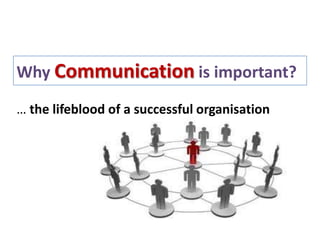
Why Communication is important?

… the lifeblood of a successful organisation
Objectives             of Presentation
• Discuss the importance of effective
  communication in healthcare management.

• Utilize communication skills effectively in the
  management process.
Outline          ……………………
  • Definition: Communication
  • Classification, Modes , & Types of
    Communication
  • Communication Process
  • Barriers of Communication
  • Cultural Differences & Breaking
    Cultural barriers strategies
  • Organisational Communication
  • Communication in Healthcare
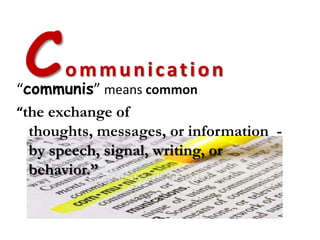
C    ommunication
“communis” means common
“the exchange of
  thoughts, messages, or information -
  by speech, signal, writing, or
  behavior.”
classification of Communication
VERBAL Communication
•   Words or Languages
     Oral and Written
NON-VERBAL Communication
• Gestures, aural, & visual
    Space, Environment, Appearance, Eye
    Contact, Posture, Facial Expression &
    Timing, Vocal Expression
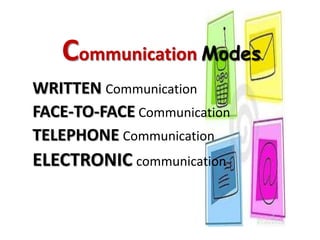
Communication Modes
WRITTEN Communication
FACE-TO-FACE Communication
TELEPHONE Communication
ELECTRONIC communication
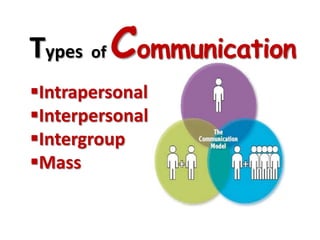
Types of Communication
Intrapersonal
Interpersonal
Intergroup
Mass
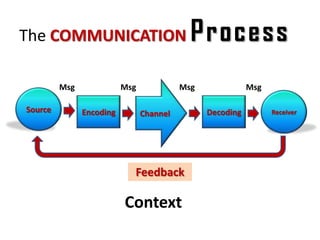
The COMMUNICATION                           Process
         Msg              Msg             Msg              Msg

Source         Encoding         Channel         Decoding         Receiver


                            Feedback

                          Context
Barriers of Communication
Internal
 Judgmental attitude, stress, fatigue, poor
   listening skills, "know it all” unconcerned
   attitude etc.
External
 Noise, distractions, bad phone
   connections, environment etc.
C ultural Differences
Cultural Differences
Beliefs, customs, language, nor
 ms & values…..
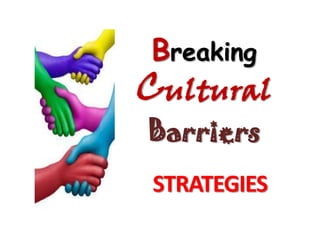
Breaking
Cultural
Barriers
 STRATEGIES
Breaking     Cultural    Barriers
Cross- Cultural Communication
Respect, tolerance, non judgmental
attitudes
Obtaining knowledge & being Sensitive
to cultural Differences
Attitude, Behavior, Values shared……
O   RGANISATIONAL

Communication
ORGANISATIONAL Communication
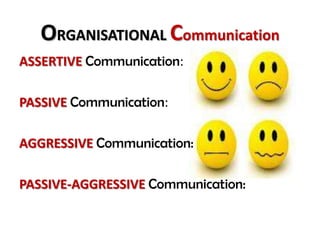
ASSERTIVE Communication:

PASSIVE Communication:

AGGRESSIVE Communication:

PASSIVE-AGGRESSIVE Communication:
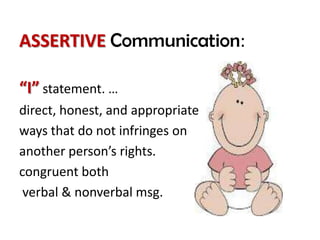
ASSERTIVE Communication:

“I” statement. …
direct, honest, and appropriate
ways that do not infringes on
another person’s rights.
congruent both
 verbal & nonverbal msg.
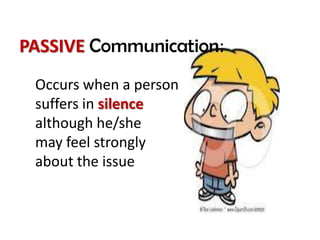
PASSIVE Communication:
 Occurs when a person
 suffers in silence
 although he/she
 may feel strongly
 about the issue
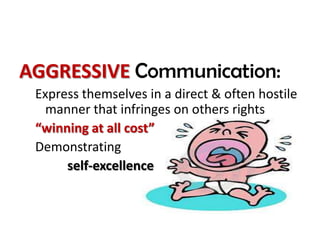
AGGRESSIVE Communication:
 Express themselves in a direct & often hostile
   manner that infringes on others rights
 “winning at all cost”
 Demonstrating
      self-excellence
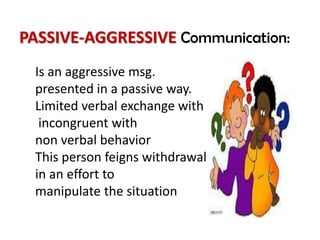
PASSIVE-AGGRESSIVE Communication:
 Is an aggressive msg.
 presented in a passive way.
 Limited verbal exchange with
  incongruent with
 non verbal behavior
 This person feigns withdrawal
 in an effort to
 manipulate the situation
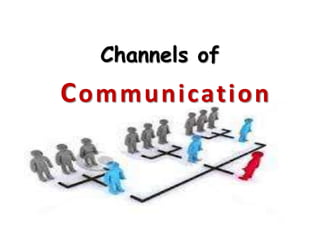
Channels of
C om m unication
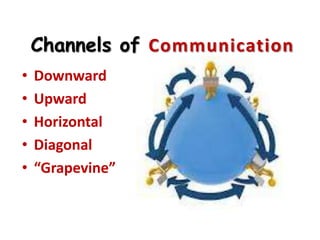
Channels of Communication
•   Downward
•   Upward
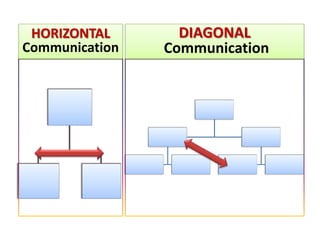
•   Horizontal
•   Diagonal
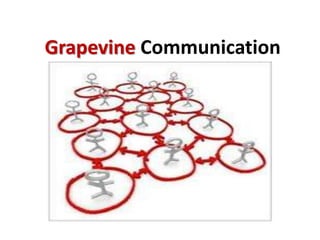
•   “Grapevine”
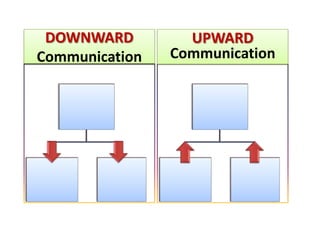
DOWNWARD         UPWARD
Communication   Communication
HORIZONTAL       DIAGONAL
Communication   Communication
Grapevine Communication
L highestTform N Communication….. …
The
    I S E
               of
                  I N G………

An active process that requires conscious
  attention, is critical to good communication.

The leader who actively listens gives genuine
  time & attention to the sender, focusing on
  verbal & nonverbal communication.
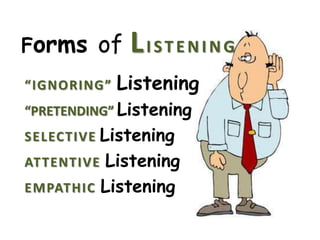
Forms       of L I S T E N I N G
“IGNORING”    Listening
“PRETENDING” Listening
SELECTIVE Listening
AT TENTIVE Listening
EMPATHIC Listening
Organizational
Communication
   Strategies
ORGANIZATIONAL Communication
                 Strategies
• Managers must assess organisational
  communication
• Managers must understand the organisation’s
  structure & recognise who will be affected by
  decisions
• Communication is not a one-way channel
• Communication must be clear, simple, &
  precise
ORGANIZATIONAL Communication
             Strategies
• Senders should seek feedback regarding whether
  their communication was accurately received
• Multiple communication methods should be
  used, when possible, if a message is important
• Managers should not overwhelm subordinates
  with unnecessary information
  KISS principle ….
        “Keep it Simple & Straightforward”
Communication
in Healthcare…..
IPSG.2
Improve Effective
   Communication
•   Timely
•   Accurate
•   Unambiguous
•   Understood by the recipient


         Reduces error
     Results in patient safety
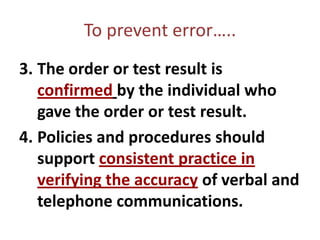
To prevent error…..
1. The complete verbal and telephone
   order or test result is written down by
   the receiver of the order or test result.
2. The complete verbal and telephone
   order or test result is read back by the
   receiver of the order or test result.
To prevent error…..
3. The order or test result is
   confirmed by the individual who
   gave the order or test result.
4. Policies and procedures should
   support consistent practice in
   verifying the accuracy of verbal and
   telephone communications.
Guide for calling the physician…..


    SBAR
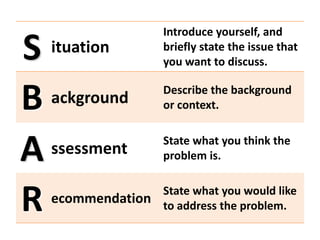
Introduce yourself, and
S  ituation         briefly state the issue that
                    you want to discuss.


B ackground
                    Describe the background
                    or context.


A ssessment
                    State what you think the
                    problem is.


R                State what you would like
   ecommendation to address the problem.
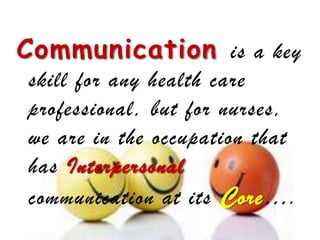
Communication is a key
skill for any health care
professional, but for nurses,
we are in the occupation that
has Interpersonal
communication at its C ore….
References:
• Leadership Roles & Management functions in Nursing by Bessie L.
  Marquis,RN, MSN & Carol J. Huston, RN,MSN, DPA, FAAN
  6th edition 2009
• Joint Commission International Accreditation Standards for Hospital
  4th Edition effective January 1, 2011
• Learning Method of effective Communication in Nursing
• MindTools.com
MAGSUKUL...

management communication skills

  • 1.
    Management COMMUNICATION MOHAMMED ALHABSI INDANAN Skills Quality Coordinator- Ambulatory Care Unit King Abdulaziz Specialist Hospital-Taif
  • 2.
    Why Communication isimportant? … the lifeblood of a successful organisation
  • 3.
    Objectives of Presentation • Discuss the importance of effective communication in healthcare management. • Utilize communication skills effectively in the management process.
  • 4.
    Outline …………………… • Definition: Communication • Classification, Modes , & Types of Communication • Communication Process • Barriers of Communication • Cultural Differences & Breaking Cultural barriers strategies • Organisational Communication • Communication in Healthcare
  • 5.
    C ommunication “communis” means common “the exchange of thoughts, messages, or information - by speech, signal, writing, or behavior.”
  • 6.
    classification of Communication VERBALCommunication • Words or Languages Oral and Written NON-VERBAL Communication • Gestures, aural, & visual Space, Environment, Appearance, Eye Contact, Posture, Facial Expression & Timing, Vocal Expression
  • 7.
    Communication Modes WRITTEN Communication FACE-TO-FACECommunication TELEPHONE Communication ELECTRONIC communication
  • 8.
  • 9.
    The COMMUNICATION Process Msg Msg Msg Msg Source Encoding Channel Decoding Receiver Feedback Context
  • 10.
  • 11.
    Barriers of Communication Internal Judgmental attitude, stress, fatigue, poor listening skills, "know it all” unconcerned attitude etc. External  Noise, distractions, bad phone connections, environment etc.
  • 12.
  • 13.
    Cultural Differences Beliefs, customs,language, nor ms & values…..
  • 14.
  • 15.
    Breaking Cultural Barriers Cross- Cultural Communication Respect, tolerance, non judgmental attitudes Obtaining knowledge & being Sensitive to cultural Differences Attitude, Behavior, Values shared……
  • 16.
    O RGANISATIONAL Communication
  • 17.
    ORGANISATIONAL Communication ASSERTIVE Communication: PASSIVECommunication: AGGRESSIVE Communication: PASSIVE-AGGRESSIVE Communication:
  • 18.
    ASSERTIVE Communication: “I” statement.… direct, honest, and appropriate ways that do not infringes on another person’s rights. congruent both verbal & nonverbal msg.
  • 19.
    PASSIVE Communication: Occurswhen a person suffers in silence although he/she may feel strongly about the issue
  • 20.
    AGGRESSIVE Communication: Expressthemselves in a direct & often hostile manner that infringes on others rights “winning at all cost” Demonstrating self-excellence
  • 21.
    PASSIVE-AGGRESSIVE Communication: Isan aggressive msg. presented in a passive way. Limited verbal exchange with incongruent with non verbal behavior This person feigns withdrawal in an effort to manipulate the situation
  • 22.
    Channels of C omm unication
  • 23.
    Channels of Communication • Downward • Upward • Horizontal • Diagonal • “Grapevine”
  • 24.
    DOWNWARD UPWARD Communication Communication
  • 25.
    HORIZONTAL DIAGONAL Communication Communication
  • 26.
  • 28.
    L highestTform NCommunication….. … The I S E of I N G……… An active process that requires conscious attention, is critical to good communication. The leader who actively listens gives genuine time & attention to the sender, focusing on verbal & nonverbal communication.
  • 29.
    Forms of L I S T E N I N G “IGNORING” Listening “PRETENDING” Listening SELECTIVE Listening AT TENTIVE Listening EMPATHIC Listening
  • 30.
  • 31.
    ORGANIZATIONAL Communication Strategies • Managers must assess organisational communication • Managers must understand the organisation’s structure & recognise who will be affected by decisions • Communication is not a one-way channel • Communication must be clear, simple, & precise
  • 32.
    ORGANIZATIONAL Communication Strategies • Senders should seek feedback regarding whether their communication was accurately received • Multiple communication methods should be used, when possible, if a message is important • Managers should not overwhelm subordinates with unnecessary information KISS principle …. “Keep it Simple & Straightforward”
  • 33.
  • 34.
  • 35.
    Timely • Accurate • Unambiguous • Understood by the recipient Reduces error Results in patient safety
  • 36.
    To prevent error….. 1.The complete verbal and telephone order or test result is written down by the receiver of the order or test result. 2. The complete verbal and telephone order or test result is read back by the receiver of the order or test result.
  • 37.
    To prevent error….. 3.The order or test result is confirmed by the individual who gave the order or test result. 4. Policies and procedures should support consistent practice in verifying the accuracy of verbal and telephone communications.
  • 38.
    Guide for callingthe physician….. SBAR
  • 39.
    Introduce yourself, and S ituation briefly state the issue that you want to discuss. B ackground Describe the background or context. A ssessment State what you think the problem is. R State what you would like ecommendation to address the problem.
  • 40.
    Communication is akey skill for any health care professional, but for nurses, we are in the occupation that has Interpersonal communication at its C ore….
  • 41.
    References: • Leadership Roles& Management functions in Nursing by Bessie L. Marquis,RN, MSN & Carol J. Huston, RN,MSN, DPA, FAAN 6th edition 2009 • Joint Commission International Accreditation Standards for Hospital 4th Edition effective January 1, 2011 • Learning Method of effective Communication in Nursing • MindTools.com
  • 42.