FOREIGN DIRECT INVESTMENT
Presented by-:
DEBASIS DAS
SUMIT BEHURA
SANTOSH ROUT
WHAT IS FDI?
 Foreign direct investment is an investment in a
business by an investor from anther country for
which the foreign investor has control over the
company purchased.
 It is also defined as cross border investment made
by a resident in one economy in an enterprise in
another company.
 FDI is direct investment into production in a country
by a company located in another country ,either by
buying a company in the target country or by
expanding operations of an existing business in that
country.
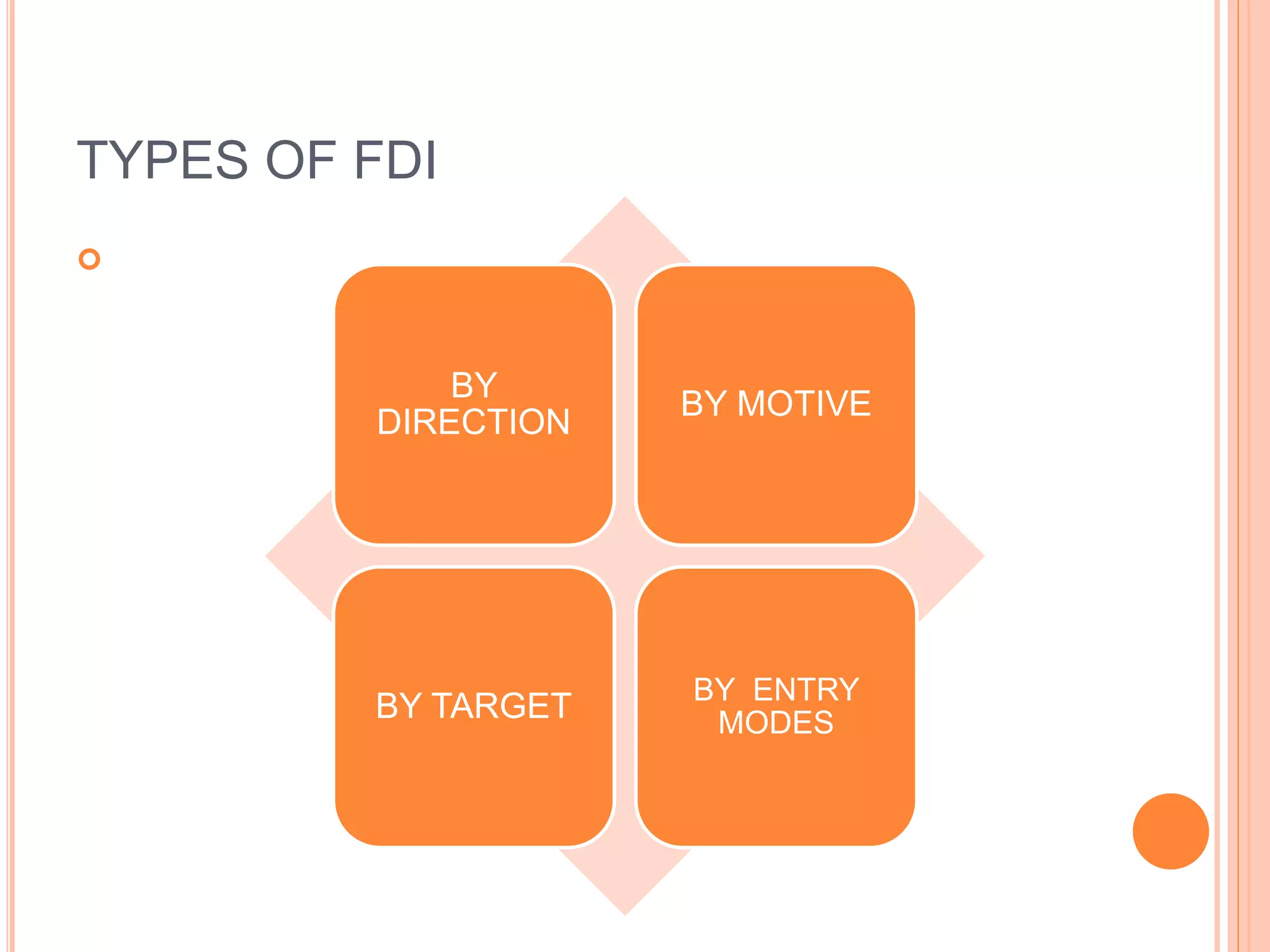
TYPES OF FDI

BY
DIRECTION
BY MOTIVE
BY TARGET BY ENTRY
MODES
BY TARGET
 HORIZONTAL FDI :-
 Where the company carries out the same activities
abroad as at home (for example toyota assembling
cars in both japan and u.k)
 VERTICAL FDI:-
 When different storage of activities are added
abroad .
 Where the FDI takes the firm nearer to the market
is called Forward vertical FDI.(for example toyota
acquiring a car distributorship in america)
 Where international integration moves back
towards raw materials is called Backward vertical
FDI.(for example toyota acquiring a tyre
manufacturers)
BY MOTIVE
 Resource seeking:-looking for resources at a
lower real cost.
 Market seeking:-secure market share and sales
growth in target foregion market.
 Efficiency seeking:-seeks to establish efficient
structure through useful factors ,cultures, policies or
markets.
 Strategic asset seeking:-seeks to acquire assets
in foreign farms that promote corporate long term
objectives.
BY DIRECTION
 INWARD FDI:-
 An inward investment involves an foreign entity
either investing in or purchasing the goods of a
local company.
 OUTWARD FDI:-
 An outward investment is a business strategy
where a domestic firm expands its operations to a
foreign country either via acquisition or expansion
of an existing foreign facility.
BY ENTRY MODES
 GREENFIELD INVESTMENT:-
 Greenfield investment is the investment in a
manufacturing ,office,etc.
 It is the idea of building a facility on a green field
such as farmland or a forest.
 MERGERS AND ACQUISITIONS:-
 A merger is a combination of two companies to
form a new company, while an acquisition is the
purchase of one company by another company in
which a new company is formed.
BENEFITS OF FDI
 Improve foreign exchange position of the country.
 Employment generation and increase in production.
 Help in capital formation by bringing fresh capital.
 Helps in transfer of new technologies and
management skill.
 Helps in increase exports.
 Increases tax revenues.
DISADVANTAGES OF FDI
 Domestic companies fear that they may lose their ownership.
 Small companies fear that they may not be able to compete
with world class large companies.
 Foreign companies invest more in machinery and intellectual
property than in wages of the local people.
 Government has less control over the functioning of such
companies as they usually work as wholly owned subsidiary
of an overseas company.
FDI IN INDIA AND ITS ROLE
 Foreign direct investment in India has played an
important role in the development of the Indian
economy.Fdi in India has in a lot of ways enabled
India to achieve a certain degree of financial
stability, growth and development. This money has
allowed India to focus on the areas that needed a
boost and economic attention , and address the
various problems that continue to challenge the
country.
PROCEDURE FOR RECEIVING FDI IN INDIA
 Automatic route:-Fdi is allowed under the
automatic route without prior approval either of the
Government or the Reserve bank of India in all
activities/sectors as specified in the consolidated
Fdi policy, issued by the government of India from
time to time.
 Government route:- Fdi in activities not covered
under the automatic route requires prior approval of
the government which are considered by the
foreign investment promotion board department of
economic affairs ministry of finance.
THANK YOU
 ‘


Foreign direct investment

  • 1.
    FOREIGN DIRECT INVESTMENT Presentedby-: DEBASIS DAS SUMIT BEHURA SANTOSH ROUT
  • 2.
    WHAT IS FDI? Foreign direct investment is an investment in a business by an investor from anther country for which the foreign investor has control over the company purchased.  It is also defined as cross border investment made by a resident in one economy in an enterprise in another company.  FDI is direct investment into production in a country by a company located in another country ,either by buying a company in the target country or by expanding operations of an existing business in that country.
  • 3.
    TYPES OF FDI  BY DIRECTION BYMOTIVE BY TARGET BY ENTRY MODES
  • 4.
    BY TARGET  HORIZONTALFDI :-  Where the company carries out the same activities abroad as at home (for example toyota assembling cars in both japan and u.k)  VERTICAL FDI:-  When different storage of activities are added abroad .  Where the FDI takes the firm nearer to the market is called Forward vertical FDI.(for example toyota acquiring a car distributorship in america)  Where international integration moves back towards raw materials is called Backward vertical FDI.(for example toyota acquiring a tyre manufacturers)
  • 5.
    BY MOTIVE  Resourceseeking:-looking for resources at a lower real cost.  Market seeking:-secure market share and sales growth in target foregion market.  Efficiency seeking:-seeks to establish efficient structure through useful factors ,cultures, policies or markets.  Strategic asset seeking:-seeks to acquire assets in foreign farms that promote corporate long term objectives.
  • 6.
    BY DIRECTION  INWARDFDI:-  An inward investment involves an foreign entity either investing in or purchasing the goods of a local company.  OUTWARD FDI:-  An outward investment is a business strategy where a domestic firm expands its operations to a foreign country either via acquisition or expansion of an existing foreign facility.
  • 7.
    BY ENTRY MODES GREENFIELD INVESTMENT:-  Greenfield investment is the investment in a manufacturing ,office,etc.  It is the idea of building a facility on a green field such as farmland or a forest.  MERGERS AND ACQUISITIONS:-  A merger is a combination of two companies to form a new company, while an acquisition is the purchase of one company by another company in which a new company is formed.
  • 8.
    BENEFITS OF FDI Improve foreign exchange position of the country.  Employment generation and increase in production.  Help in capital formation by bringing fresh capital.  Helps in transfer of new technologies and management skill.  Helps in increase exports.  Increases tax revenues.
  • 9.
    DISADVANTAGES OF FDI Domestic companies fear that they may lose their ownership.  Small companies fear that they may not be able to compete with world class large companies.  Foreign companies invest more in machinery and intellectual property than in wages of the local people.  Government has less control over the functioning of such companies as they usually work as wholly owned subsidiary of an overseas company.
  • 10.
    FDI IN INDIAAND ITS ROLE  Foreign direct investment in India has played an important role in the development of the Indian economy.Fdi in India has in a lot of ways enabled India to achieve a certain degree of financial stability, growth and development. This money has allowed India to focus on the areas that needed a boost and economic attention , and address the various problems that continue to challenge the country.
  • 11.
    PROCEDURE FOR RECEIVINGFDI IN INDIA  Automatic route:-Fdi is allowed under the automatic route without prior approval either of the Government or the Reserve bank of India in all activities/sectors as specified in the consolidated Fdi policy, issued by the government of India from time to time.  Government route:- Fdi in activities not covered under the automatic route requires prior approval of the government which are considered by the foreign investment promotion board department of economic affairs ministry of finance.
  • 12.