Presented by:-
Sumit Behura
 Axis Bank Limited is the third largest private
sector bank in India.
 Approximately 43% of the shares are owned by
Foreign Institutional Investors. Promoters
(UTI, LIC and GIC), who collectively held approx.
34% of the shares, are all entities owned and
controlled by the Government of India. The
remaining 23% shares are owned by corporate
bodies.
 UTI Bank opened its registered office in
Ahmedabad and corporate office in Mumbai in
December 1993. The first branch was
inaugurated on 2 April 1994 in Ahmedabad by
Dr.Manmohan Singh
 Axis Mutual Fund launched its first scheme in October
2009 Since then Axis Mutual fund has grown strongly.
 With an accomplished suite of 53 mutual fund schemes.
Today, Axis mutual funds are available to customers in
over 75 cities and have a customer base of over 7 lac
investors.
Types of Axis Mutual Funds
1. By Structure
Mutual funds can be segregated into two major categories
based on their structure.
I. Open Ended Mutual funds: An open-ended mutual fund
doesn’t have a fixed maturity and doesn’t trade on the
open market and is re-priced each day based on the
amount of shares bought or sold.
II. Closed Ended Mutual Funds: A closed ended mutual
fund has a fixed maturity and has a locking period for
investor’s money. Sometimes, closed-ended mutual
funds provide a repurchase choice to the investors.
By Investment Objective
This refers to the asset class targeted by the fund.
1. Equity Schemes: Equity schemes invest their money in
shares. This money can be invested either in high-
growth stocks or value stocks. Different kinds of
equity schemes offered by Axis Bank are outlined
below.
◦ Equity Diversified: These mutual fund schemes are not
particular to any sector or theme.
◦ Mid Cap: These funds invest in stocks from different
sectors. However, they invest mostly in mid-cap stocks
listed with BSE.
◦ ELSS: Equity Linked Security Schemes are open-ended
mutual funds with a locking period of up to 3 years.
Tax-Saving Funds
◦ Sector Specific: Sector specific mutual funds, as the
name suggests, invest their money in particular sectors
like manufacturing, IT etc. However, these mutual funds
have high risk because returns are closely tied to a
particular sector’s performance.
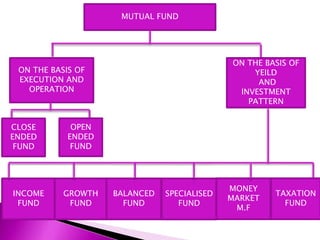
MUTUAL FUND
ON THE BASIS OF
EXECUTION AND
OPERATION
ON THE BASIS OF
YEILD
AND
INVESTMENT
PATTERN
CLOSE
ENDED
FUND
OPEN
ENDED
FUND
INCOME
FUND
GROWTH
FUND
BALANCED
FUND
SPECIALISED
FUND
MONEY
MARKET
M.F
TAXATION
FUND
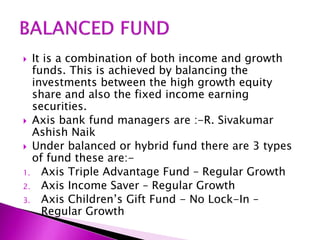
 It is a combination of both income and growth
funds. This is achieved by balancing the
investments between the high growth equity
share and also the fixed income earning
securities.
 Axis bank fund managers are :-R. Sivakumar
Ashish Naik
 Under balanced or hybrid fund there are 3 types
of fund these are:-
1. Axis Triple Advantage Fund – Regular Growth
2. Axis Income Saver – Regular Growth
3. Axis Children’s Gift Fund - No Lock-In –
Regular Growth
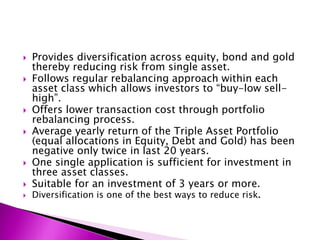
 Provides diversification across equity, bond and gold
thereby reducing risk from single asset.
 Follows regular rebalancing approach within each
asset class which allows investors to “buy-low sell-
high”.
 Offers lower transaction cost through portfolio
rebalancing process.
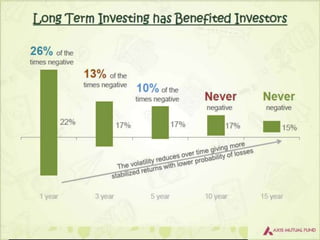
 Average yearly return of the Triple Asset Portfolio
(equal allocations in Equity, Debt and Gold) has been
negative only twice in last 20 years.
 One single application is sufficient for investment in
three asset classes.
 Suitable for an investment of 3 years or more.
 Diversification is one of the best ways to reduce risk.
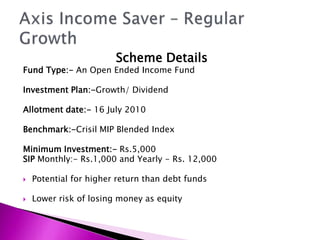
Scheme Details
Fund Type:- An Open Ended Income Fund
Investment Plan:-Growth/ Dividend
Allotment date:- 16 July 2010
Benchmark:-Crisil MIP Blended Index
Minimum Investment:- Rs.5,000
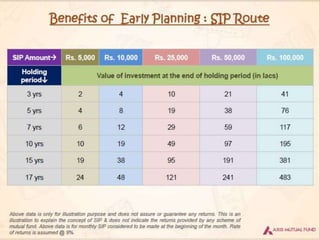
SIP Monthly:- Rs.1,000 and Yearly - Rs. 12,000
 Potential for higher return than debt funds
 Lower risk of losing money as equity
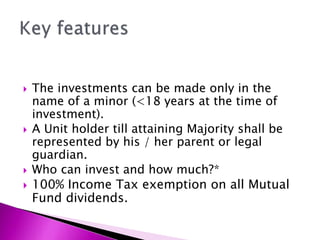
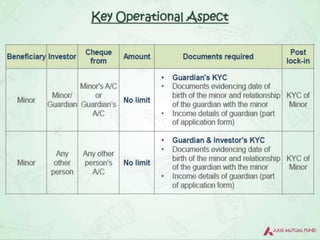
 The investments can be made only in the
name of a minor (<18 years at the time of
investment).
 A Unit holder till attaining Majority shall be
represented by his / her parent or legal
guardian.
 Who can invest and how much?*
 100% Income Tax exemption on all Mutual
Fund dividends.
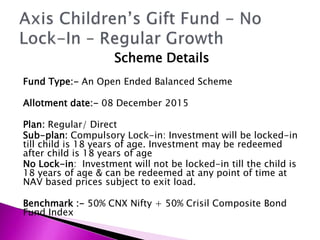
Scheme Details
Fund Type:- An Open Ended Balanced Scheme
Allotment date:- 08 December 2015
Plan: Regular/ Direct
Sub-plan: Compulsory Lock-in: Investment will be locked-in
till child is 18 years of age. Investment may be redeemed
after child is 18 years of age
No Lock-in: Investment will not be locked-in till the child is
18 years of age & can be redeemed at any point of time at
NAV based prices subject to exit load.
Benchmark :- 50% CNX Nifty + 50% Crisil Composite Bond
Fund Index
Axis bank balanced fund

Axis bank balanced fund

  • 1.
  • 2.
     Axis BankLimited is the third largest private sector bank in India.  Approximately 43% of the shares are owned by Foreign Institutional Investors. Promoters (UTI, LIC and GIC), who collectively held approx. 34% of the shares, are all entities owned and controlled by the Government of India. The remaining 23% shares are owned by corporate bodies.  UTI Bank opened its registered office in Ahmedabad and corporate office in Mumbai in December 1993. The first branch was inaugurated on 2 April 1994 in Ahmedabad by Dr.Manmohan Singh
  • 3.
     Axis MutualFund launched its first scheme in October 2009 Since then Axis Mutual fund has grown strongly.  With an accomplished suite of 53 mutual fund schemes. Today, Axis mutual funds are available to customers in over 75 cities and have a customer base of over 7 lac investors. Types of Axis Mutual Funds 1. By Structure Mutual funds can be segregated into two major categories based on their structure. I. Open Ended Mutual funds: An open-ended mutual fund doesn’t have a fixed maturity and doesn’t trade on the open market and is re-priced each day based on the amount of shares bought or sold. II. Closed Ended Mutual Funds: A closed ended mutual fund has a fixed maturity and has a locking period for investor’s money. Sometimes, closed-ended mutual funds provide a repurchase choice to the investors.
  • 4.
    By Investment Objective Thisrefers to the asset class targeted by the fund. 1. Equity Schemes: Equity schemes invest their money in shares. This money can be invested either in high- growth stocks or value stocks. Different kinds of equity schemes offered by Axis Bank are outlined below. ◦ Equity Diversified: These mutual fund schemes are not particular to any sector or theme. ◦ Mid Cap: These funds invest in stocks from different sectors. However, they invest mostly in mid-cap stocks listed with BSE. ◦ ELSS: Equity Linked Security Schemes are open-ended mutual funds with a locking period of up to 3 years. Tax-Saving Funds ◦ Sector Specific: Sector specific mutual funds, as the name suggests, invest their money in particular sectors like manufacturing, IT etc. However, these mutual funds have high risk because returns are closely tied to a particular sector’s performance.
  • 5.
    MUTUAL FUND ON THEBASIS OF EXECUTION AND OPERATION ON THE BASIS OF YEILD AND INVESTMENT PATTERN CLOSE ENDED FUND OPEN ENDED FUND INCOME FUND GROWTH FUND BALANCED FUND SPECIALISED FUND MONEY MARKET M.F TAXATION FUND
  • 6.
     It isa combination of both income and growth funds. This is achieved by balancing the investments between the high growth equity share and also the fixed income earning securities.  Axis bank fund managers are :-R. Sivakumar Ashish Naik  Under balanced or hybrid fund there are 3 types of fund these are:- 1. Axis Triple Advantage Fund – Regular Growth 2. Axis Income Saver – Regular Growth 3. Axis Children’s Gift Fund - No Lock-In – Regular Growth
  • 7.
     Provides diversificationacross equity, bond and gold thereby reducing risk from single asset.  Follows regular rebalancing approach within each asset class which allows investors to “buy-low sell- high”.  Offers lower transaction cost through portfolio rebalancing process.  Average yearly return of the Triple Asset Portfolio (equal allocations in Equity, Debt and Gold) has been negative only twice in last 20 years.  One single application is sufficient for investment in three asset classes.  Suitable for an investment of 3 years or more.  Diversification is one of the best ways to reduce risk.
  • 9.
    Scheme Details Fund Type:-An Open Ended Income Fund Investment Plan:-Growth/ Dividend Allotment date:- 16 July 2010 Benchmark:-Crisil MIP Blended Index Minimum Investment:- Rs.5,000 SIP Monthly:- Rs.1,000 and Yearly - Rs. 12,000  Potential for higher return than debt funds  Lower risk of losing money as equity
  • 15.
     The investmentscan be made only in the name of a minor (<18 years at the time of investment).  A Unit holder till attaining Majority shall be represented by his / her parent or legal guardian.  Who can invest and how much?*  100% Income Tax exemption on all Mutual Fund dividends.
  • 16.
    Scheme Details Fund Type:-An Open Ended Balanced Scheme Allotment date:- 08 December 2015 Plan: Regular/ Direct Sub-plan: Compulsory Lock-in: Investment will be locked-in till child is 18 years of age. Investment may be redeemed after child is 18 years of age No Lock-in: Investment will not be locked-in till the child is 18 years of age & can be redeemed at any point of time at NAV based prices subject to exit load. Benchmark :- 50% CNX Nifty + 50% Crisil Composite Bond Fund Index